
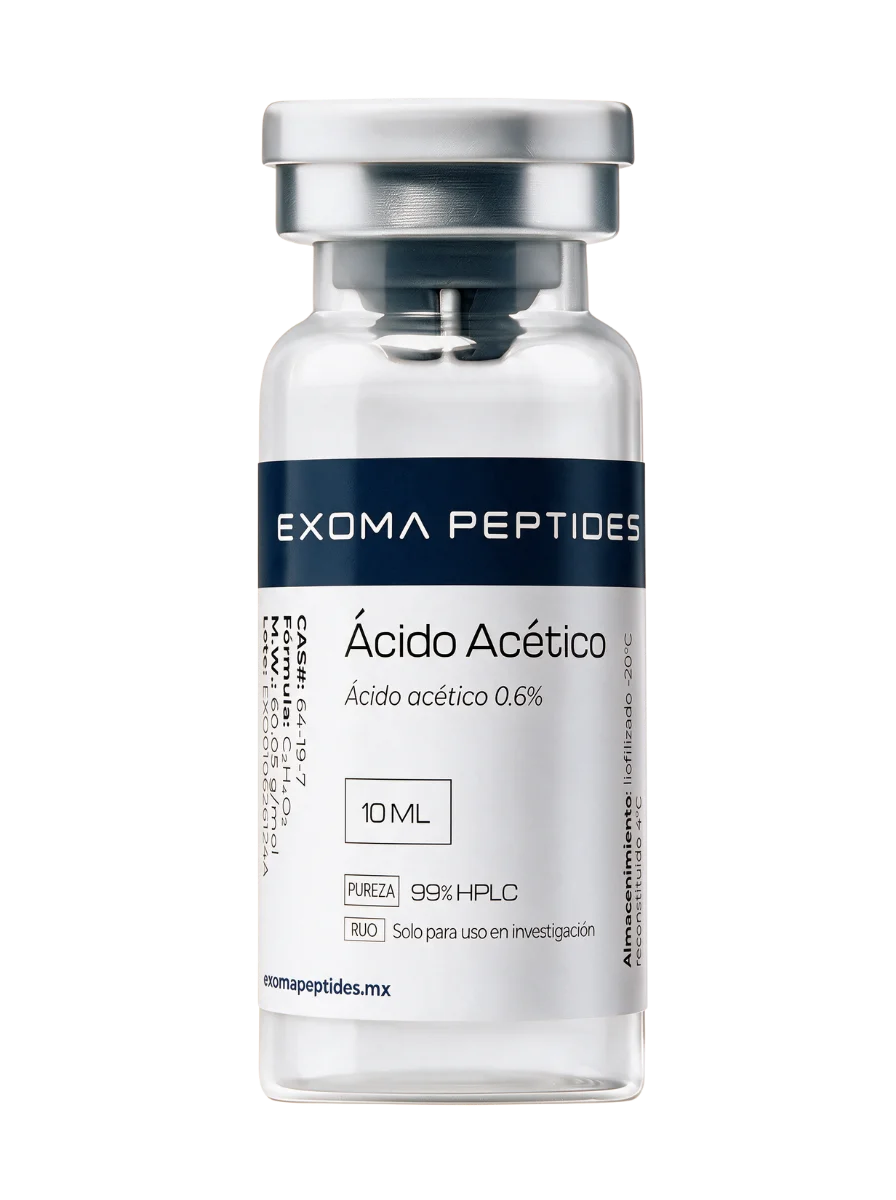
Acetic acid 0.6%
Acetic Acid 0.6% — research reagent (RUO).
Technical data
- INN name
- Acetic Acid 0.6%
- CAS
- 64-19-7
- Molecular formula
- C2H4O2
- Molecular weight
- 60.05 g/mol
Sizes and prices: 10 mL $200 MXN.
Buy 0.6% acetic acid in Mexico: order online with nationwide shipping in 1-4 business days depending on zone and tracking number. Prices in Mexican pesos. Material for research use only.
Acetic Acid 0.6% is known internationally as Acetic Acid 0.6% (INN name in English). Buy Acetic Acid 0.6% in Mexico / buy Acetic Acid 0.6% in Mexico: research reagent (RUO) and nationwide shipping.
Ácido acético 0.6% is also searched as: Acetic Acid, Ácido etanoico, Ethanoic Acid, 0.6% Acetic Acid Solution, Agua AA, AA Water, Agua con ácido acético al 0.6%.
Identity and composition
Sterile 0.6% acetic acid is a dilute aqueous solution of acetic acid (ethanoic acid, CH3COOH; CAS 64-19-7; formula C2H4O2; molecular weight 60.05 g/mol), a weak organic acid with a pKa of 4.76. At the 0.6% concentration (approximately 0.1 M) it constitutes an acidic-pH diluent designed for the reconstitution of those research peptides that do not dissolve stably in neutral bacteriostatic water. Its function is not pharmacological but rather that of a solubilization vehicle: the slightly acidic medium improves dissolution and prevents the aggregation of hydrophobic peptides or those prone to precipitate at neutral pH, such as the IGF-1 analogs (IGF-1 LR3, IGF-1 DES). It is distributed as a sterile research-use-only (RUO) reagent, filtered and particle-free, and complements bacteriostatic water as the two basic diluents of the workbench in peptide research. It is the reference solvent when the peptide's protocol specifies a low-pH vehicle.
Mechanism of action
The mechanism by which 0.6% acetic acid facilitates reconstitution is based on modifying the pH of the medium. Many research peptides are poorly soluble or unstable in neutral water: their hydrophobic regions tend to associate and form insoluble aggregates, and certain ionizable residues remain in a state that favors precipitation. By providing an acidic environment (pH around 3-4), acetic acid protonates functional groups and increases the net positive charge of the peptide, which increases the electrostatic repulsion between molecules, decreases hydrophobic aggregation, and improves solubilization. Acetic acid is also volatile, a feature exploited in peptide preparation, since it can be partially removed by evaporation. At the dilute concentration of 0.6% it provides sufficient acidity to solubilize without significantly compromising the integrity of the peptide, and the reconstituted material is usually diluted afterward with bacteriostatic water for experimental work.
Pharmacokinetics
Acetic acid at 0.6% has no pharmacokinetic activity of its own: it is a diluent excipient, not an active ingredient. Its role is limited to the peptide solution preparation phase. Once the peptide has been reconstituted in the acidic medium and, where applicable, diluted with bacteriostatic water, it is the pharmacokinetics of the peptide itself that determine the behavior of the preparation. Residual acetic acid, owing to its volatility and its metabolism as a simple organic acid, contributes no relevant systemic effects at the concentrations used as a vehicle. In the research context (RUO), its characterization focuses on physicochemical parameters —pH, sterility, absence of particles— and not on pharmacokinetic variables.
Scientific evidence
The use of dilute acetic acid as a reconstitution vehicle is established in laboratory practice with peptides. The evidence comes from handling protocols for hydrophobic peptides and growth factor analogs that specify an acidic diluent to achieve stable solutions: the paradigmatic case is the IGF-1 analogs (IGF-1 LR3 and IGF-1 DES), whose reconstitution in dilute acetic acid avoids the aggregation observed in neutral media. The peptide chemistry literature extensively documents the role of pH and of acidifying agents in solubilization and in the prevention of the formation of high-molecular-weight aggregates. As a research-use-only (RUO) reagent, the 0.6% sterile acetic acid is supplied for experimental preparation purposes; it is not a therapeutic product nor does it have a clinical indication.
Research applications
In research, sterile 0.6% acetic acid is used as the diluent of choice for the reconstitution of peptides that require an acidic pH medium. Among its described practical applications are: the reconstitution of IGF-1 analogs (IGF-1 LR3, IGF-1 DES) and of other peptides prone to aggregating in neutral water; the initial solubilization of hydrophobic peptides before their final dilution in bacteriostatic water; and the preparation of stock solutions in protocols that specify an acidified vehicle. Its selection over bacteriostatic water depends on the peptide's data sheet: when the compound is stable and soluble in a neutral medium, bacteriostatic water is used, and when it presents solubility or aggregation problems at neutral pH, acetic acid is used. It is, therefore, the specialized complement to the standard diluent at the peptide workbench.
Safety profile
Acetic acid at 0.6% is a dilute solution of a weak organic acid and, at that concentration, is easy to handle in the laboratory setting; concentrated acetic acid is indeed corrosive, but dilution to 0.6% substantially reduces that risk. As with any reagent, it is recommended to avoid prolonged direct contact with skin and mucous membranes and to maintain good handling practices. In its use as a reconstitution vehicle, the volume of acetic acid employed is small and is frequently diluted afterward with bacteriostatic water. Within the framework of research-use-only (RUO), the information is provided for scientific and laboratory-handling purposes, not as guidance for clinical use; the reagent is intended for the preparation of experimental peptide solutions.
Comparative context
0.6% acetic acid and bacteriostatic water constitute the two fundamental diluents in peptide research, and their selection is complementary. Bacteriostatic water (sterile water with 0.9% benzyl alcohol) is the neutral general-purpose vehicle, suitable for most soluble peptides and with the advantage of the preservative that allows multi-dose use. 0.6% acetic acid, by contrast, is the specialized acidic-pH vehicle reserved for peptides that aggregate or do not dissolve well in a neutral medium, notably the IGF-1 analogs (IGF-1 LR3, IGF-1 DES). Compared with other laboratory solvents such as sterile double-distilled water—without preservative or acidifying capacity—acetic acid specifically provides the low-acidity environment that certain peptides require. The practical rule is to follow the peptide's data sheet: bacteriostatic water by default, acetic acid when an acidic diluent is specified.
History and development
Acetic acid is one of the oldest and most studied organic acids in chemistry, known since antiquity as the component of vinegar and structurally characterized in the development of modern organic chemistry. In the field of peptide chemistry, dilute acetic acid was adopted as a diluent and as a component of mobile phases and buffers because of its nature as a weak, volatile acid compatible with peptides, properties that made it ideal for solubilizing problematic compounds without leaving non-volatile residues. Its sterile, standardized 0.6% formulation for the reconstitution of research peptides derives directly from that established laboratory practice, offering a ready-to-use acidic vehicle that complements bacteriostatic water in the handling of growth factor analogs and other pH-sensitive peptides.
FAQ
What is 0.6% acetic acid used for with peptides?
It is a sterile diluent of acidic pH for reconstituting research peptides that do not dissolve stably in neutral bacteriostatic water, such as IGF-1 analogs (IGF-1 LR3, IGF-1 DES). Reagent for research use only (RUO).
When to use acetic acid instead of bacteriostatic water?
Bacteriostatic water is the default neutral diluent for most peptides. 0.6% acetic acid is reserved for peptides that are hydrophobic or prone to aggregation at neutral pH, when the peptide's data sheet specifies an acidic vehicle.
How to reconstitute IGF-1 LR3 with acetic acid?
A small volume of sterile 0.6% acetic acid is added over the lyophilizate, swirling gently without shaking until dissolved, and then the volume is made up with bacteriostatic water to the working concentration. Store refrigerated at 2-8°C.
Why do some peptides require an acidic pH?
The acidic medium protonates functional groups and increases the net positive charge of the peptide, which increases the repulsion between molecules, reduces hydrophobic aggregation, and improves solubilization compared with neutral water.
Is 0.6% acetic acid dangerous?
At the 0.6% dilution it is easy to handle in the laboratory (concentrated acetic acid is indeed corrosive). Avoiding prolonged contact with skin and mucous membranes is recommended. It is a research reagent (RUO).
What are the specifications of acetic acid?
Acetic acid (ethanoic acid, CH3COOH; CAS 64-19-7; MW 60.05 g/mol; pKa 4.76) in sterile aqueous solution at 0.6% (~0.1 M), filtered and particle-free.
Customer reviews
Average rating: 4.7 out of 5, based on 6 customer ratings.
Valeria M. — 5/5
The 0.6% Acetic Acid arrived in order and very well protected against spills. Very good product.
Luis T. — 5/5
The 0.6% Acetic Acid arrived super fast, well sealed and without any issue with the courier.
Marcos T. — 4/5
I use it together with the bacteriostatic water. Fair price and fast shipping.
Alejandro P. — 5/5
Exact 0.6% concentration. Ideal for use with sensitive peptides.
Laura C. — 4/5
Basic product but of good quality. I always include it in my orders.
Diego Q. — 5/5
Essential for correct reconstitution. Good concentration and presentation.
See the full category catalog: Supplies.