LL-37
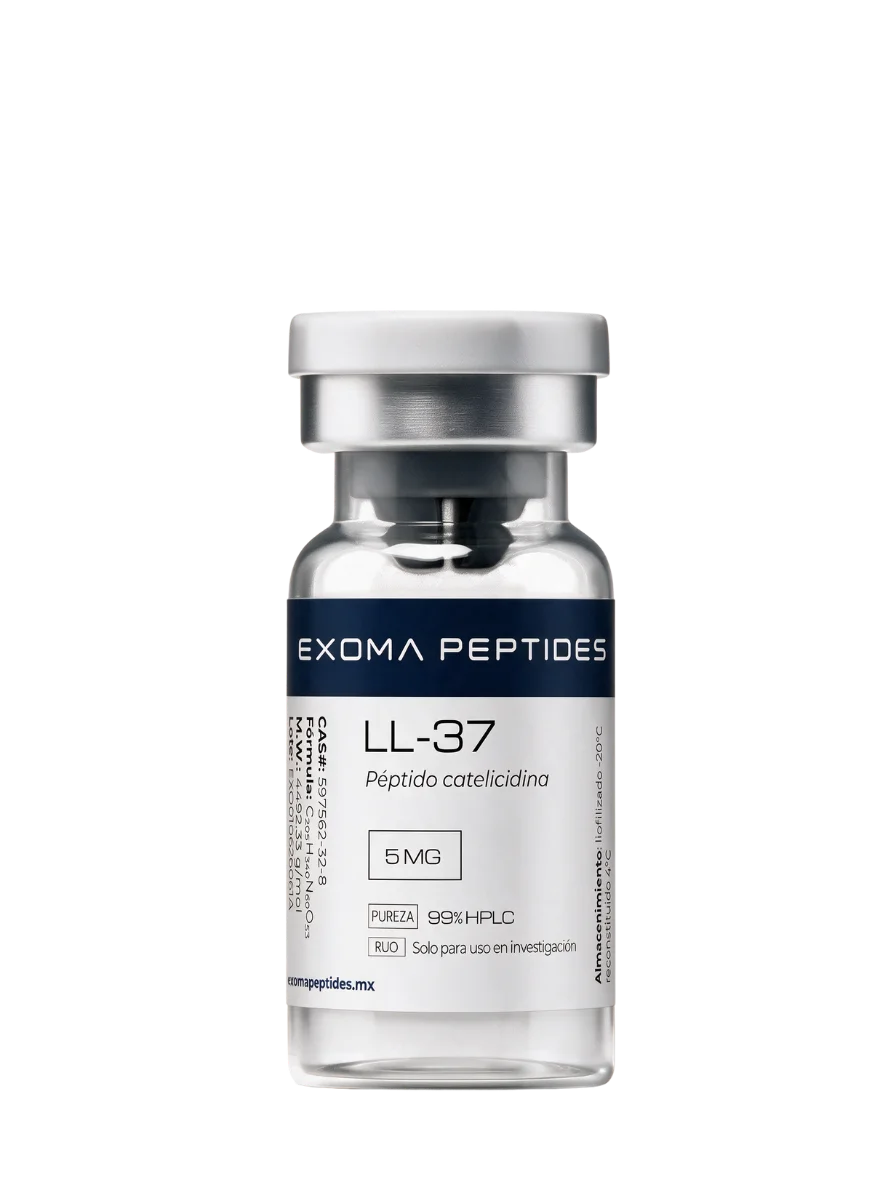
LL-37 — research reagent (RUO). COA per batch available.
Technical data
- CAS
- 154947-66-7
- Molecular formula
- C205H340N60O53
- Molecular weight
- 4493.33 g/mol
Sizes and prices: 5 mg $1,499 MXN ($300 MXN per mg).
Buy LL-37 in Mexico: order online with nationwide shipping in 1-4 business days depending on zone and tracking number. Prices in Mexican pesos. Material for research use only.
LL-37 is also searched as: Catelicidina LL-37, Cathelicidin LL-37, hCAP-18/LL-37, Fragmento C-terminal de hCAP18, LL-37 humano.
Identity and composition
LL-37 is the 37-amino-acid C-terminal peptide fragment of the human cathelicidin hCAP-18 (gene CAMP), the only cathelicidin identified in humans to date. It is a host defense peptide investigated for its antimicrobial and immunomodulatory roles. Product for research use.
Reference chemical identity data:
- Molecular formula: C205H340N60O53
- Molecular weight: ~4493 g/mol (PubChem CID 16198951)
- Sequence (37 aa): LLGDFFRKSKEKIGKEFKRIVQRIKDFLRNLVPRTES
- Synonyms: cathelicidin antimicrobial peptide, hCAP-18/LL-37, CAP-18 (C-terminal fragment), CAMP peptide, cathelicidin LL-37
The CAS number is not included because it could not be confirmed in a primary source (conflicting values appear among suppliers), so it is omitted rather than reporting an unverified datum.
Mechanism of action
LL-37 is a cationic and amphipathic peptide with an alpha-helix structure that, according to the research literature, acts through two complementary pathways (PMID 20600427):
- Direct antimicrobial activity: binds by electrostatic attraction to the negatively charged phospholipids of microbial membranes and causes their permeabilization or destabilization. The membrane-disruption models described ("carpet" type and toroidal pore) come from secondary/review literature and were not confirmed in a primary source.
- Immunomodulation: participates in the chemotaxis of immune cells, the activation of epithelial cells, angiogenesis, epithelial wound repair and the induction of chemokine secretion.
Owing to this combination of functions, in the literature it is described as a multifunctional host-defense peptide, rather than as a single-target antibiotic. It is expressed mainly in neutrophils and epithelial cells.
Pharmacokinetics
No reliable human systemic pharmacokinetic parameters (for example, plasma half-life) confirmed in a primary source are available in the consulted literature. The clinical data reviewed correspond to topical application on wounds and not to systemic dosing, so the pharmacokinetics remains unverified. Any half-life or systemic exposure figure should be treated as not established in this context.
Scientific evidence
The evidence is research-stage and limited; LL-37 it is not an FDA-approved drug for any indication. It has been studied predominantly in the healing of chronic or hard-to-resolve wounds and in antimicrobial and immunomodulatory applications.
A randomized, double-blind, placebo-controlled clinical trial (Phase I/IIa) evaluated topical LL-37 in 34 patients with difficult-to-heal venous leg ulcers; in clinical studies favored healing was observed with the lowest doses and no safety signals were reported (PMID 25041740). Other indications described in the broader literature (diabetic foot ulcers, infected wounds, and mechanistic study in mycobacterial infection) appear only in secondary abstracts and should be considered exploratory and early-stage. The preliminary evidence suggests potential of interest, but with limited scope and sample size.
Research applications
Product for research use.
Ideal for (in a research context):
- In vitro studies and research models on antimicrobial activity and disruption of microbial membranes.
- Research on immunomodulatory mechanisms: chemotaxis, epithelial activation, angiogenesis and chemokine secretion.
- Research in models of wound healing and epithelial wound repair, especially of topical application.
Not applicable for:
- clinical use, therapeutic use, diagnosis, or any administration in people or animals.
- Conclusions on systemic dosing: the available data correspond to topical use and not to systemic exposure.
- Its use as a substitute for an approved antibiotic or drug; it has no regulatory approval for any indication.
Research protocols
In the reference randomized clinical trial, LL-37 was investigated for application topical in venous leg ulcers, at concentrations of 0.5, 1.6 and 3.2 mg/mL; in clinical studies a favored wound healing was observed with the lower concentrations, whereas the highest concentration (3.2 mg/mL) showed no advantage over placebo (PMID 25041740).
There are no verified systemic dosing protocols or validated dose parameters outside of that topical context. The above ranges are cited only as a reference of what was investigated in said study and do not constitute a recommendation of use.
Reconstitution
As a standard general laboratory handling guide, lyophilized peptides such as LL-37 are usually reconstituted with bacteriostatic water (water for injection with ~0.9% benzyl alcohol as preservative) or, depending on the experimental design, with sterile water for injection.
- Add the diluent slowly, letting it run down the wall of the vial, without directing the stream directly onto the powder.
- Do not shake; let it dissolve by gentle rotation ("swirl") until you obtain a clear solution.
- Calculate the diluent volume according to the working concentration desired for your protocol.
These instructions are for general laboratory reconstitution technique and do not imply preparation for use in humans.
Stability and storage
As a standard laboratory handling guideline:
- Lyophilized (powder): is the most stable form; it is usually stored refrigerated and, for prolonged storage, frozen, protected from humidity and light.
- Reconstituted (in solution): is less stable; it is kept refrigerated and its use within a short window is recommended. For longer periods it is usually divided into aliquots and frozen, avoiding repeated freeze-thaw cycles that can degrade the peptide.
Always follow the specific conditions indicated by your supplier and your laboratory's good practices.
Safety profile
The documented safety profile is limited and comes mainly from a single trial. In the randomized, placebo-controlled study of topical application in venous leg ulcers (n=34), the authors reported that no local or systemic safety signals were identified at the doses evaluated (PMID 25041740).
Important limitations:
- The safety of systemic exposure and long-term safety were not established in the verified sources. - The data correspond to topical use and a small sample, so they should not be extrapolated to other routes of administration. - No formal contraindications are available in the consulted literature.
Because it is a research material, it must be handled with the corresponding laboratory precautions and not administered to humans or animals.
Comparative context
LL-37 is the only cathelicidin-derived antimicrobial peptide in humans, unlike other species that express multiple cathelicidins.
Compared with many classical antimicrobial peptides, which act primarily through membrane disruption, LL-37 is described in the literature as multifunctional: it combines direct microbicidal activity with immunomodulatory functions such as chemotaxis, wound repair, and chemokine induction (PMID 20600427). This dual nature distinguishes it from a single-target antibiotic and explains the interest in investigating it in both antimicrobial applications and in wound healing and immunomodulation.
History and development
LL-37 corresponds to the 37-amino-acid C-terminal fragment of the hCAP-18/hCAP18 protein, encoded by the gene CAMP and recognized as the only human cathelicidin identified to date. It is expressed mainly in neutrophils and epithelial cells as part of the host's innate defense system.
Its development remains in the research stage: it is not an FDA-approved drug for any indication. The most advanced verified clinical study is a Phase I/IIa trial of topical application in hard-to-heal venous leg ulcers (PMID 25041740). Other described applications, such as diabetic foot ulcers, infected wounds, and mycobacterial infections, have been addressed mainly in mechanistic and review literature and are considered exploratory.
FAQ
What is LL-37 and what is it researched for?
LL-37 is the C-terminal 37-amino-acid fragment of the human cathelicidin hCAP-18, the only cathelicidin identified in humans. It is investigated for its direct antimicrobial activity and for its immunomodulatory functions, including epithelial wound repair. It is a material for research use; not for clinical use.
Is LL-37 approved by the FDA?
No. LL-37 is at the research stage and is not a drug approved by the FDA for any indication. The verified clinical evidence is limited mainly to a Phase I/IIa trial of topical application in venous leg ulcers.
What doses have been used in the studies?
In the reference clinical trial, topical LL-37 was investigated at concentrations of 0.5, 1.6 and 3.2 mg/mL in venous leg ulcers; better wound healing was observed with the lowest concentrations, while 3.2 mg/mL showed no advantage over placebo (PMID 25041740).
How is LL-37 reconstituted?
As a general laboratory guide, lyophilized peptides such as LL-37 are usually reconstituted with bacteriostatic water (with ~0.9% benzyl alcohol) or sterile water, adding the diluent down the wall of the vial and dissolving with gentle rotation, without shaking. It is a laboratory technique, not preparation for clinical use.
How is LL-37 stored?
The lyophilizate is the most stable form and is usually preserved refrigerated or frozen, protected from humidity and light. Once reconstituted, it is kept refrigerated for short-term use or is aliquoted and frozen for long periods, avoiding repeated freeze-thaw cycles.
What is known about its safety?
In the placebo-controlled topical trial in venous leg ulcers (n=34), the authors did not identify local or systemic safety signals at the doses evaluated (PMID 25041740). Systemic and long-term safety was not established in the verified sources.
Certificate of analysis per batch
LL-37 lot with certificate of analysis published in the COA catalog:
- Lot EXO010626061A — 5 mg, issued 2026-05-30
Scientific references (6)
Peer-reviewed literature on LL-37, with its PubMed identifier when available:
- Human cathelicidin peptide LL-37 induces endothelial-to-mesenchymal transition (Suzuki K et al. · Bioscience, biotechnology, and biochemistry · 2025) PMID 40690262.
- Vitamin D triggers hCAP18/LL-37 production: Implications for LL-37-induced human osteoblast cytotoxicity (Aidoukovitch A et al. · Biochemical and biophysical research communications · 2024) PMID 38642493.
- LL-37, a Multi-Faceted Amphipathic Peptide Involved in NETosis (Radic M et al. · Cells · 2022) PMID 35954305.
- LL-37, the only human member of the cathelicidin family of antimicrobial peptides (Dürr, et al. · Biochimica et Biophysica Acta · 2006) PMID 16716248.
- Cathelicidin LL-37: a multitask antimicrobial peptide (Bucki, et al. · Archivum Immunologiae et Therapiae Experimentalis · 2010) PMID 20049649.
- The Human Cathelicidin Antimicrobial Peptide LL-37 as a Potential Treatment for Polymicrobial Infected Wounds (Duplantier, et al. · Frontiers in Immunology · 2013) PMID 23840194.
Full scientific profile: LL-37 in the compendium — mechanism of action, studies and technical data sheet.
See the full category catalog: Immune system.
Guides and articles about LL-37
Lecturas del blog de EXOMA que la editorial asoció a este compuesto: