
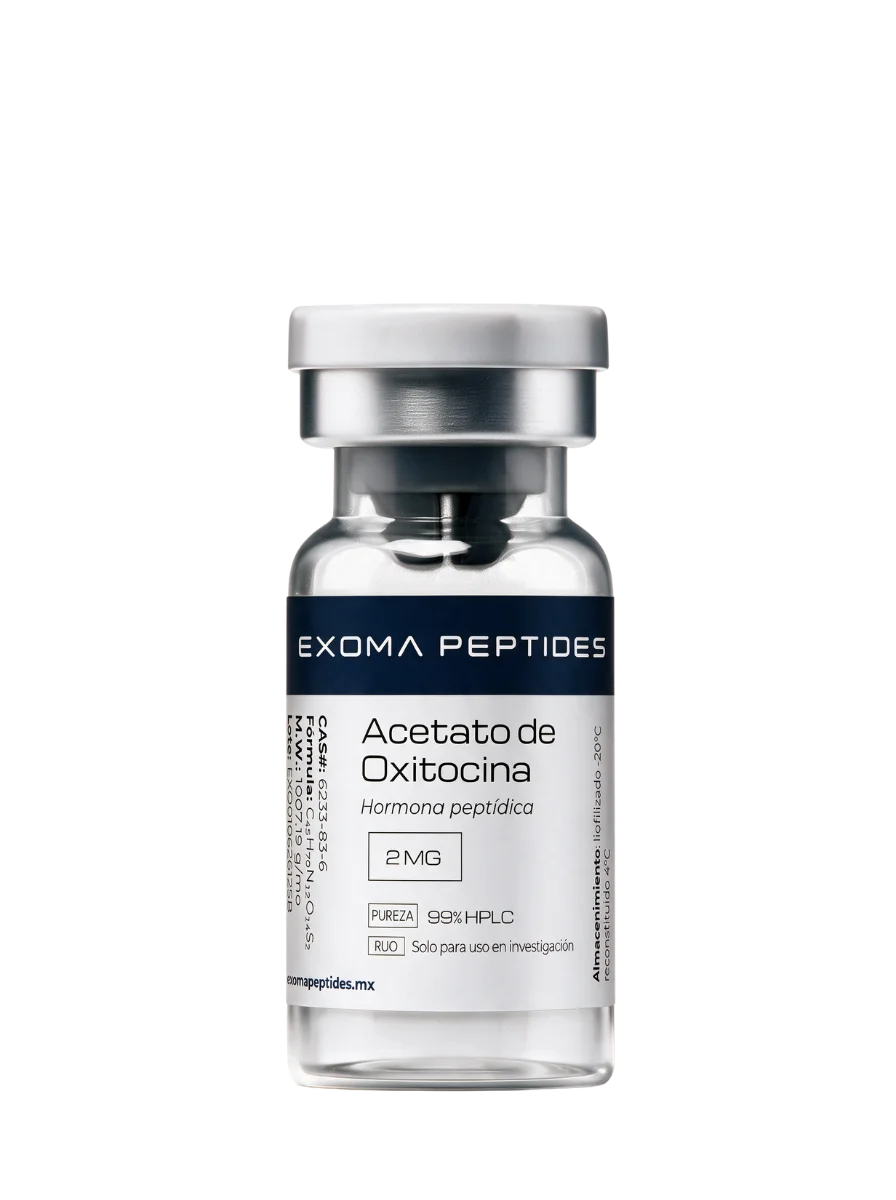
Oxytocin Acetate
Oxytocin Acetate — reagent for research use (RUO). HPLC purity 96.8% with COA per batch.
Technical data
- INN name
- Oxytocin Acetate
- CAS
- 50-56-6
- Molecular formula
- C43H66N12O12S2
- Molecular weight
- 1007.19 g/mol
Sizes and prices: 2 mg $610 MXN ($305 MXN per mg) · 5 mg $780 MXN ($156 MXN per mg) · 10 mg $999 MXN ($100 MXN per mg).
Buy Oxytocin Acetate in Mexico: order online with nationwide shipping in 1-4 business days depending on zone and tracking number. Prices in Mexican pesos. Material for research use only.
Oxytocin Acetate is known internationally as Oxytocin Acetate (English INN name). Buy Oxytocin Acetate in Mexico / comprar Oxytocin Acetate en México: reagent for research use (RUO) with HPLC purity, COA and nationwide shipping.
Oxytocin Acetate is also searched as: Oxytocin, Oxitocina, OXT, Oxytocin acetate salt.
Identity and composition
El Oxytocin Acetate is the acetate salt form of oxytocin, a neuroendocrine nonapeptide studied as a ligand of the oxytocin receptor (OXTR) in research of cell signaling and social behavior. Product for research use.
From the standpoint of chemical identity, it corresponds to the canonical structure of oxytocin: a 9-amino-acid peptide with the sequence Cys-Tyr-Ile-Gln-Asn-Cys-Pro-Leu-Gly-NH2, stabilized by a intramolecular disulfide bridge between Cys1 and Cys6. The molecular formula reported for the acetate salt form is C45H70N12O14S2 (PubChem CID 12004215), whereas the free oxytocin peptide is C43H66N12O12S2 (PubChem CID 439302).
Among its synonyms are Oxytocin acetate salt, alpha-hypophamine (acetate form), OXT acetate y Oxytocin (acetate). It is presented in doses of 2 mg, 5 mg and 10 mg. CAS number and molecular weight are not listed here because they were not confirmed in the reference source consulted; they are deliberately omitted rather than reproducing an unverified value.
Mechanism of action
Oxytocin is a hypothalamic neuropeptide of 9 amino acids that acts on the oxytocin receptor (OXTR), a G protein-coupled receptor (GPCR) with 7 transmembrane domains (Jurek & Neumann, Physiol Rev 2018; PMID 29897293).
OXTR can couple to Galphaq/11, activating the phospholipase C (PLC), which generates IP3/DAG and raises intracellular Ca2+; it can also couple to Galphai. Downstream, cascades of MAPK, PKC and CaMK which converge on transcription factors such as CREB and MEF-2 (PMID 29897293). OXTR homodimer signaling is associated with increased PLC activity and calcium levels via Gq/11, and OXTR participates in GPCR heteroreceptor networks relevant to the brain and behavior (Borroto-Escuela et al., Front Mol Neurosci 2022; PMID 36618821).
These pathways have been linked with peripheral effects (uterine contraction, milk ejection) and with central processes related to social behavior, bonding, anxiety and sociability (PMID 29897293).
Pharmacokinetics
The documented pharmacokinetics correspond to oxytocin in general (not specifically to the acetate salt). Qualitatively, a short plasma half-life after intravenous administration and a rapid clearance mediated by hepatic and renal peptidases, with minimal urinary excretion of the intact compound. Due to its rapid elimination, maintaining sustained levels would require continuous infusion in the clinical context.
Numerical half-life values are not reproduced here because they come from technical data sheets and reviews and do not have a verified primary citation in the reference material; they are described only in qualitative terms so as not to present figures without support.
Scientific evidence
The evidence on this molecule is heterogeneous and strongly context-dependent. Oxytocin and its pharmaceutical salts have been used for decades in obstetrics, but interest in neuroscientific research is more recent and less conclusive.
At the mechanistic level, the characterization of OXTR as a GPCR and its link to social behavior, anxiety, and sociability are supported by signaling reviews (Jurek & Neumann, Physiol Rev 2018; PMID 29897293; Borroto-Escuela et al., Front Mol Neurosci 2022; PMID 36618821). By contrast, much of the evidence on social and pair-bonding behavior comes from animal models and in vitro studies.
In the clinical setting, intranasal oxytocin has investigated in trials on autism spectrum disorder, social cognition, and social anxiety, but with mixed and inconsistent results; the preliminary evidence does not allow presenting it as an established treatment for social or bonding indications. It does not correspond to an approved "sexual"-type indication.
Research applications
Product for research use.
It is oriented toward experimental applications such as:
- In vitro studies of OXTR signaling (Gq/11, PLC, PKC, MAPK, CaMK pathways) and of GPCR dimerization/heteroreceptors.
- Preclinical research in animal models on social behavior, bonding, anxiety and sociability.
- Receptor binding assays, peptide pharmacology, and biochemical characterization.
Not applicable for:
- Therapeutic use, diagnostic use or any administration in humans or animals outside an authorized research protocol.
- Presenting itself as a product for "sexual", social-bonding or fertility indications; none of those is an approved indication according to the available research context.
- Substituting for regulated pharmaceutical products (e.g., uterotonics for clinical use).
Research protocols
The available reference material does not include verified study doses nor citable numerical protocols for this molecule in research, so no quantities in milligrams or experimental dosing schemes are specified.
The design of any protocol (working concentrations, vehicle, route, and frequency) is left to the discretion of the researcher according to their experimental model and the primary literature that independently validates it. The available presentations are 2 mg, 5 mg and 10 mg, which the laboratory can adjust to the reconstitution volume to obtain the desired concentration.
Reconstitution
As a general laboratory handling guide for lyophilized peptides, reconstitution is usually done with bacteriostatic water (water for injection with ~0.9% benzyl alcohol as a preservative), which allows multiple withdrawals from the vial.
Suggested standard procedure:
- Let the vial reach room temperature before opening.
- Add the diluent letting it run down the inner wall of the vial, without directing the stream directly onto the powder, to reduce shear stress on the peptide.
- Do not shake; swirl gently until complete dissolution.
- The volume of bacteriostatic water is chosen according to the desired working concentration based on the vial mass (2 mg, 5 mg or 10 mg).
For preservative-sensitive assays, sterile water or saline solution may be preferred, considering that these vehicles do not allow prolonged reuse of the vial.
Stability and storage
As a laboratory handling standard for peptides:
- Lyophilized (powder): is the most stable form; it is kept under refrigeration and, for prolonged storage, frozen, protected from moisture and light. Sealed and dry, it tolerates short-term transport well.
- Reconstituted (solution): is less stable; it must be kept refrigerated and used within a short period. Reconstituting with bacteriostatic water helps preserve the solution against microbial contamination during repeated withdrawals.
It is recommended aliquot to avoid repeated freeze-thaw cycles and to label each aliquot with the reconstitution date. These are general peptide preservation guidelines, not measured stability values for this particular lot.
Safety profile
The documented safety profile corresponds to the systemic pharmacological use of oxytocin and is described here qualitatively and educationally, not as an administration guide:
- Uterine overstimulation/hyperstimulation, with risk of uterine rupture and fetal distress in the obstetric context.
- Antidiuretic effect: with high doses and large volumes of intravenous fluids it can promote water intoxication and hyponatremia.
- Cardiovascular effects after rapid administration: hypotension, tachycardia, and arrhythmias.
- Hypersensitivity reactions.
These risks apply to systemic clinical administration and do not describe use as a laboratory reagent. Reinforcing the framing: product for research use. It must be handled with personal protective equipment and standard biosafety practices.
Comparative context
Within its class of peptides, oxytocin is closely related to vasopressin (AVP), from which it differs in only 2 of its 9 amino acids; that structural closeness explains some cross-reactivity between their receptors.
Among its analogs and related compounds are:
- Carbetocin: a long-acting analog used as a uterotonic, useful as a comparator of stability and duration of effect.
- Desmopressin: a structurally related analog, derived from vasopressin, frequently used as a reference for receptor selectivity.
In addition, OXTR participates in GPCR heteroreceptor complexes with dopamine and serotonin receptors, which can modulate their signaling and makes it of interest for studies of interaction between neurotransmission systems.
History and development
Oxytocin is a hypothalamic neuropeptide also historically known as alpha-hypophamine. Its pharmaceutical salts —such as the acetate and the chloride— have been used for decades as approved drugs for the induction and conduction of labor and the control of postpartum hemorrhage, with classic commercial presentations administered intravenously.
More recently, the compound gained relevance in neuroscience, where its role in social cognition, bonding behavior and anxiety has been investigated —mainly by the intranasal route in humans and in animal models—. That research line remains exploratory and with inconsistent results, so its value here is as research tool on the biology of the oxytocin receptor, not as an established therapy for behavioral indications.
FAQ
What is Oxytocin Acetate and what is it used for in research?
It is the acetate salt form of oxytocin, a nonapeptide that acts on the oxytocin receptor (OXTR). It is used as a research tool in studies of GPCR cell signaling and social behavior in preclinical models. It is a product for research use; not for clinical use.
What is the sequence and formula of the peptide?
Its canonical sequence is Cys-Tyr-Ile-Gln-Asn-Cys-Pro-Leu-Gly-NH2, with a disulfide bridge between Cys1 and Cys6. The reported formula of the acetate salt is C45H70N12O14S2 (PubChem CID 12004215); the free peptide is C43H66N12O12S2 (PubChem CID 439302).
What is it reconstituted with and how is it stored?
As a general laboratory guideline, lyophilized peptides are usually reconstituted with bacteriostatic water, letting it run down the wall of the vial without shaking. The powder is kept refrigerated or frozen; once in solution it should be kept refrigerated, aliquoted and used within a short period.
How does it act at the receptor level?
It acts on the OXTR, a 7-transmembrane-domain GPCR that couples to Galphaq/11, activates phospholipase C and raises intracellular Ca2+, with downstream MAPK, PKC and CaMK cascades (PMID 29897293; PMID 36618821).
Is there solid clinical evidence for social or behavioral uses?
The evidence is mixed and inconsistent. Intranasal oxytocin has been investigated in trials on autism, social cognition and social anxiety, without constituting an established treatment. A great part of the behavioral data come from animal models and in vitro.
How does it differ from vasopressin and carbetocin?
Oxytocin differs from vasopressin in only 2 of 9 amino acids, which causes cross-reactivity in their receptors. Carbetocin is a long-acting analog used as a uterotonic, and desmopressin is a related analog derived from vasopressin.
Customer reviews
Average rating: 4.5 out of 5, based on 2 customer ratings.
Andrés C. — 4/5
Quality product at a good price. The service here is always excellent.
Leticia R. — 5/5
The quality is consistent across batches. Highly recommended.
Certificate of analysis per batch
Batches of Oxytocin Acetate with a certificate of analysis published in the COA catalog:
- Lot EXO010626125B — 2 mg, issued 2026-05-29
- Lot EXO010626125C — 5 mg, issued 2026-05-30
Scientific references (4)
Peer-reviewed literature on Oxytocin Acetate, with its PubMed identifier where available:
- Oxytocin and social behavior (Donaldson ZR, Young LJ. · Science · 2008) — Review of the role of oxytocin in social behavior and affective bonds. PMID 18988842.
- Oxytocin: physiology, pharmacology, and clinical application for labor management (Hermesch, et al. · American Journal of Obstetrics and Gynecology · 2024) PMID 37460365.
- Oxytocin: Crossing the bridge between basic science and pharmacotherapy (Viero, et al. · CNS Neuroscience & Therapeutics · 2010) PMID 20626426.
- Oxytocin role in enhancing well-being: a literature review (Ishak, et al. · Journal of Affective Disorders · 2011) PMID 20584551.
Full scientific profile: Oxytocin in the compendium — mechanism of action, studies and technical data sheet.
See the full category catalog: Sexual Health.
Guides and articles on Oxytocin Acetate
Lecturas del blog de EXOMA que la editorial asoció a este compuesto: