
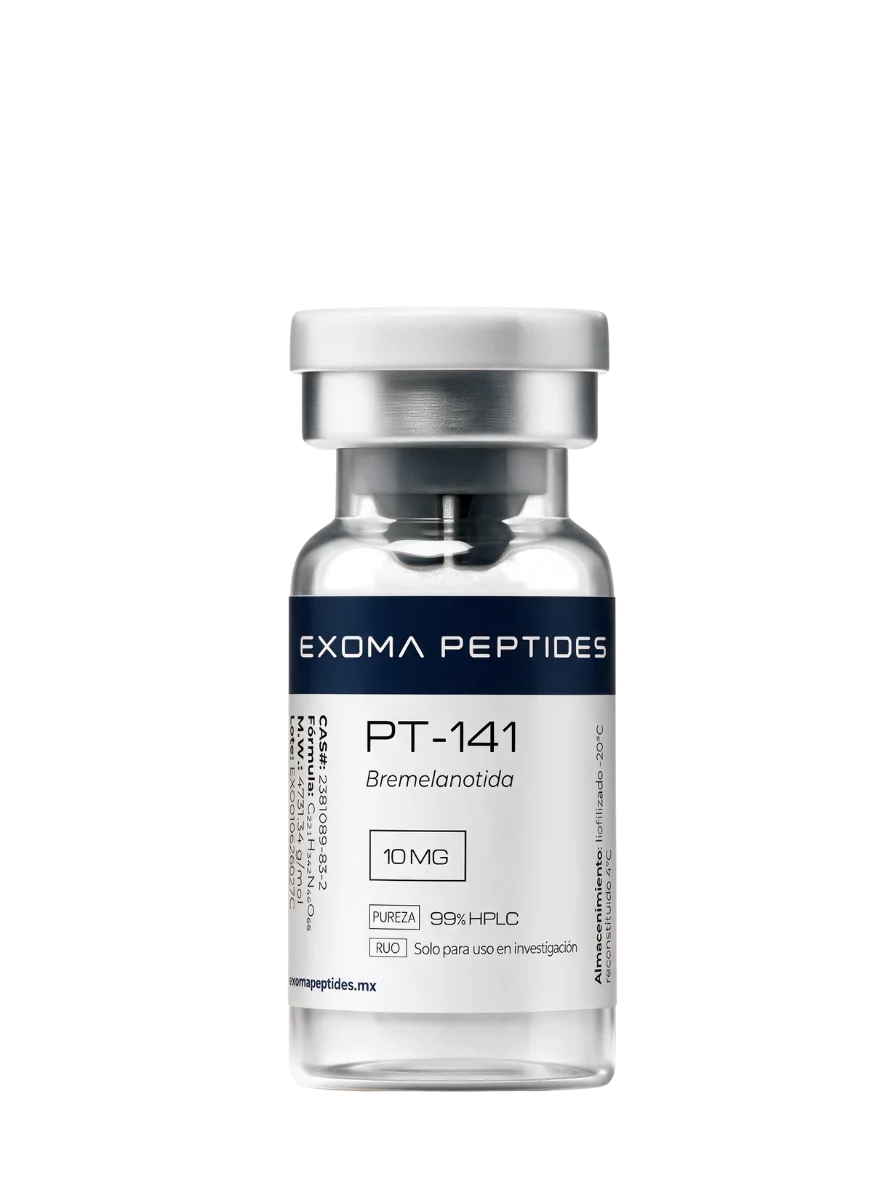
PT-141 (Bremelanotide)
PT-141 (Bremelanotide) — reagent for research use (RUO). HPLC purity 99.9% with COA per batch.
Technical data
- INN name
- PT-141 (Bremelanotide)
- Development code
- PT-141
- CAS
- 189691-06-3
- Molecular formula
- C50H68N14O10
- Molecular weight
- 1025.2 g/mol
Sizes and prices: 10 mg $870 MXN ($87 MXN per mg).
Buy PT-141 (Bremelanotide) in Mexico: order online with nationwide shipping in 1-4 business days depending on zone and tracking number. Prices in Mexican pesos. Material for research use only.
PT-141 (Bremelanotide) is known internationally as PT-141 (Bremelanotide) (English INN name). Buy PT-141 (Bremelanotide) in Mexico / comprar PT-141 (Bremelanotide) en México: reagent for research use (RUO) with HPLC purity, COA and nationwide shipping.
PT-141 (Bremelanotida) is also searched as: Bremelanotida, Bremelanotide, Bremelanotide acetate, PT-141.
Identity and composition
Bremelanotide, known as PT-141, is a cyclic heptapeptide agonist of melanocortin receptors that EXOMA markets as a research reagent (RUO). It is structurally derived from Melanotan II and preserves the melanocortinergic peptide core, but optimized toward preferential central activity. Its chemical identity is well defined: CAS number 189691-06-3 for the free base, molecular formula C50H68N14O10, and molecular weight of approximately 1025.2 g/mol. It acts as an agonist of MC1R, MC3R, and MC4R, with particular relevance to the hypothalamic MC4R. It is, moreover, the molecule the FDA approved for hypoactive sexual desire disorder (HSDD) in premenopausal women, a milestone that places it among the few melanocortinergic peptides with formal regulatory backing. In the Mexican catalog it is offered as a 10 mg lyophilized vial, the standard presentation for laboratory protocols. For those seeking to buy PT-141 in Mexico, EXOMA supplies characterized material with identity and purity documentation, intended exclusively for in vitro studies and preclinical models. Any inquiry about bremelanotide price or PT-141 availability in Mexico is handled within this research framework.
Mechanism of action
The mechanism of bremelanotide (PT-141) is central and neuromodulatory, not vascular, which distinguishes it from the phosphodiesterase type 5 inhibitors. As a melanocortin agonist it activates MC1R, MC3R, and MC4R, but its functionally most relevant action occurs on the hypothalamic MC4R, in nuclei linked to the regulation of sexual behavior and arousal. Stimulation of MC4R triggers signaling cascades that converge on the modulation of dopaminergic pathways, favoring dopamine in mesolimbic circuits associated with motivation and reward. In parallel, melanocortinergic signaling influences the release of oxytocin from hypothalamic neurons, a neuropeptide involved in bonding and arousal responses. Unlike sildenafil and other PDE5 inhibitors, which act peripherally by potentiating the vasodilation mediated by nitric oxide and cyclic GMP, PT-141 operates upstream, in the central nervous system, without depending on local hemodynamic mechanisms. This central action profile underlies the research interest in models of neurogenic desire. In RUO studies, bremelanotide is used as a tool to dissect the contribution of the melanocortin-dopamine-oxytocin axis to these behaviors.
Pharmacokinetics
The pharmacokinetic profile described for bremelanotide (PT-141) corresponds to a peptide of parenteral administration, since its peptidic nature makes it susceptible to digestive degradation by the oral route. In the established literature, following subcutaneous administration a rapid absorption is observed, with maximum plasma concentrations reached on the order of approximately one hour. The molecule presents a moderate elimination half-life, on the order of two hours, consistent with a cyclic peptide that offers greater metabolic stability than its linear analogs thanks to its cyclized structure, which reduces vulnerability to exopeptidases. Its distribution and clearance follow the typical patterns of heptapeptides, with metabolism by proteolytic hydrolysis into fragments and amino acids, without dependence on cytochrome P450. This brief kinetics explains why the exposure is concentrated in the hours following administration. In research (RUO), these parameters guide the temporal spacing of the measurements and the interpretation of the responses in models. EXOMA supplies PT-141 mexico as a characterized reagent so that laboratories can contextualize their observations within these documented pharmacokinetic ranges.
Scientific evidence
The body of evidence surrounding bremelanotide (PT-141) is solid for a melanocortinergic peptide, culminating in its regulatory approval. The FDA authorized the molecule for hypoactive sexual desire disorder (HSDD) in premenopausal women, a decision supported by randomized, double-blind, placebo-controlled clinical trials. Two pivotal phase 3 studies, the RECONNECT trials, evaluated on-demand subcutaneous administration and reported significant improvements in measures of sexual desire and in the reduction of associated distress, using validated instruments. Earlier clinical development also explored the molecule in male populations with erectile dysfunction, demonstrating its ability to induce arousal through a central mechanism. This trajectory positions PT-141 as one of the few melanocortin agonists that moved beyond the preclinical phase toward formal regulatory validation. For research (RUO), this clinical database offers a robust reference framework for interpreting results in models. Those seeking to buy PT-141 in Mexico for study purposes find a molecule backed by high-level evidence, extensively documented in the peer-reviewed literature.
Research applications
In research (RUO), bremelanotide (PT-141) is used as a reference pharmacological tool to study central melanocortinergic signaling and its role in arousal and motivation behavior. Its status as an MC4R agonist with preferential hypothalamic activity makes it an ideal reagent for dissecting the melanocortin-dopamine-oxytocin axis in in vitro and preclinical models. Among the documented lines are studies of melanocortin receptors, where PT-141 serves as an agonist ligand to characterize affinity, efficacy, and intracellular signaling in expression assays of MC1R, MC3R, and MC4R. It is also used in investigations of the neural circuits of desire and arousal of central origin, taking advantage of its non-vascular mechanism to isolate neurogenic components from hemodynamic ones. Its kinship with Melanotan II makes it useful in structure-activity relationship studies within the melanocortin family. Laboratories that acquire PT-141 mexico integrate it into protocols on the neurobiology of motivation and reward. All of these applications are framed strictly as research use, without EXOMA supplying it for purposes other than controlled experimentation.
Research protocols
In the documented experimental protocols with bremelanotide (PT-141), the lyophilized molecule is reconstituted beforehand and the aliquots are dosed according to the design of the study and the model used. The standard EXOMA presentation is the 10 mg vial, which offers flexibility to prepare stock concentrations suited to the sensitivity of the assay. In the clinical reference that gave rise to its approval, the described route was subcutaneous on demand, a fact that orients schemes reproducing episodic rather than sustained exposures, consistent with the brief half-life of the peptide. Researchers calculate administration volumes from the concentration obtained after reconstitution with bacteriostatic water, adjusting the aliquots to minimize handling cycles of the vial. The on-demand nature of the compound favors protocols with measurements close to administration, taking advantage of the window of greatest plasma exposure. These parameters are described solely as a reference framework for research (RUO) in experimental models, and do not constitute guidance for clinical use. Laboratories that acquire PT-141 mexico define their own internally validated protocols, documenting concentrations, volumes, and schedules in accordance with their good practices.
Reconstitution
The reconstitution of bremelanotide (PT-141) follows the standard practices for lyophilized laboratory peptides. The 10 mg vial supplied by EXOMA is reconstituted with 1 to 2 mL of bacteriostatic water, an amount chosen according to the desired stock concentration for the protocol. When preparing the solution, the diluent must be added slowly down the inner wall of the vial, avoiding directing the stream directly onto the lyophilized powder, since vigorous agitation and the formation of foam can compromise the structural integrity of the peptide. After incorporating the bacteriostatic water, it is advisable to let the vial rest and dissolve through gentle rotating movements, without shaking, until obtaining a transparent and homogeneous solution. The use of bacteriostatic water, which contains benzyl alcohol as a preservative, allows the reconstituted solution to be conserved for longer periods than simple sterile water. The choice between 1 mL and 2 mL depends on the calculation of aliquots: a smaller volume produces a higher concentration and vice versa. Once reconstituted, the material must be handled under aseptic conditions. EXOMA supplies PT-141 mexico as a reagent for research (RUO), and these indications are good laboratory practices.
Stability and storage
The stability of bremelanotide (PT-141) depends critically on the storage conditions before and after reconstitution. In its lyophilized form, the peptide is notably stable and must be kept at -20 °C, a temperature at which it maintains its structural integrity for prolonged periods by minimizing hydrolysis and oxidative degradation. The cyclic structure of the molecule confers on it a superior intrinsic resistance against degradation compared with linear peptides, but cold conservation remains indispensable to preserve the potency of the reagent. Once reconstituted with bacteriostatic water, the solution must be refrigerated between 2 and 8 °C and used within a maximum period of 30 days, a window during which the preservative of the diluent contributes to maintaining the microbiological and chemical stability. It is advisable to protect the material from light and to avoid repeated freeze-thaw cycles, which fragment the peptide and reduce its activity. Aliquoting after reconstitution limits the openings of the vial. These guidelines form part of the responsible handling of the reagent for research (RUO). Laboratories that buy PT-141 Mexico must verify the cold chain from reception.
Safety profile
The safety profile of bremelanotide (PT-141) documented in the pharmacological literature describes characteristic effects derived from its melanocortinergic action. The most frequently reported event in the clinical trials was nausea, at times transient and exposure-dependent. Flushing or cutaneous reddening reactions are also described, consistent with melanocortin signaling. A relevant finding is cutaneous hyperpigmentation, attributable to the activation of the MC1R receptor involved in melanogenesis, an effect shared with other agonists such as Melanotan II. At the cardiovascular level, the molecule can induce transient elevations of blood pressure together with mild decreases in heart rate, so the clinical development contemplated precautions in uncontrolled hypertension or cardiovascular disease. Other described effects include headache and reactions at the site of administration. This profile comes from established pharmacological and clinical data and is presented for informational purposes within the research framework (RUO). EXOMA supplies PT-141 mexico only as a reagent for scientific studies, and this characterization serves to contextualize the responses in models, not as guidance for clinical use.
Comparative context
Situating bremelanotide (PT-141) in its comparative context requires distinguishing it from two frequent references. Compared with Melanotan II, from which it structurally derives, PT-141 shares the melanocortinergic core and the capacity to activate MC receptors, but it was optimized to accentuate the central activity on the hypothalamic MC4R linked to arousal, while Melanotan II has been studied mostly for its effect on MC1R and pigmentation. In fact, PT-141 is a metabolite and related analog of Melanotan II, which explains shared effects such as hyperpigmentation. The most determinant difference is with respect to the PDE5 inhibitors, such as sildenafil. These act peripherally, potentiating the vasodilation mediated by nitric oxide and cyclic GMP in erectile tissue; their mechanism is hemodynamic and depends on a prior stimulus. PT-141, in contrast, acts centrally on the hypothalamic circuits of melanocortin, dopamine, and oxytocin, without requiring the vascular pathway. This dichotomy—central versus vascular—makes PT-141 a complementary tool and not equivalent to the PDE5 inhibitors. For laboratories evaluating buying PT-141 Mexico, understanding these differences is essential when designing comparative studies of the neurobiology of arousal.
History and development
The history of bremelanotide (PT-141) goes back to research on analogs of the alpha-melanocyte-stimulating hormone (α-MSH) and its synthetic derivatives. The molecule arose as a product related to Melanotan II, a peptide originally developed in studies on cutaneous pigmentation and photoprotection. During that work it was observed that certain melanocortinergic analogs induced sexual arousal responses through a central mechanism, a finding that redirected the development of PT-141 toward that specific application. The company Palatin Technologies drove the clinical program, initially exploring the intranasal route and later the subcutaneous one, following evaluations that motivated adjustments in the formulation. The development went through studies in male erectile dysfunction and, decisively, in female hypoactive sexual desire disorder. This effort culminated in 2019, when the FDA approved bremelanotide for HSDD in premenopausal women. This trajectory illustrates how a peptide born from pigmentation studies evolved toward a clinically validated centrally acting molecule. At EXOMA, PT-141 mexico is offered as a reagent for research (RUO), allowing laboratories to continue exploring this family of peptides.
FAQ
How does PT-141 differ from PDE5 inhibitors?
The difference is one of mechanism. Phosphodiesterase type 5 inhibitors, such as sildenafil, act peripherally by potentiating vasodilation mediated by nitric oxide and cyclic GMP; their effect is hemodynamic and local. PT-141 (bremelanotide) acts centrally, as an agonist of the hypothalamic MC4R receptor, modulating dopamine and oxytocin pathways without depending on the vascular circulation. That is why it is described as a neurogenic and non-vascular mechanism. In research (RUO), this distinction makes PT-141 a complementary tool, not an equivalent, to PDE5 inhibitors.
Are PT-141 and Melanotan II related?
Yes, they are closely related. PT-141 (bremelanotide) is structurally derived from Melanotan II and is in fact an analog and related metabolite of it. Both share the melanocortinergic core and activate melanocortin receptors, which explains common effects such as hyperpigmentation through action on MC1R. The difference is that PT-141 was optimized toward a preferential central activity on the hypothalamic MC4R linked to arousal, whereas Melanotan II has been studied more for its pigmentary effect. Both are supplied only for research.
What exactly is bremelanotide (PT-141)?
It is a cyclic heptapeptide agonist of the melanocortin receptors MC1R, MC3R, and MC4R, with preferential central activity on the hypothalamic MC4R. Its CAS is 189691-06-3 (free base), its formula is C50H68N14O10, and its molecular weight is around 1025.2 g/mol. It is the molecule approved by the FDA for hypoactive sexual desire disorder in premenopausal women. At EXOMA it is offered in a 10 mg vial as a research reagent (RUO). Those looking to buy PT-141 Mexico acquire it characterized for laboratory studies.
How is PT-141 reconstituted and stored?
The 10 mg lyophilized vial is reconstituted with 1 to 2 mL of bacteriostatic water, added slowly down the wall of the vial and mixed with gentle swirling, without shaking. The lyophilized powder is stored at -20 °C, where it maintains its stability for prolonged periods. Once reconstituted, the solution is refrigerated at 2 to 8 °C and used within a maximum of 30 days, avoiding light and freeze-thaw cycles. These are good laboratory practices for preserving the quality of the research reagent.
What is the scientific backing of PT-141?
PT-141 has backing that is uncommon among melanocortinergic peptides: it was approved by the FDA following randomized, double-blind, placebo-controlled phase 3 clinical trials, known as the RECONNECT studies, which evaluated its effect on hypoactive sexual desire in premenopausal women using validated instruments. It was also previously investigated in male erectile dysfunction. This peer-reviewed evidence base offers the research community a robust framework for interpreting experimental results.
Can I buy PT-141 in Mexico for research?
Yes. EXOMA supplies PT-141 mexico in a 10 mg vial as a research-use-only (RUO) reagent, intended exclusively for in vitro studies and preclinical models. The material is offered characterized, with documentation of identity and purity, for laboratories exploring melanocortinergic signaling and the neurobiology of arousal. For inquiries about bremelanotide precio or availability, the team responds within this research framework. The product is not supplied for purposes other than controlled scientific experimentation.
Customer reviews
Average rating: 4.9 out of 5, based on 17 customer ratings.
Ricardo T. — 5/5
The PT-141 arrived in excellent condition and very well refrigerated. Very professional.
Hugo F. — 5/5
It arrived without setbacks to Querétaro. The presentation is very professional.
Jimena T. — 5/5
The PT-141 arrived in excellent condition, very well refrigerated and protected. Excellent service.
Marcos L. — 5/5
It comes sealed in a well-protected alu-strip.
Uriel S. — 5/5
Excellent delivery service and functional product.
Ulises F. — 5/5
Discreet packaging, not even the courier knows what it is.
Vicente H. — 5/5
Package fully sealed and understated. All good.
Virginia E. — 5/5
It arrived discreetly at my home. All good.
Valentin K. — 5/5
Absolute discretion in the outer packaging.
Viviana N. — 5/5
Totally discreet, no visible logo.
Gabriela I. — 5/5
The PT-141 arrived at my house extremely fast. The package is super discreet and protected with bubble wrap. Highly recommended!
Carlos R. — 5/5
The purity is evident. Excellent customer service as well.
Gustavo M. — 5/5
Top-notch service; they answered me even on a Sunday and shipping was lightning fast.
Fernando T. — 4/5
Legitimate product with complete documentation. Customer service is excellent.
Andrea V. — 5/5
Second purchase. The quality is consistent and the service excellent.
Analyzed by Janoshik, an independent laboratory. Each report is verifiable per batch at janoshik.com/verify.
Scientific references (8)
Peer-reviewed literature on PT-141 (Bremelanotide), with its PubMed identifier when available:
- Bremelanotide for the Treatment of Hypoactive Sexual Desire Disorder: Two Randomized Phase 3 Trials (Kingsberg SA, et al. · Obstetrics & Gynecology · 2019) — Two randomized phase 3 trials (RECONNECT) of bremelanotide (PT-141) for hypoactive sexual desire disorder in premenopausal women. PMID 31599840.
- Long-Term Safety and Efficacy of Bremelanotide for Hypoactive Sexual Desire Disorder. (Simon JA, et al. · Obstet Gynecol · 2019) PMID 31599847.
- Safety Profile of Bremelanotide Across the Clinical Development Program. (Clayton AH, et al. · J Womens Health (Larchmt) · 2022) PMID 35147466.
- Bremelanotide for female sexual dysfunctions in premenopausal women: a randomized, placebo-controlled dose-finding trial. (Clayton AH, et al. · Womens Health (Lond) · 2016) PMID 27181790.
- Re-Analyzing Phase III Bremelanotide Trials for "Hypoactive Sexual Desire Disorder" in Women. (Spielmans GI, et al. · J Sex Res · 2021) PMID 33678061.
- Usefulness of ambulatory blood pressure monitoring to assess the melanocortin receptor agonist bremelanotide. (White WB, et al. · J Hypertens · 2017) PMID 27977473.
- An effect on the subjective sexual response in premenopausal women with sexual arousal disorder by bremelanotide (PT-141), a melanocortin receptor agonist. (Diamond LE, et al. · J Sex Med · 2006) PMID 16839319.
- Female Sexual Desire, Arousal, and Orgasmic Dysfunctions: A Systematic Review and Meta-Analysis of Treatment Options. (Toledo RG, et al. · J Minim Invasive Gynecol · 2026) PMID 40543759.
Full scientific profile: PT-141 in the compendium — mechanism of action, studies and technical data sheet.
See the full category catalog: Sexual Health.
Guides and articles about PT-141 (Bremelanotide)
Lecturas del blog de EXOMA que la editorial asoció a este compuesto: