
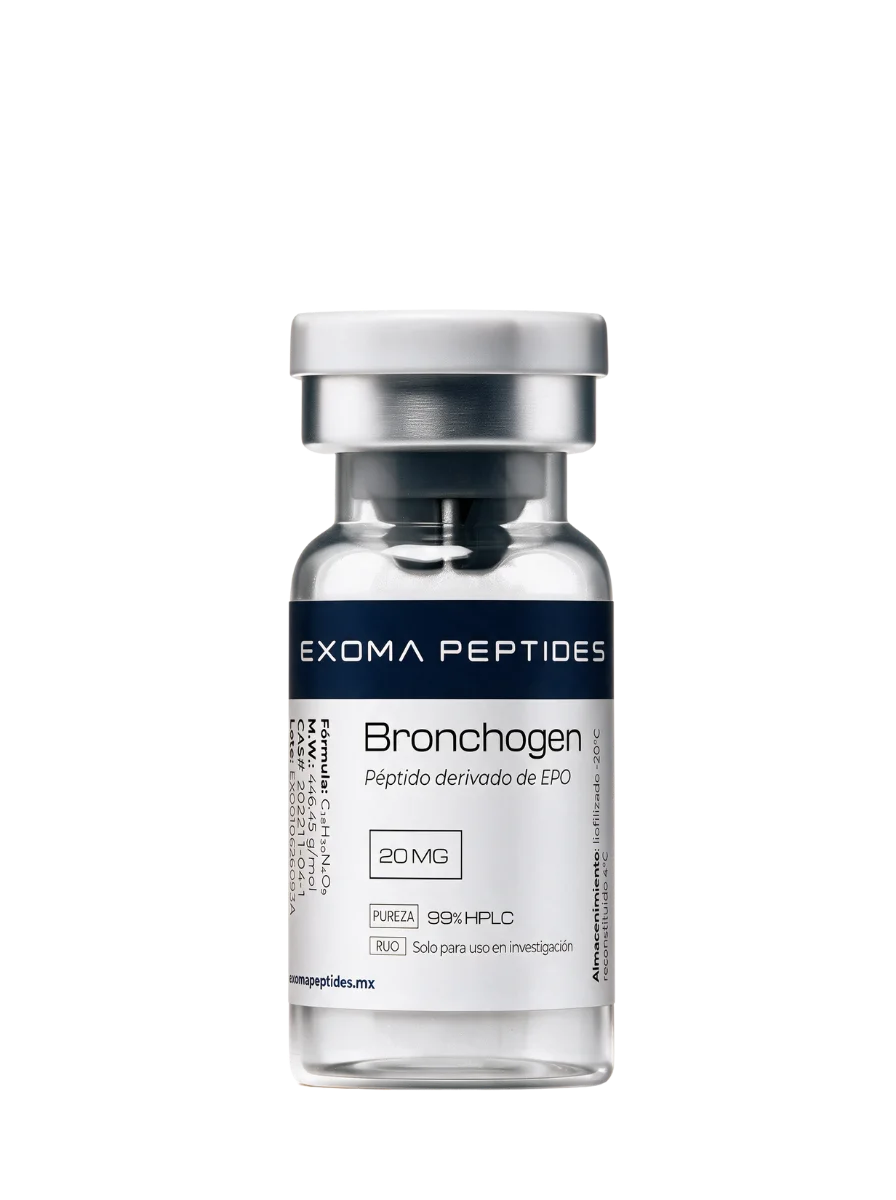
Bronchogen
Bronchogen — reagent for research use (RUO).
Sizes and prices: 20 mg $1,750 MXN ($88 MXN per mg).
Buy Bronchogen in Mexico: order online with nationwide shipping in 1-4 business days depending on zone and tracking number. Prices in Mexican pesos. Material for research use only.
Bronchogen is also searched as: AEDL, Peptido AEDL.
Identity and composition
Bronchogen is a short tetrapeptide of Khavinson's class of peptide bioregulators, studied preclinically for its affinity for bronchial tissue and its role in DNA stabilization. It is offered as reference material for research. Product for research use.
As for its chemical identity confirmed in the consulted literature:.
- Molecular formula: C18H30N4O9 (confirmed in PubChem CID 11690869). - Sequence: H-Ala-Glu-Asp-Leu-OH (AEDL) according to PubChem CID 11690869. Note: the peer-reviewed article PMID 21240358 writes the sequence as Ala-Asp-Glu-Leu (Glu/Asp order inverted); this discrepancy between sources could not be reconciled with a single authoritative source, so it is documented transparently. - Molecular weight: approximately 446.4 g/mol, a value derived from calculation based on the formula; it is not explicitly listed in the registry consulted. - Synonyms: Bronchogen, AEDL, Ala-Glu-Asp-Leu, bronchial tetrapeptide (Khavinson bioregulator).
No number is available CAS confirmed in PubChem or in regulatory sources, so it is omitted. Reference presentation: vial of 20 mg of lyophilized powder.
Mechanism of action
The primary literature documents two main mechanistic observations, both of a preclinical nature.
1. Stabilization of DNA (in vitro / physicochemical). In differential scanning microcalorimetry studies it was observed that Bronchogen acts as a DNA-stabilizing agent: it increased the melting temperature of DNA (calf thymus and mouse liver) by approximately 3.1 °C within a narrow range of molar ratios, without apparent specificity for A-T or G-C pairs, suggesting binding to both strands without base selectivity (PMID 21240358).
2. Modulation of the bronchial epithelium (in vivo, animal model). In rats with NO2-induced obstructive pulmonary pathology, administration for one month was associated with improvement of bronchial epithelium remodeling markers (goblet cell hyperplasia, squamous metaplasia, lymphocytic infiltration, emphysema), with restoration of ciliated cells, increased production of secretory IgA, and reduction of neutrophilic inflammation markers (PMID 26468022).
The proposed mechanism of gene expression modulation is consistent with the Khavinson class of bioregulators, but is not established in molecular detail in the verified sources. These observations come from experimental models and should not be extrapolated to humans.
Pharmacokinetics
No pharmacokinetic data are available for Bronchogen in the verified sources: there are no documented parameters for half-life, absorption, distribution, or elimination. As it is a short tetrapeptide, any kinetic consideration would be speculative, so no numerical values are reported. This absence of data is itself an important limit of current knowledge about the compound.
Scientific evidence
The available evidence is preliminary, preclinical and limited. The English-indexed primary literature is scarce and mostly of Russian origin (Khavinson's group, Institute of Bioregulation and Gerontology of St. Petersburg).
It essentially comes down to two works: an in vitro physicochemical study on the thermostability of DNA (PMID 21240358) and a rat model of obstructive pulmonary pathology induced by NO2 (PMID 26468022). In these preclinical studies the behavior of the peptide has been investigated, without this constituting evidence of clinical efficacy.
No registered clinical trials in humans were identified (no NCT entry located on ClinicalTrials.gov). The compound is not approved by the FDA nor by other agencies for human therapeutic use, and it remains a research compound. The claim about 'pneumocyte differentiation' could not be confirmed in the peer-reviewed sources consulted, so it is not asserted here.
Research applications
Product for research use. Bronchogen is offered exclusively as reference material for in vitro and preclinical research.
It may be of interest for research in:
- Physicochemical studies of peptide-DNA interaction and thermostability of the nucleic acid.
- Animal models of obstructive pulmonary pathology and bronchial epithelial remodeling.
- Characterization of the class of Khavinson bioregulator tetrapeptides.
Not applicable / out of scope:
- Any diagnostic, therapeutic or preventive use in humans or animals.
- clinical use, clinical administration or supplementation.
- Extrapolation of preclinical findings to outcomes in humans.
The buyer is responsible for handling the material in accordance with good laboratory practices and applicable regulations.
Research protocols
There is no established dosing protocol for Bronchogen: the verified sources do not report a dose in milligrams used in the studies, so no figure is indicated.
The only thing documented at the experimental-design level is that, in the rat model of obstructive pulmonary pathology, administration was carried out for approximately one month (PMID 26468022); the study does not specify, in the material consulted, the exact amount administered.
Consequently, any work scheme must be defined by the researcher according to their experimental design, their controls and the applicable regulations. The reference presentation is a vial of 20 mg of lyophilized powder, a product datum and not a dose recommendation.
Reconstitution
General standard laboratory handling guide for lyophilized peptides:
- The usual diluent is bacteriostatic water (water for injection with ~0.9 % benzyl alcohol), which allows multiple withdrawals from the vial thanks to its bacteriostatic action. Sterile water for injection may also be used when the protocol requires it.
- Add the diluent letting it run slowly down the wall of the vial, not directly onto the powder, to minimize mechanical degradation of the peptide.
- Do not shake vigorously: gently swirl until fully dissolved.
- The reconstitution volume is chosen according to the desired working concentration; with a 20 mg vial, a larger diluent volume produces a lower final concentration.
These indications are of general laboratory technique and do not imply an intended use in humans.
Stability and storage
General handling recommendations for research peptides (standard qualitative guide):
- Lyophilized (powder): is the most stable form. It is usually stored refrigerated for short-term use and frozen for prolonged storage; it should be protected from moisture and light. - Reconstituted (in solution): is less stable and must be kept refrigerated, being used within a relatively short period. - Avoid repeated freeze-thaw cycles: it is advisable to aliquot the solution so as not to subject all the material to temperature variations.
The consulted literature does not include specific stability data (times, exact temperatures) for Bronchogen, so the above is only general laboratory guidance.
Safety profile
No formal safety profile is available. In the verified sources, no human toxicology data or dedicated toxicity studies were found.
In the rat model, administration for one month was tolerated and was associated with favorable morphofunctional effects with no toxicity reported in the study summary (PMID 26468022); however, this does not constitute a safety profile and does not allow conclusions about risk in humans.
There are no human clinical data, nor documented contraindications, precisely because no studies have been conducted in people. Therefore, the material must be treated with the precautions proper to a research compound not toxicologically characterized and handled only in appropriate laboratory settings. We reiterate: product for research use.
Comparative context
Bronchogen belongs to the family of short bioregulatory tetrapeptides of Khavinson, which are characterized by sequences of 2 to 4 amino acids, a supposed tissue-specific affinity and a proposed modulation of gene expression. Conceptual analogs within this class include Epitalon (Ala-Glu-Asp-Gly) and Cortagen, among others.
A shared trait described for several members of this class is the property of DNA stabilization, which in the case of Bronchogen has been documented experimentally (PMID 21240358). What conceptually distinguishes Bronchogen within the group is its orientation toward bronchial tissue in preclinical models.
It is important to note that direct comparisons of potency or efficacy compared with other members of the class are not supported by the verified sources; any claim of relative superiority would lack support.
History and development
Bronchogen falls within the research program of short peptide bioregulators developed by the Khavinson group at the Institute of Bioregulation and Gerontology in St. Petersburg (Russia), a line of work that has proposed tetrapeptides with supposed tissue affinity and the ability to modulate gene expression.
The primary evidence indexed in English is scarce and mostly of Russian origin. The two milestones documented in the verified sources are an in vitro physicochemical study on the thermostability of DNA (2011; PMID 21240358) and a rat model of NO2-induced obstructive pulmonary pathology (2015; PMID 26468022).
As far as the consulted sources reflect, the compound has not advanced to registered clinical trials in humans nor does it have regulatory approval, and it remains a research compound.
FAQ
What is Bronchogen and what is it studied for?
It is a short tetrapeptide (sequence AEDL) of the Khavinson bioregulator class. In preclinical studies it has been investigated for its ability to stabilize DNA in vitro and for its effect on the bronchial epithelium in animal models of obstructive pulmonary pathology. It is a compound for research use, not for clinical use.
Does Bronchogen have human clinical trials or FDA approval?
No. In the verified sources, no registered clinical trials in humans were identified (no NCT entry located) and the compound is not approved by the FDA or by other agencies for therapeutic use. The available evidence is exclusively preclinical.
What is the formula and sequence of Bronchogen?
Its molecular formula confirmed in PubChem (CID 11690869) is C18H30N4O9, with an approximate molecular weight of 446.4 g/mol derived from calculation. The sequence appears as H-Ala-Glu-Asp-Leu-OH (AEDL), although a peer-reviewed article writes it as Ala-Asp-Glu-Leu; this discrepancy between sources is documented transparently.
How is Bronchogen reconstituted and stored?
As a general laboratory guide, the lyophilized powder is usually reconstituted with bacteriostatic water, letting it run down the wall of the vial and swirling gently without shaking. The lyophilizate is more stable (refrigerated or frozen) and, once in solution, it is advisable to refrigerate, aliquot and avoid freeze-thaw cycles.
What dose was used in the Bronchogen studies?
The verified sources do not report a dose in milligrams, so no figure is indicated. It is only recorded that, in the rat model, administration was carried out for approximately one month. The reference presentation is a 20 mg vial, a product datum and not a dose recommendation.
Are there safety data for Bronchogen?
There is no formal safety profile nor human toxicology studies in the verified sources. In the rat model, administration for one month was tolerated with no toxicity reported in the summary, but this does not constitute evidence of safety. It must be handled as a research compound not toxicologically characterized.
Scientific references (7)
Peer-reviewed literature on Bronchogen, with its PubMed identifier where available:
- Effect of the peptide bronchogen (Ala-Asp-Glu-Leu) on DNA thermostability (Monaselidze JR et al. · Bulletin of experimental biology and medicine · 2011) PMID 21240358.
- Modulating Effect of Peptide Therapy on the Morphofunctional State of Bronchial Epithelium in Rats with Obstructive Lung Pathology (Kuzubova, et al. · Bulletin of Experimental Biology and Medicine · 2015) PMID 26468022.
- [Antiinflammatory and Regenerative Effect of Peptide Therapy in the Model of Obstructive Lung Pathology] (Titova, et al. · Rossiiskii Fiziologicheskii Zhurnal Imeni I.M. Sechenova · 2017) PMID 30199201.
- Peptide regulation of gene expression and protein synthesis in bronchial epithelium. (Khavinson VKh, et al. · Lung · 2014) PMID 25015171.
- Peptides tissue-specifically stimulate cell differentiation during their aging. (Khavinson VKh, et al. · Bull Exp Biol Med · 2012) PMID 22808515.
- Peptide Regulation of Cell Differentiation. (Khavinson V, et al. · Stem Cell Rev Rep · 2020) PMID 31808038.
- Feasibility of Transport of 26 Biologically Active Ultrashort Peptides via LAT and PEPT Family Transportrs. (Khavinson VK, et al. · Biomolecules · 2023) PMID 36979488.
Full scientific profile: Bronchogen in the compendium — mechanism of action, studies and technical data sheet.
See the full category catalog: Bioregulators.
Guides and articles about Bronchogen
Lecturas del blog de EXOMA que la editorial asoció a este compuesto: