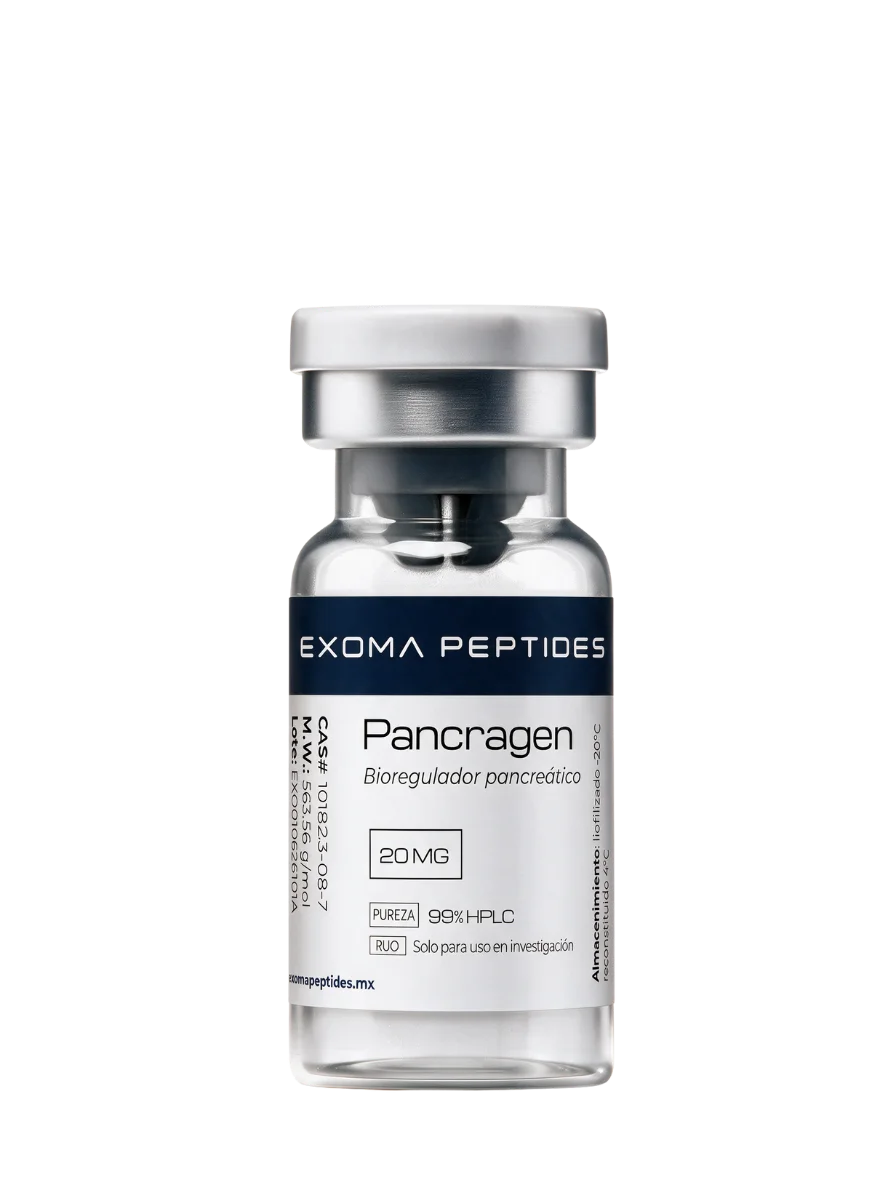
Pancragen
Pancragen — research reagent (RUO).
Sizes and prices: 20 mg $1,750 MXN ($88 MXN per mg).
Buy Pancragen in Mexico: order online with nationwide shipping in 1-4 business days depending on zone and tracking number. Prices in Mexican pesos. Material for research use only.
Pancragen is also searched as: KEDW, Peptido KEDW.
Identity and composition
Pancragen is a short synthetic tetrapeptide of sequence Lys-Glu-Asp-Trp (KEDW), belonging to the class of Khavinson peptide bioregulators and associated with the pancreas. In preclinical research it has been studied in the context of pancreatic endocrine function and age-associated glucose tolerance. Product for research use.
Regarding its chemical identity, the amide form H-Lys-Glu-Asp-Trp-NH2 is confirmed in PubChem (CID 68451868), with molecular formula C26H37N7O8 and molecular weight of ~575.6 Da. The peptide sequence is Lys-Glu-Asp-Trp (KEDW).
The CAS number does not appear in the primary or regulatory sources reviewed, so it is omitted. The exact formula and weight of the free-acid form are also not confirmed on a verified PubChem page, so the foregoing values correspond specifically to the amide form.
This material is offered in a presentation of 20 mg. It is also known by the synonyms KEDW, Lys-Glu-Asp-Trp, H-Lys-Glu-Asp-Trp-OH, pancreas peptide bioregulator y Khavinson tetrapeptide.
Mechanism of action
Pancragen is a short tetrapeptide (Lys-Glu-Asp-Trp, KEDW) from the family of "peptide bioregulators" described by Khavinson, related to specific tissues and organs; in this case, the pancreas.
In preclinical models with non-human primates, its relationship with pancreatic endocrine function has been investigated. In aged rhesus monkeys with impaired glucose tolerance, it was observed that intramuscular administration of Pancragen increased the rate of glucose "disappearance" and normalized insulin and C-peptide responses to a glucose load, with an effect that persisted partially for around three weeks after discontinuing administration (PMID 25946840).
It should be noted that certain claims about gene regulation and beta-cell transcription factors (for example, Pdx1 or Pax4) circulate in supplier material, but no could be confirmed in the primary sources reviewed and no are considered established here.
Pharmacokinetics
No verifiable pharmacokinetic data (half-life, absorption, clearance, or bioavailability) were identified in the sources examined. Therefore, it is not possible to describe a numerical pharmacokinetic profile for this compound.
As a reference of experimental context, in the primary study administration was by the intramuscular route for a defined period (see the protocols section). Any additional kinetic parameter is outside of what is documented in the available sources.
Scientific evidence
The evidence on Pancragen is preliminary and preclinical in nature, limited to animal studies. The bulk of the work comes from Khavinson and collaborators in aged non-human primates (aged female rhesus monkeys), focused on impaired glucose tolerance and age-associated pancreatic endocrine function.
In preclinical studies, Pancragen has been observed to increase the rate of glucose disappearance and to normalize insulin and C-peptide responses, with partial persistence of the effect after discontinuation (PMID 25946840). Another study reported reduced fasting glucose and normalization of insulin and C-peptide in the same animal model (PMID 28509500).
No registered clinical trials, defined clinical phase, or regulatory approval (FDA/EMA) were found. Efficacy and safety in humans are not established.
Research applications
Product for research use.
Suitable for (in research):
- Preclinical in vitro or animal-model studies on bioregulator peptides of the Khavinson class.
- Exploratory/geroprotective research lines on pancreatic endocrine function and age-associated glucose tolerance.
- Chemical characterization and reference work on the tetrapeptide KEDW.
Not applicable for:
- Any use or clinical use, diagnosis, treatment, or prevention of diseases.
- Clinical applications: there are no registered clinical trials or regulatory approval (FDA/EMA).
- Extrapolating results from animal models to humans; the evidence in humans is not established.
Research protocols
The following figures correspond solely to animal research protocols and are cited for reference purposes; they do not constitute usage guidance.
In the primary study in aged rhesus monkeys, the documented administration was 50 µg/day by intramuscular route for 10 days (PMID 25946840). In preclinical studies it was observed that part of the effect on glucose persisted around three weeks after discontinuing administration.
No validated dosing protocols for other contexts, or human guidelines, were identified. Any experimental design must be based on the primary literature and on the practices of the corresponding laboratory.
Reconstitution
As a general laboratory handling guideline for lyophilized peptides:
- It is usually reconstituted with bacteriostatic water (sterile water with ~0.9% benzyl alcohol), which helps preserve the solution in multi-use storage. Sterile water for injection may also be used when the protocol indicates it.
- Add the solvent slowly down the vial wall, letting it run over the powder; no injecting the stream directly onto the lyophilizate.
- Gently swirl the vial until fully dissolved; avoid shaking forcefully so as not to damage the peptide.
- The reconstitution volume is chosen according to the concentration desired for the experimental work (for example, based on the 20 mg of the presentation).
These indications are standard laboratory technique and do not imply suitability for clinical use.
Stability and storage
Standard handling recommendations for peptides:
- Lyophilized (powder): is the most stable form. It is usually kept refrigerated for short-term use and frozen for long-term storage, protected from moisture and light.
- Reconstituted (in solution): is kept refrigerated and used within a short window of time; the use of bacteriostatic water favors its preservation in multi-use presentations.
- Avoid repeated freeze-thaw cycles, which can degrade the peptide; it is advisable to fraction into aliquots when possible.
These ranges are general laboratory practices and do not replace the specific conditions determined by each protocol.
Safety profile
The documented safety profile is very limited and comes only from animal models.
In the glucose tolerance study in aged primates, the authors characterized Pancragen as an effective and safe intervention within that aged-animal model (PMID 28509500). This assessment corresponds to a specific experimental context and no can be extrapolated to people.
No human safety data, toxicology studies or adverse event profile were found. The compound is not approved by FDA/EMA and its use in humans is not regulated. Efficacy and safety in humans are not established.
Comparative context
In the primate study that compared Pancragen with glimepiride (a sulfonylurea), it was observed that glimepiride produced a more pronounced but later-onset reduction of glucose, in addition to stimulating the release of C-peptide; for its part, Pancragen normalized insulin and C-peptide levels along with a reduction of glucose (PMID 28509500). These are distinct behaviors observed in an animal model, not a hierarchy of superiority.
Pancragen belongs to the same family of Khavinson short peptide bioregulators as other tissue-specific tetrapeptides. The claims of comparative superiority within this class no are supported by the reviewed sources.
History and development
Pancragen is part of the class of short "peptide bioregulators" described by Khavinson and colleagues, a group of tetrapeptides associated with specific tissues or organs; in this case, the pancreas.
Its documented research has been developed mainly in the field preclinical and geroprotective, with works by Goncharova, Khavinson and colleagues in aged non-human primates (old female rhesus monkeys), oriented toward impaired glucose tolerance and the decline of pancreatic endocrine function associated with age (PMID 25946840; PMID 28509500).
As of this information, no registered clinical trials, defined clinical phases or regulatory approvals were identified for the compound.
FAQ
What is Pancragen and what is it studied for?
It is a short synthetic tetrapeptide (Lys-Glu-Asp-Trp, KEDW) of the Khavinson class of bioregulators, associated with the pancreas. In preclinical research it has been studied in relation to pancreatic endocrine function and age-associated glucose tolerance. It is a product for research use; not for clinical use.
What is the sequence and chemical identity of Pancragen?
Its sequence is Lys-Glu-Asp-Trp (KEDW). The amide form H-Lys-Glu-Asp-Trp-NH2 is confirmed in PubChem (CID 68451868), with formula C26H37N7O8 and molecular weight of ~575.6 Da. No CAS number was identified in the reviewed sources.
Are there human clinical trials with Pancragen?
No. The available evidence is preliminary and preclinical, limited to studies in aged non-human primates. No registered clinical trials, a defined clinical phase or regulatory approval (FDA/EMA) were found, and efficacy and safety in humans are not established.
How is lyophilized Pancragen reconstituted?
As a general laboratory guide, it is reconstituted with bacteriostatic water (sterile water with ~0.9% benzyl alcohol), adding it slowly down the wall of the vial and swirling gently until dissolved. It is not shaken vigorously. The volume is adjusted to the desired concentration. It is a laboratory technique, not a guideline for clinical use.
How does Pancragen compare with glimepiride in the studies?
In a study in aged primates, glimepiride (a sulfonylurea) produced a more marked but later glucose reduction and stimulated C-peptide, whereas Pancragen normalized insulin and C-peptide along with glucose reduction (PMID 28509500). These are distinct behaviors in an animal model, without a hierarchy of superiority.
How is Pancragen stored?
The lyophilizate is the most stable form: refrigerated for the short term and frozen for prolonged storage, protected from humidity and light. Reconstituted, it is kept refrigerated and used within a short window. It is advisable to avoid repeated freeze-thaw cycles.
Customer reviews
Average rating: 4.3 out of 5, based on 4 customer ratings.
Fabiola G. — 4/5
The Pancragen arrived well packaged. The store is very reliable and serious.
Ricardo A. — 4/5
Everything fine with the Pancragen. Good price compared to other sites, and the quality looks quite good at first glance.
Diana S. — 5/5
Everything perfect with the Pancragen. It arrived a day earlier than expected and with all its original seals.
Scientific references (6)
Peer-reviewed literature on Pancragen, with its PubMed identifier when available:
- [Correction of impaired glucose tolerance using tetrapeptide (Pancragen) in old female rhesus monkeys] (Goncharova ND et al. · Advances in gerontology = Uspekhi gerontologii · 2015) PMID 28509500.
- Effects of pancragen on the differentiation of pancreatic cells during their ageing (Khavinson VKh et al. · Bulletin of experimental biology and medicine · 2013) PMID 23486591.
- Prospects of using pancragen for correction of metabolic disorders in elderly people (Korkushko OV et al. · Bulletin of experimental biology and medicine · 2011) PMID 22448364.
- Study of biological activity of Lys-Glu-Asp-Trp-NH2 endogenous tetrapeptide (Khavinson, et al. · Bulletin of Experimental Biology and Medicine · 2010) PMID 21246099.
- Effect of pancragen on blood glucose level, capillary permeability and adhesion in rats with experimental diabetes mellitus (Khavinson, et al. · Bulletin of Experimental Biology and Medicine · 2007) PMID 18642713.
- [Impact of tetrapeptide pancragen on endocrine function of the pancreas in old monkeys] (Goncharova, et al. · Advances in Gerontology (Uspekhi Gerontologii) · 2014) PMID 25946840.
Full scientific profile: Pancragen in the compendium — mechanism of action, studies and technical data sheet.
See the full category catalog: Bioregulators.