
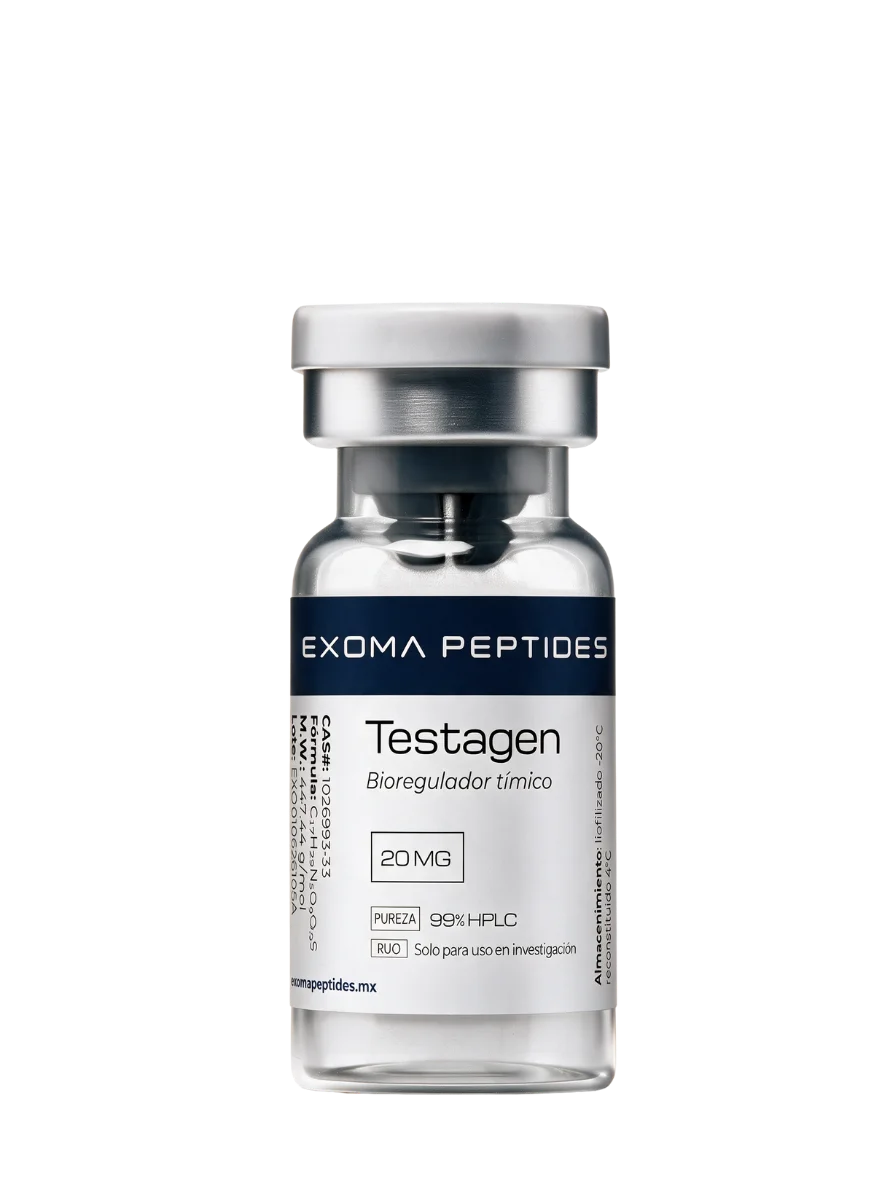
Testagen
Testagen — reagent for research use (RUO).
Technical data
- CAS
- 1026993-38-3
- Molecular formula
- C17H29N5O9
- Molecular weight
- 447.45 g/mol
Sizes and prices: 20 mg $1,750 MXN ($88 MXN per mg).
Buy Testagen in Mexico: order online with nationwide shipping in 1-4 business days depending on zone and tracking number. Prices in Mexican pesos. Material for research use only.
Testagen is also searched as: KEDG.
Identity and composition
Testagen is a synthetic tetrapeptide with the sequence Lys-Glu-Asp-Gly (abbreviated KEDG), with CAS number 1026993-38-3, molecular formula C17H29N5O9, and an approximate molecular mass of 447.44 g/mol, made up of four amino acids. It belongs to the family of short peptide bioregulators developed by the school of Vladimir Khavinson in Saint Petersburg, a set of short-chain peptides whose design is oriented toward tissue-specific gene regulation. Within this group, Testagen is distinguished by its proposed tropism toward the endocrine-reproductive axis, unlike thymic peptides such as Thymogen (Glu-Trp) or Vilon (Lys-Glu). It is offered in lyophilized presentation exclusively for research (RUO) in the laboratory, and as a reference material it is of interest to teams studying steroidogenesis and endocrine regulation in vitro. For those looking to buy Testagen in Mexico, it is useful to remember that its chemical identity (sequence KEDG, CAS, and molecular weight) is the starting point for verifying the purity and traceability of any Khavinson bioregulator before designing an experimental protocol.
Mechanism of action
The proposed mechanism for Testagen is endocrine-reproductive in nature and was put forward by Khavinson's group within the framework of their theory of peptide regulation of gene expression. According to this hypothesis, the tetrapeptide KEDG would interact with regulatory regions of DNA in gonadal cells and in the pituitary-thyroid axis, modulating the transcription of key genes of androgenic steroidogenesis: the StAR protein (transport of cholesterol into the mitochondrion), the LH receptor, 3β-hydroxysteroid dehydrogenase (3β-HSD) and CYP17A1. The proposed result would be a fine regulation of steroid synthesis in in vitro and preclinical models. It is essential to be honest about the state of this evidence: this is a proposed mechanism, supported mainly by work from the same group of origin and not yet independently validated by external laboratories with robust replications. For that reason, for research (RUO) Testagen should be interpreted as a tool for exploring hypotheses of endocrine gene regulation, not as a compound of demonstrated efficacy. Anyone assessing the price of Testagen should weigh precisely this exploratory character of the Khavinson bioregulator.
Pharmacokinetics
Formal pharmacokinetic data for Testagen are very limited, something common among the short peptides of the Khavinson school, whose ADME characterization (absorption, distribution, metabolism, excretion) has not been developed with the detail that conventional pharmacological standards would require. Being a low-molecular-weight tetrapeptide (~447.44 g/mol) composed of four amino acids, one would expect, by analogy with other short peptides, a brief plasma half-life, susceptibility to hydrolysis by peptidases, and rapid clearance, with no prolonged tissue accumulation. The mechanistic hypothesis of its proponents suggests an action at the level of gene regulation that would not require sustained concentrations, but rather transient signaling; however, this has not been confirmed by bioavailability, tissue distribution, or metabolite studies in the independent literature. In the research context (RUO), any kinetic parameter must be generated experimentally in one's own model and not assumed from extrapolations. This scarcity of data is a factor to consider for any laboratory intending to buy Testagen in Mexico for analytical characterization purposes.
Scientific evidence
The body of evidence on Testagen comes almost entirely from the school of short peptide bioregulators founded by Vladimir Khavinson at the St. Petersburg Institute. For decades this group has published work on peptides of two to four amino acids with proposed effects of tissue-specific gene regulation and geroprotection. For Testagen in particular, the available data are concentrated in in vitro and preclinical studies that suggest modulation of steroidogenesis and of endocrine genes. The central limitation, which must be declared transparently, is that this evidence comes mostly from a single research group and does not have a critical mass of independent replications, large controlled trials or external meta-analyses that confirm the proposed effects. This does not invalidate the observations, but it does place them at a preliminary and exploratory level of evidence. That is why Testagen is marketed strictly for research (RUO): it is a tool for independent laboratories to put the hypotheses of the Khavinson school to the test. In assessing the price of Testagen, it is worth understanding that one is paying for a bioregulator of scientific interest, not for established clinical efficacy.
Research applications
The documented applications of Testagen are situated in the in vitro and preclinical terrain, always within the research (RUO) framework. Its main interest lies in the study of endocrine gene regulation and androgenic steroidogenesis: the teams working with this KEDG tetrapeptide use it as a probe to explore whether a short peptide can modulate the expression of mediators such as StAR, the LH receptor, 3β-HSD and CYP17A1 in cultures of gonadal cells or steroidogenic lines. It is also useful as a reference material in comparative studies of the Khavinson family of bioregulators, allowing the endocrine-reproductive tropism of Testagen to be contrasted with the thymic or pineal tropism of other peptides of the same lineage. In basic research on reproductive aging and hormonal signaling, it serves to design experiments that test the theory of peptide regulation of transcription. It must be emphasized that none of these applications is equivalent to a demonstrated or approved use; they are open lines of inquiry. Laboratories in Mexico that seek to buy Testagen usually do so precisely to incorporate this bioregulator into experimental panels of molecular endocrinology.
Research protocols
In the research framework (RUO), protocols with Testagen are designed according to the experimental model, and no clinically validated standardized schemes exist, so any procedure must be understood as a laboratory configuration. Habitually, the 20 mg lyophilized vial is reconstituted with 1 to 2 mL of bacteriostatic water to obtain a stock solution of known concentration, from which working dilutions are prepared in the culture medium or the pertinent vehicle. In in vitro assays on steroidogenesis, designs usually include dose-response curves, vehicle controls, and comparative groups with other Khavinson bioregulators to contextualize the effect. Reproducibility requires documenting the lot, purity, exact concentration, and incubation conditions. Being a tetrapeptide susceptible to degradation, it is advisable to minimize freeze-thaw cycles of the reconstituted solution and to work with aliquots. No protocol described here constitutes a guideline for clinical use or a dosing recommendation; they are only bench handling parameters. Whoever plans to buy Testagen in Mexico for experimentation must define in advance measurable endpoints (for example, gene expression or steroid production) that justify the design.
Reconstitution
The reconstitution of Testagen follows the general principles of handling lyophilized peptides in the laboratory, always for research (RUO). For a 20 mg vial it is recommended to use between 1 and 2 mL of bacteriostatic water, which yields a stock solution concentration of 20 mg/mL or 10 mg/mL respectively, according to the chosen volume; the selection depends on the required working concentration and on the convenience of pipetting. The solvent must be added by letting it run slowly down the inner wall of the vial, avoiding directing the stream directly onto the lyophilized powder, and then it is left to rest and swirled gently without vigorous agitation, since intense mechanical agitation can damage the integrity of the tetrapeptide. It must not be vortexed. Once completely dissolved, without visible particles, it is advisable to fractionate into aliquots to reduce freeze-thaw cycles. It is good practice to record the exact concentration, the reconstitution date, and the lot of the Khavinson bioregulator to ensure traceability. These indications are for the technical handling of laboratory material and do not imply an administration guideline. Verifying these details helps whoever is going to buy Testagen in Mexico to plan their reconstitution volume.
Stability and storage
The stability of Testagen depends on maintaining adequate storage conditions throughout its entire cycle of use in the laboratory, within the research framework (RUO). In its lyophilized form, the tetrapeptide best preserves its integrity when stored at -20 °C, protected from moisture and light; under these conditions the dry powder offers the greatest shelf life, a common characteristic of the short peptides of the Khavinson bioregulator family. Once reconstituted with bacteriostatic water, the solution must be kept under refrigeration at 2-8 °C and used within a period no greater than 30 days, since in an aqueous medium the peptide is exposed to progressive hydrolysis and to the action of residual peptidases. To preserve the experimental activity it is advisable to avoid repeated freeze-thaw cycles, work with aliquots, and minimize the time at room temperature during handling. The appearance of turbidity, precipitate, or color change are warning signs to discard the solution. Documenting the cold chain and the reconstitution dates is essential for reproducibility. Anyone evaluating the price of Testagen should consider these conservation requirements as part of the real cost of working with the bioregulator.
Safety profile
The safety profile of Testagen must be interpreted strictly under the research framework (RUO): it is a material intended for experimental use in the laboratory and does not have a complete toxicological dossier or safety evaluations in accordance with conventional pharmacological standards. The available information comes almost exclusively from in vitro and preclinical studies of the Khavinson group, which do not substitute for the systematic characterization of toxicity, mutagenicity, immunogenicity, or long-term effects that any rigorous evaluation would require. Consequently, an established safety profile cannot be affirmed, and all handling must be carried out with good laboratory practices: use of personal protective equipment, handling on clean surfaces, contamination control, and disposal in accordance with institutional regulations. Being a short tetrapeptide, it shares with other peptides of its class the general expectation of low accumulation, but this is not equivalent to demonstrated safety. Personnel working with this Khavinson bioregulator must treat the absence of data as a real limitation and not as a guarantee of safety. Whoever decides to buy Testagen in Mexico assumes the responsibility of handling it solely as a research reagent under technical supervision.
Comparative context
Testagen makes the most sense when placed within the family of Khavinson short peptide bioregulators, a set of two- to four-amino-acid peptides with proposed tissue-specific tropisms. In this map, each peptide is associated with a distinct organ or axis: Thymogen (Glu-Trp) is linked to the thymus and immune modulation, Vilon (Lys-Glu) also to the immune system, and Epitalon is related to the pineal gland and the regulation of melatonin and telomerase. In contrast, Testagen (Lys-Glu-Asp-Gly, KEDG) is proposed with an endocrine-reproductive tropism, oriented toward the pituitary-thyroid axis and androgenic steroidogenesis. This logic of tissue-based specialization is the hallmark of the St. Petersburg school and explains why compounds with such similar sequences are studied for different biological systems. It is worth remembering that these tropism assignments are hypotheses from the group itself and share the same limitation of independent evidence. For a laboratory, understanding this comparison is key when deciding which Khavinson bioregulator to incorporate; whoever compares the price of Testagen against Epitalon or Thymogen in Mexico is actually choosing among different hypotheses of gene regulation.
History and development
The development of Testagen is set within the trajectory of Vladimir Khavinson and the St. Petersburg school of gerontology, which throughout the final decades of the 20th century and the beginning of the 21st investigated the so-called short bioregulatory peptides. The origin of this line goes back to the peptide extracts of animal organs (cytamines and cytomedins), from which the group identified and then synthesized very short sequences, of two to four amino acids, with proposed effects of tissue-specific gene expression regulation. Khavinson's central hypothesis is that these peptides would act as epigenetic signals capable of restoring the function of aged tissues, giving rise to a concept of peptide geroprotection. Testagen arises from this program as the candidate oriented to the endocrine-reproductive axis, complementing peptides directed at the thymus, the pineal gland, or the immune system. It is important to place this history in perspective: it is a prolific body of work but largely concentrated in a single scientific lineage, whose external validation remains limited. Today Testagen is offered for research (RUO), and those seeking to buy Testagen in Mexico access a Khavinson bioregulator with a singular scientific history and a still-open verification agenda.
FAQ
What is a Khavinson bioregulator?
It is a very short-chain peptide, typically of two to four amino acids, developed by the school of Vladimir Khavinson in St. Petersburg. The hypothesis of its proponents is that these peptides regulate gene expression in a tissue-specific manner, acting as signals that would modulate the function of specific organs. Testagen (Lys-Glu-Asp-Gly, KEDG) is the Khavinson bioregulator oriented toward the endocrine-reproductive axis. It is offered solely for research (RUO), and its theoretical framework, though prolific, has limited independent validation.
What is the evidence for Testagen?
The evidence on Testagen is preliminary and comes almost entirely from in vitro and preclinical studies by Khavinson's own group, which suggest modulation of steroidogenesis and of endocrine genes such as StAR, the LH receptor, 3β-HSD, and CYP17A1. The key limitation, which we state transparently, is the scarcity of independent replications and of large controlled trials confirming these effects. For this reason, Testagen is handled strictly for research (RUO) and not as a compound of demonstrated efficacy.
What is the sequence and chemical data of Testagen?
Testagen is a tetrapeptide of sequence Lys-Glu-Asp-Gly, abbreviated KEDG. Its CAS number is 1026993-38-3, its molecular formula C17H29N5O9, and its molecular mass approximately 447.44 g/mol, with four amino acids in total. These identity data are the starting point for verifying the purity and traceability of the material before any experimental work with this Khavinson bioregulator.
How is Testagen reconstituted and stored?
For a 20 mg vial, between 1 and 2 mL of bacteriostatic water are used, letting the solvent run down the wall of the vial and swirling gently without vigorous shaking. In its lyophilized form it is stored at -20 °C, protected from light and humidity; once reconstituted it must be kept at 2-8 °C and used within a maximum of 30 days. It is advisable to divide into aliquots to avoid freeze-thaw cycles. These are laboratory-handling indications for research (RUO).
How does Testagen differ from other Khavinson peptides?
Each Khavinson bioregulator has a proposed tissue-specific tropism: Thymogen (Glu-Trp) is associated with the thymus, Vilon (Lys-Glu) with the immune system, and Epitalon with the pineal gland. Testagen (KEDG) is distinguished by its endocrine-reproductive tropism, oriented toward the pituitary-thyroid axis and androgenic steroidogenesis. This tissue specialization is the hallmark of the St. Petersburg school, although all these assignments share the same limitation of independent evidence.
Where to buy Testagen in Mexico and what to consider about the price?
At EXOMA we offer Testagen as research material (RUO), with verifiable chemical identity (KEDG sequence, CAS, and molecular weight) and lyophilized presentation. When comparing the price of Testagen, it is worth remembering that you are acquiring a bioregulator of scientific interest with still-exploratory evidence, not a compound of established clinical efficacy. Anyone looking to buy Testagen in Mexico should weigh purity, batch traceability, and storage requirements as part of the real cost of working with this peptide.
Customer reviews
Average rating: 5.0 out of 5, based on 3 customer ratings.
Francisco Javier G. — 5/5
Very satisfied with the Testagen. The purchase process was very easy and fast.
Andrea G. — 5/5
The Testagen arrived in record time. Very happy with the purchase, the packaging is very secure.
Scientific references (6)
Peer-reviewed literature on Testagen, with its PubMed identifier when available:
- The Inhibitory Effect and Adsorption Properties of Testagen Peptide on Copper Surfaces in Saline Environments: An Experimental and Computational Study (Dobriţescu A et al. · Molecules (Basel, Switzerland) · 2025) PMID 40807317.
- Effect of tetrapeptides Lys-Glu-Asp-Gly and Ala-Glu-Asp-Gly on the structure and function of the thyroid gland in neonatally hypophysectomized chickens (Kuznik, BI, et al. · Bulletin of Experimental Biology and Medicine · 2008) PMID 19024016.
- Effect of peptides Lys-Glu-Asp-Gly and Ala-Glu-Asp-Gly on the morphology of the thymus in hypophysectomized young and old birds. (Pateyk AV, et al. · Bull Exp Biol Med · 2013) PMID 23658898.
- Effects of peptides Lys-Glu-Asp-Gly and Ala-Glu-Asp-Gly on hormonal activity and structure of the thyroid gland in hypophysectomized young chickens and old hens. (Kuznik BI, et al. · Bull Exp Biol Med · 2011) PMID 22268052.
- Interaction of short peptides with FITC-labeled wheat histones and their complexes with deoxyribooligonucleotides. (Fedoreyeva LI, et al. · Biochemistry (Mosc) · 2013) PMID 23581987.
- [Effects of hypophyseal Lys-Glu-Asp-Gly and Ala-Glu-Asp-Gly synthetic peptides on immunity, hemostasis, morphology and functions of the thyroid gland in neonatally hypophysectomized chicken and one-year-old birds]. (Kuznik BI, et al. · Patol Fiziol Eksp Ter · 2010) PMID 20731122.
Full scientific profile: Testagen in the compendium — mechanism of action, studies and technical data sheet.
See the full category catalog: Bioregulators.