
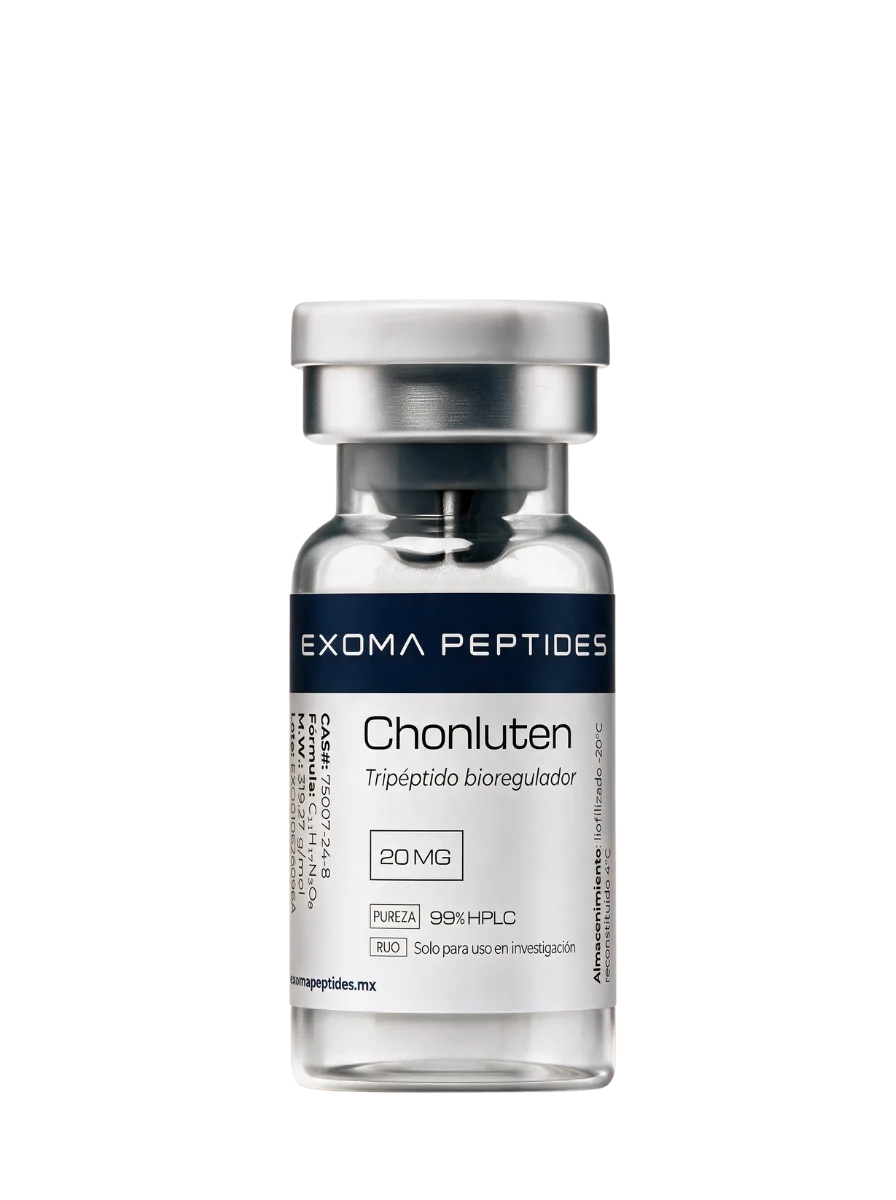
Chonluten
Chonluten — reagent for research use (RUO).
Technical data
- CAS
- 75007-24-8
- Molecular formula
- C11H17N3O8
- Molecular weight
- 319.27 g/mol
Sizes and prices: 20 mg $1,750 MXN ($88 MXN per mg).
Buy Chonluten in Mexico: order online with nationwide shipping in 1-4 business days depending on zone and tracking number. Prices in Mexican pesos. Material for research use only.
Chonluten is also searched as: EDG Peptide, Tripeptido EDG, Glutamil-Aspartil-Glicina.
Identity and composition
Chonluten is a short synthetic tripeptide of sequence Glu-Asp-Gly (glutamyl-aspartyl-glycine), belonging to the class of Khavinson peptide bioregulators, studied in preclinical models for its described tropism toward the bronchial/respiratory epithelium. It is offered in a lyophilized presentation of 20 mg for research use only.
Its chemical identity is confirmed in PubChem (CID 194641) as the tripeptide Glu-Asp-Gly, with molecular formula C11H17N3O8. The reported molecular weight is 319.27 g/mol (value calculated from the formula; not verified as a figure listed in an open primary source). It is also identified by the synonyms EDG y glutamyl-aspartyl-glycine.
Product for research use.
Mechanism of action
Chonluten is a short tripeptide of the Khavinson family of peptide bioregulators, to which the literature attributes a tropism toward bronchial/respiratory tissue. In a peer-reviewed in vitro study on the monocyte/macrophage line THP-1, it was observed that the peptide inhibited the production of TNF in monocytes exposed to lipopolysaccharide (LPS) bacterial and reduced markers of inflammation, with lower expression of proinflammatory cytokines and lower cell adhesion; at the same time a moderate but consistent apoptotic profile was recorded in a fraction of the THP-1 cells incubated with the peptide (PMID 35408963).
It is important to note that the frequent claims in outreach or supplier material according to which it would act by regulating specific genes (such as c-Fos, HSP70, SOD, or COX-2) or by binding directly to DNA promoters could not be confirmed in a primary source and are considered unverified. The mechanism described here is limited to what was observed in vitro in the peer-reviewed source.
Pharmacokinetics
No verifiable pharmacokinetic data are available for Chonluten. No parameters such as half-life, distribution, metabolism, or elimination were located in open primary sources. The existing evidence is in vitro in nature, so any pharmacokinetic figure circulating in outreach material must be considered unfounded as long as there is no primary source to support it.
Scientific evidence
The available evidence on Chonluten is preliminary, preclinical and of an in vitro nature. The located peer-reviewed source evaluates the peptide, together with other short Khavinson tripeptides, in a monocyte/macrophage cell line (THP-1), in the context of proliferative and inflammatory activity; in that model, inhibition of LPS-induced TNF production was observed, an anti-inflammatory effect and a moderate apoptotic profile in a cell subpopulation (PMID 35408963).
No registered clinical trials on ClinicalTrials.gov nor controlled phase I-III data in humans were identified for this compound. The Russian clinical literature cited by secondary sources is observational and uncontrolled, so any indication (for example, related to respiratory or bronchial function) should be considered exploratory and not established. It must not be interpreted as validated therapeutic use.
Research applications
Product for research use.
- Ideal for: in vitro studies on cellular models of monocytes/macrophages; exploratory research into the class of Khavinson short peptide bioregulators; characterization of inflammatory pathways (for example, LPS-induced TNF production) and of apoptotic profiles in cell culture, within the scope described by the available preclinical evidence.
- Not applicable for: clinical or animal use; therapeutic, diagnostic, or preventive use; self-administration. There is no controlled clinical evidence supporting indications in humans, so it must not be used outside a controlled research setting.
Research protocols
No validated dosing protocol or established dose-response is available for Chonluten. The peer-reviewed evidence comes from an in vitro model on THP-1 cells, in which anti-inflammatory activity and a moderate apoptotic profile were documented, but the source does not support a dosing scheme translatable to other contexts (PMID 35408963).
The product is presented in a lyophilized vial of 20 mg. Any working concentration must be defined by the researcher according to their experimental design; there are no human dose parameters that can be cited responsibly.
Reconstitution
As a general laboratory-handling guide, lyophilized peptides are usually reconstituted with bacteriostatic water (water for injection with approximately 0.9% benzyl alcohol as a preservative), which allows multiple withdrawals while maintaining sterility.
- Add the diluent letting it run slowly down the inner wall of the vial, without directing the stream directly onto the powder.
- Do not shake; gently swirl the vial until fully dissolved to preserve the integrity of the peptide.
- Calculate the diluent volume according to the working concentration your protocol requires.
This guide is qualitative and for standard handling; it does not constitute an indication for use in humans.
Stability and storage
As standard laboratory handling practice for peptides:
- Lyophilized (powder): is the most stable form. It is usually stored refrigerated for short-term storage and frozen for prolonged periods, protected from light and moisture.
- Reconstituted (in solution): is less stable and must be kept refrigerated, being used within a short time window. Avoid repeated freeze-thaw cycles, which can degrade the peptide.
Always handle the vial with aseptic technique. These are general storage recommendations, not stability parameters measured specifically for this compound.
Safety profile
No formal toxicology, dose-response or human safety data for Chonluten were found in verifiable primary sources. The only relevant confirmed biological observation is a moderate apoptotic profile in a fraction of THP-1 cells in vitro (PMID 35408963), whose significance for in vivo safety is unknown.
It is essential to understand that the absence of data does not equal established safety. There are no documented contraindications in primary sources precisely because there are no safety studies in humans. For this reason, the compound must be handled only as research material, with the corresponding protective equipment and laboratory practices, and never administered to people or animals.
Comparative context
Chonluten belongs to the family of short bioregulatory tripeptides of Khavinson, in which each peptide has a supposed specific tissue tropism; Chonluten is attributed affinity for bronchial/respiratory tissue.
In the in vitro study on the THP-1 line, Chonluten stood out within the panel of compared peptides by inducing a consistent apoptotic profile in a cellular subpopulation, unlike the predominantly proliferative effect observed in other peptides of the same group (PMID 35408963).
Quantitative comparisons of potency or pharmacology against other members of the class are not documented in verifiable primary sources, so any efficacy hierarchy among these compounds must be considered unfounded.
History and development
Chonluten is part of the short peptide bioregulators developed within the research line associated with Vladimir Khavinson, a group of tripeptides and short peptides to which tropism toward specific tissues is attributed. Within this framework, Chonluten (Glu-Asp-Gly) is described as a peptide derived from the bronchial epithelium.
Its modern characterization in the peer-reviewed literature is limited: the located source evaluates it in vitro together with other peptides of the same family in a monocyte/macrophage cell model (PMID 35408963). Its chemical identity as the tripeptide Glu-Asp-Gly is registered in PubChem (CID 194641). The additional clinical documentation attributed to this compound comes mostly from secondary observational sources without support in registered trials.
FAQ
What is Chonluten and what is it studied for?
Chonluten is a short synthetic tripeptide (Glu-Asp-Gly) of the Khavinson peptide bioregulator class, with described tropism toward bronchial/respiratory tissue. In in vitro research, its anti-inflammatory activity and its apoptotic profile in THP-1 cells have been studied (PMID 35408963). It is a product for research use, not for clinical use.
What is the chemical identity of Chonluten?
It is confirmed in PubChem (CID 194641) as the tripeptide Glu-Asp-Gly, with molecular formula C11H17N3O8 and a molecular weight of 319.27 g/mol (a value calculated from the formula, not verified in an open primary source). It is also known as EDG.
Are there human clinical trials with Chonluten?
No. No registered clinical trials on ClinicalTrials.gov nor controlled phase I-III data in humans were identified. The available evidence is preclinical and in vitro, and the observational literature cited by secondary sources is uncontrolled, so any indication is exploratory and not established.
How is Chonluten reconstituted in the laboratory?
As a general laboratory guide, lyophilized peptides are usually reconstituted with bacteriostatic water, letting it run down the wall of the vial without shaking and swirling it gently until dissolved. The volume depends on the working concentration of the protocol. It is a handling guide, not an indication for human use.
What is known about the safety of Chonluten?
There are no formal toxicology or safety data in humans in verifiable primary sources. The only confirmed observation is a moderate apoptotic profile in THP-1 cells in vitro (PMID 35408963), whose in vivo significance is unknown. The absence of data does not equate to established safety.
How does Chonluten differ from other Khavinson peptides?
It belongs to the same family of short tripeptides with specific tissue tropism. In the in vitro study on THP-1, it stood out for inducing a consistent apoptotic profile in a cell subpopulation, in contrast to the predominantly proliferative effect of other compared peptides (PMID 35408963). There are no quantitative potency comparisons in primary sources.
Scientific references (2)
Peer-reviewed literature on Chonluten, with its PubMed identifier when available:
- Peptides Regulating Proliferative Activity and Inflammatory Pathways in the Monocyte/Macrophage THP-1 Cell Line (Avolio, et al. · International Journal of Molecular Sciences · 2022) PMID 35408963.
- Effect of bioregulatory tripeptides on the culture of skin cells from young and old rats. (Voicekhovskaya MA, et al. · Bull Exp Biol Med · 2012) PMID 22803085.
Full scientific profile: Chonluten in the compendium — mechanism of action, studies and technical data sheet.
See the full category catalog: Bioregulators.
Guides and articles about Chonluten
Lecturas del blog de EXOMA que la editorial asoció a este compuesto: