
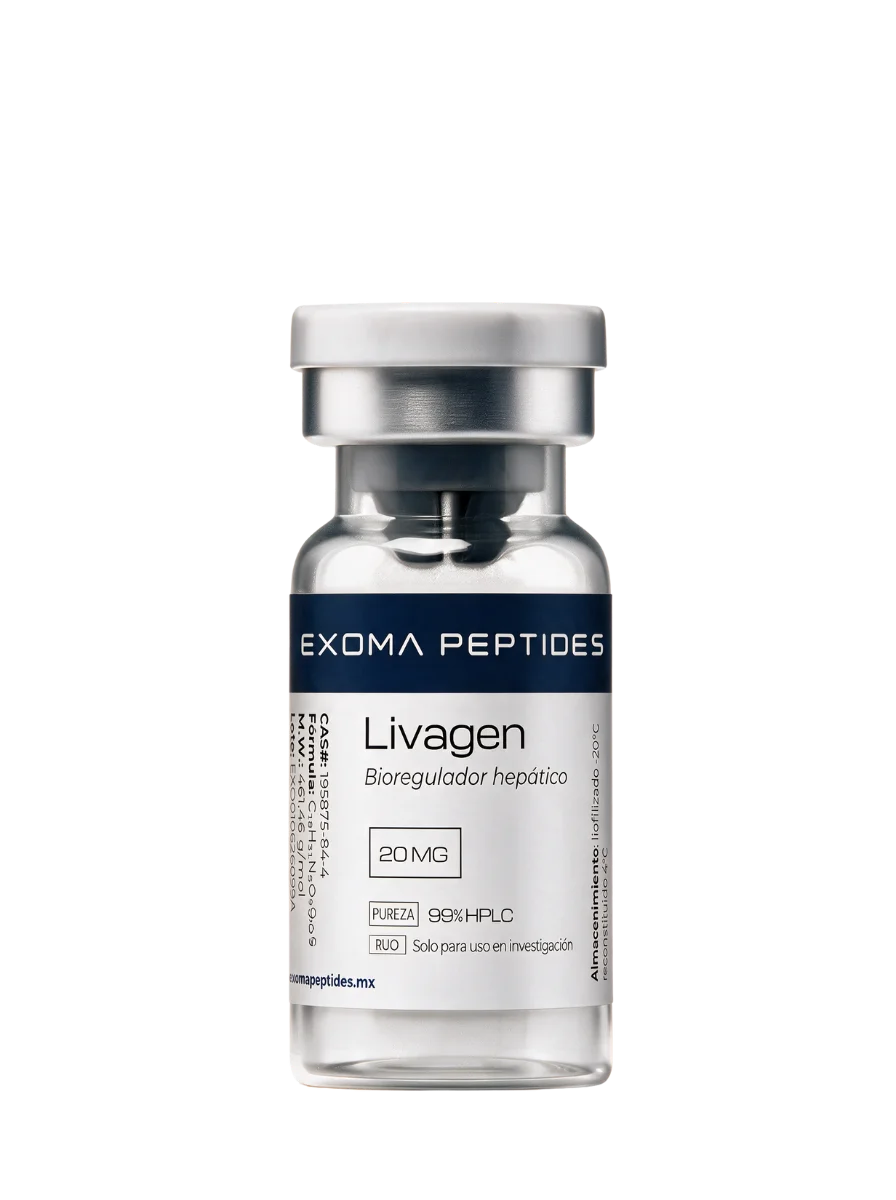
Livagen
Livagen — reagent for research use (RUO).
Technical data
- Molecular formula
- C18H31N5O9
- Molecular weight
- 461.47 g/mol
Sizes and prices: 20 mg $1,750 MXN ($88 MXN per mg).
Buy Livagen in Mexico: order online with nationwide shipping in 1-4 business days depending on zone and tracking number. Prices in Mexican pesos. Material for research use only.
Livagen is also searched as: KEDA.
Identity and composition
Livagen is a short synthetic tetrapeptide (sequence Lys-Glu-Asp-Ala, abbreviated KEDA) belonging to the class of Khavinson short peptide bioregulators. It is studied in preclinical and in vitro models for its effects on chromatin activation and gene expression in the context of cellular aging.
From the standpoint of chemical identity, it corresponds to the molecular formula C18H31N5O9, with an approximate molecular weight of 461.47 g/mol and is registered in PubChem with the CID 87919683. It is also known by the synonyms KEDA, Lys-Glu-Asp-Ala y H-Lys-Glu-Asp-Ala-OH. No CAS number confirmed in verifiable reference sources is available, so it is omitted.
Product for research use.
Mechanism of action
The documented mechanism of Livagen is of the type epigenetic / at the chromatin level, rather than a classic action of agonism on receptors. In cultured lymphocytes from elderly people, it was observed that Livagen induced the activation of ribosomal genes, the decondensation of pericentromeric structural heterochromatin and the de-repression ("de-heterochromatinization") of genes silenced by the condensation of euchromatic regions associated with aging (PMID 12533768).
Like other peptides of the Khavinson family, the working hypothesis is a modulation tissue/gene-selective of gene expression through chromatin decondensation. It is worth noting that the effects of hepatic tropism or "hepatocyte regeneration" that appear in some secondary sources are not supported by verifiable primary literature, which focuses on lymphocyte chromatin; therefore they should be considered unconfirmed.
Pharmacokinetics
No formal pharmacokinetic data (half-life, ADME, absorption or elimination) were found in peer-reviewed or regulatory sources. Therefore, no numerical half-life or disposition profile is reported. Any specific pharmacokinetic figure should be treated as unavailable within the current verifiable evidence.
Scientific evidence
The available evidence is preliminary and of a preclinical / in vitro nature. It is essentially limited to early-2000s works by the Khavinson and Lezhava groups on cultured human lymphocytes from elderly donors, in which chromatin activation and gene de-repression were investigated in the context of aging (PMID 12533768).
No registered clinical trials (no records on ClinicalTrials.gov) nor a defined clinical development phase were identified. Overall it is a poorly studied compound, with very scarce peer-reviewed literature, so the observations must be interpreted with caution and not as established clinical results.
Research applications
Product for research use.
- It may be of interest for: in vitro studies on chromatin activation, heterochromatin decondensation and gene de-repression; basic research on the biology of cellular aging; comparative characterization within the class of short Khavinson peptide bioregulators.
- Not applicable for: therapeutic, diagnostic, or any form of clinical or animal use; it has no approved indication or regulatory safety review. It must not be used outside a laboratory environment controlled by trained personnel.
Research protocols
The verifiable primary study was conducted in a model in vitro of cultured lymphocytes from elderly people (PMID 12533768); that work describes effects at the chromatin level, but within the verifiable sources no dosing scheme (mg) transferable to research protocols is available nor of established clinical doses.
For this reason no dose figures are specified: any regimen must be defined by the investigator in accordance with the experimental design and good laboratory practices, understanding that there is no validated reference dose in the peer-reviewed literature.
Reconstitution
As a standard general laboratory handling guide for lyophilized peptides, reconstitution is usually carried out with bacteriostatic water (water for injection with approximately 0.9% benzyl alcohol as preservative). It is recommended:
- Let the vial reach room temperature before opening it.
- Add the diluent, letting it run slowly down the inner wall of the vial, without directing the stream straight onto the powder.
- Do not shake; swirl gently ("swirl") until complete dissolution.
The volume of diluent is chosen according to the desired working concentration. This procedure is a general laboratory reference and does not constitute an indication for use in humans.
Stability and storage
As general laboratory handling reference:
- Lyophilized (powder): is usually kept stable for prolonged periods when stored refrigerated or frozen, protected from light and humidity.
- Reconstituted (in solution): is kept under refrigeration and used within a short time; for longer-term storage it is recommended to freeze in aliquots and avoid repeated freeze-thaw cycles.
These are standard peptide storage practices and do not reflect specific stability data published for Livagen.
Safety profile
No formal safety, toxicology or pharmacokinetic data were located for Livagen in peer-reviewed or regulatory sources. General reference sources note that the anti-aging and anti-inflammatory claims associated with this peptide are supported by relatively limited evidence.
As it is a compound for research use exclusively, without an approved therapeutic indication or regulatory safety review, it must be handled with the usual laboratory precautions for materials with an uncharacterized toxicological profile. No documented contraindications are available due to the absence of clinical studies.
Comparative context
Livagen is part of the family of short peptide bioregulators of Khavinson, along with other tri- and tetrapeptides such as Epitalon / Epithalon (Ala-Glu-Asp-Gly) and Vilon (Lys-Glu).
What these peptides share, according to the predominant working hypothesis in the class, is a proposed mechanism of tissue/gene-selective chromatin decondensation and modulation of gene expression, rather than classic agonism on receptors. Within this framework, Livagen is distinguished by its particular sequence (KEDA) and by the in vitro evidence focused on lymphocytes from elderly donors.
History and development
Livagen emerges in the context of research on short bioregulatory peptides developed by the groups of Khavinson and Lezhava in the early 2000s. The verifiable primary work is framed in the study of the biology of aging, evaluating in vitro the activation of chromatin and gene de-repression in lymphocytes of elderly people (PMID 12533768).
Its chemical identity (sequence KEDA, formula C18H31N5O9) is registered in PubChem (CID 87919683). It is a little-known compound, without registered clinical trials or a defined clinical development phase, whose peer-reviewed literature remains very scarce.
FAQ
What is Livagen and what is it investigated for?
Livagen is a short synthetic tetrapeptide (sequence Lys-Glu-Asp-Ala, KEDA) of the Khavinson class of bioregulators. It is investigated in vitro for its effects on chromatin activation and gene expression in the context of cellular aging. It is a product for research use; not for clinical use.
What is the sequence and chemical formula of Livagen?
Its sequence is Lys-Glu-Asp-Ala (abbreviated KEDA), with molecular formula C18H31N5O9 and an approximate molecular weight of 461.47 g/mol. It is registered in PubChem with the CID 87919683. No confirmed CAS number is available in verifiable reference sources.
Does Livagen have proven effects on the liver?
The framing of "hepatic bioregulator" or hepatocyte restoration appears in secondary and vendor sources, but it is not supported by the verifiable primary literature, which focuses on lymphocyte chromatin. For this reason it must be considered an unconfirmed claim.
How is lyophilized Livagen reconstituted?
As a general laboratory guideline, lyophilized peptides are usually reconstituted with bacteriostatic water (water with ~0.9% benzyl alcohol), adding it down the wall of the vial and swirling gently without shaking until dissolved. The volume depends on the desired working concentration.
Are there clinical trials or established doses for Livagen?
No registered clinical trials or a defined clinical development phase were identified, and there is no validated reference dose in the peer-reviewed literature. The available evidence is preliminary, preclinical, and in vitro.
How is Livagen stored?
As standard laboratory practice, the lyophilized powder is preserved refrigerated or frozen, protected from light and humidity. Once reconstituted, it is kept refrigerated and used within a short period, or is frozen in aliquots avoiding repeated freeze-thaw cycles.
Scientific references (7)
Peer-reviewed literature on Livagen, with its PubMed identifier when available:
- [Effect of new peptide bioregulators livagen and epitalon on enkephalin-degrading enzymes in human serum] (Kost NV et al. · Izvestiia Akademii nauk. Seriia biologicheskaia · 2003) PMID 12942748.
- Effects of Livagen peptide on chromatin activation in lymphocytes from old people (Khavinson VKh et al. · Bulletin of experimental biology and medicine · 2002) PMID 12533768.
- Effect of peptide Livagen on activity of digestive enzymes in gastrointestinal tract and non-digestive organs in rats of different ages (Timofeeva, et al. · Advances in Gerontology (Uspekhi Gerontologii) · 2005) PMID 16075683.
- [Rhythm of protein synthesis in cultures of hepatocytes from rats of different ages. Norm and effect of the peptide livagen]. (Brodskiĭ VIa, et al. · Izv Akad Nauk Ser Biol · 2001) PMID 15926314.
- Activation of pericentromeric and telomeric heterochromatin in cultured lymphocytes from old individuals. (Lezhava T, et al. · Ann N Y Acad Sci · 2007) PMID 17460203.
- Effects of short peptides on lymphocyte chromatin in senile subjects. (Khavinson VKh, et al. · Bull Exp Biol Med · 2004) PMID 15085253.
- [The influence of polypeptide liver complex and tetrapeptide KEDA on organism physiological function in norm and age-related pathology.]. (Kuznik BI, et al. · Adv Gerontol · 2020) PMID 32362099.
Full scientific profile: Livagen in the compendium — mechanism of action, studies and technical data sheet.
See the full category catalog: Bioregulators.