
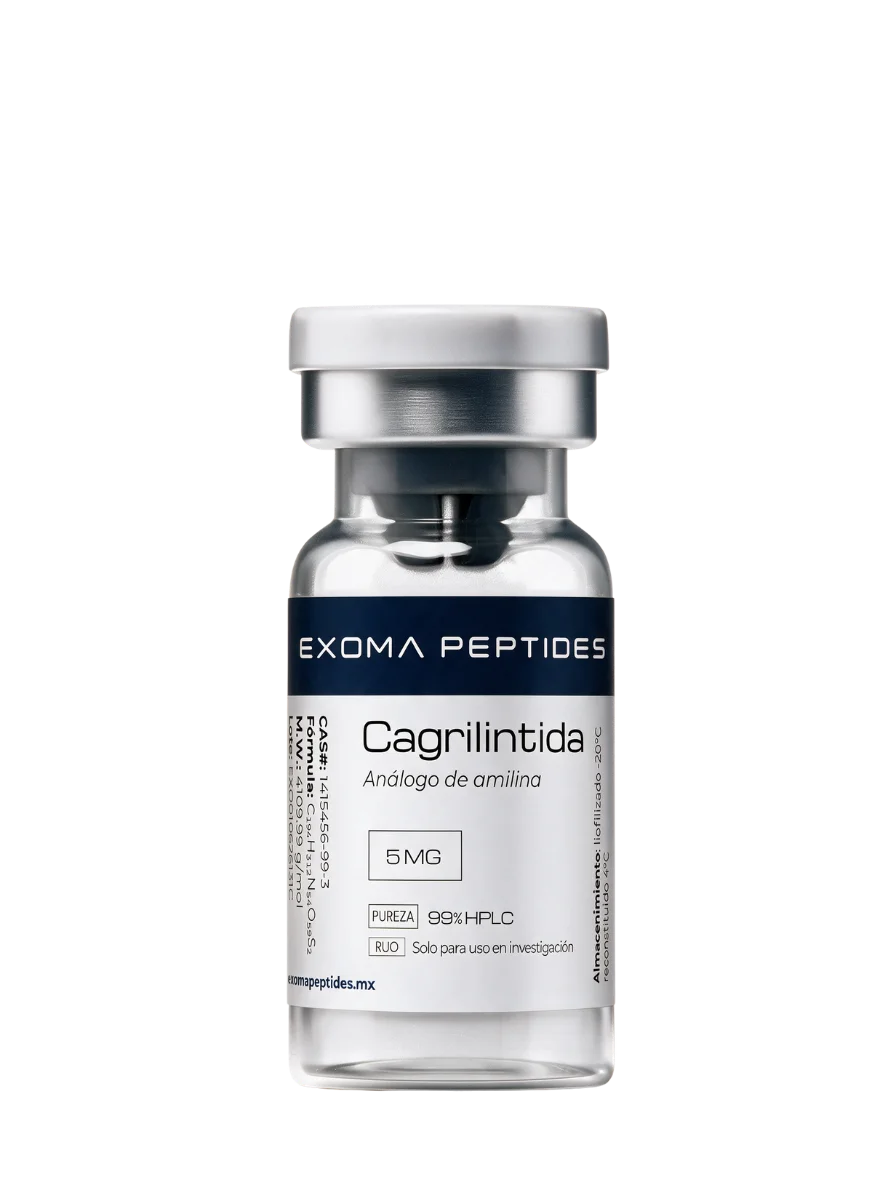
Cagrilintide
Cagrilintide — research reagent (RUO). COA per batch available.
Technical data
- INN name
- Cagrilintide
- Development code
- AM833
- CAS
- 1415456-99-3
- Molecular formula
- C194H312N54O59S2
- Molecular weight
- 4409.01 g/mol
Sizes and prices: 5 mg $1,199 MXN ($240 MXN per mg) · 10 mg $1,900 MXN ($190 MXN per mg) · 20 mg $2,700 MXN ($135 MXN per mg).
Buy Cagrilintide in Mexico: order online with nationwide shipping in 1-4 business days depending on zone and tracking number. Prices in Mexican pesos. Material for research use only.
Cagrilintide is known internationally as Cagrilintide (INN name in English). Buy Cagrilintide in Mexico / buy Cagrilintide in Mexico: research reagent (RUO) with COA per batch and nationwide shipping.
Cagrilintida is also searched as: AM833, NNC0174-0833, cagri.
Identity and composition
Cagrilintide it is a long-acting synthetic amylin analog that is investigated mainly in the context of obesity, overweight, and metabolic regulation. It is a 37-amino-acid peptide modified for experimental laboratory use. Product for research use.
As for its chemical identity, it is assigned the number CAS 1415456-99-3 and the molecular formula C194H312N54O59S2 (confirmed in PubChem, CID 171397054). Its exact molecular weight was not explicitly verified in the open sources reviewed, so this data sheet does not report a definitive numerical value. The complete amino acid sequence was also not obtained textually from an open source, so it is described only qualitatively as a peptide of 37 residues with substitutions designed to prevent amyloid aggregation.
It is also known by the synonyms AM833, NNC0174-0833 y GLXC-26801.
Mechanism of action
Cagrilintide is a long-acting amylin analog. Its structure incorporates amino acid substitutions intended to prevent amyloid aggregation and a C20 fatty diacid attached via a linker, which allows reversible binding to albumin and prolongs its residence time in the body (D'Ascanio et al., Cardiol Rev 2024; PMID 36883831).
Pharmacologically, it acts as agonist of the amylin receptor complex, formed by the calcitonin receptor (CTR) heterodimerized with receptor activity-modifying proteins (RAMP1-3). In preclinical studies with genetically modified mice (RAMP1/3 knockout), it was observed that its effects on the reduction of food intake and body weight depend specifically on the amylin receptors AMY1 and AMY3, with activation (cFos marker) of the area postrema and the nucleus of the solitary tract in the brainstem (eBioMedicine 2025; PMC12270663).
In experimental models it has been investigated to induce satiety through both homeostatic (hypothalamic) and hedonic brain regions, with a selective reduction of fat mass that preserves lean mass. Unlike salmon calcitonin (sCT), its metabolic profile depends on residence-time dynamics at the amylin receptor.
Pharmacokinetics
Cagrilintide is designed for a weekly dosing (once per week). This property is attributed to reversible binding to albumin mediated by the C20 fatty-acid side chain, which substantially prolongs its half-life relative to native amylin and to pramlintide.
In the open sources reviewed an exact numerical half-life value was not confirmed, so this datum is left as unverified and no specific figure is reported. The description is limited to the qualitative feature of prolonged action compatible with weekly administration schedules.
Scientific evidence
The available evidence corresponds to a compound still under research. It has been studied mainly for obesity and overweight, and also in the context of type 2 diabetes; additionally there is exploratory research on bone metabolism (D'Ascanio et al., Cardiol Rev 2024; PMID 36883831).
- En monotherapy, reached trials of phase 2, in which a dose-response relationship has been investigated with dose-dependent reduction of weight and waist circumference.
- The most advanced clinical development corresponds to the combination with semaglutide (CagriSema), which has reached phase 3 within the REDEFINE program. In REDEFINE-1 (68 weeks), in clinical studies CagriSema was observed to produce a considerably greater weight reduction than placebo.
As amylin monotherapy, cagrilintide remains an investigational compound without confirmed regulatory approval at the time of this review. The evidence should be interpreted as preliminary and evolving.
Research applications
Use framing: Product for research use.
Ideal for (research contexts):
- Laboratory studies on agonism of the amylin receptor complex (CTR + RAMP).
- In vitro and preclinical research on satiety signaling pathways, energy balance and body composition.
- Comparative experimental work within the class of long-acting amylin analogs.
- Exploratory research in combination with GLP-1 agonists in experimental models.
Not applicable for:
- clinical use, food use, therapeutic, diagnostic, or cosmetic use.
- Self-administration or any clinical use in humans.
- Practical veterinary use outside of controlled research protocols.
This material is offered exclusively as a research reagent intended for trained personnel in laboratory environments.
Research protocols
En phase 2 studies as monotherapy a regimen has been investigated with weekly dosing and a dose-dependent response on weight and waist circumference (D'Ascanio et al., Cardiol Rev 2024; PMID 36883831).
The open sources reviewed did not confirm specific numerical milligram dose values used in said trials, so no experimental dose figures are reported in this data sheet. As a general handling reference, the described regimens are compatible with once-weekly administration due to the prolonged action of the compound.
Any experimental protocol design must be based on peer-reviewed primary literature and on the internal procedures of each laboratory, not on this commercial data sheet.
Reconstitution
As a general standard laboratory guide for lyophilized peptides, reconstitution is usually performed with bacteriostatic water (water for injection with 0.9% benzyl alcohol) or, depending on the experimental design, with sterile water for injection.
- Add the solvent slowly down the vial wall, without directing the stream directly onto the powder.
- Allow the material to dissolve by gentle diffusion; avoid vigorous agitation that could damage the peptide structure.
- Swirl carefully (rotating motion) until obtaining a clear solution.
These indications are general in nature for handling research reagents and do not constitute preparation instructions for clinical use.
Stability and storage
As a general handling standard for this type of peptide:
- Lyophilized (powder): store protected from light, humidity, and heat. Storage under freezing (for example, at sub-zero temperatures) favors prolonged preservation; lyophilized material is usually more stable than reconstituted material. - Reconstituted (in solution): keep refrigerated and use within a short window of time according to laboratory practices; avoid repeated freeze-thaw cycles.
These are general stability guidelines for research reagents. The consulted literature sources do not provide specific numerical stability data for cagrilintide, so no concrete figures of temperature or expiration are reported.
Safety profile
The reviewed sources describe cagrilintide as a compound well characterized at the mechanistic level, but do not detail a complete adverse event profile in the open abstracts consulted.
- By their class (amylin agonists/amylin analogs), the gastrointestinal effects, especially nausea, they are an expected and frequently reported event in this pharmacological class; however, this was not confirmed quantitatively in the open sources reviewed here. - The specific safety notes and detailed contraindications remain as not verified in the consulted literature.
As it is research material, it must be handled with standard laboratory precautions (personal protective equipment, handling by trained personnel) and never administered to human beings or animals outside of authorized research protocols.
Comparative context
Within its class of amylin analogs, cagrilintide shows the following differences described in the literature:.
- Compared with pramlintide: pramlintide is a short-acting amylin analog that requires dosing with meals, whereas cagrilintide is prolonged action and allows a weekly dosing. - Compared with salmon calcitonin (sCT): in knockout models, sCT produced opposite effects, while the effects of cagrilintide on energy balance depend specifically on the receptors AMY1/AMY3 (eBioMedicine 2025; PMC12270663). - In combination with semaglutide (CagriSema): when combined with this GLP-1 agonist, studies have observed an additive or synergistic effect on weight loss compared with either of the two components as monotherapy (D'Ascanio et al., Cardiol Rev 2024; PMID 36883831).
History and development
Cagrilintide (also known by the development codes AM833 y NNC0174-0833) emerges as a synthetic amylin analog designed for prolonged action, with structural modifications aimed at avoiding amyloid aggregation and achieving reversible binding to albumin that allows weekly dosing.
Its clinical development progressed from trials of phase 2 as monotherapy for obesity and overweight toward its combination with semaglutide (CagriSema), which reached phase 3 within the REDEFINE program, including the 68-week REDEFINE-1 study. It has also been explored in the context of type 2 diabetes and in research on bone metabolism. At the time of this review, as amylin monotherapy it remains a compound under research without confirmed regulatory approval.
FAQ
What is cagrilintide and what is it researched for?
It is a long-acting synthetic amylin analog that is investigated mainly for obesity and overweight, and has also been studied in type 2 diabetes and bone metabolism. It is a product for research use; not for clinical use.
How does cagrilintide act?
It acts as an agonist of the amylin receptor complex (calcitonin receptor with RAMP proteins). In preclinical studies its effects on intake and weight depended on the AMY1 and AMY3 receptors, with activation of the area postrema and the nucleus of the solitary tract (eBioMedicine 2025; PMC12270663).
How frequently was it dosed in the studies?
It is designed for weekly dosing thanks to its reversible binding to albumin mediated by a C20 fatty-acid chain. The reviewed sources did not confirm an exact numerical value of half-life or a dose in milligrams, so those data are not reported here.
How does it differ from pramlintide?
Pramlintide is a short-acting amylin analog that is administered with meals, while cagrilintide is long-acting and allows weekly dosing. In addition, their effects on energy balance depend on the AMY1/AMY3 receptors.
What is CagriSema?
It is the combination of cagrilintide with the GLP-1 agonist semaglutide. In studies, an additive or synergistic effect on weight loss has been observed; this regimen reached phase 3 in the REDEFINE program, including the 68-week REDEFINE-1 (D'Ascanio et al., Cardiol Rev 2024; PMID 36883831).
Is Cagrilintide approved for clinical use?
As amylin monotherapy it remains a research compound without confirmed regulatory approval at the time of this review. This material is offered exclusively as a research reagent and not for clinical use.
Certificate of analysis per batch
Cagrilintide batches with certificate of analysis published in the COA catalog:
- Lot EXO010626131A — 10 mg, issued 2026-05-30
- Lot EXO010626131B — 20 mg, issued 2026-05-30
- Lot EXO010626131C — 5 mg, issued 2026-05-29
Scientific references (6)
Peer-reviewed literature on Cagrilintide, with its PubMed identifier where available:
- Cagrilintide-semaglutide (CagriSema) versus semaglutide or cagrilintide in people with type 2 diabetes (REIMAGINE 2): a double-blind, randomised, controlled, phase 3 study (Buse JB et al. · The lancet. Diabetes & endocrinology · 2026) PMID 42251859.
- Cagrilintide-Semaglutide in Adults with Overweight or Obesity and Type 2 Diabetes (Davies MJ et al. · The New England journal of medicine · 2025) PMID 40544432.
- Coadministered Cagrilintide and Semaglutide in Adults with Overweight or Obesity (Garvey WT et al. · The New England journal of medicine · 2025) PMID 40544433.
- Development of Cagrilintide, a Long-Acting Amylin Analogue (Kruse, et al. · Journal of Medicinal Chemistry · 2021) PMID 34288673.
- Once-Weekly Cagrilintide for Weight Management in People with Overweight and Obesity: a Multicentre, Randomised, Double-Blind, Placebo-Controlled and Active-Controlled, Dose-Finding Phase 2 Trial (Lau, et al. · The Lancet · 2021) PMID 34798060.
- Cagrilintide Lowers Bodyweight Through Brain Amylin Receptors 1 and 3 (Carvas, et al. · EBioMedicine · 2025) PMID 40609154.
Full scientific profile: Cagrilintide in the compendium — mechanism of action, studies and technical data sheet.
See the full category catalog: Metabolism.
Other related research peptides
Compara con otros agonistas incretínicos: retatrutide y tirzepatide.