
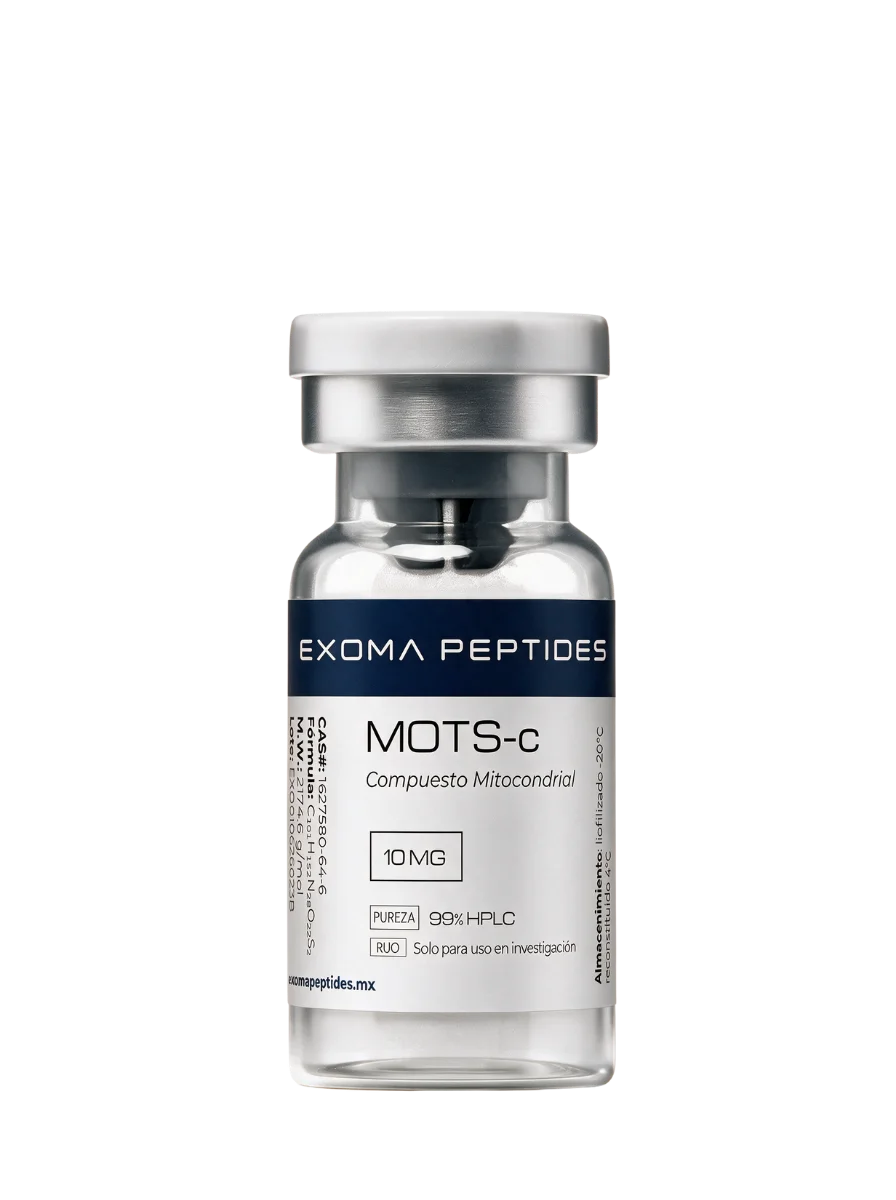
MOTS-c
MOTS-c — reactivo for research (RUO). HPLC purity 98,9 % con COA per batch. Contenido revisado por el Dr. Jesús Jaramillo.
Technical data
- CAS
- 1627580-64-6
- Molecular formula
- C101H152N28O22S2
- Molecular weight
- 2174.63 g/mol
Sizes and prices: 10 mg $850 MXN ($85 MXN per mg) · 40 mg $2,300 MXN ($58 MXN per mg).
Buy MOTS-c in Mexico: order online with nationwide shipping in 1-4 business days depending on zone and tracking number. Prices in Mexican pesos. Material for research use only.
MOTS-c is also searched as: MRWQEMGYIFYPRKLR.
Identity and composition
MOTS-c (CAS 1627580-64-6) is a mitochondrial-derived peptide (MDP) of 16 amino acids with the sequence MRWQEMGYIFYPRKLR, whose particularity is that its reading frame is not encoded in nuclear DNA but rather within mitochondrial DNA, specifically in the region of the 12S ribosomal RNA. Its molecular formula is C101H152N28O22S2 and its approximate mass is around 2174.6 Da. First described around 2015, MOTS-c broadened the concept that the mitochondrion is not only an energy factory but also a source of peptide signals that communicate the cell's bioenergetic state to the rest of the organism. In the EXOMA catalog it is offered as a lyophilized reference material in a 40 mg vial, intended exclusively for research (RUO). For those looking to buy MOTS-c in Mexico, this mitochondrial peptide represents one of the most studied molecules within the MDP family for its role in metabolic homeostasis. All the information about MOTS-c price, presentation, and physicochemical characterization is framed within its use as a laboratory reagent, never as a consumer product.
Mechanism of action
The central mechanism of MOTS-c revolves around the activation of AMP-activated protein kinase (AMPK), the main cellular energy sensor. When the AMP/ATP ratio indicates an energy deficit, MOTS-c enhances the AMPK pathway and, with it, triggers catabolic programs that restore metabolic balance. A distinctive feature is that MOTS-c interferes with the folate pathway and the methionine cycle, causing the accumulation of AICAR, an intermediate that activates AMPK directly and independently of classical signals. This cascade increases the translocation of the GLUT4 transporter to the muscle membrane, favoring glucose uptake through an insulin-independent mechanism, which explains much of the interest in this mitochondrial peptide. Under conditions of metabolic stress, MOTS-c also translocates to the nucleus, where it regulates the expression of antioxidant response genes through the NRF2/ARE pathway, modulating defense against oxidative stress. Taken together, these axes describe MOTS-c as a regulator that connects the mitochondrial energy state with nuclear transcription, always studied in experimental models for research (RUO).
Pharmacokinetics
The pharmacokinetic profile of MOTS-c described in the preclinical literature corresponds to that of a small 16-amino-acid peptide, with a relatively short plasma half-life after systemic administration in animal models, followed by distribution to metabolically active tissues such as skeletal muscle, liver and adipose tissue. Being a peptide, it is susceptible to degradation by peptidases, which conditions the dosing strategies used in experimental studies, where repeated schedules are usually employed to maintain exposure. A notable characteristic observed in research is that endogenous levels of circulating MOTS-c decrease with age and with insulin-resistance states, which has motivated its study as a biomarker and as a replacement agent in models. Its ability to translocate to the nucleus under metabolic stress adds a dynamic dimension to its subcellular distribution. It is worth emphasizing that these parameters come from animal models and in vitro systems; there are no established human clinical parameters, so all handling of MOTS-c is carried out strictly within the framework of research (RUO) and not as a dosing reference for people.
Scientific evidence
The experimental evidence on MOTS-c is concentrated in the metabolic domain. In rodent models fed high-fat diets, administration of this mitochondrial peptide has been associated with improvements in insulin sensitivity, reduction of fat accumulation and prevention of diet-induced obesity, effects attributed to AMPK activation and to increased muscle glucose uptake. Various works describe its role in insulin resistance, positioning it as a candidate of interest in the study of metabolic syndrome and type 2 diabetes in preclinical models. Another relevant line explores its relationship with aging: MOTS-c levels decline with age, and its replacement in models has been linked to improvements in physical capacity and in markers of sarcopenia, as well as to hypotheses about longevity tied to mitochondrial function. It has also been investigated in contexts of oxidative stress for its action on the NRF2/ARE pathway. It is important to emphasize that all of this evidence is preclinical and from basic research; MOTS-c is marketed at EXOMA solely for research (RUO), with no therapeutic claims in humans.
Research applications
The applications of MOTS-c in the research domain cluster around metabolic and mitochondrial biology. Groups working on insulin resistance and glucose homeostasis use it as a tool to interrogate the AMPK-GLUT4 pathway and insulin-independent glucose uptake in myotube cultures and in animal models. In studies of metabolic obesity and lipid metabolism, it serves to explore fatty-acid beta-oxidation and energy expenditure. The decline of MOTS-c with age makes it an object of study in research on aging, sarcopenia, and exercise capacity, where its role as a potential exercise mimetic at the molecular level is examined. Additionally, its nuclear translocation and modulation of the NRF2/ARE pathway make it useful in work on oxidative stress and mitochondrion-nucleus signaling, a field known as retrograde communication. Each of these applications falls within the use of MOTS-c as a laboratory reagent for research (RUO). For laboratories seeking to buy MOTS-c in Mexico with appropriate characterization, EXOMA offers the 40 mg vial with reference documentation oriented to these experimental purposes.
Research protocols
In experimental practice, protocols with MOTS-c start from the 40 mg lyophilized vial that must be reconstituted before use. In vitro designs usually prepare stock solutions in bacteriostatic water or in sterile saline solution and then dilute to the working concentrations required by each cellular assay, adjusting according to the cell line and the endpoint measured, whether glucose uptake, AMPK phosphorylation, or gene expression. In animal models, the preclinical literature has employed repeated administration schemes, given the short-half-life peptide profile, to maintain sustained exposure throughout the study period. The suggested reconstitution for the EXOMA vial is 1 to 2 mL of bacteriostatic water, which makes it possible to calculate reproducible aliquots and minimize freeze-thaw cycles. It is recommended to document concentration, volume, and reconstitution date in each preparation to ensure traceability. These guidelines are technical reagent-handling guidance and do not constitute clinical dosing recommendations: MOTS-c is intended exclusively for research (RUO), and any protocol must be defined and validated by the responsible researcher within their experimental framework.
Reconstitution
Reconstitution of MOTS-c starts from the lyophilized 40 mg vial, which must be brought to room temperature before opening to avoid condensation on the powder. It is recommended to add 1 to 2 mL of bacteriostatic water, letting the diluent run slowly down the inner wall of the vial rather than projecting it directly onto the peptide, since vigorous agitation can generate foam and compromise the integrity of the peptide chain. After adding the diluent, it is advisable to swirl the vial gently until a clear, homogeneous solution is achieved, without shaking. With 1 mL a concentration of 40 mg/mL is obtained and with 2 mL a concentration of 20 mg/mL, which makes it easy to calculate working aliquots precisely. Once reconstituted, it is suggested to divide it into sterile aliquots to reduce the freeze-thaw cycles that degrade peptides. All handling must be performed with aseptic technique, ideally under a laminar flow hood. These instructions correspond to the handling of MOTS-c as a laboratory material for research (RUO); the researcher must record the volume and concentration in each preparation to ensure experimental reproducibility and traceability.
Stability and storage
The stability of MOTS-c depends directly on its physical state and on the storage temperature. In its lyophilized form, the peptide is notably stable and should be kept at -20 °C, protected from moisture and light, conditions under which it maintains its integrity for extended periods. Once reconstituted in bacteriostatic water, MOTS-c enters a more labile state and should be refrigerated between 2 and 8 °C, preferably used within a maximum of 30 days to preserve its activity in assays. It is recommended to avoid repeated freeze-thaw cycles, which are one of the main causes of degradation and loss of potency in research peptides; for this reason it is useful to divide the solution into single-use aliquots from the moment of reconstitution. Keeping the vial closed, labeled with the date, and away from heat sources helps extend the shelf life of the reagent. These storage conditions apply to the use of MOTS-c as research material (RUO) and aim to ensure consistent and reproducible experimental results throughout the study.
Safety profile
The safety profile of MOTS-c must be interpreted strictly in the context of preclinical research and laboratory handling, since there are no studies supporting clinical use in humans. In animal models, metabolic studies have used the peptide without reporting relevant toxicities in the regimens tested, although complete toxicological characterization remains a matter of basic research. Like any laboratory peptide, MOTS-c must be handled with appropriate personal protective equipment, including gloves and a lab coat, using aseptic technique and avoiding the generation of aerosols during reconstitution. The reconstituted material must be handled with care, labeled correctly, and stored according to the indicated conditions to prevent microbial contamination. EXOMA distributes MOTS-c exclusively as a research-use-only (RUO) reagent; it is not intended for diagnosis or for any application in humans or animals outside a controlled experimental protocol. Responsibility for safe use, risk assessment, and compliance with biosafety standards rests with the researcher and their institution.
Comparative context
Within the family of mitochondrial-derived peptides (MDP), MOTS-c shares its conceptual origin with humanin and the SHLP peptides, all encoded in the mitochondrial genome, but it is distinguished by its predominantly metabolic action on the AMPK-GLUT4 pathway, while humanin stands out above all for its cytoprotective and antiapoptotic properties. Compared with other molecules studied in energy metabolism, MOTS-c occupies a complementary niche: unlike 5-Amino-1MQ, which acts by inhibiting the enzyme NNMT to modulate NAD+ metabolism and adipose tissue, MOTS-c operates upstream as a bioenergetic sensor that reprograms glucose uptake. And unlike NAD+ repletion strategies, which seek to raise the redox cofactor to sustain mitochondrial function and the sirtuins, MOTS-c acts as a peptide signal that integrates the energy state with nuclear transcription. Its capacity to reproduce at the molecular level several adaptations of training has earned it the label of exercise mimetic. For laboratories comparing options before buying MOTS-c in Mexico, understanding these differences helps to select the appropriate mitochondrial peptide according to the metabolic axis under study, always for research (RUO).
History and development
The discovery of MOTS-c is placed around 2015, when researchers analyzing the mitochondrial genome identified an open reading frame within the 12S ribosomal RNA gene that encoded a small functional peptide of 16 amino acids. This finding fit within the emerging field of mitochondrial-derived peptides (MDPs), inaugurated years earlier with the characterization of humanin, and consolidated the idea that the mitochondrion possesses its own repertoire of peptide signals capable of acting beyond the organelle. The name MOTS-c comes from its description as a peptide encoded by the mitochondrial DNA of the 12S rRNA with regulatory effects. From its identification onward, research quickly turned toward its role in metabolic homeostasis, revealing its ability to activate AMPK and modulate glucose uptake, as well as its decline with age. These discoveries positioned MOTS-c as one of the most promising molecules for the study of metabolism, aging, and communication between the mitochondrion and the cell nucleus. Today it is offered as reference material for research (RUO), and the interest in buying MOTS-c in Mexico reflects the expansion of this field.
FAQ
What is a mitochondrial peptide?
A mitochondrial-derived peptide (MDP) is a small protein encoded within the mitochondria's own DNA, and not in the DNA of the cell nucleus like most proteins. MOTS-c is one of these peptides: its 16 amino acids come from a hidden reading frame in the region of the 12S mitochondrial ribosomal RNA. These peptides act as signals that communicate the energy state of the mitochondria to the rest of the cell and even to other tissues, participating in the regulation of metabolism and the stress response. Its study is always carried out for research (RUO).
Why is it called an exercise mimetic?
MOTS-c is called an exercise mimetic because, in experimental models, it reproduces at the molecular level several of the adaptations normally achieved with physical training. By activating the AMPK pathway and increasing glucose uptake by muscle via GLUT4 in an insulin-independent manner, it mimics signals that exercise naturally activates. It also promotes fatty-acid beta-oxidation and modulates mitochondrial genes. It is important to clarify that this description comes from preclinical studies and that this mitochondrial peptide is intended exclusively for research (RUO).
Is MOTS-c suitable for clinical use?
No. MOTS-c is distributed at EXOMA only as a reference material for research (RUO), that is, as a reagent intended for laboratory studies and scientific experimentation. It is not a therapeutic product, nor is there clinical evidence to support its use in people. All available information comes from preclinical research in cell and animal models. Handling, manipulation, and any experimental protocol are the responsibility of the researcher and their institution within a controlled environment and in accordance with the corresponding biosafety standards.
How is the 40 mg MOTS-c vial reconstituted and stored?
The 40 mg lyophilized vial is reconstituted by adding 1 to 2 mL of bacteriostatic water, letting the diluent run down the inner wall of the vial and swirling gently until a clear solution is obtained, without shaking vigorously. With 1 mL you obtain 40 mg/mL and with 2 mL, 20 mg/mL. The lyophilized powder is stored at -20 °C, while the reconstituted solution should be refrigerated at 2 to 8 °C and used within a maximum of 30 days. It is advisable to divide it into aliquots to avoid freeze-thaw cycles.
Where to buy MOTS-c in Mexico and what determines its price?
At EXOMA you can buy MOTS-c in Mexico as a reference mitochondrial peptide for research (RUO), presented in a 40 mg lyophilized vial with technical documentation. The MOTS-c precio depends on factors such as purity, presentation, synthesis process, and physicochemical characterization of the lot. As a research material, quality and traceability of the reagent are prioritized. We recommend reviewing the product data sheet to learn the current presentation and characterization details before placing your order.
How does MOTS-c differ from humanin and other metabolic peptides?
MOTS-c and humanin are mitochondrial-derived peptides (MDP), both encoded in the mitochondrial genome, but they have different emphases: MOTS-c acts above all on energy metabolism by activating AMPK and glucose uptake via GLUT4, while humanin stands out for cytoprotective and antiapoptotic effects. Compared with molecules such as 5-Amino-1MQ, which modulates NAD+ by inhibiting NNMT, or with NAD+ replenishment strategies, MOTS-c functions as a peptide signal that senses the energy state. All of this is studied strictly for research (RUO).
Customer reviews
Average rating: 4.9 out of 5, based on 18 customer ratings.
Margarita T. — 5/5
Highly recommended. The vials come very well sealed and the bundle-purchase discount is worth it.
Andres V. — 5/5
It exceeded my expectations. The courier delivered in 2 days here in Monterrey.
Jimena E. — 5/5
No allergic reactions or burning. The lyophilizate came nicely compact.
Montserrat P. — 5/5
Excellent experience from the moment I made the purchase on the site.
Laura D. — 5/5
Price-to-quality ratio of 10, I will order again.
Melisa P. — 5/5
Compact powder without crumbling, high-quality presentation.
Miriam C. — 5/5
All good, super fast service even on the weekend.
Mireya B. — 5/5
Affordable prices compared to importing it from abroad.
Claudia R. — 5/5
Zero discomfort after application and very efficient service. Highly recommended.
Mónica L. — 5/5
You save quite a lot compared to direct imports.
Ernesto Damián R. — 5/5
It demonstrates why it is a market leader. Impeccable product.
Marcos S. — 5/5
Unbeatable prices in the domestic market.
Miriam R. — 5/5
One of the most innovative peptides. Great quality.
Adrián U. — 4/5
It works very well in our laboratory models.
Luis A. — 4/5
The product arrived well packaged and on time. Verified quality.
Berenice T. — 5/5
It arrived cold in its little cooler and I was able to verify the batch tests directly on the web.
Raúl S. — 5/5
It arrived without any issue via the courier, all good.
Irene S. — 5/5
The product's purity is exactly as stated. Highly recommended.
Certificate of analysis per batch
MOTS-c lot with certificate of analysis published in the COA catalog:
- Lot EXO010626023A — 40 mg, issued 2026-05-29
Scientific references (8)
Peer-reviewed literature on MOTS-c, with its PubMed identifier when available:
- MOTS-c is an exercise-induced mitochondrial-encoded regulator (Lee C, et al. · Nature Communications · 2021) — Discovery of MOTS-c as an exercise-induced mitochondrial regulator. PMID 33473109.
- The mitochondrial-derived peptide MOTS-c promotes metabolic homeostasis and reduces obesity and insulin resistance (Lee, et al. · Cell Metabolism · 2015) PMID 25738459.
- MOTS-c: A novel mitochondrial-derived peptide regulating muscle and fat metabolism (Lee, et al. · Free Radical Biology & Medicine · 2016) PMID 27216708.
- Repeated Heat Stress Modulates the Levels of the Mitokines MOTS-C and FGF21 in Active Men during Calf Muscle Immobilization. (Elhusseiny R, et al. · Med Sci Sports Exerc · 2025) PMID 40674654.
- Circulating levels of MOTS-c in patients with breast cancer treated with metformin. (Cuyàs E, et al. · Aging (Albany NY) · 2022) PMID 36490309.
- Effect of aerobic and resistance exercise on the mitochondrial peptide MOTS-c in Hispanic and Non-Hispanic White breast cancer survivors. (Dieli-Conwright CM, et al. · Sci Rep · 2021) PMID 34413391.
- MOTS-c: A promising mitochondrial-derived peptide for therapeutic exploitation. (Zheng Y, et al. · Front Endocrinol (Lausanne) · 2023) PMID 36761202.
- The correlation between mitochondrial derived peptide (MDP) and metabolic states: a systematic review and meta-analysis. (Zhou Q, et al. · Diabetol Metab Syndr · 2024) PMID 39160573.
Full scientific profile: MOTS-c in the compendium — mechanism of action, studies and technical data sheet.
See the full category catalog: Metabolism · Longevity.
Guides and articles about MOTS-c
Lecturas del blog de EXOMA que la editorial asoció a este compuesto: