
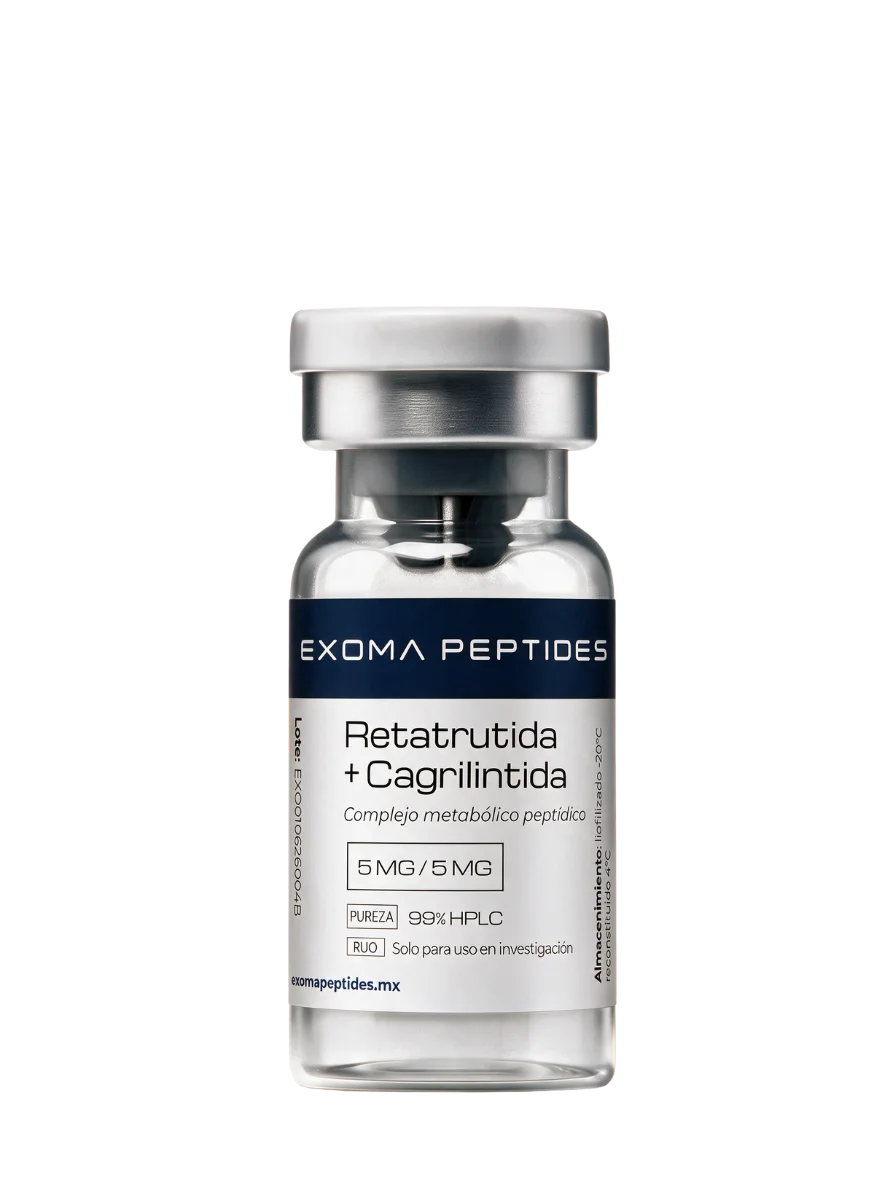
Retatrutide + Cagrilintide
Retatrutida + Cagrilintida — reactivo for research (RUO). Contenido revisado por el Dr. Jesús Jaramillo.
Sizes and prices: 10 mg $2,450 MXN ($245 MXN per mg).
Buy Retatrutide + Cagrilintide in Mexico: order online with nationwide shipping in 1-4 business days depending on zone and tracking number. Prices in Mexican pesos. Material for research use only.
Identity and composition
Retatrutide + Cagrilintide is an experimental coformulation of two distinct peptides that combine an incretin/glucagon triagonist (retatrutide) with a long-acting amylin analog (cagrilintide), studied separately in the context of energy balance. Product for research use.
As it is a mixture of two different peptides, there is no single chemical identity (CAS, molecular weight, formula, or sequence) for the co-formulation as an entity; that is why those parameters are not reported at the blend level.
At the component level:
- Retatrutide (LY3437943; also LY-3437943): CAS 2381089-83-2. A 39-amino-acid peptide lipidated with a C20 fatty diacid. Described as a triagonist of the GIP/GLP-1/glucagon receptors.
- Cagrilintide (AM833; NN9838; NN0174-0833): acylated amylin analog, a 37-amino-acid peptide.
Common synonyms: Reta+Cagri, triagonist incretin + amylin analog coformulation.
Mechanism of action
The rationale for this coformulation is to combine two complementary mechanisms on energy balance.
- Retatrutide acts as a unique agonist ("triagonist") of the receptors of GLP-1, GIP and glucagon. The GLP-1 pathway is associated with glucose-dependent insulin secretion and satiety; the GIP pathway modulates insulin signaling; and glucagon receptor agonism is related to greater energy expenditure and hepatic lipolysis (NEJM 2023; PMID 37366315; Nat Med 2024; PMID 38858523).
- Cagrilintide is a long-acting amylin analog, a non-selective agonist of the amylin receptors (AMY1-3R) and of the calcitonin receptor, which has been described as acting in the area postrema and the hypothalamus, slowing gastric emptying and increasing satiety (Lancet 2021; PMID 34798060).
The rationale for co-formulating them is to add the amylin pathway to the triple incretin/glucagon agonism. It is important to note that this specific combination has not been mechanistically validated in a peer-reviewed publication of the coformulation as a single entity; the mechanistic basis comes from each component separately.
Pharmacokinetics
The available pharmacokinetic data are at the component level, not of the coformulation.
- Retatrutide: a half-life of approximately has been reported 6 days and dose-proportional pharmacokinetics, which is associated with weekly subcutaneous administration through reversible binding to albumin due to its acylation with a C20 fatty acid (PMID 37366315).
- Cagrilintide: long-acting acylated analog, compatible with weekly dosing (PMID 34798060).
No pharmacokinetic data are available for the coformulation as such, nor for possible pharmacokinetic interactions between the two peptides.
Scientific evidence
The direct evidence on this combination is nonexistent in humans; what is known comes from the components separately, in advanced clinical development.
- Retatrutide: it completed phase 2 in obesity and phase 2a in metabolic dysfunction-associated steatotic liver disease (MASLD), with a phase 3 program underway for obesity and type 2 diabetes (PMID 37366315; PMID 38858523). In studies a weight loss of up to ~24% at 48 weeks has been observed in the context of obesity (PMID 37366315).
- Cagrilintide: it completed phase 2 dose-finding in obesity, where ~10.8% weight loss was observed at 26 weeks, and it has been studied co-administered with semaglutide (CagriSema) (PMID 34798060).
No registered clinical trial or peer-reviewed publication evaluating the specific coformulation or co-administration of retatrutide with cagrilintide in humans has been identified. Therefore, their combined use should be considered experimental and without direct clinical evidence. The studied indications of the components (obesity/overweight, type 2 diabetes, MASLD) are mentioned only as research context, not as validated applications of the mixture.
Research applications
Product for research use.
It may be of interest for research in:
- In vitro and preclinical studies on the signaling of incretin receptors (GLP-1/GIP), the glucagon receptor and amylin receptors.
- Comparative characterization of complementary mechanisms on satiety, gastric emptying and energy expenditure at the experimental-model level.
- Methodological work on handling, reconstitution, and stability of long-acting acylated peptides.
Not applicable for:
- Any form of clinical use, therapeutic use, diagnosis, or self-administration.
- Supporting claims of clinical efficacy for the combination: there are no direct clinical data on the co-formulation.
Research protocols
There is no validated dosing regimen for the retatrutide + cagrilintide combination. The presentation of 10 mg does not correspond to a verified scheme in the clinical literature for this blend and should not be interpreted as a recommended dose.
As context reference, in the studies of the separate components, administration was investigated weekly subcutaneous, consistent with the prolonged half-life of both peptides (retatrutide ~6 days; PMID 37366315). The specific dose regimens of those trials correspond to the individual components and not to the co-formulation, so they do not transfer to this mixture.
The design of any experimental protocol rests entirely with the researcher and their institutional framework.
Reconstitution
As a general laboratory guide for lyophilized peptides:
- It is usually reconstituted with bacteriostatic water (water with ~0.9% benzyl alcohol), which facilitates multiple withdrawals by inhibiting microbial growth. For single use, sterile water for injection may be used.
- Add the diluent letting it run down the wall of the vial, not directly onto the powder, to reduce mechanical stress on the peptide.
- Do not shake; gently swirl the vial until fully dissolved.
- Verify that the solution is clear and free of particles before using it.
The reconstitution volume depends on the working concentration defined by the experimental protocol.
Stability and storage
Standard laboratory handling for peptides:
- Lyophilized (unreconstituted): stores its stability better long-term when frozen; protect it from light and moisture. For short-term storage it is usually kept refrigerated.
- Reconstituted: maintain refrigerated (2-8 °C) and use within a short window; the benzyl alcohol in bacteriostatic water helps preserve the solution during that period.
- Avoid repeated freeze-thaw cycles, which degrade peptides; it is advisable aliquot before freezing.
These ranges are general handling guidance; they do not replace the specific conditions determined by the protocol or the batch documentation.
Safety profile
There are no safety data for the combination. The documented profile corresponds to each component separately and is dominated by transient gastrointestinal events of mild to moderate intensity (nausea, vomiting, diarrhea, constipation), more frequent at high doses.
- Retatrutide: gastrointestinal events were the most frequent; mild increases in heart rate and increases in beta-hydroxybutyrate without ketoacidosis were reported, with no signal of hepatotoxicity through 48 weeks in the obesity/MASLD population. In the MASLD trial, serious adverse events were reported in ~2.5% (PMID 38858523; PMID 37366315).
- Cagrilintide: gastrointestinal events in ~41-63% depending on the dose (versus ~32% with placebo), injection-site reactions, and discontinuation of ~10% (PMID 34798060).
The possible additive gastrointestinal risks and other potential class effects (pancreatitis, gallbladder disease) have not been characterized for the coformulation. As there are no clinical data on the mixture, its combined safety profile is unknown.
Comparative context
Within their class, the two components occupy distinct categories:
- Retatrutide it differs from dual GIP/GLP-1 agonists (such as tirzepatide) and from pure GLP-1 agonists (such as semaglutide) in that adding glucagon receptor agonism, associated with greater energy expenditure; in phase 2 trials the greatest weight reductions of the class were reported (~24%; PMID 37366315).
- Cagrilintide belongs to a different class, that of the amylin analogs, and its most studied comparator in combination is semaglutide (CagriSema; PMID 34798060).
The logic of retatrutide + cagrilintide conceptually mimics CagriSema, but replacing the incretin agonist with a triagonist. This comparison is theoretical: there are no head-to-head data or data on the specific combination supporting equivalence or superiority.
History and development
Both peptides come from independent development programs in the field of energy balance.
- Retatrutide (LY3437943) was developed as a triagonist of the GIP/GLP-1/glucagon receptors and advanced to phase 2 in obesity and phase 2a in MASLD, with a subsequent phase 3 program in obesity and type 2 diabetes (PMID 37366315; PMID 38858523).
- Cagrilintide (AM833) was developed as a long-acting amylin analogue for weight management, completed phase 2 dose-finding and has been studied in co-administration with semaglutide (PMID 34798060).
The idea of co-formulate both arises from combining the amylin pathway with the triple incretin/glucagon agonism. However, this co-formulation does not come from a clinical program published as a single entity: it is an experimental combination with no registered trials or peer-reviewed evidence for the mixture.
FAQ
Are there clinical studies of the retatrutide + cagrilintide combination?
No. No registered clinical trial or peer-reviewed publication has been identified that evaluates the specific coformulation or coadministration of retatrutide with cagrilintide in humans. The available data correspond to each component separately; the combination is considered experimental and without direct clinical evidence.
What sets retatrutide apart from other compounds in its class?
Retatrutide is described as a triagonist of the GLP-1, GIP and glucagon receptors. Compared to the dual GIP/GLP-1 agonists and to pure GLP-1 agonists, it adds glucagon receptor agonism, associated with greater energy expenditure. In phase 2 a weight loss of up to ~24% at 48 weeks was reported (PMID 37366315).
Does the 10 mg presentation correspond to a validated dose?
No. The figure of 10 mg does not correspond to a regimen validated in the clinical literature for this combination and must not be interpreted as a recommended dose. There is no verified dosing scheme for the retatrutide + cagrilintide coformulation.
What is the half-life of these peptides?
At the component level, retatrutide has a half-life of approximately 6 days, consistent with weekly subcutaneous administration owing to its reversible binding to albumin (PMID 37366315). Cagrilintide is also a long-acting acylated analogue compatible with weekly dosing (PMID 34798060). There are no pharmacokinetic data for the mixture.
How is it reconstituted and stored?
As a general laboratory guideline, lyophilized peptides are usually reconstituted with bacteriostatic water (water with ~0.9% benzyl alcohol), added down the wall of the vial and without shaking. The lyophilizate is best stored frozen and, once reconstituted, refrigerated (2-8 °C) and used within a short window, avoiding freeze-thaw cycles.
What adverse events have been documented for the components?
At the level of each component, transient mild-to-moderate gastrointestinal events predominate (nausea, vomiting, diarrhea, constipation), more frequent at high doses. In cagrilintide they were reported in ~41-63% depending on the dose, with discontinuation of ~10% (PMID 34798060). There are no safety data for the combination, and its additive risks have not been characterized.
Scientific references (6)
There is no peer-reviewed literature on Retatrutide + Cagrilintide as a combination. What follows is the literature for each component separately, with its PubMed identifier:
- Sobre Retatrutide: LY3437943, a novel triple glucagon, GIP, and GLP-1 receptor agonist for glycemic control and weight loss: From discovery to clinical proof of concept (Coskun T, et al. · Cell Metabolism · 2022) PMID 35985340.
- About Cagrilintide: Development of Cagrilintide, a Long-Acting Amylin Analogue (Kruse, et al. · Journal of Medicinal Chemistry · 2021) PMID 34288673.
- Sobre Retatrutide: Triple–Hormone-Receptor Agonist Retatrutide for Obesity — A Phase 2 Trial (Jastreboff, et al. · New England Journal of Medicine · 2023) PMID 37366315.
- About Cagrilintide: Once-Weekly Cagrilintide for Weight Management in People with Overweight and Obesity: a Multicentre, Randomised, Double-Blind, Placebo-Controlled and Active-Controlled, Dose-Finding Phase 2 Trial (Lau, et al. · The Lancet · 2021) PMID 34798060.
- Sobre Retatrutide: Effects of once-weekly subcutaneous retatrutide on weight and metabolic markers: A systematic review and meta-analysis of randomized controlled trials (Pasqualotto E, et al. · Metabolism Open · 2024) PMID 39318607.
- About Cagrilintide: Cagrilintide Lowers Bodyweight Through Brain Amylin Receptors 1 and 3 (Carvas, et al. · EBioMedicine · 2025) PMID 40609154.
Full scientific profile: Retatrutide + Cagrilintide in the compendium — mechanism of action, studies and technical data sheet.
See the full category catalog: Metabolism · Hormonal.
Other related research peptides
Compara con otros agonistas incretínicos: retatrutide y tirzepatide.