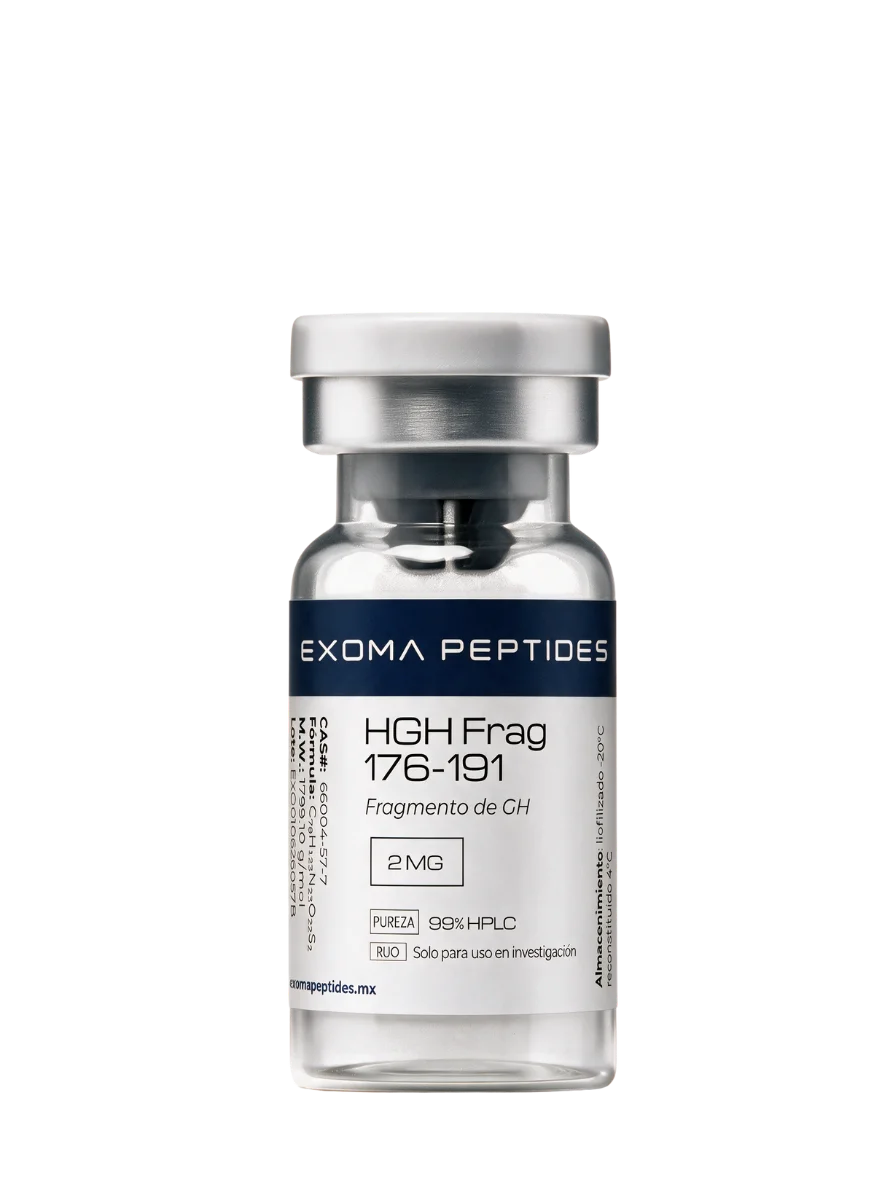
HGH Frag 176-191
HGH Frag 176-191 — reagent for research use (RUO).
Technical data
- INN name
- HGH Fragment 176-191
- CAS
- 66004-57-7
- Molecular formula
- C78H123N23O22S2
- Molecular weight
- 1799.10 g/mol
Sizes and prices: 2 mg $780 MXN ($390 MXN per mg) · 5 mg $1,099 MXN ($220 MXN per mg).
Buy HGH Frag 176-191 in Mexico: order online with nationwide shipping in 1-4 business days depending on zone and tracking number. Prices in Mexican pesos. Material for research use only.
HGH Frag 176-191 is known internationally as HGH Fragment 176-191 (English INN name). Buy HGH Fragment 176-191 in Mexico / comprar HGH Fragment 176-191 en México: reagent for research use (RUO) and nationwide shipping.
HGH Frag 176-191 is also searched as: Somatotropin (176-191), HGH Frag.
Identity and composition
HGH Frag 176-191 is a peptide that corresponds to the C-terminal lipolytic domain of human growth hormone (residues 176-191 of the 191-amino-acid molecule). It is studied as a research agent associated with lipid metabolism and the lipolytic activity of adipose tissue. Product for research use.
Regarding its chemical identity, the available data show inconsistencies between sources and should be taken with caution:
- Reported CAS number: 66004-57-7 (appears mainly in commercial and aggregator listings, not confirmed against an authoritative registry).
- Molecular weight: the sources are conflicting (~1799 to ~1817 g/mol).
- Molecular formula: aggregators report C78H123N23O22S2, while the PubChem registry (CID 172966176) lists a divergent formula, C80H127N23O24S2.
- Reported sequence: Tyr-Leu-Arg-Ile-Val-Gln-Cys-Arg-Ser-Val-Glu-Gly-Ser-Cys-Gly-Phe (C-terminal residues 176-191; reported, not independently confirmed against a primary GH reference).
Among its synonyms are: hGH Frag 176-191, GH fragment 176-191 and "lipolytic fragment of hGH". It should not be confused with AOD9604, a modified, distinct analog (CAS 221231-10-3).
Mechanism of action
HGH Frag 176-191 represents the C-terminal lipolytic domain of human growth hormone. In preclinical studies with obese rodents, it has been observed that the fragment and its closely related modified analog (AOD9604) reduce body weight gain and increase the lipolytic activity of adipose tissue, fat oxidation, and plasma glycerol, an index of lipolysis (Heffernan et al., Int J Obes 2001; PMID 11673763).
A feature documented in this literature is that these metabolic effects were reported without the somatotrophic or diabetogenic effects of full-length GH: no adverse effect on insulin sensitivity was observed (Ng et al., Horm Res 2000; PMID 11146367). In preclinical models, the fragment did not bind or activate the GH receptor, which suggests a GH receptor-independent pathway (participation of the beta3-adrenergic pathway in mice has been proposed) (PMID 11673763).
It is important to note that the claim that it does not raise IGF-1 comes mainly from the literature on the modified analog (AOD9604), not from the unmodified 176-191 fragment. Most of the primary data correspond to rodents; robust mechanistic confirmation in humans is limited.
Pharmacokinetics
The pharmacokinetic parameters are not reliably established from the sources reviewed. Early rodent studies noted some oral activity of the fragment/AOD9604 in reducing weight gain, but validated human pharmacokinetic parameters were not confirmed (for example, plasma half-life) in the sources consulted. Any specific half-life figure in humans should be considered unverified.
Scientific evidence
The available evidence is preliminary and mostly preclinical. Research on this sequence is closely intertwined with that of AOD9604, an analog developed as an anti-obesity drug based on the 177-191 region. The preclinical studies date from approximately 2000-2001, in obese Zucker rats and obese and beta3-AR knockout mice (Ng et al., Horm Res 2000; PMID 11146367; Heffernan et al., Int J Obes 2001; PMID 11673763).
According to secondary reports, AOD9604 advanced to human obesity trials in the 2000s, but did not reach statistical significance in its largest Phase IIb study, and its clinical development for obesity was discontinued (~2007). It does not have FDA approval for any indication and has been flagged by the FDA as a bulk drug substance of possible concern.
The specific evidence for the unmodified 176-191 fragment in humans is scarce. There is a compound record in PubChem (CID 172966176), although the formula and the molecular weight present conflicts among entries and aggregators (PubChem CID 172966176). Claims of efficacy should be treated as unproven.
Research applications
Product for research use.
Appropriate uses in a research context:
- In vitro and preclinical studies on lipid metabolism and lipolytic activity of adipose tissue.
- Comparative research against full-length GH and against the analog AOD9604.
- Characterization of proposed metabolic pathways (for example, GH receptor-independent signaling) in preclinical models.
Not applicable for:
- Any form of human consumption, administration or self-experimentation.
- Diagnostic, therapeutic, or preventive use: it is not approved by the FDA for any indication.
- Applications that assume proven clinical efficacy in humans: the evidence is preliminary and largely preclinical.
Research protocols
The literature reviewed does not provide specific numerical doses used in the reviewed studies, so quantitative dosing protocols are not indicated. What is qualitatively established: in the preclinical literature it was applied chronic treatment of the fragment or of the modified analog in obese-rodent models, with reports of reduced weight gain and increased fat oxidation (Heffernan et al., Int J Obes 2001; PMID 11673763). These are animal research designs and do not constitute clinical-use protocols. Any handling scheme in the laboratory must be defined according to each institution's approved experimental protocol.
Reconstitution
General standard laboratory guide for lyophilized peptides (does not constitute a clinical-use instruction):
- Reconstitute with bacteriostatic water (sterile water with 0.9% benzyl alcohol) or with sterile water for injection, depending on the experimental protocol.
- Add the diluent slowly down the wall of the vial, letting it run over the powder; do not inject the stream directly onto the lyophilized material.
- Swirl the vial gently until fully dissolved; do not shake vigorously to avoid degradation of the peptide.
- Adjust the diluent volume according to the target concentration of the experiment (for example, for a 5 mg vial).
Use aseptic technique at all times.
Stability and storage
Standard handling and storage guidelines for research peptides (not specific to the consulted literature, but common laboratory practices):.
- Lyophilized: store in a cool, dry place protected from light; refrigeration is recommended and, for prolonged storage, freezing (for example, -20 °C or lower). In lyophilized form, peptides are usually stable for longer periods. - Reconstituted: keep refrigerated (approximately 2-8 °C) and use within a short period; avoid exposure to light and prolonged room temperature. - Minimize the cycles of freeze-thaw, as they can degrade the peptide; consider aliquots for prolonged storage.
Always follow the conditions established by the laboratory protocol.
Safety profile
The safety profile must be interpreted with caution, since much of the data comes from the AOD9604 analog and from preclinical studies:
- In the preclinical literature reviewed, the fragment/AOD9604 did not adversely affect insulin sensitivity nor did it induce hyperglycemia, unlike full-length GH (Ng et al., Horm Res 2000; PMID 11146367; Heffernan et al., Int J Obes 2001; PMID 11673763). - Secondary reports on human trials of AOD9604 describe an adverse-event profile comparable to placebo, with no reported genotoxicity. - Important limitations: the compound is not approved by the FDA, has been listed by the FDA as a bulk drug substance that may present risks, and long-term human safety data are lacking.
For these reasons, it is intended exclusively for research use. The literature consulted does not provide specific formal contraindications.
Comparative context
In prose, to avoid frequent confusion:
Compared to AOD9604: HGH Frag 176-191 is often confused with AOD9604, but they are distinct. AOD9604 is a modified analog (with a Tyr residue added at the N-terminal end over the 177-191 region; CAS 221231-10-3), designed to preserve lipolytic activity without somatotrophic action. A good part of the efficacy and safety data cited derive from AOD9604, not from the unmodified 176-191 fragment.
Compared with full-length human growth hormone: in rodent data, the fragment reproduces the lipolytic and fat-oxidation effects of GH, but reportedly avoids activation of the GH receptor, elevation of IGF-1, and the insulin-desensitizing effects (preclinical data). This separation of metabolic and somatotropic effects is the main point of interest of the class.
History and development
Research on the 176-191 sequence developed largely intertwined with that of AOD9604, an analog built on the 177-191 region for anti-obesity purposes. The foundational preclinical studies date from approximately 2000-2001, using obese Zucker rat models and obese mouse and beta3-adrenergic receptor knockout mouse models (Ng et al., Horm Res 2000; PMID 11146367; Heffernan et al., Int J Obes 2001; PMID 11673763).
AOD9604 advanced to clinical trials for obesity during the 2000s. According to secondary reports, it did not reach statistical significance in its largest Phase IIb study and its clinical development for obesity was discontinued around 2007. Subsequently, in more recent gray literature, uses in cartilage/joints and metabolic health have been explored more speculatively, without these being established. The compound does not have FDA approval for any indication.
FAQ
Is HGH Frag 176-191 the same as AOD9604?
No. They are distinct compounds that are often confused. AOD9604 is a modified analog (with a Tyr residue added to the 177-191 region, CAS 221231-10-3), whereas HGH Frag 176-191 corresponds to the C-terminal fragment without that modification. Much of the cited efficacy and safety data actually comes from AOD9604.
What has been researched about HGH Frag 176-191?
In preclinical studies with obese rodents it has been observed that the fragment and the analog AOD9604 reduce weight gain and increase lipolytic activity and fat oxidation, without adversely affecting insulin sensitivity (PMID 11146367; PMID 11673763). Evidence in humans for the unmodified fragment is scarce and efficacy claims must be considered unproven.
Is it approved by the FDA?
No. The compound does not have FDA approval for any indication. In addition, the FDA has flagged AOD9604 (a related analog) as a bulk drug substance that may present risks. Long-term human safety data are lacking. It is intended exclusively for research use.
What is the half-life of HGH Frag 176-191?
The pharmacokinetic parameters are not reliably established in the reviewed sources. No validated human parameters, such as plasma half-life, were confirmed. Any specific figure must be considered unverified.
How is it reconstituted and stored?
As a general laboratory guideline, lyophilized peptides are usually reconstituted with bacteriostatic water, added slowly down the wall of the vial and swirled gently without shaking. The lyophilizate is best stored frozen or refrigerated and protected from light; once reconstituted, it is kept refrigerated and freeze-thaw cycles are minimized.
Can it be used in humans?
No. Product for research use; not for clinical use. It is not applicable for diagnostic, therapeutic, or preventive use, nor for self-experimentation. The available evidence is preliminary and largely preclinical.
Scientific references (4)
Peer-reviewed literature on HGH Frag 176-191, with its PubMed identifier where available:
- Effects of Growth Hormone on Body Composition (Rudman D, et al. · New England Journal of Medicine · 1990) — Classic study on the effects of GH on body composition in older adults. PMID 2355952.
- Antilipogenic action of synthetic C-terminal sequence 177-191 of human growth hormone (Wu, et al. · Biochemistry and Molecular Biology International · 1993) PMID 8358331.
- Reduction of cumulative body weight gain and adipose tissue mass in obese mice: response to chronic treatment with synthetic hGH 177-191 peptide (Natera, et al. · Biochemistry and Molecular Biology International · 1994) PMID 7987248.
- Human Growth Hormone Fragment 176-191 Peptide Enhances the Toxicity of Doxorubicin-Loaded Chitosan Nanoparticles Against MCF-7 Breast Cancer Cells (Habibullah, et al. · Drug Design, Development and Therapy · 2022) PMID 35783198.
Full scientific profile: HGH in the compendium — mechanism of action, studies and technical data sheet.
See the full category catalog: Metabolism.
Otras presentaciones de HGH Frag 176-191
Guides and articles about HGH Frag 176-191
Lecturas del blog de EXOMA que la editorial asoció a este compuesto: