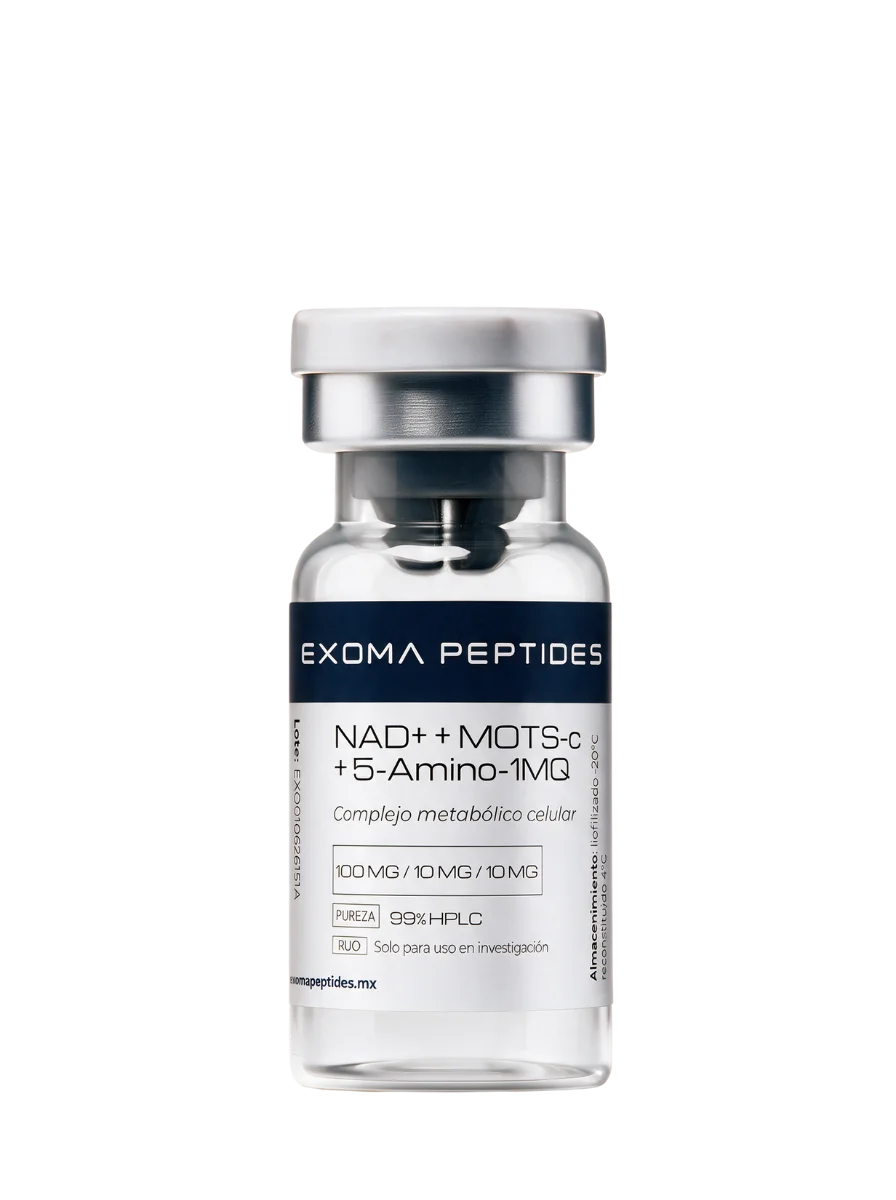
NAD+ + MOTS-c + 5-Amino-1MQ
NAD+ + MOTS-c + 5-Amino-1MQ — reagent for research use (RUO).
Technical data
- INN name
- NAD+ / MOTS-c / 5-Amino-1MQ Blend
Sizes and prices: 100 mg + 10 mg + 10 mg $2,450 MXN ($20 MXN per mg) (sold out).
Buy NAD+ + MOTS-c + 5-Amino-1MQ in Mexico: order online with nationwide shipping in 1-4 business days depending on zone and tracking number. Prices in Mexican pesos. Material for research use only.
NAD+ + MOTS-c + 5-Amino-1MQ is known internationally as NAD+ / MOTS-c / 5-Amino-1MQ Blend (English INN name). Buy NAD+ / MOTS-c / 5-Amino-1MQ Blend in Mexico / comprar NAD+ / MOTS-c / 5-Amino-1MQ Blend en México: reagent for research use (RUO) and nationwide shipping.
Identity and composition
The NAD+ + MOTS-c + 5-Amino-1MQ blend is a research-use-only (RUO) coformulation that brings together three complementary metabolic agents in a single lyophilized vial of 100 mg + 10 mg + 10 mg. NAD+ (β-Nicotinamide Adenine Dinucleotide, oxidized form; CAS 53-84-9; molecular formula C21H27N7O14P2; molecular weight 663.43 g/mol) is the central redox coenzyme of energy metabolism. MOTS-c is a mitochondria-derived peptide, encoded in the 12S rRNA region of mitochondrial DNA, that acts as a regulator of energy homeostasis. 5-Amino-1MQ is a small molecule that selectively inhibits the enzyme NNMT (nicotinamide N-methyltransferase) in adipose tissue. The objective of this combination in experimental models is to study the NAD+/AMPK/sirtuin axis from three convergent angles: direct coenzyme supply, activation of energy sensors, and preservation of the NAD+ pool. For those looking to buy NAD+ MOTS-c 5-amino Mexico for research purposes, this metabolic longevity blend offers a unique vehicle to characterize synergies. All the material is intended exclusively for laboratory research.
Mechanism of action
The mechanistic basis of the blend rests on three pathways that converge on the same metabolic axis. First, NAD+ functions as a direct redox coenzyme: it transports electrons in oxidative phosphorylation (OXPHOS) and serves as a consumable substrate for the PARPs (DNA repair) and the sirtuins SIRT1-7, NAD+-dependent deacetylases that regulate gene expression, mitochondrial biogenesis, and the stress response. Providing NAD+ directly seeks to raise the substrate available for these enzymes. Second, MOTS-c acts as an exercise mimetic: it activates AMPK (AMP-activated protein kinase), the master sensor that switches on when the energy charge falls, promoting glucose uptake, substrate oxidation, and insulin sensitivity. Third, 5-Amino-1MQ inhibits NNMT, the enzyme that methylates nicotinamide by consuming methyl groups from SAM; by halting that reaction, the recycling of NAD+ and of SAM is preserved and the β-oxidation of fatty acids in the adipocyte is favored. The convergence is clear: MOTS-c switches on AMPK, which in turn favors the activity of NAD+-dependent sirtuins; 5-Amino-1MQ protects the NAD+ pool against its degradation; and exogenous NAD+ feeds the system. Thus, the three pieces feed back into the NAD+/AMPK/sirtuins axis in research models.
Pharmacokinetics
The pharmacokinetic behavior of this blend must be understood as the sum of three distinct profiles, all characterized solely in preclinical research contexts (RUO). NAD+ is a large, polar molecule (663.43 g/mol) with systemic bioavailability limited by non-parenteral routes; in experimental models its administration is studied mainly by routes that avoid digestive degradation, and a fraction is rapidly catabolized to nicotinamide and other metabolites that feed the intracellular recovery pathways. MOTS-c, as a 16-amino-acid peptide, has a relatively short half-life and depends on cellular uptake and nuclear translocation under metabolic stress, where it modulates adaptive gene expression. 5-Amino-1MQ, being a small, low-weight molecule, shows greater permeability and distribution to tissues, including adipose tissue, where it exerts its inhibition of NNMT. The coformulation does not alter these intrinsic parameters, but it does allow the study of their temporal overlap in a single experimental design. The precise quantitative data (Cmax, Tmax, clearance) vary by species, route and model, and must be obtained in each specific research protocol, without extrapolation to non-validated contexts.
Scientific evidence
The available evidence for each component comes from preclinical literature and basic research, not from approved applications. For NAD+ and its precursors there is a consolidated body of work linking the availability of this coenzyme with sirtuin activity, PARP-mediated DNA repair and OXPHOS efficiency; NAD+ levels have been observed to decline with age in multiple tissues, which has prompted its study in models of metabolism and senescence. For MOTS-c, studies in animal models have described AMPK activation, improvements in glucose homeostasis and an exercise-mimetic-type response against high-fat diets. For 5-Amino-1MQ, research focuses on the selective inhibition of NNMT in adipose tissue, with reports of increased β-oxidation and energy expenditure in models of experimental obesity. The rationale for combining them arises from the mechanistic convergence on the NAD+/AMPK/sirtuin axis, but the specific synergy of the blend as a whole is still a matter of experimental characterization. All of this information is offered for research (RUO) purposes and does not constitute a clinical or therapeutic claim of any kind.
Research applications
The applications of this blend are confined entirely to the domain of in vitro research and preclinical models (RUO). In the laboratory, the NAD+ + MOTS-c + 5-Amino-1MQ coformulation is of interest to groups studying cellular energy metabolism, mitochondrial biogenesis, and sirtuin biology, precisely because it allows intervention on the NAD+/AMPK axis simultaneously through three mechanisms. It is used to investigate how the direct supply of the redox coenzyme interacts with AMPK activation induced by a mitochondrial peptide and with the preservation of the NAD+ pool achieved by inhibiting NNMT. Other research lines include insulin resistance models, the study of fatty-acid β-oxidation in adipocytes, PARP-dependent DNA repair assays, and the characterization of exercise-mimetic-type responses. For researchers evaluating whether to buy NAD+ MOTS-c 5-amino in Mexico, the metabolic longevity blend offers an integrated model to dissect synergies that would be difficult to isolate by administering each agent separately. None of these applications imply diagnostic, therapeutic, or human use: the material is strictly for research.
Research protocols
The experimental handling protocols for this blend must be defined by the responsible researcher according to their model and objectives, within the strict framework of research (RUO). As general laboratory guidance, the lyophilized vial of 100 mg + 10 mg + 10 mg is reconstituted with 2-3 mL of bacteriostatic water, obtaining a stock solution whose concentration per component is calculated by dividing the mass by the chosen final volume. From that solution the working aliquots are prepared according to the experimental matrix. Given that the three agents have distinct mechanisms and kinetics, designs usually contemplate comparative arms: each component separately versus the complete blend, in order to be able to attribute observed effects to the co-formulation or to its parts. It is advisable to record precisely the lot, the reconstitution date, and the conservation conditions of each aliquot, as well as to include vehicle controls. The concentrations, frequencies, and duration of exposure depend entirely on the model (cell lines, tissue, or species) and on the reference literature. This content is informative to contextualize the product and does not constitute a dosing recommendation for any use outside laboratory research.
Reconstitution
Reconstitution of this metabolic blend must be performed with aseptic technique in a suitable laboratory environment, always for research (RUO). The vial contains 100 mg of NAD+, 10 mg of MOTS-c and 10 mg of 5-Amino-1MQ in lyophilized form. It is recommended to add 2 to 3 mL of bacteriostatic water, letting the diluent run slowly down the inner wall of the vial rather than directing it straight onto the powder, in order to minimize foam formation and stress on the peptide component (MOTS-c). It should not be shaken vigorously: it is enough to swirl the vial gently or let it stand until the lyophilizate dissolves completely, forming a clear solution. The choice of volume (2 or 3 mL) determines the concentration per component and it is advisable to fix it before reconstituting to simplify the aliquot calculations. Once reconstituted, the solution must be handled with sterile syringes and vials, avoiding repeated needle-entry cycles that compromise sterility. Recording the date and time of reconstitution is indispensable for stability monitoring. The entire procedure is carried out exclusively with material intended for laboratory research.
Stability and storage
The stability of this blend depends on correct thermal and light handling at all times, within the research framework (RUO). In its lyophilized form, the vial must be kept refrigerated between 2 and 8 °C and protected from light, conditions under which the three components maintain their integrity for prolonged periods. Lyophilization contributes stability by removing the water that favors hydrolysis, especially relevant for the peptidic component MOTS-c and for the NAD+ molecule, which is sensitive to degradation. Once reconstituted with bacteriostatic water, the solution must be kept refrigerated and used within a limited window, since in an aqueous medium peptides and coenzymes are more labile against hydrolysis, oxidation, and residual enzymatic activity. It is advisable to avoid prolonged exposure to room temperature, direct light, and the repeated freeze-thaw cycles that generate aggregation and loss of activity. It is recommended to aliquot in order to reduce handling and to protect each portion from light. Any change in appearance—turbidity, precipitate, or anomalous coloration—suggests degradation and advises against the experimental use of that aliquot. These guidelines apply to laboratory material for research.
Safety profile
The safety profile of this blend is described strictly in the context of handling research reagents (RUO), not as information about use in humans or animals outside an approved protocol. Being a coformulation of three agents with distinct mechanisms —a redox coenzyme, a mitochondrial peptide and a small-molecule inhibitor— laboratory personnel must handle it with the standard precautions for bioactive compounds: use of gloves, lab coat and eye protection, work on clean surfaces and avoidance of aerosol formation during reconstitution. It must be kept out of the reach of unauthorized persons and stored in a labeled manner, separate from incompatible reagents. The complete toxicological data for the combination are not exhaustively characterized, so it is recommended to treat the material with the caution appropriate for research substances whose profile is still under study. The responsibility for defining controls, exposure limits and handling procedures rests with the researcher and the institution. This product is not intended for consumption or for diagnostic or therapeutic applications: its use is solely for laboratory research under competent supervision.
Comparative context
Compared with the administration of each component separately, the blend NAD+ + MOTS-c + 5-Amino-1MQ seeks to capture synergies on a single axis. NAD+ alone provides the coenzyme but does not directly activate the energy sensors or protect the pool against its degradation; MOTS-c alone turns on AMPK and improves insulin sensitivity, but does not raise the substrate of the sirtuins or halt the methylation of nicotinamide; 5-Amino-1MQ alone inhibits NNMT and favors β-oxidation, but does not by itself increase the available coenzyme. The coformulation allows the three effects to be studied in overlap. With respect to the precursors NMN (nicotinamide mononucleotide) and NR (nicotinamide riboside), the conceptual difference is relevant: NMN and NR are substrates that the cell must enzymatically convert into NAD+ through the salvage pathway, whereas this blend provides NAD+ as such and, in addition, protects the pool by inhibiting NNMT, a two-front approach that the precursors alone do not cover. For anyone evaluating buying NAD+ MOTS-c 5-amino Mexico, this metabolic longevity blend positions itself in research as a more comprehensive tool than an isolated precursor. All these comparisons are of a scientific nature and for research (RUO).
History and development
The convergence of these three agents in a single blend reflects the evolution of research on NAD+ metabolism and mitochondrial biology. NAD+ has been known for more than a century as an essential redox coenzyme, but it was the discovery of sirtuins as NAD+-dependent enzymes and the finding that their levels decline with age that revived interest in modulating it. In parallel, the identification of mitochondria-derived peptides opened a new category: MOTS-c, encoded within the mitochondrial 12S rRNA, was characterized as a regulator of energy homeostasis capable of activating AMPK and behaving as an exercise mimetic. More recently, the enzyme NNMT emerged as a metabolic target in adipose tissue, and 5-Amino-1MQ was developed as a selective inhibitor to study how nicotinamide methylation affects the NAD+ and SAM pool. The idea of combining them arises from recognizing that the three research lines converge on the NAD+/AMPK/sirtuin axis. Thus, the blend represents an effort to integrate into a single experimental vehicle findings that were historically studied separately, always within the realm of research (RUO).
FAQ
Why combine NAD+, MOTS-c, and 5-Amino-1MQ in a single blend?
Because the three converge on the NAD+/AMPK/sirtuin metabolic axis from complementary angles. NAD+ directly provides the redox coenzyme that fuels sirtuins and PARP; MOTS-c activates AMPK as an exercise mimetic and improves insulin sensitivity; and 5-Amino-1MQ inhibits NNMT, preserving the NAD+ and SAM pool. Combining them allows the study of synergies that would be difficult to isolate with each agent separately. It is a coformulation for research (RUO).
What exactly does each component do?
NAD+ (CAS 53-84-9; C21H27N7O14P2; 663.43 g/mol) is the redox coenzyme of OXPHOS and a substrate of PARP and the SIRT1-7 sirtuins. MOTS-c is a mitochondrial peptide encoded by the 12S rRNA that regulates energy homeostasis via AMPK. 5-Amino-1MQ is a selective inhibitor of the enzyme NNMT in adipose tissue, favoring beta-oxidation. Each one acts at a distinct point of the same metabolic axis, for research purposes.
How does this blend differ from taking precursors such as NMN or NR?
NMN and NR are precursors that the cell must enzymatically convert into NAD+ via the salvage pathway. This blend supplies NAD+ as such and, in addition, protects the pool by inhibiting NNMT with 5-Amino-1MQ and activates AMPK with MOTS-c. It is a multi-front approach to the NAD+/AMPK/sirtuin axis that an isolated precursor does not cover. The comparison is scientific and applies only to research contexts (RUO).
How is the vial reconstituted?
The lyophilized vial of 100 mg NAD+ + 10 mg MOTS-c + 10 mg 5-Amino-1MQ is reconstituted with 2 to 3 mL of bacteriostatic water. It is advisable to let the diluent run down the wall of the vial, avoid vigorous shaking to protect the peptide component, and swirl gently until a clear solution is obtained. The chosen volume determines the concentration per component. The procedure is carried out with aseptic technique and research materials.
How should it be stored?
In lyophilized form, store between 2 and 8 °C, protected from light; in this way the three components maintain their integrity for prolonged periods. Once reconstituted with bacteriostatic water, keep refrigerated and use within a limited window, avoiding prolonged room temperature, direct light, and freeze-thaw cycles. Aliquoting helps reduce handling. Any turbidity or precipitate advises against using that aliquot in the experiment.
What is this blend used for?
Exclusively for research use only (RUO) in the laboratory. It is of interest in models of energy metabolism, mitochondrial biogenesis, sirtuin biology, insulin resistance, β-oxidation in adipocytes, and exercise-mimetic-type responses, because it allows intervention on the NAD+/AMPK axis simultaneously. It is not intended for clinical use or for diagnostic or therapeutic applications. Whoever seeks to buy NAD+ MOTS-c 5-amino Mexico acquires it as a research reagent.
Scientific references (7)
Peer-reviewed literature on NAD+ + MOTS-c + 5-Amino-1MQ, with its PubMed identifier when available:
- NAD+ in aging, metabolism, and neurodegeneration (Verdin E. · Science · 2015) — Comprehensive review of the role of NAD+ in aging and cellular metabolism. PMID 26785480.
- About NAD+: Nicotinamide Adenine Dinucleotide (NAD+) and Enkephalinase Inhibition (IV1114589NAD) Infusions Significantly Attenuate Psychiatric Burden Sequalae in Substance Use Disorder (SUD) in Fifty Cases (Blum, et al. · Current Psychiatry Research and Reviews · 2022) PMID 36118157.
- About MOTS-c: The mitochondrial-derived peptide MOTS-c promotes metabolic homeostasis and reduces obesity and insulin resistance (Lee, et al. · Cell Metabolism · 2015) PMID 25738459.
- About 5-Amino-1MQ: Selective and membrane-permeable small molecule inhibitors of nicotinamide N-methyltransferase reverse high fat diet-induced obesity in mice (Neelakantan, et al. · Biochemical Pharmacology · 2018) PMID 29155147.
- About NAD+: Evaluation of safety and effectiveness of NAD in different clinical conditions: a systematic review (Gindri, et al. · American Journal of Physiology-Endocrinology and Metabolism · 2024) PMID 37971292.
- About MOTS-c: MOTS-c is an exercise-induced mitochondrial-encoded regulator of age-dependent physical decline and muscle homeostasis (Reynolds, et al. · Nature Communications · 2021) PMID 33473109.
- About 5-Amino-1MQ: Reduced calorie diet combined with NNMT inhibition establishes a distinct microbiome in DIO mice (Dimet-Wiley, et al. · Scientific Reports · 2022) PMID 35013352.
Full scientific profile: NAD+ in the compendium — mechanism of action, studies and technical data sheet.
See the full category catalog: Metabolism.