
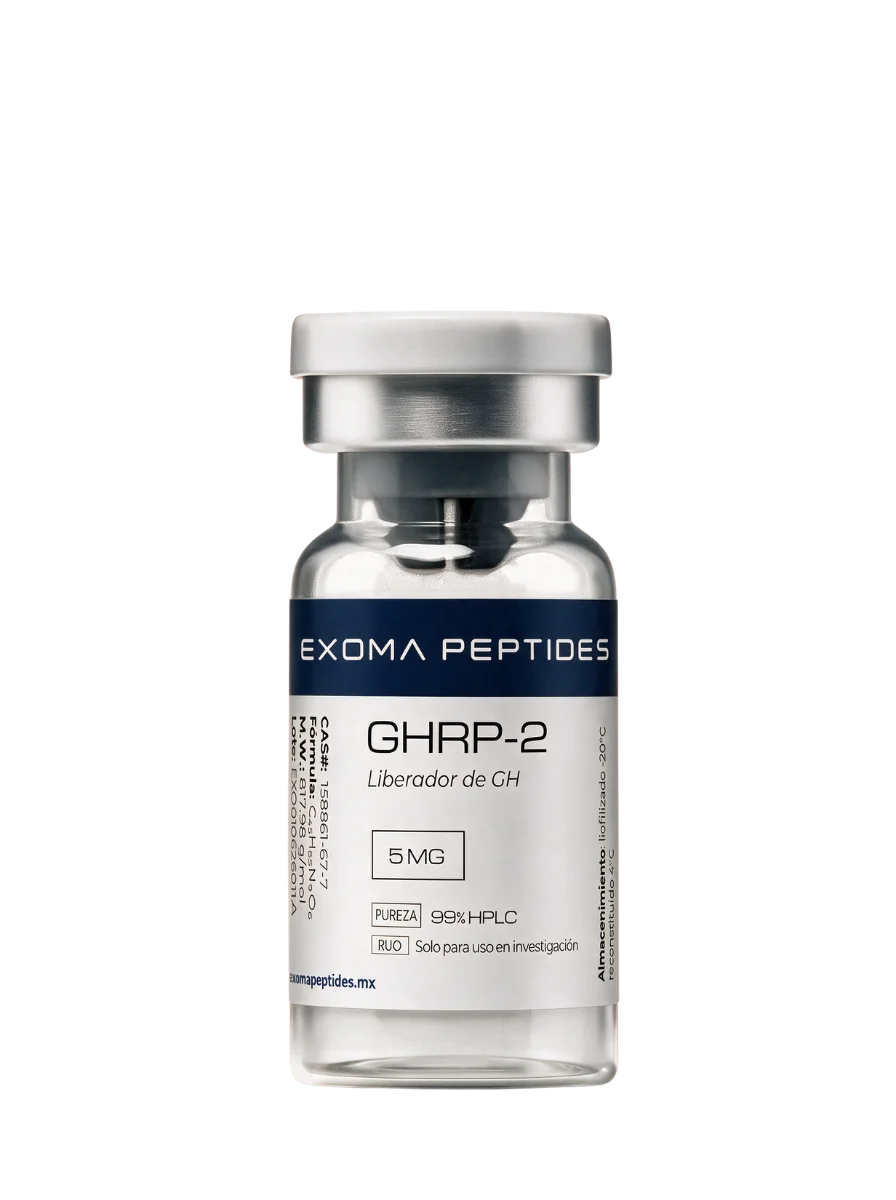
GHRP-2
GHRP-2 — research reagent (RUO). COA per batch available.
Technical data
- Development code
- KP-102
- CAS
- 158861-67-7
- Molecular formula
- C45H55N9O6
- Molecular weight
- 817.99 g/mol
Sizes and prices: 5 mg $520 MXN ($104 MXN per mg) · 10 mg $799 MXN ($80 MXN per mg) (out of stock).
Buy GHRP-2 in Mexico: order online with nationwide shipping in 1-4 business days depending on zone and tracking number. Prices in Mexican pesos. Material for research use only.
GHRP-2 is also searched as: Pralmorelin, Pralmorelina, GPA-748, KP-102, KP-102D.
Identity and composition
GHRP-2 (pralmorelin) is a synthetic hexapeptide studied in research as an agonist of the growth hormone secretagogue receptor (GHS-R1a), the same receptor as ghrelin. It is investigated mainly for its ability to stimulate growth hormone (GH) release and as an agent in pituitary diagnostic tests.
Product for research use.
Chemical identity data confirmed in the consulted literature:.
- Name / synonyms: Pralmorelin, GHRP-2, KP-102, Growth Hormone Releasing Peptide-2, GHRP Kaken 100 (diagnostic brand in Japan), pralmorelin dihydrochloride (salt form). - CAS: 158861-67-7
- Molecular weight: 817.99 g/mol (free base)
- Molecular formula: C45H55N9O6
- Sequence: D-Ala-D-2-Nal-Ala-Trp-D-Phe-Lys-NH2 (hexapeptide with C-terminal amide; 2-Nal = 3-(2-naphthyl)-D-alanine)
The chemical identity and sequence are documented in PubChem (CID 5493556). Transparency note: the CAS number was confirmed from secondary chemical databases rather than from a primary CAS field in the reviewed excerpt.
Mechanism of action
GHRP-2 acts as synthetic agonist of the growth hormone secretagogue receptor type 1a (GHS-R1a), a G protein-coupled receptor that is also the target of endogenous ghrelin. Upon binding to GHS-R1a in the somatotropic cells of the anterior pituitary (and at the hypothalamic level), in models and in diagnostic use it has been observed to stimulate the release of growth hormone (GH) (PubChem CID 5493556).
In addition to the effect on GH, the administration of GHRP-2 has been associated with documented secondary elevations of ACTH, cortisol and prolactin. This multi-hormonal response is the basis of its use in the evaluation of pituitary-adrenal function, as described in the clinical diagnostic literature (PMID:27020037).
It was described as the first growth hormone secretagogue of this class introduced into the clinical setting.
Pharmacokinetics
In its established diagnostic use, GHRP-2 is administered by intravenous route. After IV dosing, both unchanged GHRP-2 and a specific metabolite, D-Ala-D-(beta-naphthyl)-Ala-Ala-OH (called "AA-3"), are detected in human urine; this urinary excretion is the basis of the anti-doping detection assays (LC-ESI-MS/MS, with an approximate sensitivity of 0.5-10 ng/mL) (PMID:20552695).
A precise numerical plasma elimination half-life was not confirmed in the primary sources reviewed. The GH response is transient and tends to return toward baseline values, which is consistent with the pharmacokinetics of short peptides; however, the exact half-life value remains unverified and should not be assumed.
Scientific evidence
The available evidence is limited and mainly of a diagnostic context, not therapeutic. Pralmorelin has regulatory approval in Japan (PMDA) as a single-dose intravenous diagnostic agent to assess growth hormone deficiency (marketed as GHRP Kaken 100); this appears to be its only regulatory approval and it is not approved as a treatment.
More recent clinical research has evaluated the GHRP-2 stimulation test for the diagnosis of secondary adrenal insufficiency and hypothalamic-pituitary disorders through its ACTH/cortisol responses (PMID:27020037).
GHRP-2 is reported to have been investigated as a treatment for GH deficiency and short stature/pituitary dwarfism, apparently reaching intermediate-phase clinical evaluation (phase II) for those indications, without having been marketed for them; this phase detail should be treated as approximate. Part of the literature corresponds to anti-doping control (PMID:20552695) rather than to therapeutic development.
Research applications
Product for research use.
Based on the documented context, GHRP-2 may be of interest in research scenarios such as:
- In vitro and preclinical studies on GHS-R1a receptor signaling and the ghrelin pathway.
- Research on the release dynamics of growth hormone and its multihormonal response (ACTH, cortisol, prolactin).
- Development and validation of analytical methods, including anti-doping detection assays (LC-ESI-MS/MS).
Not applicable for:
- clinical use, therapeutic use, self-experimentation or administration for health, athletic or aesthetic purposes.
- Clinical use outside regulated settings; GHRP-2 is a substance prohibited by the World Anti-Doping Agency (WADA).
Research protocols
The literature reviewed does not provide a specific numerical dosing protocol nor milligrams per administration for studies. What is documented qualitatively: - In its established diagnostic use, GHRP-2 was administered by intravenous route in a single dose to assess growth hormone deficiency (PMDA/GHRP Kaken 100 context). - The GHRP-2 stimulation test has been used to elicit ACTH/cortisol responses in the evaluation of secondary adrenal insufficiency (PMID:27020037). The presentations offered by EXOMA are for 5 mg y 10 mg in a lyophilized vial. Any handling scheme must be defined by the responsible investigator within a controlled protocol.
Reconstitution
General standard laboratory guide for lyophilized peptides (for reference, not a clinical protocol):
- Reconstitute the lyophilized vial with bacteriostatic water (sterile water with 0.9% benzyl alcohol) added slowly along the vial wall, avoiding the direct stream onto the powder.
- Do not shake vigorously; swirl the vial gently until complete dissolution to preserve the integrity of the peptide.
- The diluent volume is chosen according to the desired working concentration for the 5 mg or 10 mg vial, in accordance with the study design.
- Handle under aseptic technique. Product for research use.
Stability and storage
Standard handling and stability recommendations for peptides (for reference):
- Lyophilized (unreconstituted): keep under refrigeration; for prolonged storage, freezing is recommended (for example, -20 °C or lower). Protect from light, heat and humidity. In the lyophilized and sealed state, peptides are usually stable for prolonged periods. - Reconstituted: keep refrigerated (approximately 2-8 °C) and use within a short window of days to a few weeks, according to laboratory practices; avoid repeated freeze-thaw cycles. - Label with the reconstitution date and concentration.
The consulted literature does not specify stability parameters specific to GHRP-2, so the above corresponds to general laboratory handling, not to data for the compound.
Safety profile
Safety profile with limited data; there is no long-term controlled safety set located in the primary sources.
- GHRP-2 is documented as substance prohibited by the World Anti-Doping Agency (WADA).
- In addition to GH, its administration raises ACTH, cortisol and prolactin; as a ghrelin receptor agonist, it has been described that it may induce hunger / increased food intake.
- The GH-elevating effect is markedly attenuated in individuals with genuine GH deficiency compared to healthy subjects; this is the basis of the diagnostic test but limits its therapeutic usefulness.
- No comprehensive profile of adverse events or of long-term toxicology was found beyond the acute diagnostic setting; such a profile is not established here.
As it is a research product, it must be handled only by trained personnel, with appropriate protective equipment and under institutional protocols. Not for clinical use.
Comparative context
Within its class, GHRP-2 ranks among the growth hormone secretagogues that act on the GHS-R1a receptor (of ghrelin):
- Shares mechanism with other GHS-R1a agonists such as GHRP-6, hexarelin and ipamorelin.
- It differs mechanistically from the GHRH analogs (for example, sermorelin and CJC-1295), which act on the GHRH receptor, a distinct pathway.
- Compared with ipamorelin, considered a more selective secretagogue, GHRP-2 is reported to produce greater "off-target" pituitary hormone release (notably ACTH, cortisol, and prolactin).
This comparative claim of selectivity comes from secondary / review sources and should be taken as indicative, not as a definitively quantified comparison.
History and development
GHRP-2 (pralmorelin) was described as the first-in-class growth hormone secretagogue introduced into the clinical setting. Its development focused on stimulating GH release through the GHS-R1a receptor.
It obtained regulatory approval in Japan (PMDA) as a single-dose intravenous diagnostic agent to assess growth hormone deficiency, marketed as GHRP Kaken 100; this appears to be its only regulatory approval. It was additionally investigated as a treatment for GH deficiency and short stature / pituitary dwarfism, apparently reaching intermediate-phase evaluation without being commercialized for those indications (approximate phase detail).
Over time, the literature has diversified toward the GHRP-2 stimulation test for hypothalamic-pituitary disorders and secondary adrenal insufficiency (PMID:27020037), as well as toward anti-doping control, given its status as a substance prohibited by WADA (PMID:20552695).
FAQ
What is GHRP-2 and what is it studied for?
GHRP-2 (pralmorelin) is a synthetic hexapeptide agonist of the GHS-R1a receptor (the ghrelin receptor). It is studied mainly for its ability to stimulate growth hormone release and for its use in diagnostic tests of pituitary-adrenal function. It is a product for research use; not for clinical use.
How does GHRP-2 differ from ipamorelin or CJC-1295?
GHRP-2 shares its mechanism with GHRP-6, hexarelin, and ipamorelin (all GHS-R1a agonists). Compared with the more selective ipamorelin, GHRP-2 is reported to produce greater release of ACTH, cortisol, and prolactin. CJC-1295 and sermorelin are GHRH analogs and act on a different receptor. These comparisons come from review sources and are indicative.
What is the half-life of GHRP-2?
A precise numerical value of plasma half-life was not confirmed in the reviewed primary sources. The growth hormone response is transient and returns toward baseline values, which is consistent with short peptides, but the exact value remains unverified.
Is GHRP-2 banned in sport?
Yes. GHRP-2 is documented as a substance prohibited by the World Anti-Doping Agency (WADA). In fact, part of the literature focuses on its anti-doping detection through the urinary excretion of the compound and its metabolite AA-3.
How is the 5 mg or 10 mg vial reconstituted?
As a general laboratory guide, lyophilized peptides are reconstituted with bacteriostatic water added slowly down the wall of the vial, swirling it gently without shaking. The volume depends on the desired working concentration. Handle under aseptic technique; product for research use, not for clinical use.
How is GHRP-2 stored?
In the lyophilized and sealed state it is advisable to refrigerate or freeze it for prolonged storage, protected from light, heat and humidity. Once reconstituted, keep refrigerated (2-8 °C) and use within a short window, avoiding freeze-thaw cycles. These are standard handling practices, not compound-specific parameters.
Customer reviews
Average rating: 5.0 out of 5, based on 4 customer ratings.
Mauricio D. — 5/5
Good phone support for tracking the shipment.
Enrique B. — 5/5
One of the best secretagogues available.
Mario V. — 5/5
The product has excellent presentation and support responds super fast even on weekends.
Rosa M. — 5/5
I always trust this brand. Excellent product.
Certificate of analysis per batch
GHRP-2 lots with certificate of analysis published in the COA catalog:
- Lot EXO010626011A — 5 mg, issued 2026-05-29
- Lot EXO010626011B — 10 mg, issued 2026-05-30
Scientific references (6)
Peer-reviewed literature on GHRP-2, with its PubMed identifier when available:
- Pralmorelin: GHRP 2, GPA 748, growth hormone-releasing peptide 2, KP-102 D, KP-102 LN, KP-102D, KP-102LN (Drugs in R&D · 2004) PMID 15230633.
- General pharmacology of KP-102 (GHRP-2), a potent growth hormone-releasing peptide (Furuta S et al. · Arzneimittel-Forschung · 2004) PMID 15646371.
- Growth hormone-releasing peptide-2 (GHRP-2) does not act via the human growth hormone-releasing factor receptor in GC cells (Chen C et al. · Endocrine · 1998) PMID 9798733.
- Treatment effects of intranasal growth hormone releasing peptide-2 in children with short stature (Pihoker, et al. · Journal of Endocrinology · 1997) PMID 9390009.
- Pharmacokinetics and pharmacodynamics of growth hormone-releasing peptide-2: a phase I study in children (Pihoker, et al. · The Journal of Clinical Endocrinology & Metabolism · 1998) PMID 9543135.
- Growth hormone releasing peptide-2 (GHRP-2), like ghrelin, increases food intake in healthy men (Laferrère, et al. · The Journal of Clinical Endocrinology & Metabolism · 2005) PMID 15699539.
Full scientific profile: GHRP-2 in the compendium — mechanism of action, studies and technical data sheet.
See the full category catalog: Hormonal · Metabolism.