
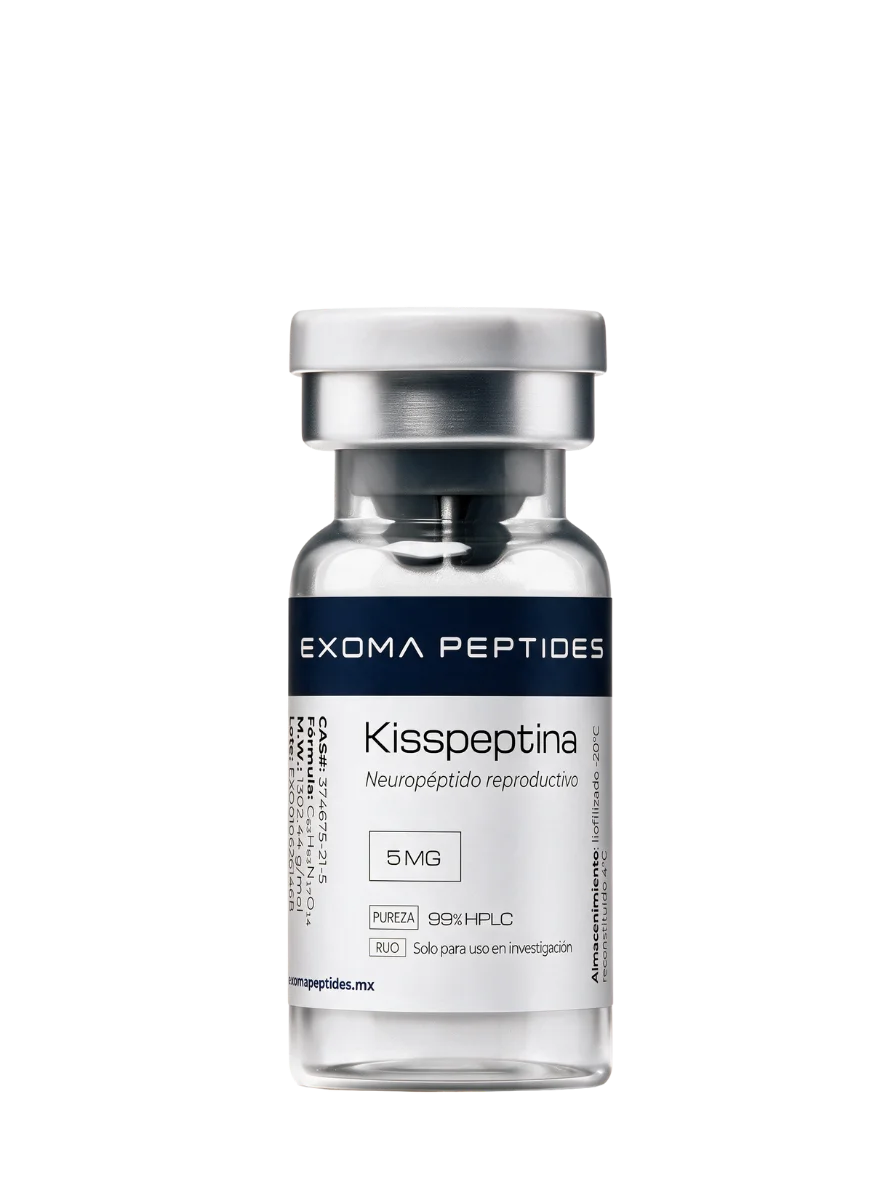
Kisspeptin
Kisspeptin — reagent for research use (RUO). HPLC purity 99.8% with COA per batch.
Technical data
- INN name
- Kisspeptin
- CAS
- 374675-21-5
- Molecular formula
- C63H83N17O14
- Molecular weight
- 1302.46 g/mol
Sizes and prices: 5 mg $780 MXN ($156 MXN per mg) · 10 mg $1,220 MXN ($122 MXN per mg).
Buy Kisspeptin in Mexico: order online with nationwide shipping in 1-4 business days depending on zone and tracking number. Prices in Mexican pesos. Material for research use only.
Kisspeptin is known internationally as Kisspeptin (English INN name). Buy Kisspeptin in Mexico / comprar Kisspeptin en México: reagent for research use (RUO) with HPLC purity, COA and nationwide shipping.
Kisspeptina is also searched as: Kisspeptin-10, Kisspeptina-10, KP-10, Metastin (45-54), Metastina, KISS1 (112-121), Kisspeptin-10 (human).
Identity and composition
Kisspeptin (Kisspeptin-10 / KP-10) is a bioactive decapeptide derived from the product of the KISS1 gene (metastin/kisspeptin-54), corresponding to its C-terminal residues 45-54. In research it is studied as an upstream regulator of the reproductive axis, capable of stimulating the physiological release of GnRH. Product for research use.
Chemical identity data (verifiable reference):
- CAS: 374675-21-5
- Molecular formula: C63H83N17O14
- Molecular weight: ~1302.5 g/mol
- Sequence: H-Tyr-Asn-Trp-Asn-Ser-Phe-Gly-Leu-Arg-Phe-NH2 (YNWNSFGLRF-NH2, C-terminal amidated)
- Synonyms: Kisspeptin-10, KP-10, Metastin (45-54), Kisspeptin 45-54, PubChem CID 25240297
It is offered in presentations of 5 mg y 10 mg.
Mechanism of action
Kisspeptin-10 is the minimal bioactive fragment of kisspeptin and acts as agonist of the G protein-coupled receptor KISS1R (GPR54). Its activation in the GnRH neurons of the hypothalamus stimulates the release of GnRH, which in turn triggers the pituitary secretion of LH and FSH, activating the hypothalamic-pituitary-gonadal (HPG) axis.
Unlike direct GnRH agonists, kisspeptin works as upstream regulator: exogenous administration induces a physiological and pulsatile release of GnRH, instead of an artificial sustained stimulation.
In models of hyperprolactinemia, where prolactin suppresses the expression of endogenous kisspeptin (many kisspeptin neurons express the prolactin receptor, but few GnRH neurons do), it has been observed that exogenous kisspeptin restores pulsatile LH secretion, suggesting that the GnRH neuronal network remains functionally intact (PMC9282259).
Pharmacokinetics
Native KP-10 is characterized by a short half-life, reported approximately between ~55 seconds and ~4 minutes, markedly shorter than that of kisspeptin-54 (KP-54: ~28 min to ~1.8 h) (PMC9125910).
This rapid kinetics favors intravenous bolus or pulsatile administration. In studies an IV bolus was used (for example, 0.24 nmol/kg), observing an LH response in less than 30 minutes (PMC9282259).
The long-acting synthetic analogues (TAK-448, TAK-683) were designed with much longer half-lives (~1.6-2.2 h and up to ~18 h, respectively), as an alternative for sustained effects (PMC9125910).
Scientific evidence
Kisspeptin-10 is a clinical/experimental research tool and not an approved drug. The available evidence comes mainly from small, early-phase studies (proof-of-concept), so its definitive therapeutic efficacy is not established (PMC9125910).
In these exploratory contexts, the following have been investigated, among others:
- Induction of ovulation and oocyte maturation in IVF, especially in patients at high risk of ovarian hyperstimulation syndrome (OHSS).
- Tests of GnRH neuronal function.
- Evaluation of puberty disorders (distinguishing physiological vs pathological hypogonadism).
- Hypothalamic amenorrhea and polycystic ovary syndrome (PCOS).
In hypothalamic amenorrhea, it was observed that chronic twice-daily administration produced complete receptor desensitization (PMC9125910). Overall, the evidence is mostly exploratory and preliminary in nature.
Research applications
Product for research use.
Ideal for research lines such as:
- Study of the HPG axis and KISS1R/GPR54 signaling in experimental models.
- Research on the pulsatile release of GnRH, LH, and FSH as an upstream regulator.
- Exploratory models of reproduction (IVF/OHSS, PCOS, hypothalamic amenorrhea) and of GnRH neuronal function at an early stage.
- Comparative characterization against KP-54 or long-acting analogs.
Not applicable for:
- Any use in humans, diagnosis, treatment, or consumption.
- Protocols that require sustained action from a single bolus, given its short half-life (KP-54 or the analogs are more appropriate for prolonged effects).
- Chronic/frequent dosing schedules without considering the risk of desensitization (tachyphylaxis).
Research protocols
The doses described correspond exclusively to research studies and are presented in a qualitative/hedged manner; they do not constitute a usage guideline.
In studies the route used was intravenous bolus, taking advantage of the short half-life of KP-10. For example, an IV bolus of 0.24 nmol/kg, with an LH response observed in under 30 minutes (PMC9282259).
It was further documented that chronic twice-daily administration in hypothalamic amenorrhea led to complete receptor desensitization, which highlights the importance of the administration pattern in experimental design (PMC9125910). The consulted literature provides no additional fixed-dose protocols by presentation (5 mg / 10 mg).
Reconstitution
Standard general laboratory guide (not a use indication): the lyophilized peptide is usually reconstituted with bacteriostatic water (sterile water with ~0.9% benzyl alcohol as preservative), which allows multiple withdrawals while maintaining relative sterility.
Usual handling recommendations:
- Allow the peptide vial to reach room temperature before reconstituting.
- Add the diluent, letting it run down the wall of the vial, without directing the stream directly onto the powder.
- Do not shake; swirl gently until fully dissolved.
- Calculate the diluent volume according to the desired concentration, considering the nominal 5 mg or 10 mg content of the vial.
For assays where the preservative may interfere, sterile water for injection may be preferred, assuming its single-use nature.
Stability and storage
General laboratory handling standard for peptides (not an indication for use):
- Lyophilized (unreconstituted): is the most stable form. It is typically stored refrigerated in the short term and frozen for long-term storage, protected from moisture and light.
- Reconstituted in solution: is less stable and must be kept refrigerated, being used within a relatively short timeframe.
Good practices: avoid repeated freeze-thaw cycles, aliquot where applicable to minimize handling of the stock, and keep the vials well closed. Since KP-10 is a decapeptide, careful handling is advisable to preserve its integrity.
Safety profile
Profile based on limited data from early-phase studies and small cohorts with short exposure; it does not constitute a safety evaluation for clinical use.
In these exploratory studies no increases in adverse events versus placebo were reported (with no significant changes in nausea, heart rate or blood pressure) nor serious adverse events, and a selective hypothalamic action was described without affecting GH, prolactin or TSH (PMC9125910).
Relevant warning: the chronic or frequent administration can cause receptor desensitization and loss of response (tachyphylaxis), observed with twice-daily dosing in hypothalamic amenorrhea (PMC9125910).
The safety data are limited to small populations and brief exposures, so the long-term profile is not characterized.
Comparative context
Within the kisspeptin family and its functional class:
- KP-10 vs KP-54: KP-10 is the minimal bioactive fragment, with potency comparable to KP-54 for activating KISS1R, but with a much shorter half-life. For this reason, KP-54 is preferable when sustained effects via bolus are sought.
- Long-acting analogs (TAK-448, TAK-683): were designed specifically to prolong the duration of action relative to native KP-10.
- Compared to direct GnRH agonists: kisspeptin acts upstream, on GnRH neurons, generating a more physiological release and, in IVF protocols, being associated with a lower risk of OHSS (PMC9125910).
The choice between these molecules depends on the experimental objective: rapid, pulsatile action (KP-10) versus sustained exposure (KP-54 or analogs).
History and development
Kisspeptin-10 is identified as the C-terminal decapeptide (residues 45-54) derived from the gene product KISS1, whose complete peptide is metastin/kisspeptin-54. It corresponds to the minimal fragment capable of activating the KISS1R receptor (GPR54), which made it a key tool for studying the role of the kisspeptin-GnRH pathway in reproduction.
Its subsequent development led to the design of long-acting synthetic analogs (TAK-448 and TAK-683), explored separately to overcome the short half-life of native KP-10. It remains an early-phase research reagent and not an approved drug (PMC9125910).
FAQ
What is Kisspeptin-10 (KP-10)?
It is a bioactive decapeptide derived from the KISS1 gene (residues 45-54 of metastin/kisspeptin-54) that acts as an agonist of the KISS1R receptor (GPR54). It is offered as a product for research use; not for clinical use.
How does KP-10 differ from KP-54?
KP-10 is the minimal bioactive fragment with potency comparable to KP-54 for activating KISS1R, but with a much shorter half-life. That is why KP-54 is usually preferred when sustained effects by bolus are sought.
What is the half-life of KP-10?
A short half-life has been reported, approximately between ~55 seconds and ~4 minutes, notably shorter than that of KP-54 (~28 min to ~1.8 h). This rapid kinetics favors bolus IV or pulsatile administration.
How is Kisspeptin-10 reconstituted?
As general laboratory guidance, the lyophilizate is usually reconstituted with bacteriostatic water, adding it down the wall of the vial and swirling gently without shaking until dissolved, calculating the volume according to the 5 mg or 10 mg in the vial.
How is KP-10 stored?
The lyophilizate is the most stable form: refrigerated for the short term and frozen for the long term, protected from humidity and light. Once reconstituted it must be kept refrigerated and used within a short window, avoiding freeze-thaw cycles.
What is known about its safety?
In early-phase studies, no increases in adverse events versus placebo or serious events were reported, with a selective hypothalamic action. However, frequent administration can cause desensitization (tachyphylaxis). The data are limited and of a research nature.
Customer reviews
Average rating: 4.9 out of 5, based on 7 customer ratings.
Ximena F. — 5/5
The Kisspeptin arrived on time and in good order. I loved that the box came perfectly sealed and with clear batch information.
Manuel E. — 5/5
Very happy with the Kisspeptin purchase. The delivery service met exactly what was promised.
Joaquin G. — 5/5
Top-notch personalized service. They resolve everything in minutes.
Tomás L. — 4/5
Meets expectations. Fast shipping.
Lucero G. — 5/5
One of the few reliable Kisspeptin suppliers.
Gabriela I. — 5/5
The Kisspeptin arrived in excellent condition and very fast. Very happy with the purchase.
Certificate of analysis per batch
Kisspeptin batch with certificate of analysis published in the COA catalog:
- Lot EXO010626146B — 5 mg, issued 2026-05-30
Scientific references (4)
Peer-reviewed literature on Kisspeptin, with its PubMed identifier where available:
- Kisspeptin and Endometriosis-Is There a Link? (Meczekalski B et al. · Journal of clinical medicine · 2024) PMID 39768606.
- The metastasis suppressor gene KiSS-1 encodes kisspeptins, the natural ligands of the orphan G protein-coupled receptor GPR54 (Kotani, et al. · Journal of Biological Chemistry · 2001) PMID 11457843.
- The GPR54 gene as a regulator of puberty (Seminara, et al. · The New England Journal of Medicine · 2003) PMID 14573733.
- Kisspeptin-54 stimulates the hypothalamic-pituitary gonadal axis in human males (Dhillo, et al. · The Journal of Clinical Endocrinology & Metabolism · 2005) PMID 16174713.
Full scientific profile: Kisspeptin in the compendium — mechanism of action, studies and technical data sheet.
See the full category catalog: Hormonal.