
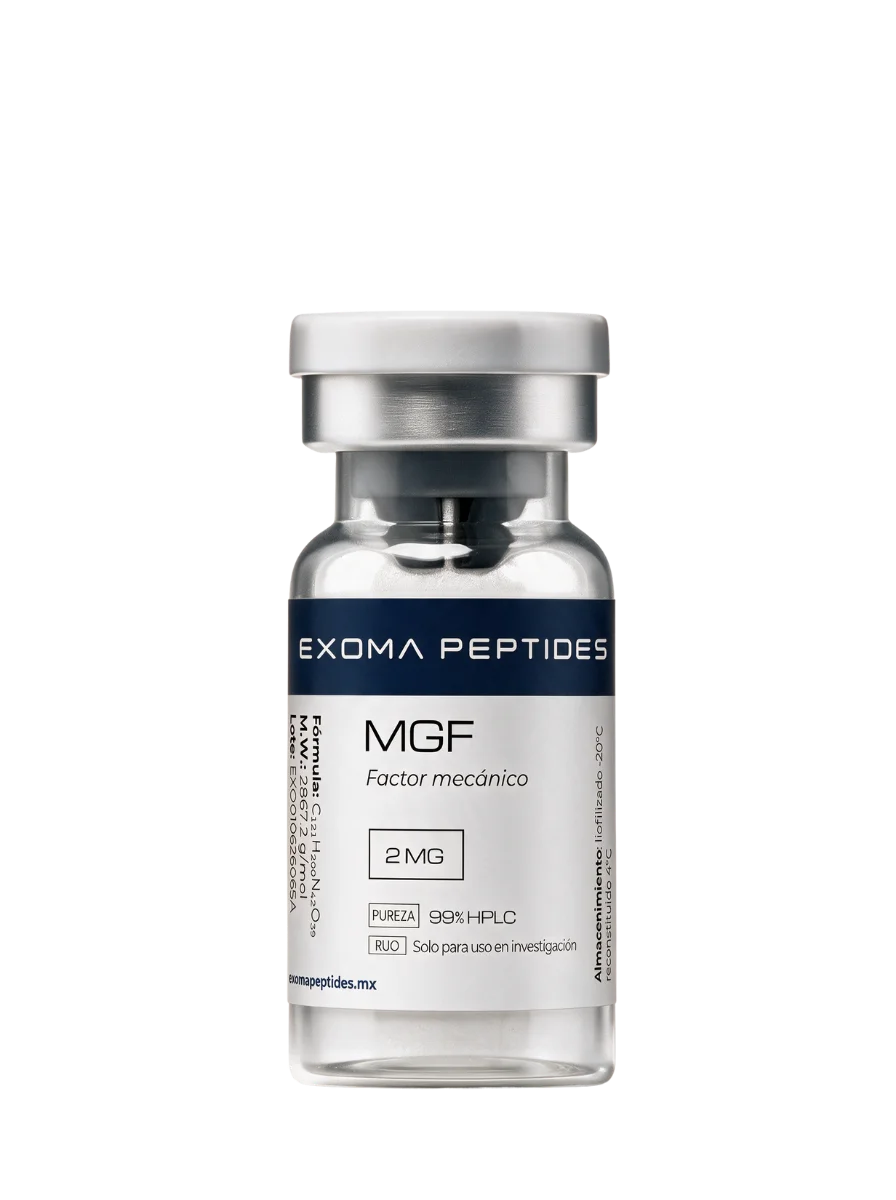
MGF
MGF — reactivo for research (RUO). Contenido revisado por el Dr. Jesús Jaramillo.
Technical data
- INN name
- Mechano Growth Factor
Sizes and prices: 2 mg $780 MXN ($390 MXN per mg).
Buy MGF in Mexico: order online with nationwide shipping in 1-4 business days depending on region, with a tracking number. Prices in Mexican pesos. Material for research use only.
MGF is known internationally as Mechano Growth Factor (English INN name). Buy Mechano Growth Factor in Mexico / comprar Mechano Growth Factor en México: reagent for research use (RUO) and nationwide shipping.
MGF is also searched as: Factor de Crecimiento Mecanico, IGF-1 Ec, Peptido E de MGF, MGF E-peptide.
Identity and composition
MGF (Mechano Growth Factor / IGF-1Ec) is a peptide corresponding to the C-terminal E domain of a splice variant of the IGF-1 gene. It is studied in preclinical research on skeletal muscle repair and regeneration. Product for research use.
From the standpoint of chemical identity, MGF is a 24-amino-acid peptide from the E domain of the human IGF-1Ec isoform, with the following sequence:
- Sequence: YQPPSTNKNTKSQRRKGSTFEERK (Tyr-Gln-Pro-Pro-Ser-Thr-Asn-Lys-Asn-Thr-Lys-Ser-Gln-Arg-Arg-Lys-Gly-Ser-Thr-Phe-Glu-Glu-Arg-Lys)
- Molecular formula: C121H199N41O40
- Molecular weight: ~2868.2 g/mol (corroborated by PubChem CID 175675731 and the reference chembox)
Among its synonyms are Mechano Growth Factor, IGF-1Ec, IGF-1 Ec, MGF E-peptide, IGF-1Eb (homolog in rodents) and MGF-24aa-E peptide. No confirmed CAS number is available in authoritative chemistry sources, so that datum is deliberately omitted.
Mechanism of action
MGF is a splice variant (alternative splicing) of the IGF-1 gene. A 49-base-pair insert in humans (52 bp in rodents) causes a reading-frame shift that generates a distinct C-terminal E domain of ~24-25 amino acids, different from that of the circulating hepatic-origin isoform IGF-1Ea. Its expression is induced in specific tissues —notably skeletal muscle— in response to mechanical overload or to injury/pathological stimuli.
The review literature describes that the synthetic E-domain peptide would have biological activity independent of the mature IGF-1 domain and that it would not act primarily through the IGF-1 receptor; among the proposed sites of action is the cell nucleus, with signaling via the PKC and MAPK/ERK pathways. In muscle, it has been described as activating quiescent satellite cells (muscle stem cells) so that they re-enter the cell cycle and proliferate, delaying their fusion/differentiation (Zablocka/Goldspink 2012; PMID PMC3485521).
It is important to note that the existence and physiological role of endogenous E-peptides remain unconfirmed. In addition, a 2014 study found that the synthetic MGF peptide had no effect on the proliferation of several types of muscle cells, which directly challenges the satellite cell activation hypothesis (Fornaro et al. 2014; PMID 24253050).
Pharmacokinetics
The synthetic unmodified peptide E is described as of rapid metabolization in vivo, with a short-duration local action according to the review literature. No precise documented half-life values are available in the peer-reviewed sources that could be confirmed: the short half-life figures (on the order of minutes) that are usually cited, as well as the long-acting pegylated derivative (PEG-MGF), appear only in non-authoritative or vendor sources and are not verified here. For this reason, this profile is described only qualitatively: rapid action and short life, with no reliable numbers available.
Scientific evidence
The evidence on MGF is preliminary and of basic research (preclinical): it has been studied in vitro and in animal models, mainly in the repair/regeneration of skeletal muscle and the activation of satellite cells. No approved therapeutic indications or completed efficacy trials in humans were identified.
The evidence base is furthermore contradictory. Some reviews describe a plausible role in muscle repair and report that the MGF-24aa-E peptide would activate satellite cells (Zablocka/Goldspink 2012; PMID PMC3485521). However, a controlled study observed that the synthetic MGF peptide did not reproduce proliferative effects on myoblasts or muscle stem cells, and the functional endogenous E-peptide has not been confirmed (Fornaro et al. 2014; PMID 24253050). Reviews also note that MGF appears in illicit doping products despite the lack of sufficient data in humans. Overall: with no established clinical phase and with efficacy in humans unproven.
Research applications
Product for research use.
Ideal for (in a research context):
- In vitro and animal-model studies on repair and regeneration of skeletal muscle.
- Exploratory research on satellite cell biology and proposed signaling pathways (PKC, MAPK/ERK).
- Comparative work against mature IGF-1 and the systemic isoform IGF-1Ea to characterize the activity of the isolated E domain.
Not applicable for:
- Any use in humans, diagnosis, treatment, or consumption.
- Applications that presuppose clinical efficacy: there is no established clinical phase or efficacy results in humans.
- Uses that assume satellite cell activation as a fact, given the contradictory evidence.
Research protocols
No clinical dosing protocols are available: no human efficacy trials or established clinical phase were identified, so no clinical doses are documented here.
In the in vitro experimental context, the only concentration reference supported by the consulted literature comes from a cell culture study, in which the synthetic MGF peptide was evaluated up to 500 ng/ml on C2C12 cells, primary human myoblasts, and mouse muscle stem cells, with no increase in proliferation observed (Fornaro et al. 2014; PMID 24253050). This datum corresponds to an in vitro design and does not constitute a dosing guideline. Any experimental protocol must be defined within a controlled research framework.
Reconstitution
As a general standard laboratory guide for lyophilized peptides: reconstitution is usually performed with bacteriostatic water (water for injection with ~0.9% benzyl alcohol as preservative), added slowly along the vial wall onto the lyophilized powder.
- Let the liquid run over the peptide instead of directing the stream directly onto it.
- Gently swirl the vial (without shaking vigorously) until fully dissolved; avoid foam formation.
- Choose the solvent volume according to the working concentration desired for your experimental design.
This is only a qualitative laboratory handling guide, not an instruction for use in living beings.
Stability and storage
As standard laboratory handling practice for peptides:
- Lyophilized (powder): is the most stable form. It is usually kept refrigerated for short-term storage and frozen for long-term storage, protected from light and moisture.
- Reconstituted (in solution): less stable; it is generally kept refrigerated and used within a limited time window. For longer-term storage, freezing is usually resorted to, avoiding repeated freeze-thaw cycles as much as possible.
In addition, the review literature describes that the unmodified E peptide is rapidly metabolized in vivo, which reinforces the importance of careful handling and of preparing working solutions shortly before their experimental use.
Safety profile
El the safety profile in humans is undetermined. No systematic clinical safety data were identified in the reviewed sources. Reviews note that MGF has been used in unregulated/illegal doping products despite the lack of sufficient efficacy and safety data in humans (Zablocka/Goldspink 2012; PMID PMC3485521).
No documented contraindications or adverse-event rates are found in the available sources, precisely because of the absence of safety studies. For this reason, handling must be limited to research conditions with the appropriate laboratory precautions. Product for research use.
Comparative context
MGF (IGF-1Ec) is contrasted with mature IGF-1 and with the systemic isoform IGF-1Ea:
- Origin: MGF arises from alternative splicing of the IGF-1 gene and gives rise to a distinct C-terminal E domain; IGF-1Ea is the circulating isoform of hepatic origin.
- Proposed mechanism: it is proposed that the E domain of MGF acts locally and independently of the IGF-1 receptor, whereas mature IGF-1 signals through IGF-1R.
- Observed activity: in the study by Fornaro et al. (2014; PMID 24253050), the cell types evaluated responded proliferatively to mature IGF-1 or to full-length IGF-1Eb, but no to the isolated MGF E-peptide, which indicates that the E domain by itself would lack the mitogenic activity of the intact IGF-1 molecule.
In summary, compared with its class, MGF represents the isolated portion of the E domain, whose own biological activity remains the subject of scientific debate.
History and development
MGF was identified and described as a splice variant of the IGF-1 gene whose expression is induced in specific tissues, above all skeletal muscle, upon mechanical overload or injury, hence the name "Mechano Growth Factor." Research interest centered on its distinctive C-terminal E domain (24-25 amino acids), proposed as a local repair signal different from that of circulating IGF-1.
The review work by Zablocka, Goldspink, and colleagues (2012; PMID PMC3485521) systematized the hypothesis of muscle repair and satellite cell activation by the MGF-24aa-E peptide. Subsequently, the study by Fornaro et al. (2014; PMID 24253050) questioned that hypothesis by failing to reproduce proliferative effects with the synthetic peptide. The compound remains within the scope of basic research, with no approved therapeutic indications and with the physiological existence of the endogenous E-peptide still unconfirmed.
FAQ
What exactly is MGF and what is it researched for?
MGF (Mechano Growth Factor / IGF-1Ec) is a peptide from the C-terminal E domain of a splice variant of the IGF-1 gene. It is studied in preclinical research, mainly in vitro and in animal models, in the repair and regeneration of skeletal muscle and the activation of satellite cells. It has no approved indications nor proven efficacy in humans. It is a product for research use; not for clinical use.
Does MGF really activate the satellite cells of the muscle?
The evidence is contradictory. A 2012 review (PMID PMC3485521) describes that the MGF-24aa-E peptide would activate satellite cells, but a controlled 2014 study (PMID 24253050) did not reproduce proliferative effects with the synthetic peptide up to 500 ng/ml. Moreover, the existence of the functional endogenous E-peptide is not confirmed, so it is a hypothesis under debate, not an established fact.
What is the molecular weight and sequence of MGF?
It is a 24-amino-acid peptide with sequence YQPPSTNKNTKSQRRKGSTFEERK, molecular formula C121H199N41O40 and an approximate molecular weight of 2868.2 g/mol (corroborated by PubChem CID 175675731). A confirmed CAS number is not available in authoritative chemistry sources, so that datum is omitted.
How does MGF differ from IGF-1?
MGF (IGF-1Ec) arises by alternative splicing of the IGF-1 gene and it is proposed that its E domain acts locally and independently of the IGF-1 receptor, whereas mature IGF-1 signals through IGF-1R. In the study by Fornaro et al. (2014), cells responded to mature IGF-1 or full IGF-1Eb, but not to the isolated MGF E-peptide.
How is MGF reconstituted and stored?
As a general laboratory guideline, the lyophilizate is usually reconstituted with bacteriostatic water added slowly down the wall of the vial, swirling it gently without shaking. As a powder it is kept refrigerated or frozen for prolonged storage; once reconstituted, it is refrigerated and used within a limited window, avoiding repeated freeze-thaw cycles.
Is there safety information on MGF in humans?
No. The safety profile in humans is undetermined and no systematic clinical safety data were identified. Reviews note that MGF has appeared in unregulated doping products despite the lack of sufficient data. For this reason its handling should be limited to research conditions. Product for research use; not for clinical use.
Scientific references (5)
Peer-reviewed literature on MGF, with its PubMed identifier when available:
- Preferential expression of IGF-1Ec (MGF) transcript in cancerous tissues of human prostate: evidence for a novel and autonomous growth factor activity of MGF E peptide in human prostate cancer cells (Armakolas A et al. · The Prostate · 2010) PMID 20564425.
- Mechano Growth Factor E peptide (MGF-E), derived from an isoform of IGF-1, activates human muscle progenitor cells and induces an increase in their fusion potential at different ages (Kandalla, et al. · Mechanisms of Ageing and Development · 2011) PMID 21354439.
- Insulin-like growth factor I (IGF-1) Ec/Mechano Growth factor--a splice variant of IGF-1 within the growth plate (Schlegel, et al. · PLoS One · 2013) PMID 24146828.
- Mechano-growth factor peptide, the COOH terminus of unprocessed insulin-like growth factor 1, has no apparent effect on myoblasts or primary muscle stem cells (Fornaro, et al. · American Journal of Physiology-Endocrinology and Metabolism · 2014) PMID 24253050.
- Overload training inhibits phagocytosis and ROS generation of peritoneal macrophages: role of IGF-1 and MGF. (Xiao W, et al. · Eur J Appl Physiol · 2013) PMID 22592456.
Full scientific profile: MGF in the compendium — mechanism of action, studies and technical data sheet.
See the full category catalog: Hormonal · Recovery.