
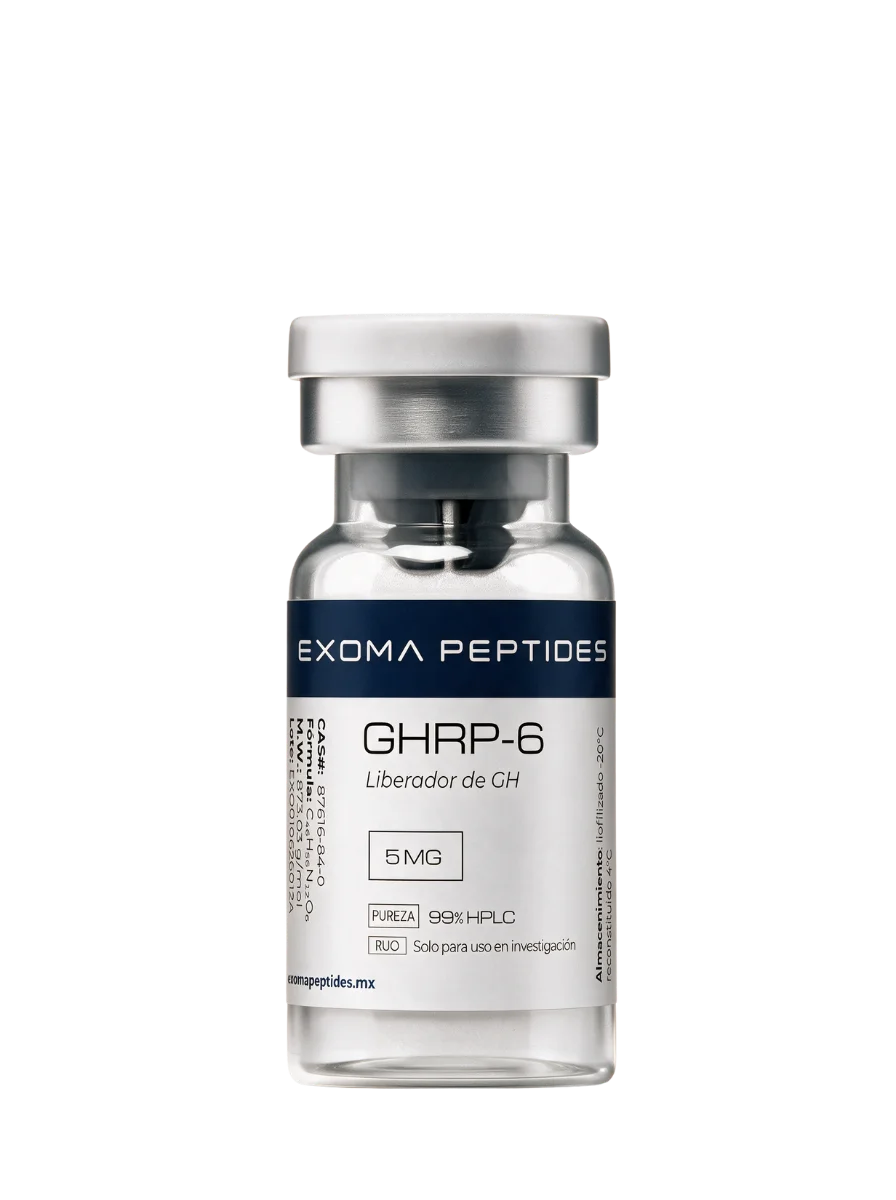
GHRP-6
GHRP-6 — reagent for research use (RUO). COA per batch available.
Technical data
- Development code
- SKF-110679
- CAS
- 87616-84-0
- Molecular formula
- C46H56N12O6
- Molecular weight
- 873.03 g/mol
Sizes and prices: 5 mg $520 MXN ($104 MXN per mg) · 10 mg $799 MXN ($80 MXN per mg).
Buy GHRP-6 in Mexico: order online with nationwide shipping in 1-4 business days depending on zone and tracking number. Prices in Mexican pesos. Material for research use only.
GHRP-6 is also searched as: [His1, Lys6]-GHRP, GHRP-6 acetato, SKF-110679.
Identity and composition
GHRP-6 (Growth Hormone Releasing Peptide-6) is a synthetic hexapeptide growth hormone secretagogue that is investigated for its ability to stimulate the pulsatile release of GH by acting as a ghrelin mimetic. It is a research-use compound, without marketing authorization. Product for research use.
Chemical identity:
- Name: GHRP-6 (growth hormone-releasing hexapeptide; Hexapeptide-2)
- Sequence: His-D-Trp-Ala-Trp-D-Phe-Lys-NH2 (L-histidyl-D-tryptophyl-L-alanyl-L-tryptophyl-D-phenylalanyl-L-lysinamide)
- Molecular formula: C46H56N12O6
- Molecular weight: 873.03 g/mol (free base; ~872.44 monoisotopic)
- CAS: 87616-84-0 (free base); 145177-42-0 (acetate salt)
- Synonyms: Growth hormone-releasing hexapeptide, Hexapeptide-2, SKF-110679, U-75799E, HWAWFK-NH2, PubChem CID 4345065
Note: the canonical salt form (free base versus acetate) could not be definitively confirmed in a single authoritative record in the literature consulted.
Mechanism of action
GHRP-6 is a growth hormone secretagogue that behaves as ghrelin mimetic: agonizes the growth hormone secretagogue receptor 1a (GHS-R1a), a Gq/11-coupled GPCR expressed in the somatotrophs of the anterior pituitary and in neurons of the hypothalamic arcuate nucleus.
Receptor activation drives the activity of phospholipase C, IP3-mediated intracellular calcium mobilization and the exocytosis of GH vesicles, which produces a release pulsatile of growth hormone. This effect occurs through a pathway distinct from that of GHRH and, according to the literature, GHRP-6 and GHRH can act synergistically on GH release.
In studies in healthy men it has been observed that the orally administered GHRP stimulates GH secretion in a dose-dependent manner, increasing the amplitude of the secretory pulse rather than its frequency (Hartman et al., 1992; PMID 1592884).
By activating the same receptor as ghrelin, effects are also attributed to it orexigenic (appetite stimulation). The D-amino acids in its sequence (D-Trp, D-Phe) confer resistance to degradation by peptidases. Despite deriving structurally from met-enkephalin analogs, it lacks opioid activity.
Pharmacokinetics
The pharmacokinetic data come mainly from a single-dose IV study in nine healthy male volunteers (Cabrales et al., 2013; PMID 23099431).
- After a single IV bolus (100/200/400 µg/kg), the plasma disposition fit a model bicompartmental (biexponential), with R2 > 0.99.
- Distribution half-life: ~7.6 +/- 1.9 min.
- Elimination half-life: ~2.5 +/- 1.1 h.
- El AUC increased in a dose-proportional manner.
Oral bioavailability is low (reported as <1%, a figure cited by a secondary source and not confirmed as a primary value). Even so, the oral dose produces measurable GH release, with a slower onset and similar duration (~120-150 min) compared to the IV route (Hartman et al., 1992; PMID 1592884).
Scientific evidence
The available evidence is preliminary and mostly of early phase or mechanistic; GHRP-6 is a research peptide without marketing authorization for any indication, is not approved by the FDA and is prohibited in sport by WADA (class S2).
Work in humans includes single-dose IV pharmacokinetics and safety studies in healthy male volunteers (Cabrales et al., 2013; PMID 23099431) and oral GH provocation studies in normal men (Hartman et al., 1992; PMID 1592884). Historically it has been used as diagnostic probe of the pituitary GH reserve and as a template for the subsequent development of drugs targeting the ghrelin system.
The reports on body composition, glucose metabolism, memory and cardioprotection should be considered hypothesis-generating: robust controlled efficacy trials for a defined therapeutic indication are lacking.
Research applications
Product for research use.
Within an exclusively research context, GHRP-6 has been used as:
- Tool for studying GHS-R1a receptor signaling and the ghrelin pathway.
- Probe of the pituitary GH reserve in experimental models and mechanistic studies of pulsatile growth hormone release.
- Reference compound (first-generation prototype) to compare later analogs of the GHS/GHRP class.
- Subject of single-dose pharmacokinetics and safety study within the research framework described in the literature.
Not applicable for: clinical use, therapeutic use, clinical diagnosis outside research, or use in sport (it is prohibited by WADA, class S2). There is no regulatory authorization for any indication.
Research protocols
The doses described below correspond solely to what is reported in research studies and do not constitute a usage guideline.
- In the IV pharmacokinetics study, ... were administered single boluses of 100, 200 and 400 µg/kg intravenously in healthy male volunteers (Cabrales et al., 2013; PMID 23099431). - In the GH provocation studies, administration was documented oral dose-dependent, with a slower onset and a duration of ~120-150 min compared to the IV route (Hartman et al., 1992; PMID 1592884).
No validated repeated or chronic dosing protocol is available in the literature consulted, and there is no approved therapeutic regimen. Any handling must be limited to research contexts with appropriate controls.
Reconstitution
General standard laboratory guide for lyophilized peptides (not a clinical-use instruction):
- Lyophilized peptides such as GHRP-6 are usually reconstituted with bacteriostatic water (sterile water with 0.9% benzyl alcohol) for research work.
- Add the diluent slowly along the vial wall, letting it run down onto the pellet rather than directing it straight onto the powder.
- Do not shake; gently swirl the vial until fully dissolved to prevent degradation of the peptide.
- The diluent volume is chosen according to the concentration desired for the experimental work (for example, for 5 mg and 10 mg presentations).
These are general laboratory-handling practices and not a recommendation for administration.
Stability and storage
General handling and stability recommendations for lyophilized peptides (laboratory standard):
- Lyophilized (powder): store frozen, protected from light and moisture. In the dry state, peptides usually maintain their stability for prolonged periods at -20 °C or lower.
- Reconstituted (in solution): keep refrigerated (2-8 °C) and use within a short period; avoid repeated freeze-thaw cycles.
- Minimize exposure to light, heat and air.
The structure of GHRP-6 incorporates D-amino acids (D-Trp, D-Phe) that confer resistance to degradation by peptidases, but this does not substitute good storage practices. These indications are general handling ones and do not guarantee a specific preservation period.
Safety profile
The safety profile should be interpreted with caution: there is no set of long-term safety data in humans and it is not an approved drug.
- In dose-escalation studies in healthy volunteers (Cuban studies), IV GHRP-6 was tolerated at the clinical doses studied (Cabrales et al., 2013; PMID 23099431).
- At the class level, the following have been considered transient effects on other pituitary axes (cortisol, prolactin, ACTH) and appetite stimulation by activation of the ghrelin receptor.
- The complete profiles of adverse events, contraindications, and chronic toxicity were not confirmed in a primary regulatory source and should be considered not established.
No chronic toxicity or carcinogenicity data are available. As this is a research compound, any handling must be carried out under controlled conditions.
Comparative context
Within the GH secretagogue / GHRP class, GHRP-6 is the prototypical first-generation hexapeptide and presents distinctive features:
- Compared to GHRP-2 and ipamorelin: GHRP-6 is notably more orexigenic (greater ghrelin-like effect on appetite). Ipamorelin is described as more selective for GH release, with a lower effect on cortisol, prolactin, and appetite.
- Compared to GHRH: GHRP-6 acts through the receptor GHS-R1a and not the GHRH receptor; both can act synergistically on GH release.
- Structure-activity relationship: the D-Lys3 analog is a well-known antagonist of the GHS-R1a, which illustrates the importance of the structure within the series.
In summary, GHRP-6 combines potent GH release with a marked orexigenic effect, a characteristic that distinguishes it from later, more selective analogs.
History and development
GHRP-6 emerged from the pioneering work of the Bowers era on growth hormone secretagogues, deriving structurally from analogs of met-enkephalin but without retaining opioid activity. It became the prototypical first-generation hexapeptide of the GHS/GHRP class.
Historically it was used as diagnostic probe of the pituitary GH reserve and as template for the subsequent development of drugs targeting the ghrelin system (for example, agents explored for GH deficiency and for cachexia/muscle wasting). The work in humans has been mainly early-phase: pharmacokinetic and safety studies of a single IV dose (Cabrales et al., 2013; PMID 23099431) and oral GH-provocation studies (Hartman et al., 1992; PMID 1592884). To date it does not have marketing authorization for any indication.
FAQ
What is GHRP-6 and what is it studied for?
GHRP-6 (Growth Hormone Releasing Peptide-6) is a synthetic hexapeptide growth hormone secretagogue that acts as a ghrelin mimetic on the GHS-R1a receptor. In research, its ability to stimulate the pulsatile release of GH and its use as a probe of pituitary reserve have been studied. It is a product for research use; not for clinical use.
What is the half-life of GHRP-6?
In a single-dose IV study in healthy male volunteers, the disposition fit a two-compartment model, with a distribution half-life of ~7.6 minutes and an elimination half-life of ~2.5 hours (Cabrales et al., 2013; PMID 23099431).
How does GHRP-6 differ from GHRP-2 and ipamorelin?
GHRP-6 is the prototypical first-generation hexapeptide and is notably more orexigenic (greater appetite stimulation, ghrelin-like effect) than later analogs. Ipamorelin is described as more selective for GH release, with less effect on cortisol, prolactin and appetite.
Is GHRP-6 approved or safe for clinical use?
No. GHRP-6 is a research peptide without marketing authorization, it is not approved by the FDA and it is prohibited in sport by WADA (class S2). There is no long-term safety dataset in humans. It is a product for research use; not for clinical use.
How is GHRP-6 reconstituted and stored?
As a general laboratory guide, lyophilized peptides are usually reconstituted with bacteriostatic water added slowly down the wall of the vial, without shaking. The lyophilized powder is stored frozen, protected from light and humidity; once reconstituted it is kept refrigerated and freeze-thaw cycles are avoided.
What effects have been observed in studies with GHRP-6?
In healthy males it has been observed to stimulate GH secretion in a dose-dependent manner, increasing the amplitude of the secretory pulse (Hartman et al., 1992; PMID 1592884). Reports on body composition, glucose, memory and cardioprotection are preliminary and hypothesis-generating; robust controlled evidence is lacking.
Customer reviews
Average rating: 4.0 out of 5, based on 2 customer ratings.
Leticia V. — 4/5
Good product for a bulking phase. High quality.
Cristina G. — 4/5
Reliable product with complete documentation.
Certificate of analysis per batch
GHRP-6 lots with certificate of analysis published in the COA catalog:
- Lot EXO010626012A — 5 mg, issued 2026-05-30
- Lot EXO010626012B — 10 mg, issued 2026-05-29
Scientific references (6)
Peer-reviewed literature on GHRP-6, with its PubMed identifier when available:
- [D-Lys3]-GHRP-6 exhibits pro-autophagic effects on skeletal muscle (Yu AP et al. · Molecular and cellular endocrinology · 2015) PMID 25450862.
- d-Lys-GHRP-6 does not modify the endocrine response to acylated ghrelin or hexarelin in humans (Benso A et al. · Neuropeptides · 2007) PMID 17112585.
- Growth hormone releasing hexapeptide-6 (GHRP-6) test in the diagnosis of GH-deficiency (Pombo M et al. · Journal of pediatric endocrinology & metabolism: JPEM · 1996) PMID 8887178.
- Growth hormone (GH)-releasing peptide-6 requires endogenous hypothalamic GH-releasing hormone for maximal GH stimulation (Pandya, et al. · The Journal of Clinical Endocrinology & Metabolism · 1998) PMID 9543138.
- Growth hormone-releasing effect of oral growth hormone-releasing peptide 6 (GHRP-6) administration in children with short stature (Bellone, et al. · European Journal of Endocrinology · 1995) PMID 7581965.
- Growth hormone releasing peptide (GHRP-6) stimulates phosphatidylinositol (PI) turnover in human pituitary somatotroph cells (Lei, et al. · Journal of Molecular Endocrinology · 1995) PMID 7772238.
Full scientific profile: GHRP-6 in the compendium — mechanism of action, studies and technical data sheet.
See the full category catalog: Hormonal · Metabolism.