
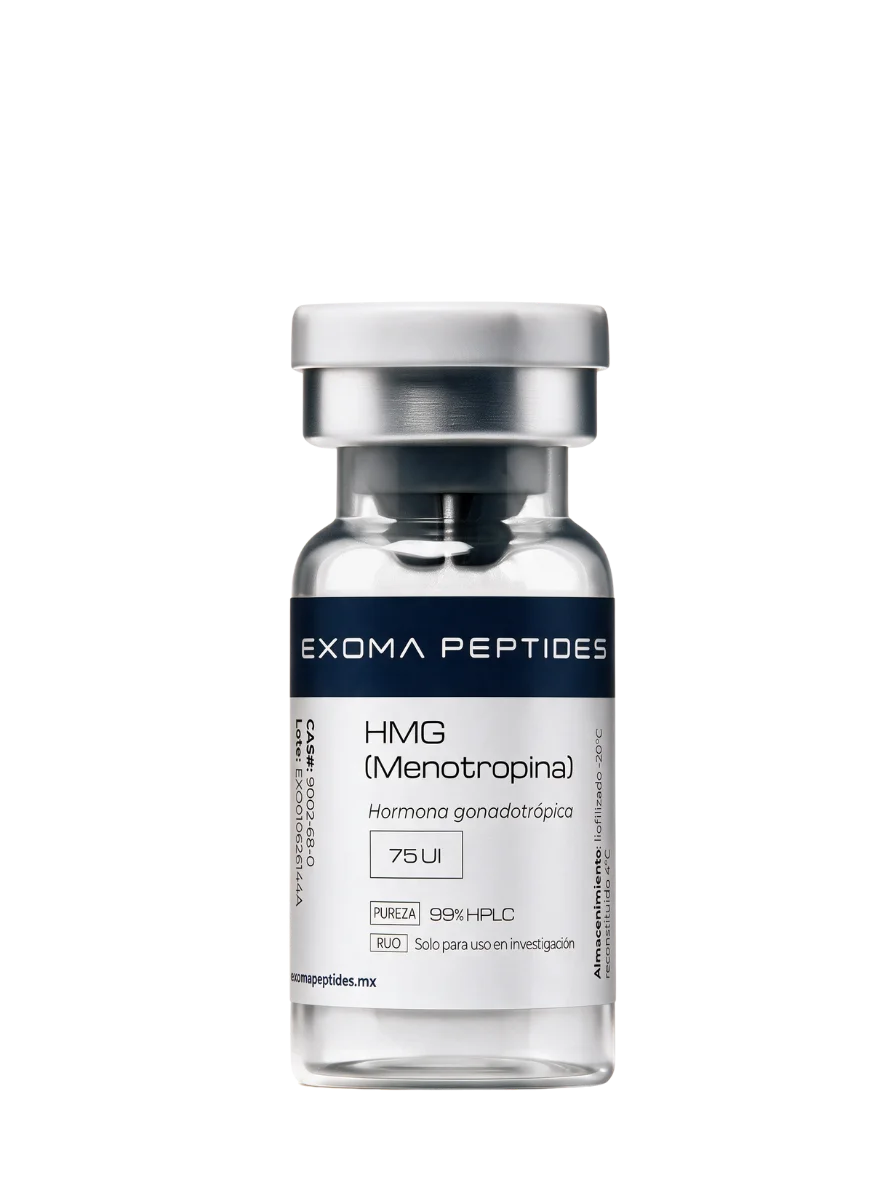
HMG (Menotropin)
HMG (Menotropin) — research reagent (RUO).
Technical data
- INN name
- HMG (Menotropins)
- CAS
- 61489-71-2
Sizes and prices: 75 IU $950 MXN.
Buy HMG (Menotropin) in Mexico: order online with nationwide shipping in 1-4 business days depending on zone and tracking number. Prices in Mexican pesos. Material for research use only.
HMG (Menotropin) is known internationally as HMG (Menotropins) (INN name in English). Buy HMG (Menotropins) in Mexico / buy HMG (Menotropins) in Mexico: research reagent (RUO) and nationwide shipping.
HMG (Menotropina) is also searched as: Menotropinas, Menotropins, Human Menopausal Gonadotropin, hMG.
Identity and composition
La HMG (menotropin), also called human menopausal gonadotropin, is a purified biological preparation obtained from the urine of postmenopausal women, which provides combined activity of follicle-stimulating hormone (FSH) y luteinizing hormone (LH), traditionally standardized in an approximate 1:1 ratio (by convention, 75 IU of FSH and 75 IU of LH per vial). It is investigated in the context of ovarian stimulation and reproductive medicine.
As it is a heterogeneous biological extract (a mixture of glycoproteins with different glycosylation patterns), it is not appropriate to assign it a single molecular formula, molecular weight, or sequence, so these parameters do not apply to this compound. In the preparations highly purified (HP-hMG), much of the LH-type bioactivity comes from hCG present and concentrated in the source urine.
Its synonyms include: Menotropins, Human Menopausal Gonadotropin, hMG, HP-hMG (highly purified menotropin) and the brand Menopur.
Product for research use.
Mechanism of action
HMG acts as agonist of the FSH and LH/hCG receptors. The component FSH stimulates the recruitment and growth of ovarian follicles in the early phases of folliculogenesis, while the component LH/hCG supports ovarian steroidogenesis -androgen synthesis in the theca cells as a substrate for aromatization to estradiol- and contributes to the development of the preovulatory follicle in the late phases.
In highly purified preparations, the LH-like bioactivity derives largely from the hCG concentrated in the urine of origin (PMID 28476487). Because of its nature as a mixture of glycoproteins with different glycosylation patterns, no single molecular structure is assigned to it (PMID 32416978).
Pharmacokinetics
The specific pharmacokinetics of HMG was not confirmed with an open primary source in this review, so it is described qualitatively and with reservations. The dynamics are usually characterized from its FSH component, with slow absorption after intramuscular or subcutaneous administration and prolonged elimination; however, a numerical half-life value was not verified here, so no specific figure is reported.
Scientific evidence
HMG is a compound with established clinical use in reproductive medicine, not an early experimental compound; it has been studied for decades in the context of ovarian stimulation. The recent literature includes randomized controlled trials comparing highly purified menotropin (HP-hMG) against recombinant FSH and among different HMG preparations, focusing on oocyte yield, pregnancy or live-birth rates, and safety.
In the trial MEGASET-HR, in high-responder patients undergoing ICSI, HP-hMG was observed to be associated with lower incidence of ovarian hyperstimulation syndrome versus recombinant FSH, with comparable live birth rates (PMID 32416978). Another randomized trial confirmed that HMG is an FSH+LH preparation whose LH bioactivity derives from hCG, used in ovarian stimulation for IVF (PMID 28476487).
Claims of relative superiority should be interpreted with caution, since they depend on the clinical context and the population studied.
Research applications
Use framing: Product for research use.
It may be of interest for research relating to:
- Study of the dual signaling of FSH and LH/hCG receptors.
- In vitro models of ovarian folliculogenesis and steroidogenesis.
- Comparisons of biological preparations (HMG vs recombinant FSH or purified urinary FSH) within the framework of reproductive endocrinology.
Not applicable for:
- Any form of human consumption, self-administration or therapeutic use.
- Diagnostic or clinical use outside a regulated setting.
This material is offered only as a laboratory research reagent.
Research protocols
HMG is conventionally presented standardized per vial in an approximate 1:1 ratio, with 75 IU of FSH and 75 IU of LH per unit, which is the reference basis for the product's composition.
Regarding specific dosing protocols used in the studies (regimens, total doses, or duration per treatment arm), the literature consulted does not provide specific trial dose figures, so they are not reported here. The available trials are framed in contexts of controlled ovarian stimulation for IVF/ICSI (PMID 32416978; PMID 28476487), but any numerical protocol parameter must be consulted directly in the corresponding primary source.
Reconstitution
As a general laboratory handling guide, lyophilized peptides and preparations are usually reconstituted with bacteriostatic water (sterile water with approximately 0.9% benzyl alcohol as preservative), added slowly down the wall of the vial without vigorous shaking; it is advisable to let the solid dissolve on its own or with a gentle swirl to avoid the mechanical degradation of the material.
This instruction is a standard laboratory technique and does not constitute a recommendation for clinical use. The reconstitution volume is chosen according to the working concentration desired for the experiment.
Stability and storage
As a general handling standard:
- Lyophilized (unreconstituted): the dry material is the most stable; it is usually stored refrigerated and, for long-term storage, frozen, protected from light and moisture. - Reconstituted: once in solution, stability decreases; it is handled refrigerated and it is recommended to avoid repeated freeze-thaw cycles, which can degrade the biological activity of the glycoproteins.
These are qualitative laboratory storage guidelines; the consulted literature does not provide specific numerical stability data for this compound.
Safety profile
The main documented risk associated with ovarian stimulation with HMG is ovarian hyperstimulation syndrome (SHO/OHSS) and the multiple pregnancy.
In the MEGASET-HR trial, in high-response patients, HP-hMG was associated with lower overall incidence of OHSS compared to recombinant FSH (9.7% vs 21.4%), with comparable cumulative live-birth rates (PMID 32416978). Other HMG preparations showed equivalent OHSS safety profiles among themselves.
Since it is a product of urinary/biological origin, general considerations of possible hypersensitivity reactions apply. All the information is presented for research purposes and not as clinical guidance; this product is not intended for clinical use.
Comparative context
Within its class of gonadotropins, HMG is distinguished by its combined FSH and LH content:
- Compared to recombinant FSH (rFSH): HMG additionally provides LH/hCG activity, which can favor ovarian steroidogenesis. In high-response populations, randomized data suggest comparable efficacy with a lower incidence of OHSS for HP-hMG (PMID 32416978).
- Compared to purified urinary FSH: HMG is distinguished by its combined composition of FSH+LH in an approximate 1:1 ratio, whereas purified FSH lacks that added luteinizing activity.
The interpretation of these differences depends on the experimental context and the study population.
History and development
HMG has a well-established origin in the history of reproductive medicine: it has been used since the decades of 1950-1960 for controlled ovarian stimulation, ovulation induction in cases of anovulation and, in males, to stimulate spermatogenesis in hypogonadotropic hypogonadism.
Its development stems from the purification of gonadotropins from the urine of postmenopausal women, a source rich in FSH and LH activity. Over time, the preparations emerged highly purified (HP-hMG), in which much of the LH-like bioactivity comes from the hCG concentrated in the source urine (PMID 28476487).
FAQ
What is HMG (menotropin)?
It is a biological preparation purified from the urine of postmenopausal women that provides combined FSH and LH activity, traditionally standardized in a 1:1 ratio (by convention, 75 IU of FSH and 75 IU of LH per vial). It is studied in the context of ovarian stimulation. Product for research use; not for clinical use.
How does HMG differ from recombinant FSH?
HMG provides LH/hCG activity in addition to FSH, which can favor steroidogenesis. In high-responder populations, randomized data suggest comparable efficacy with a lower incidence of OHSS for HP-hMG (PMID 32416978), whereas recombinant FSH lacks that added LH activity.
What is the most documented safety risk?
Ovarian hyperstimulation syndrome (OHSS) and multiple pregnancy associated with ovarian stimulation. In the MEGASET-HR trial, HP-hMG showed a lower incidence of OHSS than recombinant FSH (9.7% vs 21.4%), with comparable live-birth rates (PMID 32416978). Being of urinary origin, hypersensitivity considerations apply.
Why does HMG not have a molecular formula or molecular weight?
Because it is not a single defined compound, but a heterogeneous biological extract: a mixture of glycoproteins with distinct glycosylation patterns. Due to that nature it is not appropriate to assign it a unique molecular formula, molecular weight or sequence.
How is HMG reconstituted in the laboratory?
As a general handling guide, lyophilized preparations are reconstituted with bacteriostatic water (sterile water with ~0.9% benzyl alcohol), added slowly down the wall of the vial and letting it dissolve without vigorous shaking. It is a standard laboratory technique, not an indication for clinical use.
Where does the LH activity in highly purified preparations come from?
In highly purified preparations (HP-hMG), much of the LH-type bioactivity comes from the hCG present and concentrated in the urine of origin, as was confirmed in randomized trials that compared HMG preparations (PMID 28476487).
Customer reviews
Average rating: 5.0 out of 5, based on 3 customer ratings.
Alfonso M. — 5/5
Everything perfect with the HMG. The shipment was extremely discreet and fast.
Diana S. — 5/5
Everything excellent with the HMG (Menotropin). It arrived within the estimated time and very well packed to avoid damage.
Scientific references (7)
Peer-reviewed literature on HMG (Menotropin), with its PubMed identifier where available:
- Human menopausal gonadotropin (HMG) combined different doses of letrozole for treating anovulatory infertility in patients with polycystic ovary syndrome: a randomized controlled trial (Li J et al. · Journal of assisted reproduction and genetics · 2025) PMID 40193016.
- Randomized, assessor-blinded trial comparing highly purified human menotropin and recombinant follicle-stimulating hormone in high responders undergoing intracytoplasmic sperm injection (Witz CA et al. · Fertility and sterility · 2020) PMID 32416978.
- Highly Purified Human Menopausal Gonadotropin (Menopur(®)): A Profile of Its Use in Infertility (Deeks ED · Clinical drug investigation · 2018) PMID 30264288.
- A pilot study of the use of low dose human menopausal gonadotropin in ovulation induction (Ku, et al. · European Journal of Obstetrics, Gynecology, and Reproductive Biology · 2003) PMID 12818444.
- Generic human menopausal gonadotropin (hMG) in place of more costly follicle-stimulating hormone (FSH) for routine ovulation induction (Gleicher, et al. · Journal of Assisted Reproduction and Genetics · 2000) PMID 11155320.
- Clinical characteristics of ovulation induction with human menopausal gonadotropins with and without leuprolide acetate in polycystic ovary syndrome (Dodson, et al. · Fertility and Sterility · 1989) PMID 2512181.
- High-dose human menopausal gonadotropin therapy for successful ovulation induction for in vitro fertilization in perimenopausal women (Friberg, et al. · Annals of the New York Academy of Sciences · 1985) PMID 3925835.
Full scientific profile: HMG (Menotropin) in the compendium — mechanism of action, studies and technical data sheet.
See the full category catalog: Hormonal.