
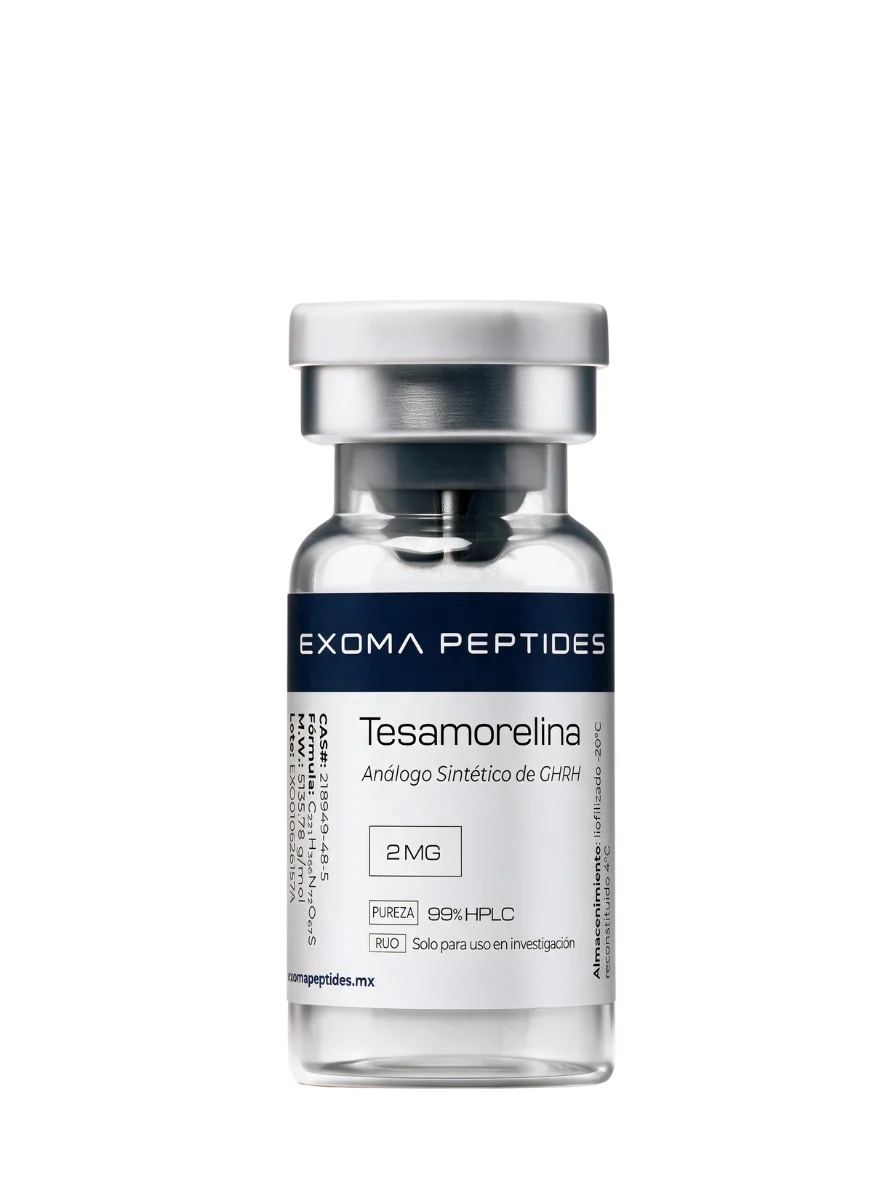
Tesamorelin
Tesamorelin — reagent for research use (RUO). HPLC purity 97.6% with COA per batch.
Technical data
- INN name
- Tesamorelin
- Development code
- TH9507
- CAS
- 218949-48-5
- Molecular formula
- C221H366N72O67S
- Molecular weight
- 5135.89 g/mol
Sizes and prices: 2 mg $620 MXN ($310 MXN per mg) · 5 mg $980 MXN ($196 MXN per mg) (out of stock) · 10 mg $1,890 MXN ($189 MXN per mg) · 20 mg $3,190 MXN ($160 MXN per mg).
Buy Tesamorelin in Mexico: order online with nationwide shipping in 1-4 business days depending on zone and tracking number. Prices in Mexican pesos. Material for research use only.
Tesamorelin is known internationally as Tesamorelin (English INN name). Buy Tesamorelin in Mexico / comprar Tesamorelin en México: reagent for research use (RUO) with HPLC purity, COA and nationwide shipping.
Tesamorelina is also searched as: Tesamorelin acetate, Acetato de tesamorelina, TH9507.
Identity and composition
Tesamorelin is a synthetic analog of human growth hormone-releasing factor, GHRH(1-44), investigated for its ability to stimulate endogenous growth hormone (GH) secretion and, with it, the reduction of visceral adipose tissue. It is a peptide in acetate formulation, studied mainly in the context of HIV-associated lipodystrophy.
Chemical identity:.
Product for research use.
Mechanism of action
Tesamorelin acts as GHRH receptor agonist in the pituitary. Upon binding to that receptor it stimulates the synthesis and release pulsatile of endogenous growth hormone (GH), with the consequent increase of insulin-like growth factor type 1 (IGF-1). The increase of GH promotes lipolysis and, in the models studied, the reduction of visceral adipose tissue (PubChem CID 16137828; PMID 22050344).
A distinctive feature is its N-terminal modification with trans-3-hexenoic acid, which protects it from degradation by the enzyme dipeptidyl peptidase IV (DPP-IV). This stabilization prolongs its functional life compared with native GHRH, which degrades rapidly. The pharmaceutical formulation is a peptide acetate.
It is important to emphasize that the preceding description is of a educational on the proposed mechanism and does not constitute a claim of results in any use context.
Pharmacokinetics
A ... has been reported elimination half-life of approximately 8 minutes in healthy subjects after a single subcutaneous dose (FDA label). The N-terminal modification that confers resistance to DPP-IV is what, in the studies, allowed once-daily subcutaneous dosing despite that short half-life.
Scientific evidence
The efficacy evidence comes primarily from population with HIV-associated lipodystrophy. In two randomized phase III trials (26 weeks, with extension to 52 weeks), a significant reduction in visceral adipose tissue, waist circumference, and hepatic fat was observed, with a modest increase in lean mass and no clinically relevant effect on subcutaneous fat (PMID 22050344). A meta-analytic synthesis of randomized trials supports these findings in body composition, hepatic fat, and safety in that same population (PMID 41545261).
In addition, in a double-blind randomized trial in non-alcoholic fatty liver disease (NAFLD/MASH) in people with HIV, a reduction of the hepatic fat fraction was observed (approximately -4.1% absolute), resolution of steatosis and prevention of the progression of fibrosis (PMID 31611038).
Limits of the evidence: the data derive mainly from the HIV context. Its application outside that population remains subject of research and must be interpreted with caution. The preliminary evidence suggests metabolic effects, but should not be read as a promise of a result.
Research applications
Product for research use. This material is offered exclusively for laboratory research purposes.
Suitable for (in research):
- In vitro and model studies on GHRH receptor signaling and the GH/IGF-1 axis.
- Research on lipolysis and visceral adipose tissue dynamics.
- Analytical characterization work on peptides (identity, purity, stability).
Not applicable for:
- clinical use, self-administration or any therapeutic or diagnostic use.
- Clinical use outside a regulated framework; the available clinical evidence is limited to specific populations (HIV-associated lipodystrophy).
Any interpretation of results must take into account that efficacy has been investigated in limited contexts and does not automatically transfer to other scenarios.
Research protocols
In the clinical trials cited in the consulted literature, the typical investigated dose was 2 mg subcutaneous daily in the population with HIV-associated lipodystrophy, evaluated over 26-week periods with extension to 52 weeks (PMID 22050344). In those studies, discontinuation of treatment was associated with reaccumulation of visceral fat.
The presentations of this product (2 mg, 5 mg, 10 mg, 20 mg) correspond to research formats and do not constitute dosing recommendations for any use in people. There is no information in the reviewed literature on validated dosing schemes outside the clinical context described, so no additional protocols are offered.
Reconstitution
Standard general laboratory handling guide for lyophilized peptides (not an instruction for use in people):
- The usual reconstitution is carried out with bacteriostatic water (water for injection with 0.9% benzyl alcohol) or, depending on the experimental design, sterile water. - It is recommended to direct the solvent slowly against the wall of the vial and let the peptide dissolve by diffusion, without vigorous shaking, to preserve the integrity of the peptide chain. - The volume of solvent is chosen according to the desired working concentration for the experiment. - Use aseptic technique and appropriate laboratory materials.
These indications are of a general nature and do not derive from specific data in the literature consulted.
Stability and storage
General standard handling guide (not specific to the consulted literature):.
- Lyophilized: lyophilized powder peptides are usually preserved more stably under cold conditions and protected from light and moisture; freezer storage favors long-term stability. - Reconstituted: once in solution, the stability decreases; it is usually preserved under refrigeration and its use is recommended within a short period, avoiding repeated freeze-thaw cycles. - Minimize exposure to room temperature, light and air.
As a peptide acetate, it is handled with the general precautions applicable to synthetic peptides. Specific times or temperatures are not included here because they are not part of the consulted literature.
Safety profile
According to the consulted literature, in the 26-week trials tesamorelin was generally well tolerated, with serious treatment-emergent adverse events in fewer than 4% of patients (PMID 22050344). The most frequent events were injection site reactions and known effects of growth hormone therapy, such as arthralgia, headache and peripheral edema.
These observations correspond to the clinical contexts studied and are presented for informational purposes, without constituting any guarantee of safety in any use.
Comparative context
Comparison with its class, in prose:
Compared with the recombinant growth hormone (rGH), which provides exogenous GH directly, tesamorelin acts upstream: it stimulates the endogenous and pulsatile secretion of GH through the GHRH receptor. In HIV-associated lipodystrophy, this mechanism has been associated with a better preservation of the physiological feedback axis and with a metabolic profile described as more favorable (PMID 22050344).
Compared with the native GHRH, which the DPP-IV enzyme degrades rapidly, the N-terminal modification with trans-3-hexenoic acid confers stability against that protease, prolonging its functional life.
These differences are mechanistic and of research context, not a claim of generalizable clinical superiority.
History and development
Tesamorelin (development code TH9507, developed by Theratechnologies) was approved by the FDA in 2010 for the reduction of excess abdominal fat in people with HIV-associated lipodystrophy. The approval was based on two 26-week phase III trials with extension to 52 weeks.
It was subsequently investigated in non-alcoholic fatty liver disease (NAFLD/MASH) in people with HIV, with results published in Lancet HIV in 2019 (PMID 31611038). Various commercial presentations have circulated. Its development falls within the search for GHRH analogs resistant to degradation by DPP-IV.
FAQ
What is tesamorelin and what is it researched for?
It is a synthetic analogue of human GHRH(1-44) that acts as a GHRH receptor agonist and stimulates the pulsatile release of endogenous growth hormone. It has been investigated above all for the reduction of visceral adipose tissue in HIV-associated lipodystrophy (PMID 22050344). Product for research use; not for clinical use.
How does it differ from recombinant growth hormone?
rGH provides exogenous growth hormone directly, whereas tesamorelin acts upstream by stimulating endogenous and pulsatile secretion through the GHRH receptor. In HIV lipodystrophy this mechanism has been associated with better preservation of the feedback axis (PMID 22050344).
What dose has been used in studies?
In the cited clinical trials, the typical investigated dose was 2 mg subcutaneous per day in people with HIV-associated lipodystrophy, evaluated over 26 weeks with extension to 52 (PMID 22050344). The presentations offered are research formats and not dosing recommendations.
What is its half-life?
An elimination half-life of approximately 11 minutes has been reported in healthy subjects after a single subcutaneous dose. The N-terminal modification protects it from the DPP-IV enzyme, which in the studies allowed once-daily dosing despite that short half-life.
What adverse effects have been documented?
In 26-week trials it was generally well tolerated, with serious events in fewer than 4% of patients. The most frequent were injection-site reactions, arthralgia, headache, and peripheral edema. The FDA label mentions altered glucose tolerance and contraindications such as active neoplasia and pregnancy (PMID 22050344).
How is it reconstituted and stored?
As a general laboratory guide, lyophilized peptides are usually reconstituted with bacteriostatic water directed slowly against the wall of the vial, without vigorous shaking. The lyophilized powder is best stored cold and protected from light and humidity; once reconstituted, it is kept refrigerated and used within a short period.
Customer reviews
Average rating: 5.0 out of 5, based on 11 customer ratings.
Daniela M. — 5/5
The Tesamorelin arrived in perfect condition. Very good service from the store.
Diana S. — 5/5
It came out much cheaper than ordering it from abroad and the chat support was impeccable. 10/10.
Regina A. — 5/5
Super transparent with the laboratory analyses. I would buy again.
Claudia R. — 5/5
The Tesamorelin arrived perfect and very well protected. Excellent service and attention from start to finish.
Diana P. — 5/5
Prompt service via WhatsApp, the professionalism shows.
Dalia F. — 5/5
Efficient support via WhatsApp, everything well coordinated.
Erika R. — 5/5
They answer usage questions very kindly.
Ernesto A. — 5/5
Clear certificates when scanning the QR. 10/10.
Eugenio O. — 5/5
Super kind service at all times.
Emilio R. — 5/5
Direct service in chat, they resolved everything immediately.
Certificate of analysis per batch
Tesamorelin batches with certificate of analysis published in the COA catalog:
- Lot EXO010626157A — 2 mg, issued 2026-05-29
- Lot EXO010626157D — 5 mg, issued 2026-05-29
Scientific references (3)
Peer-reviewed literature on Tesamorelin, with its PubMed identifier where available:
- Tesamorelin reduces visceral adipose tissue (Falutz J, et al. · New England Journal of Medicine · 2007) — Clinical study of tesamorelin for visceral fat reduction. PMID 18057338.
- A placebo-controlled, dose-ranging study of a growth hormone releasing factor in HIV-infected patients with abdominal fat accumulation (Falutz, et al. · AIDS · 2005) PMID 16052083.
- Tesamorelin: a review of its use in the management of HIV-associated lipodystrophy (Dhillon, et al. · Drugs · 2011) PMID 21668043.
Full scientific profile: Tesamorelin in the compendium — mechanism of action, studies and technical data sheet.
See the full category catalog: Hormonal · Metabolism.
Otras presentaciones de Tesamorelina
Guides and articles about Tesamorelin
Lecturas del blog de EXOMA que la editorial asoció a este compuesto: