
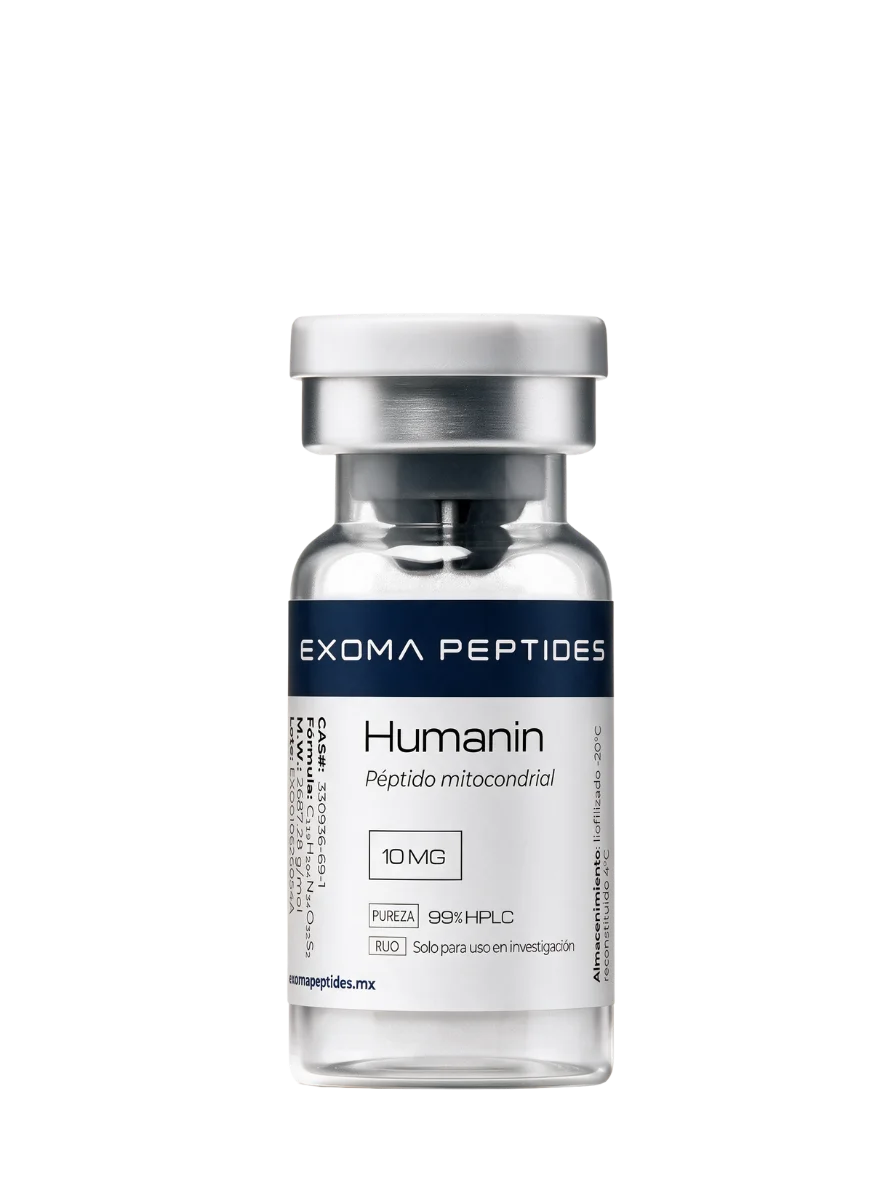
Humanin
Humanin — research reagent (RUO).
Technical data
- CAS
- 330936-69-1
- Molecular formula
- C119H204N34O32S2
- Molecular weight
- 2687.18 g/mol
Sizes and prices: 10 mg $3,150 MXN ($315 MXN per mg).
Buy Humanin in Mexico: order online with nationwide shipping in 1-4 business days depending on zone and tracking number. Prices in Mexican pesos. Material for research use only.
Humanin is also searched as: HN, Humanin (human), MAPRGFSCLLLLTSEIDLPVKRRA.
Identity and composition
Humanin is a 24-amino-acid peptide derived from the mitochondrial genome, studied in research as a cytoprotective and anti-apoptotic factor. It is provided in a 10 mg presentation for experimental use. Product for research use.
As for its chemical identity, the sequence reported in the literature consulted is MAPRGFSCLLLLTSEIDLPVKRRA (24 amino acids). It was the first identified peptide derived from the mitochondrial genome, encoded within the mitochondrial gene MT-RNR2 (16S rRNA).
It is also known by several synonyms:
- HN y HNM
- Peptide derived from MT-RNR2
- Mitochondria-derived peptide (MDP)
- Rattin (rodent ortholog)
No confirmed CAS number, molecular weight or molecular formula is available in open reference sources (PubChem/DrugBank), so such data are omitted rather than reporting unverified values.
Mechanism of action
Humanin is a 24-amino-acid peptide encoded by a small open reading frame within the mitochondrial 16S rRNA gene (MT-RNR2); it is described as the first peptide derived from the mitochondrial genome to be identified. In preclinical studies its cytoprotective and anti-apoptotic action has been characterized through two main pathways (PMID 23239898):
- Intracellular pathway: binds and inhibits pro-apoptotic proteins of the Bcl-2 family —BAX, tBID y BimEL—, which has been associated with blockade of the mitochondrial apoptotic pathway.
- Route as a secreted peptide: signals through the formyl-peptide-type G protein-coupled receptor FPRL1 (and FPRL2), and through a tripartite cytokine-type receptor complex (CNTFR/WSX1/gp130) that activates the cascade JAK2/STAT3.
Additionally, the available evidence suggests that circulating levels of humanin decrease with age in both humans and mice, and they have been studied in relation to the regulation of apoptosis, insulin sensitivity and inflammatory markers (PMID 27070352). This information is provided for educational purposes and describes research findings, not established clinical effects.
Pharmacokinetics
No pharmacokinetic data (half-life, absorption, distribution, or elimination) for humanin were located in the reviewed sources. Therefore, it is not possible to describe supported numerical parameters of half-life or disposition dynamics. Any quantitative characterization of its kinetic behavior falls outside the scope of the available evidence and is considered an open data gap.
Scientific evidence
The evidence on humanin is mostly preclinical (in vitro studies and animal models) and should be considered preliminary and experimental. In these models its role has been investigated in cytoprotection against apoptosis, oxidative stress, serum deprivation, hypoxia and beta-amyloid toxicity related to Alzheimer's, in addition to signals in neuroprotection, insulin sensitivity/metabolism, inflammation and cardioprotection.
In the available research, humanin has been observed to act as an age-dependent regulator of apoptosis, insulin sensitivity, and inflammation, with circulating levels that decline with age (PMID 27070352). Its anti-apoptotic and cellular stress-resistance function has also been documented in reviews on the topic (PMID 23239898).
It is important to note that, in the search conducted, no registered interventional clinical trials were identified with exogenous humanin, and there are no approved indications. The status should be considered experimental/investigational.
Research applications
The following framing applies exclusively to research contexts. Product for research use.
It may be of interest for research in:
- In vitro and animal-model studies on mechanisms of cytoprotection and mitochondrial apoptosis.
- Exploratory research in neuroprotection, including beta-amyloid toxicity models.
- Studies on mitochondrial-derived peptides (MDPs) and their role in metabolism, insulin sensitivity and inflammation.
- Comparative research within the MDP class.
Not applicable for:
- clinical use, supplementation, or any therapeutic, diagnostic, or preventive use.
- Clinical applications: there are no clinical trials or approved indications for exogenous humanin.
- Use in people or animals outside a controlled and authorized research protocol.
Research protocols
The literature reviewed does not include numerical doses from studies (mg, concentrations, or regimens) that can be cited with support for humanin. Therefore, no experimental dosing ranges are specified.
The available evidence is qualitative and is based on in vitro and animal models, where humanin has been investigated as a cytoprotective and anti-apoptotic agent (PMID 23239898). The design of any experimental protocol —including concentrations, routes, and controls— must be based on primary literature reviewed by the researcher and on their institution's guidelines, not on this sheet.
Reconstitution
As a general standard laboratory guide for lyophilized peptides, reconstitution is usually performed with bacteriostatic water (sterile water with approximately 0.9% benzyl alcohol), which helps preserve the solution during repeated handling.
General technique recommendations:
- Add the diluent slowly along the vial wall, letting it run down onto the powder rather than directing it straight onto the peptide.
- Do not shake vigorously; swirl or rotate the vial gently until completely dissolved to minimize degradation from mechanical stress.
- Prepare the solution under aseptic conditions.
- The diluent volume is chosen according to the desired working concentration for the protocol, on the basis of the 10 mg presentation.
These instructions are for general laboratory handling and do not constitute a validated protocol for humanin in particular.
Stability and storage
As standard practice for handling peptides in the laboratory:
- Lyophilized (powder): the powdered material is usually stored in cool conditions. For prolonged storage, it is common to keep it frozen, protected from moisture and light.
- Reconstituted (in solution): once dissolved, the solution is generally kept under refrigeration and used within a relatively short time; for longer-term storage, freezing in aliquots is usually considered.
General recommendations for preserving integrity:
- Avoid repeated freeze-thaw cycles by using aliquots. - Protect from light and minimize exposure to room temperature.
These are general laboratory handling guidelines; the literature consulted provides no specific stability data for humanin.
Safety profile
No safety data in humans were located for humanin, given that no clinical trials were identified. Therefore, its safety profile in people is not characterized and any use is considered experimental and without clinical safety support.
As a caution signal relevant to research: in experimental models it has been reported that humanin may promote tumor progression in triple-negative breast cancer. This finding raises a theoretical concern that requires further study and must be taken into account when designing and evaluating research work.
In the absence of clinical data, it is not possible to describe contraindications, interactions or adverse-event rates in humans. This material must be handled only within a controlled research environment and with standard laboratory precautions.
Comparative context
Humanin belongs to the class of mitochondria-derived peptides (MDPs), which also includes MOTS-c and to the peptides SHLP1-6.
Some distinctions described in the research:
- Compared to MOTS-c —more associated with metabolism and the AMPK pathway—, humanin is characterized by its function direct anti-apoptotic and cytoprotective, in part through its binding to BAX.
- Its synthetic analog S14G-humanin (HNG) is reported as markedly more potent than native humanin in neuroprotection assays. HNG is the most-studied variant within this research line; it is mentioned here only as comparative context and no is the compound of this data sheet.
This comparison is descriptive in nature and is based on preclinical observations.
History and development
Humanin stands out for being the first peptide derived from the mitochondrial genome identified. It is encoded from a small open reading frame within the mitochondrial gene MT-RNR2 (16S rRNA), which established it as a founding piece of the concept of mitochondrial-derived peptides (MDPs) (PMID 23239898).
Subsequent research characterized it as an age-dependent regulator of processes such as apoptosis, insulin sensitivity and inflammation, with the observation that its circulating levels decrease with age in humans and mice (PMID 27070352). From the native molecule the synthetic analog was developed S14G-humanin (HNG), more potent in neuroprotection models, which has become the most studied variant. The body of evidence remains predominantly preclinical, and the compound remains at experimental/investigational status.
FAQ
What is humanin and what is it studied for?
It is a 24-amino-acid peptide derived from the mitochondrial genome (MT-RNR2 gene), studied in preclinical research for its cytoprotective and anti-apoptotic action. It is offered for research use; not for clinical use.
Are there approved clinical trials with humanin?
No. In the search conducted, no registered interventional clinical trials with exogenous humanin were identified, and there are no approved indications. Its status must be considered experimental and investigational.
How does it differ from MOTS-c and the HNG analog?
Humanin and MOTS-c belong to the class of mitochondria-derived peptides; MOTS-c is associated more with metabolism and AMPK, while humanin is distinguished by its direct anti-apoptotic function. Its analog S14G-humanin (HNG) is reported as more potent in neuroprotection.
How is the lyophilized peptide reconstituted?
As general laboratory guidance, bacteriostatic water is usually used, added slowly down the wall of the vial and mixed with gentle swirls, without vigorous shaking. This is general handling guidance, not a validated protocol for humanin.
How should it be stored?
The lyophilized powder is usually kept cold, and for prolonged periods, frozen and protected from light and moisture. Once reconstituted, it is generally refrigerated and used within a short time, avoiding freeze-thaw cycles by means of aliquots.
Are there safety signals to consider in research?
There are no human safety data. In experimental models, humanin has been reported to be able to promote tumor progression in triple-negative breast cancer, a theoretical cautionary signal that requires further study.
Customer reviews
Average rating: 4.3 out of 5, based on 3 customer ratings.
Lorena F. — 4/5
The Humanin arrived well sealed. I really liked the presentation and the discretion of the package.
Lorena F. — 4/5
The Humanin arrived well sealed and with very discreet packaging.
Andrea G. — 5/5
Excellent service, the Humanin arrived intact and the chat support was very kind when I asked about the status.
Scientific references (6)
Peer-reviewed literature on Humanin, with its PubMed identifier when available:
- The role of humanin in the regulation of reproduction (Lei H et al. · Biochimica et biophysica acta. General subjects · 2022) PMID 34626748.
- Humanin: Functional Interfaces with IGF-I (Xiao J et al. · Growth hormone & IGF research: official journal of the Growth Hormone Research Society and the International IGF Research Society · 2016) PMID 27082450.
- Humanin: after the discovery (Niikura T et al. · Molecular neurobiology · 2004) PMID 15655255.
- A rescue factor abolishing neuronal cell death by a wide spectrum of familial Alzheimer's disease genes and Aβ (Hashimoto, et al. · Proceedings of the National Academy of Sciences of the United States of America · 2001) PMID 11371646.
- Detailed characterization of neuroprotection by a rescue factor humanin against various Alzheimer's disease-relevant insults (Hashimoto, et al. · The Journal of Neuroscience · 2001) PMID 11717357.
- Evidence for in vivo production of Humanin peptide, a neuroprotective factor against Alzheimer's disease-related insults (Tajima, et al. · Neuroscience Letters · 2002) PMID 12009529.
Full scientific profile: Humanin in the compendium — mechanism of action, studies and technical data sheet.
See the full category catalog: Longevity.