
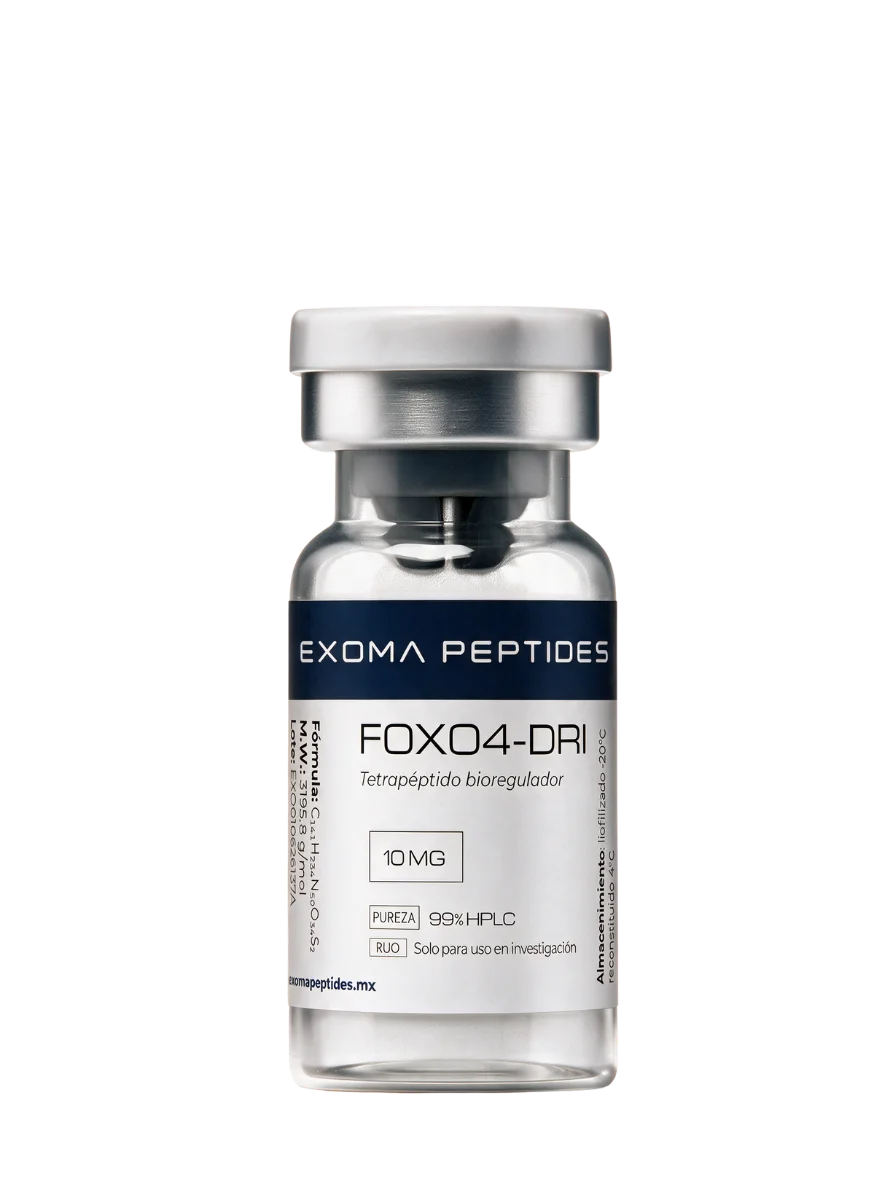
FOXO4-DRI
FOXO4-DRI — reactivo for research (RUO). COA per batch disponible. Contenido revisado por el Dr. Jesús Jaramillo.
Technical data
- CAS
- 2460055-10-9
- Molecular formula
- C228H388N86O64
- Molecular weight
- 5358.15 g/mol
Sizes and prices: 10 mg $4,999 MXN ($500 MXN per mg) (sold out).
Buy FOXO4-DRI in Mexico: order online with nationwide shipping in 1-4 business days depending on zone and tracking number. Prices in Mexican pesos. Material for research use only.
FOXO4-DRI is also searched as: FOXO4 D-Retro-Inverso, FOXO4-DRI peptide, Peptido senolitico FOXO4-DRI.
Identity and composition
FOXO4-DRI is a senolytic research peptide designed to interfere with the FOXO4-p53 interaction, an axis implicated in the survival of senescent cells. It is studied exclusively in preclinical models as a tool to selectively eliminate senescent cells (senolysis). Product for research use.
As for its chemical identity, it is a peptide D-retro-inverso derived from a region of FOXO4 fused to an arginine-rich cell-penetrating domain; the design with D-amino acids seeks protease resistance while preserving the topology of the side chains. Its molecular formula reported is C228H388N86O64 (free base), confirmed in the PubChem entry (CID 167312269).
No verified CAS number or molecular weight is available in the reference sources consulted, so those fields are deliberately omitted. The exact amino acid sequence appears in the literature and catalogs, but was not confirmed in the PubChem entry, so it is described here qualitatively and is not asserted as reference data.
Among its synonyms include: FOXO4 D-Retro-Inverso, Proxofim and FOXO4-p53 interaction inhibitor.
Mechanism of action
FOXO4-DRI is a peptide D-retro-inverso designed from a region of FOXO4 with the aim of interfering with the axis FOXO4-p53, considered critical for the viability of senescent cells. The D-retro-inverso format is used to seek greater stability against proteases while maintaining the spatial arrangement of the side chains.
Recent structural evidence obtained by solution NMR shows that FOXO4-DRI, an intrinsically disordered peptide, binds directly to the disordered transactivation domain of p53 (p53TAD2), forming a transiently folded complex; phosphorylation of p53 would increase the affinity for both FOXO4 and FOXO4-DRI (PMID 40593617).
According to the proposed model, the disruption of the FOXO4-p53 interaction leads to the exclusion of p53 from the nucleus and to selective apoptosis (senolysis) of senescent cells. Both the FOXO4-derived fragment and the cell-penetrating cationic component would contribute to the binding.
Pharmacokinetics
No peer-reviewed primary source was found that reports quantitative pharmacokinetic parameters (half-life, bioavailability) in humans for FOXO4-DRI.
The design D-retro-inverso is theoretically motivated by greater stability against proteases compared to L-amino acid peptides, but a numerical half-life value was not confirmed in the open sources consulted. Any additional kinetic characterization remains pending formal studies.
Scientific evidence
The available evidence is preliminary and exclusively preclinical (in vitro assays and animal models). No registered clinical trials in humans were identified on ClinicalTrials.gov, and it is not a drug approved by any regulatory agency.
Among the indications explored in preclinical models and cell cultures, the following have been investigated: age-associated senescence, the insufficiency of testosterone secretion attributed to senescent Leydig cells in aged mice (PMCID PMC7053614), the senescence of human chondrocytes expanded in vitro and the senescence of endothelial cells via the p53 pathway.
These findings should be interpreted as preclinical and not directly translatable to humans.
Research applications
Product for research use.
Given the current state of the evidence, FOXO4-DRI is positioned as a laboratory tool for studies of cellular senescence.
Ideal for (research contexts):
- In vitro studies on senolysis and the FOXO4-p53 axis.
- Mechanistic research on the interaction of FOXO4-DRI with the transactivation domain of p53.
- Preclinical animal models of age-associated senescence.
- Cell culture assays with chondrocytes or senescent endothelial cells.
Not applicable for:
- clinical use, diagnostic use, or therapeutic use.
- Self-administration or any clinical use.
- Situations that require a product approved by regulatory agencies.
Research protocols
The literature reviewed does not include specific figures for doses, concentrations, or validated administration schedules in studies, so no numerical values are reported here to avoid unsupported claims.
The studied indications (for example, the selective elimination of senescent Leydig cells in aged mice, PMCID PMC7053614) were carried out in preclinical contexts with experimental designs specific to each laboratory. Any research-use protocol must be defined on the basis of the corresponding primary literature and laboratory practices, not on this sheet.
The reference presentation is 10 mg of lyophilized peptide.
Reconstitution
As a general laboratory handling guide for lyophilized peptides, FOXO4-DRI is usually reconstituted with bacteriostatic water (sterile water with approximately 0.9% benzyl alcohol), which helps limit microbial growth in multi-use vials.
Suggested general steps:
- Let the vial reach room temperature before opening.
- Add the diluent, letting it run slowly down the inner wall of the vial, without injecting directly onto the powder.
- Do not shake vigorously; swirl gently until completely dissolved.
- The diluent volume is chosen according to the desired working concentration.
This is standard qualitative laboratory guidance and not a clinical protocol.
Stability and storage
As standard laboratory handling practice:
- Lyophilized (powder): the peptide in powder form is more stable and is usually stored refrigerated or frozen, protected from humidity and light, until reconstitution.
- Reconstituted (in solution): once dissolved, the peptide is less stable and it is advisable to keep it refrigerated, use it within a short period, and avoid repeated freeze-thaw cycles.
The D-retro-inverso design is theoretically proposed to improve resistance against proteases, but this does not substitute good cold-storage practices. These recommendations are qualitative and general for the handling of peptides in research.
Safety profile
No safety data in humans were identified, since there are no registered clinical trials for FOXO4-DRI. The available information is limited to preclinical models.
Since the proposed mechanism activates p53-mediated apoptosis, a ... has been proposed general theoretical concern about possible off-target effects in non-senescent tissues; however, no formal toxicity profile was documented in the sources reviewed.
No established clinical contraindications are available. Owing to its nature as a research material, it must be handled with appropriate protective equipment and following the laboratory's biosafety practices. It is not for clinical use.
Comparative context
FOXO4-DRI belongs to the class of compounds senolytics, which seek to selectively eliminate senescent cells. Within this class there are also small molecules such as the combination dasatinib + quercetin, the navitoclax (BCL-2/BCL-xL inhibitor) and the fisetin.
The main mechanistic difference is that FOXO4-DRI is a peptide specifically targeting the axis FOXO4-p53, rather than acting on the BCL-2 protein family like several small-molecule senolytics. This targeting has been proposed theoretically as a distinct selectivity route.
This is a general mechanistic class comparison and does not imply demonstrated superiority of one compound over another.
History and development
FOXO4-DRI arose as a rationally designed peptide created from a region of the protein FOXO4, with the aim of disrupting its interaction with p53 in senescent cells. The format D-retro-inverso (use of D-amino acids with reversed order) was chosen to seek resistance to degradation by proteases while conserving the topology of the side chains, and an arginine-rich cell-penetrating domain was fused to it to favor its cellular entry.
Its development has remained within the scope of preclinical research, with in vitro studies and animal models on age-associated senescence. More recent structural works by NMR have specified that its target is the disordered transactivation domain of p53 (PMID 40593617). It is also known by the synonym Proxofim. To date it has no registered clinical trials or regulatory approval.
FAQ
What is FOXO4-DRI and what is it studied for?
It is a senolytic research peptide, designed in a D-retro-inverso format, that interferes with the FOXO4-p53 interaction. In preclinical models it has been investigated as a tool to selectively eliminate senescent cells. It is a product for research use; not for clinical use.
Is FOXO4-DRI approved for human use?
No. It is not a drug approved by any regulatory agency and no registered clinical trials in humans were identified. All the available evidence is preclinical (in vitro and animal models) and does not translate directly to humans.
How does it work at the molecular level?
It binds to the disordered transactivation domain of p53 (p53TAD2), forming a transiently folded complex, and interrupts the FOXO4-p53 axis. According to the proposed model, this leads to the exclusion of p53 from the nucleus and to selective apoptosis of senescent cells (PMID 40593617).
How does it differ from other senolytics?
Unlike small-molecule senolytics such as dasatinib+quercetin, navitoclax or fisetin, FOXO4-DRI is a peptide directed specifically at the FOXO4-p53 axis and not at the BCL-2 family. It is theoretically proposed as a distinct selectivity pathway, without demonstrated superiority.
How is it reconstituted and stored?
As a general laboratory guideline, the lyophilized peptide is usually reconstituted with bacteriostatic water, adding it down the wall of the vial and swirling gently. As a powder it should be refrigerated or frozen; once reconstituted, keep it cold, use it promptly and avoid repeated freezing.
Are safety or pharmacokinetic data known?
There are no verified safety data or pharmacokinetic parameters in humans, as no clinical trials exist. There is a theoretical concern about off-target effects due to its p53-dependent mechanism, but a formal toxicity profile was not documented in the reviewed sources.
Customer reviews
Average rating: 4.8 out of 5, based on 4 customer ratings.
Marcela A. — 5/5
The FOXO4-DRI arrived in excellent condition. I will definitely buy here again.
Camila O. — 5/5
Excellent service via WhatsApp when I had a question about my address. The FOXO4-DRI comes sealed and with all its standards correct. 100% recommended.
Mauricio V. — 4/5
The FOXO4-DRI arrived fine. It took a bit longer due to weekend courier issues, but the product came intact and protected.
Certificate of analysis per batch
FOXO4-DRI lot with certificate of analysis published in the COA catalog:
- Lot EXO010626137A — 10 mg, issued 2026-05-29
Scientific references (6)
Peer-reviewed literature on FOXO4-DRI, with its PubMed identifier when available:
- The disordered p53 transactivation domain is the target of FOXO4 and the senolytic compound FOXO4-DRI (Bourgeois B et al. · Nature communications · 2025) PMID 40593617.
- FOXO4-D-Retro-Inverso targets extracellular matrix production in fibroblasts and ameliorates bleomycin-induced pulmonary fibrosis in mice (Liu Y et al. · Naunyn-Schmiedeberg's archives of pharmacology · 2023) PMID 37074394.
- Senolytic Peptide FOXO4-DRI Selectively Removes Senescent Cells From in vitro Expanded Human Chondrocytes (Huang Y et al. · Frontiers in bioengineering and biotechnology · 2021) PMID 33996787.
- Regulation of cellular senescence via the FOXO4-p53 axis (Bourgeois, et al. · FEBS Letters · 2018) PMID 29683489.
- FOXO4-DRI induces keloid senescent fibroblast apoptosis by promoting nuclear exclusion of upregulated p53-serine 15 phosphorylation (Kong YX, et al. · Communications Biology · 2025) PMID 39994346.
- FOXO4-DRI improves spermatogenesis in aged mice through reducing senescence-associated secretory phenotype secretion from Leydig cells (Li Y, et al. · Experimental Gerontology · 2024) PMID 39025385.
Full scientific profile: FOXO4-DRI in the compendium — mechanism of action, studies and technical data sheet.
See the full category catalog: Longevity.