NAD+
NAD+ — reactivo for research (RUO). COA per batch disponible. Contenido revisado por el Dr. Jesús Jaramillo.
Technical data
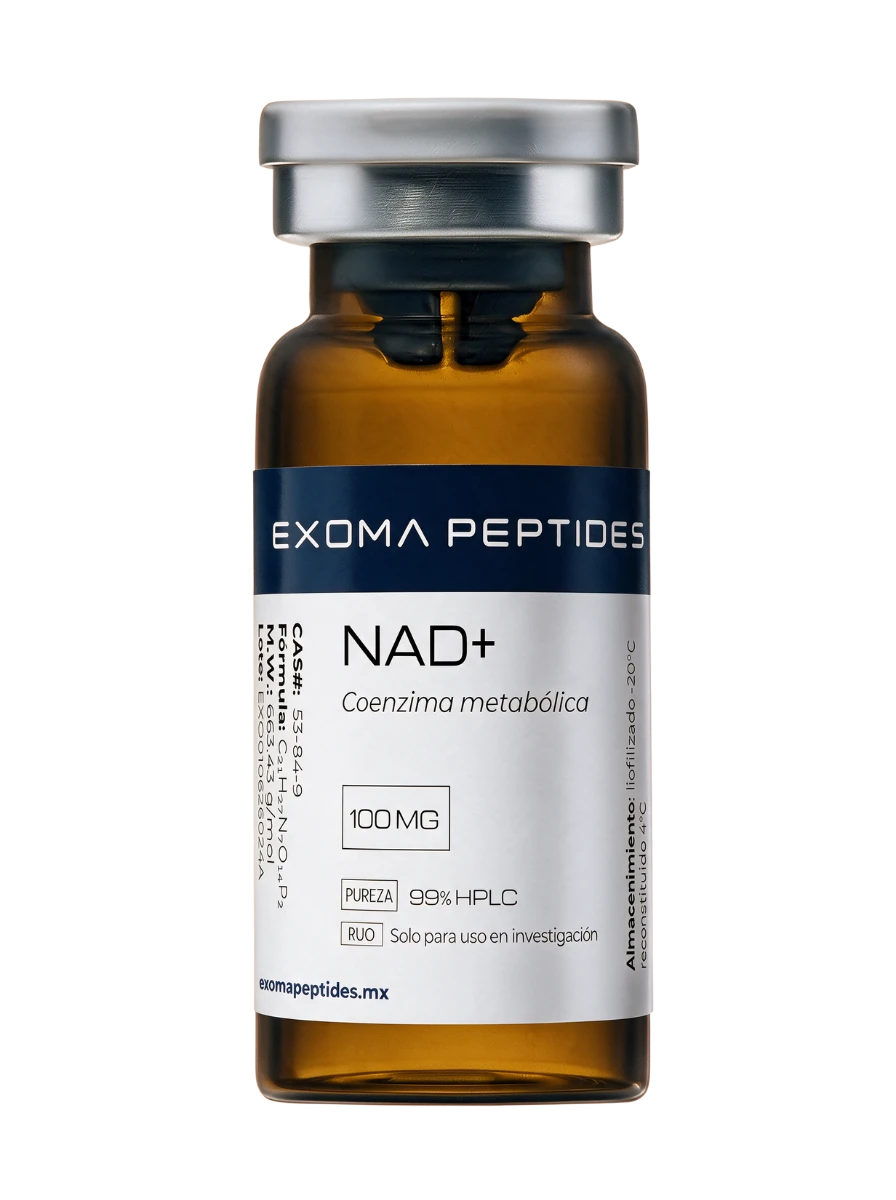
- CAS
- 53-84-9
- Molecular formula
- C21H27N7O14P2
- Molecular weight
- 663.43 g/mol
Sizes and prices: 100 mg $610 MXN ($6.1 MXN per mg) · 250 mg $870 MXN ($3.48 MXN per mg) · 500 mg $1,220 MXN ($2.44 MXN per mg) · 1000 mg $1,899 MXN ($1.9 MXN per mg) (out of stock).
Buy NAD+ in Mexico: order online with nationwide shipping in 1-4 business days depending on region, with a tracking number. Prices in Mexican pesos. Material for research use only.
NAD+ is also searched as: beta-NAD, Nadide, Coenzima I, Cozimasa, beta-DPN.
Identity and composition
NAD+ (nicotinamide adenine dinucleotide, CAS 53-84-9, formula C21H27N7O14P2, molecular weight 663.43 g/mol) is a pyridine-nucleotide coenzyme present in all living cells, essential for redox reactions and for the activity of NAD+-consuming enzymes such as sirtuins (SIRT1-7), PARPs, and CD38. In research it is distributed as a lyophilized powder in presentations of 250 mg, 500 mg, and 1000 mg for reconstitution with sterile water. The sodium form of the nucleotide is hygroscopic and sensitive to prolonged alkaline pH, so stability studies report extended shelf life under dry, dark storage. Its research importance lies in the fact that intracellular NAD+ levels decline with chronological age and under metabolic stress, which has positioned this coenzyme as a central target of aging biology.
Mechanism of action
NAD+ acts as an electron acceptor in catabolic reactions (glycolysis, beta-oxidation, Krebs cycle), generating NADH, which donates electrons to the mitochondrial transport chain to produce ATP. Beyond its redox role, NAD+ is a consumable substrate of three enzyme families: (1) sirtuins, NAD+-dependent deacetylases that regulate gene expression, mitochondrial biogenesis via PGC-1α, and the response to oxidative stress; (2) PARPs (poly-ADP-ribose polymerases), which use NAD+ during the repair of DNA breaks; (3) CD38 and SARM1, NADases associated with inflammation and axonal degeneration. Exogenous administration in preclinical models raises intracellular pools via salvage pathways (NMN, NR) or by direct uptake depending on the tissue evaluated.
Pharmacokinetics
The pharmacokinetics of exogenous NAD+ depend strongly on the route. By slow intravenous administration in animal models, transient plasma elevations are reported, followed by rapid extracellular hydrolysis by CD38 and NADases to nicotinamide and ADP-ribose. The oral bioavailability of intact NAD+ is negligible due to gastrointestinal degradation. The plasma half-life of free NAD+ is estimated at minutes, whereas the tissue pools regenerated through precursors (NMN, NR) show sustained kinetics of hours. In research, subcutaneous and intranasal routes with distinct pharmacokinetic profiles are being explored, where absorption is slower but allows prolonged exposure of the target tissue.
Scientific evidence
Belenky et al. (2007) demonstrated in S. cerevisiae that NAD+ and its precursors extend replicative lifespan via SIR2. Yoshino et al. (Cell Metab 2011) showed that restoring NAD+ with NMN reverses mitochondrial dysfunction in diabetic mice. Mills et al. (Cell Metab 2016) reported that long-term administration of NMN mitigates age-associated physiological declines in C57BL/6N mice. Camacho-Pereira et al. (Cell Metab 2016) identified CD38 as the main NADase responsible for the decline of NAD+ with age. Work by Sinclair and Imai has characterized the SIRT1-NAD+ connection in response to caloric restriction. In preliminary clinical research, phase I trials of precursors show consistent elevations of NAD+ in whole blood.
Research applications
Research lines involving NAD+ and its precursors include: the biology of cellular aging and senescence, mitochondrial biogenesis and bioenergetic function, models of neurodegeneration (Alzheimer's, Parkinson's, multiple sclerosis), recovery after cardiac ischemia, non-alcoholic hepatosteatosis, sarcopenia, DNA repair under genotoxic stress, modulation of the circadian axis, and studies of metabolic fatigue. It is also used as a standard cofactor in in vitro enzymatic assays for sirtuins and PARPs.
Research protocols
Preclinical protocols with exogenous NAD+ have employed IV infusions of 100-500 mg/kg in murine models over 7-28 days, with observed elevation of hepatic and muscular pools. In ischemia-reperfusion models, single boluses of 20 mg/kg administered before reperfusion have been used. In longevity studies, precursors are preferred (NMN 300-500 mg/kg/day oral) for stability. The designs include vehicle groups (sterile PBS), monitoring of tissue NAD+ by LC-MS/MS, and mitochondrial functional markers (oxygen consumption by Seahorse).
Reconstitution
Reconstitute the lyophilized vial with sterile bacteriostatic water. For 1000 mg, dissolve with 5-10 mL to obtain concentrations of 100-200 mg/mL. NAD+ is highly soluble in water. Swirl gently; avoid vigorous vortexing that could induce oxidation. The reconstituted solution has a slightly yellowish tint, which is normal. For in vitro assays, prepare fresh stock solutions on the day of the experiment. Filter through 0.22 µm if sterility is required for cell cultures.
Stability and storage
In lyophilized form and under dry, dark, refrigerated storage, NAD+ maintains integrity for at least 24 months. Reconstituted in water at neutral pH, use within 7-14 days under refrigeration (2-8 °C) is recommended due to slow hydrolysis of the pyrophosphate bond. Avoid exposure to alkaline pH, heat (>40 °C), and repeated freeze-thaw cycles that accelerate degradation to ADP-ribose and nicotinamide. Purity by HPLC at lot intake is ≥99%.
Safety profile
Preclinical reports describe a favorable safety profile at the doses studied. Effects observed at high IV doses include transient flushing, slight tachycardia, and nausea attributed to nicotinamide release and conversion to methylnicotinamide. Chronic artificial elevation of NAD+ could theoretically favor cells with unrepaired replicative damage, which is why oncological research requires strict controls. No relevant organ-specific toxicities have been described in subchronic studies at the therapeutic doses explored.
Comparative context
Exogenous NAD+ vs precursors (NR, NMN): intact NAD+ offers direct elevation but low oral bioavailability; NR and NMN are more stable and raise intracellular pools via salvage pathways. Compared with CD38 inhibitors (78c, apigenin), the exogenous supply acts through substrate whereas the inhibitors reduce catabolism. Compared with MOTS-c and other mitochondrial peptides, NAD+ acts as a universal coenzyme, not a tissue-specific peptide.
History and development
NAD+ was discovered by Arthur Harden and William Young in 1906 during fermentation studies. Otto Warburg characterized its redox role in 1936. Hans von Euler-Chelpin received the Nobel Prize in 1929 for work on fermentation that included this cofactor. The modern research revival began in 2000 with the discovery that SIRT1 requires NAD+, positioning the coenzyme at the center of the biology of aging (Imai, Guarente). Research with precursors accelerated after 2013 with Sinclair's publications on the reversal of mitochondrial declines in mice.
FAQ
What purity does the NAD+ you offer have?
Each batch is released with HPLC-verified purity and a traceable COA per batch.
What is the difference between NAD+, NMN, and NR for research?
NAD+ is the active coenzyme; NMN and NR are precursors that require intracellular enzymatic conversion. Direct NAD+ is used more in preclinical IV infusion; NMN/NR in oral studies.
Why is the reconstituted solution slightly yellow?
It is normal coloration of the nucleotide in aqueous solution; it does not indicate degradation if the storage conditions are maintained.
How many presentations are there?
250 mg, 500 mg and 1000 mg per lyophilized vial.
Can it be lyophilized again after reconstitution?
Not recommended; repeatedly altering the physical state promotes hydrolysis of the pyrophosphate bond.
What is the shelf life once reconstituted?
7-14 days refrigerated at 2-8 °C, avoiding freeze-thaw cycles.
What solvent is recommended?
Sterile bacteriostatic water. For cell cultures, filter at 0.22 µm after reconstituting.
What is it used for in in vitro research?
As a cofactor in enzymatic assays of sirtuins, PARPs and dehydrogenases.
Can it be combined with MOTS-c or 5-Amino-1MQ?
In research, mitochondrial stacks are explored; each compound must be characterized individually before evaluating synergy.
How do I confirm the integrity of the lot?
Through the included COA, which reports HPLC purity, MS identity, and solvent residues.
Customer reviews
Average rating: 4.9 out of 5, based on 18 customer ratings.
Javier Z. — 5/5
Excellent product, the NAD+. The delivery was very punctual and the packaging impeccable.
Elena R. — 5/5
The box came intact and the laboratory tests available. I will definitely order again.
Ximena F. — 5/5
The NAD+ arrived in excellent condition and very well refrigerated. The commitment to product quality is evident.
Paulina G. — 5/5
The NAD+ arrived impeccable. It's the second time I order here and I've never had any problem.
Lidia N. — 5/5
Zero inflammation at the application site. Very good purity.
Nora B. — 5/5
Excellent thermal packaging, everything premium quality.
Gerardo F. — 4/5
Good stability after reconstitution.
Olga V. — 5/5
Immediate responses via WhatsApp and updated tracking.
Jorge Alberto V. — 4/5
The quality is evident from the packaging. I fully recommend it.
Ofelia I. — 5/5
Arrived cold in San Luis Potosí. Very pleased.
Lucía R. — 5/5
I have compared with other suppliers and it has the best value for money. The COA confirms the advertised purity.
Olidia G. — 5/5
Impeccable service. They answered my questions about storage.
Paulina G. — 5/5
The NAD+ arrived impeccable. I always buy here and have never had problems.
Oliva S. — 5/5
All well chilled on receipt in Guadalajara.
Orlando M. — 5/5
Super humane and attentive customer service.
Claudia Berenice M. — 5/5
Very satisfied with the purchase. The product exceeded my expectations.
Roberto E. — 5/5
Super attentive, they emailed me the batch studies and the package comes ultra discreet.
Certificate of analysis per batch
NAD+ lots with certificate of analysis published in the COA catalog:
- Lot EXO010626024A — 100 mg, issued 2026-05-21
- Lot EXO010626024B — 250 mg, issued 2026-05-21
- Lot EXO010626024C — 500 mg, issued 2026-05-24
- Lot EXO010626024D — 1000 mg, issued 2026-05-28
Scientific references (7)
Peer-reviewed literature on NAD+, with its PubMed identifier when available:
- NAD+ in aging, metabolism, and neurodegeneration (Verdin E. · Science · 2015) — Comprehensive review of the role of NAD+ in aging and cellular metabolism. PMID 26785480.
- Nicotinamide Adenine Dinucleotide (NAD+) and Enkephalinase Inhibition (IV1114589NAD) Infusions Significantly Attenuate Psychiatric Burden Sequalae in Substance Use Disorder (SUD) in Fifty Cases (Blum, et al. · Current Psychiatry Research and Reviews · 2022) PMID 36118157.
- Evaluation of safety and effectiveness of NAD in different clinical conditions: a systematic review (Gindri, et al. · American Journal of Physiology-Endocrinology and Metabolism · 2024) PMID 37971292.
- Effect of Nicotinamide Adenine Dinucleotide on Heart Failure Caused by Ischemic Cardiomyopathy: A Randomized, Placebo-Controlled Trial. (Yu X, et al. · Am J Cardiovasc Drugs · 2026) PMID 40954388.
- A Pilot Study Investigating Changes in the Human Plasma and Urine NAD+ Metabolome During a 6 Hour Intravenous Infusion of NAD. (Grant R, et al. · Front Aging Neurosci · 2019) PMID 31572171.
- NAD⁺ supplementation for anti-aging and wellness: A PRISMA-guided systematic review of preclinical and clinical evidence. (Gallagher C, et al. · Ageing Res Rev · 2026) PMID 41655607.
- CD38 Dictates Age-Related NAD Decline and Mitochondrial Dysfunction through an SIRT3-Dependent Mechanism. (Camacho-Pereira J, et al. · Cell Metab · 2016) PMID 27304511.
Full scientific profile: NAD+ in the compendium — mechanism of action, studies and technical data sheet.
See the full category catalog: Longevity.