
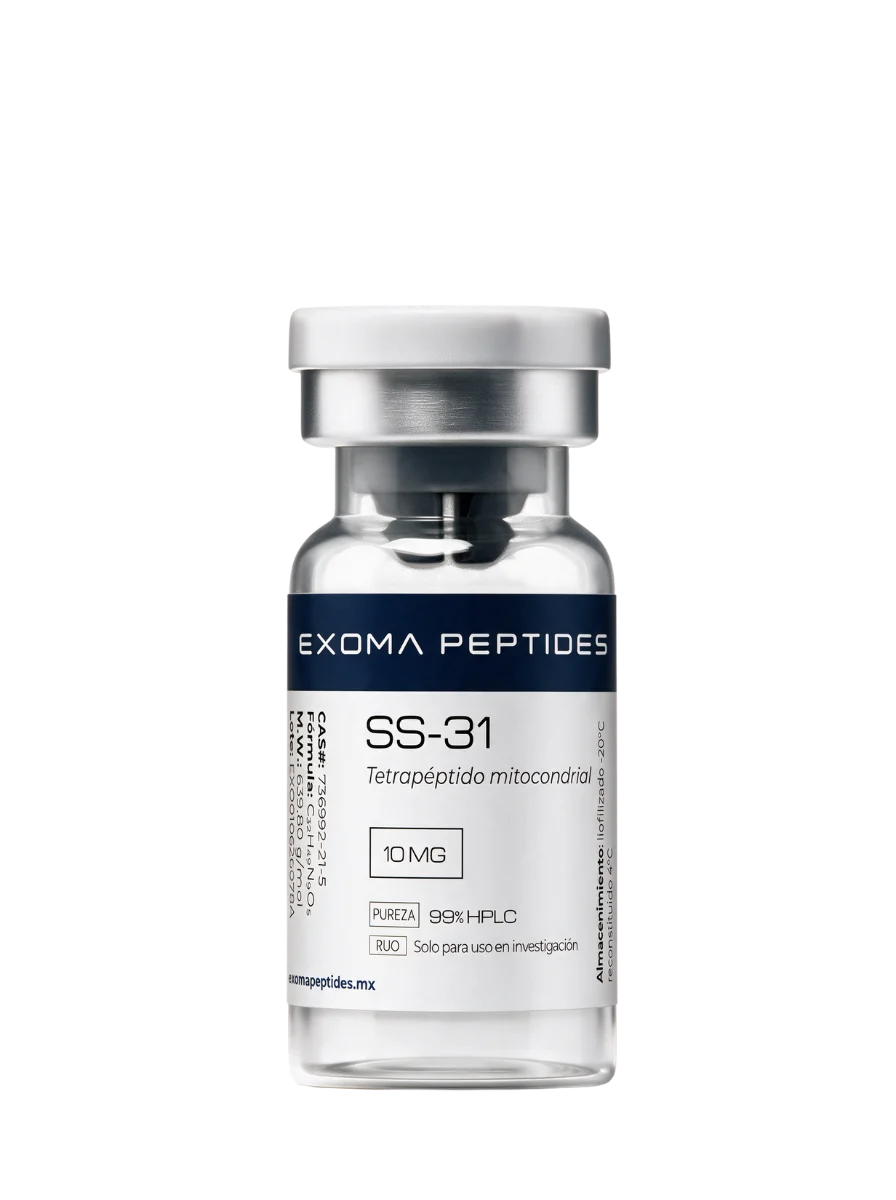
SS-31
SS-31 — reagent for research use (RUO). HPLC purity 99.7% with COA per batch.
Technical data
- Development code
- MTP-131
- CAS
- 736992-21-5
- Molecular formula
- C32H49N9O5
- Molecular weight
- 639.8 g/mol
Sizes and prices: 10 mg $1,099 MXN ($110 MXN per mg) · 50 mg $3,899 MXN ($78 MXN per mg).
Buy SS-31 in Mexico: order online with nationwide shipping in 1-4 business days depending on zone and tracking number. Prices in Mexican pesos. Material for research use only.
SS-31 is also searched as: Elamipretide, MTP-131, Szeto-Schiller peptide 31, SS-31 peptide.
Identity and composition
SS-31, also known as elamipretide, is a cationic aromatic tetrapeptide, water-soluble and cell-permeable, studied for its affinity toward the inner mitochondrial membrane. It is offered in presentations of 10 mg y 50 mg for research use.
Chemical identity (reference data):
- CAS: 736992-21-5
- Molecular formula: C32H49N9O5
- Molecular weight: 639.8 g/mol
- Sequence: D-Arg-Dmt-Lys-Phe-NH2 (D-arginine – 2',6'-dimethyl-L-tyrosine – L-lysine – L-phenylalanine amide), confirmed via PubChem CID 11764719
- Synonyms: Elamipretide, MTP-131, Bendavia, SS-31, UNII-87GWG91S09
Product for research use.
Mechanism of action
SS-31 concentrates in the inner mitochondrial membrane and binds with high affinity to the cardiolipin, an anionic phospholipid essential for the structure of the cristae and the organization of the electron transport chain.
Upon associating with cardiolipin, experimental models have observed that SS-31 helps preserve the architecture of the cristae, favors the assembly and activity of the respiratory complexes, and stabilizes the interaction between cytochrome c and cardiolipin. In an ischemia model, the SS-31/cardiolipin complex inhibited the peroxidase activity of cytochrome c—limiting oxidative damage to the iron of the heme group—and accelerated ATP recovery after reperfusion (J Am Soc Nephrol 2013; PMID 23813215).
Unlike conventional antioxidants, its action is directed at the inner membrane rather than acting as a nonspecific scavenger of free radicals.
Pharmacokinetics
In the clinical trials, elamipretide was administered via subcutaneous. Quantitative pharmacokinetic parameters (half-life, Cmax or clearance) were not confirmed in the primary sources reviewed, so these values remain unverified and are deliberately omitted rather than estimated. Any additional pharmacokinetic characterization would fall within the scope of controlled research.
Scientific evidence
The available evidence is mixed and should be interpreted with caution. Elamipretide is the most clinically advanced mitochondria-targeted peptide, and it has been investigated in sponsored programs for primary mitochondrial myopathy, Barth syndrome, heart failure with preserved ejection fraction, dry age-related macular degeneration and ischemia-reperfusion injury.
The pivotal phase 3 trial MMPOWER-3 in primary mitochondrial myopathy (n=218, 40 mg/day subcutaneous, 24 weeks) did not meet its co-primary endpoints (6-minute walk test and PMMSA fatigue scale) versus placebo, although a post-hoc subgroup with nuclear DNA defects showed a signal (Neurology 2023; PMID 37268435).
Most claims about longevity or anti-aging are based on data preclinical (aged rodents) and not in controlled human trials. The reports of a regulatory approval in 2025 come from secondary sources and were not independently confirmed.
Research applications
Product for research use.
It may be of interest for research in:
- Studies of mitochondrial biochemistry and the role of cardiolipin in the inner membrane
- Preclinical models of bioenergetics, cristae function, and ATP recovery
- Research on ischemia-reperfusion injury in experimental models
- Analytical and reference characterization of peptides targeted to the mitochondria
Not applicable for:
- clinical use, therapeutic use, diagnostic or preventive
- Self-administration or any clinical use outside an authorized research framework
- Formulation of supplements or products for public sale
Research protocols
In the phase 3 clinical trial MMPOWER-3, elamipretide was administered at 40 mg per day subcutaneously for 24 weeks in participants with primary mitochondrial myopathy (PMID 37268435). This figure corresponds to the design of a specific study and is cited only as a reference for the research context; does not constitute a dosing recommendation.
No reconstitution schemes or validated dose ranges for laboratory use are available in the literature consulted, so any experimental design corresponds to the researcher's discretion within an authorized framework.
Reconstitution
As a general laboratory-handling guide, lyophilized peptides are usually reconstituted with bacteriostatic water (sterile water with approximately 0.9% benzyl alcohol), which helps limit microbial growth in preparations for repeated use.
Standard technique recommendations:
- Add the diluent slowly down the wall of the vial, letting it run down onto the solid instead of directing it straight at the powder.
- Do not shake; gently swirl the vial until fully dissolved to reduce stress on the peptide.
- Prepare under clean conditions and calculate the concentration according to the diluent volume used.
This guide is qualitative and for general handling; it does not replace a validated experimental protocol.
Stability and storage
As standard laboratory handling practice:
- Lyophilized (powder): is the most stable form. It is usually stored refrigerated and, for long-term storage, frozen, protected from light and moisture. - Reconstituted (in solution): is less stable and is generally kept refrigerated, being used within a short time window. - It is advisable minimize freeze-thaw cycles, since they can degrade peptides.
These ranges are general storage guidelines; the literature consulted provides no specific stability data for this compound.
Safety profile
The available safety profile is limited and was not independently verified. In the clinical trials, elamipretide was administered by daily subcutaneous injection, and the class of adverse effect most frequently reported in its research program were the injection site reactions.
The detailed adverse-event tables from the MMPOWER-3 trial could not be extracted beyond the summary view, so no quantitative event-rate data are asserted here. No serious safety signal is declared beyond the documented injection-site reactions, and the complete profile remains unverified.
As this is a product for research use, it must be handled with the usual laboratory precautions and kept out of the reach of untrained persons.
Comparative context
SS-31 is the principal member of the peptide family Szeto-Schiller (SS), cationic and cell-permeable compounds designed to target the mitochondrion.
Its distinctive feature compared to other strategies is the selective, high-affinity binding to cardiolipin of the inner mitochondrial membrane, in contrast to:
- The broad-spectrum antioxidants, which act as nonspecific scavengers of reactive oxygen species.
- The mitochondrial uncouplers, whose mechanism is different.
In addition, it is the only compound of its mechanistic class that has reached pivotal-stage human trials, which makes it the most studied reference of this group.
History and development
SS-31 arises from the family of peptides Szeto-Schiller (SS), a group of cationic, cell-permeable compounds designed to concentrate in the mitochondria. Under the name of elamipretide, was developed by Stealth BioTherapeutics and studied in sponsored phase 2 and 3 programs.
Throughout its development it has received several designations, among them MTP-131 y Bendavia. It has been investigated in indications such as primary mitochondrial myopathy, Barth syndrome, heart failure with preserved ejection fraction, dry age-related macular degeneration and ischemia-reperfusion injury, with mixed results detailed in the evidence summary.
FAQ
What is SS-31 and why is it studied?
It is an aromatic cationic tetrapeptide, also called elamipretide, that concentrates in the inner mitochondrial membrane and binds to cardiolipin. It is investigated for its role in mitochondrial bioenergetics and the preservation of cristae structure. It is a product for research use; not for clinical use.
What is the difference between SS-31 and elamipretide?
They are the same compound. SS-31 is the designation of the Szeto-Schiller family of peptides, while elamipretide is its common name. It also appears under the codes MTP-131 and Bendavia.
Does SS-31 have solid clinical evidence?
The evidence is mixed. The phase 3 trial MMPOWER-3 in primary mitochondrial myopathy (40 mg/day subcutaneous, 24 weeks) did not meet its co-primary endpoints versus placebo (PMID 37268435). Many longevity claims are based on preclinical data in rodents, not on controlled human trials.
How is SS-31 reconstituted in the laboratory?
As a general guideline, lyophilized peptides are usually reconstituted with bacteriostatic water, adding it slowly down the wall of the vial and swirling it gently without shaking. It is a laboratory handling orientation, not a validated protocol for this compound.
How is SS-31 stored?
In lyophilized powder it is more stable and is usually stored refrigerated or frozen for the long term, protected from light. Reconstituted, it is less stable and is kept refrigerated for a short time, avoiding freeze-thaw cycles.
What was the most reported adverse effect in the studies?
In its trial program, administered by daily subcutaneous injection, the most frequently reported class of adverse effect was injection-site reactions. The complete safety profile was not independently verified.
Customer reviews
Average rating: 5.0 out of 5, based on 7 customer ratings.
Diego P. — 5/5
Completely discreet package; the box doesn't even say what's inside. Well done there.
Edgar J. — 5/5
Lab analysis readily available. Super reliable seller.
Emanuel N. — 5/5
A very good purchase option; they sent me a current lab test.
Felipe D. — 5/5
It comes with very clear labels and an intact aluminum seal.
Flor T. — 5/5
It arrived the next business day to Pachuca. Excellent service.
Fabián R. — 5/5
QR code for a real lab, that gives peace of mind.
Flavia M. — 5/5
Very reassuring to have the laboratory proof published.
Certificate of analysis per batch
SS-31 lot with certificate of analysis published in the COA catalog:
- Lot EXO010626078A — 10 mg, issued 2026-05-30
Scientific references (5)
Peer-reviewed literature on SS-31, with its PubMed identifier when available:
- SS-31@Fer-1 Alleviates ferroptosis in hypoxia/reoxygenation cardiomyocytes via mitochondrial targeting (Zheng H et al. · Biomedicine & pharmacotherapy = Biomedecine & pharmacotherapie · 2025) PMID 39848110.
- Elamipretide (SS-31) improves mitochondrial dysfunction, synaptic and memory impairment induced by lipopolysaccharide in mice (Zhao W et al. · Journal of neuroinflammation · 2019) PMID 31747905.
- Protection of mitochondria prevents high-fat diet-induced glomerulopathy and proximal tubular injury (Szeto, et al. · Kidney International · 2016) PMID 27519664.
- Elamipretide: A Review of Its Structure, Mechanism of Action, and Therapeutic Potential (Tung, et al. · International Journal of Molecular Sciences · 2025) PMID 39940712.
- Natural history comparison study to assess the efficacy of elamipretide in patients with Barth syndrome (Hornby, et al. · Orphanet Journal of Rare Diseases · 2022) PMID 36056411.
Full scientific profile: SS-31 in the compendium — mechanism of action, studies and technical data sheet.
See the full category catalog: Longevity.