
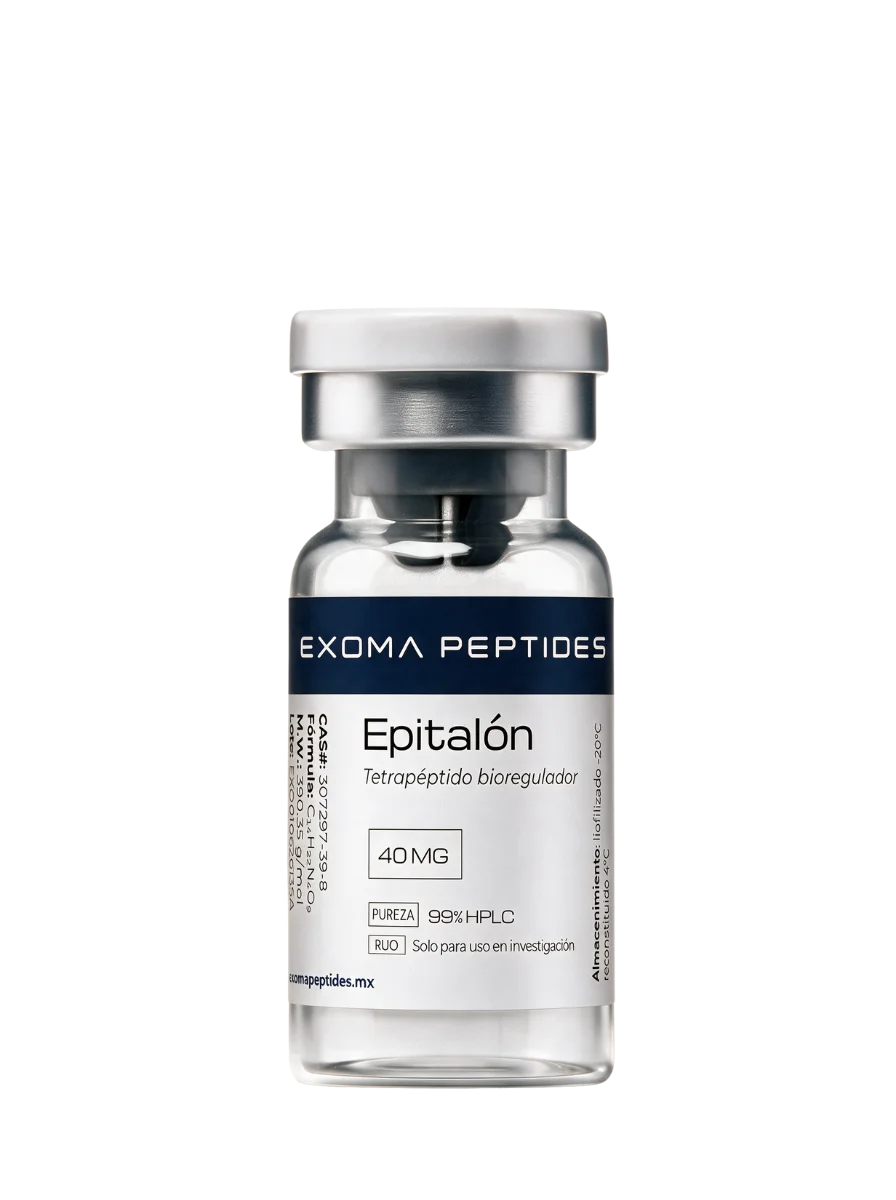
Epitalon
Epitalon — research reagent (RUO). HPLC purity 97.8 % with COA per batch.
Technical data
- INN name
- Epithalon
- CAS
- 307297-39-8
- Molecular formula
- C14H22N4O9
- Molecular weight
- 390.35 g/mol
Sizes and prices: 10 mg $700 MXN ($70 MXN per mg) (out of stock) · 40 mg $2,360 MXN ($59 MXN per mg) · 50 mg $2,620 MXN ($52 MXN per mg) (out of stock).
Buy Epitalon in Mexico: order online with nationwide shipping in 1-4 business days depending on zone and tracking number. Prices in Mexican pesos. Material for research use only.
Epitalon is known internationally as Epithalon (INN name in English). Buy Epithalon in Mexico / buy Epithalon in Mexico: research reagent (RUO) with HPLC purity with COA and nationwide shipping.
Epitalon is also searched as: Epithalone, AEDG Peptide.
Identity and composition
Epitalon (also written Epithalon or Epithalone) is a synthetic linear tetrapeptide of sequence Ala-Glu-Asp-Gly (AEDG), designed as a short analogue of the pineal polypeptide extract Epithalamin. In the research setting it is studied mainly for its in vitro signal on telomerase and telomere length. Product for research use.
Reference chemical identity data:
- CAS number: 307297-39-8
- Molecular formula: C14H22N4O9
- Molecular weight: 390.35 g/mol
- Sequence: H-Ala-Glu-Asp-Gly-OH (AEDG)
- Chemical name: L-alanyl-L-glutamyl-L-aspartyl-glycine
- Common synonyms: Epithalon, Epithalone, AEDG peptide, N-terminal fragment of Epithalamin
It is offered in presentations of 5 mg, 10 mg, 40 mg and 50 mg of lyophilized material for laboratory handling.
Mechanism of action
The best-documented mechanism of Epitalon is the upregulation of telomerase in cellular models. In human telomerase-negative fibroblasts it has been observed in vitro that it induces the expression of the catalytic subunit of telomerase (hTERT), it increases the enzymatic activity of telomerase and produces elongation of the telomeres (PMID 12937682; PMID 15455129).
A 2025 in vitro study reproduced the telomeric lengthening in normal fibroblasts and epithelial cells through the hTERT/telomerase pathway, and reported that in cancer cell lines the telomeric extension occurred instead through the mechanism of Alternative Lengthening of Telomeres (ALT), despite the upregulation of hTERT (PMID 40908429).
Other mechanisms attributed to the peptide, such as the restoration of melatonin secretion and an antioxidant activity, come largely from the primary work of the laboratory of origin and are not independently confirmed in the sources reviewed. The chemical identity is corroborated by PubChem (CID 219042).
Pharmacokinetics
No reliable human pharmacokinetic data were found (half-life, bioavailability, clearance) in the reviewed sources. Due to its nature as a small, unmodified linear peptide, one would theoretically expect a low oral bioavailability and a rapid proteolytic degradation; however, this is a general inference about peptides and not a value obtained from a specific study. Any numerical parameter of half-life or bioavailability must be considered uncharacterized in the indexed literature.
Scientific evidence
The evidence on Epitalon is predominantly in vitro (human cell lines) and preclinical. The foundational findings on telomerase and telomeres come from the group of Khavinson and collaborators (2003-2004), and in vitro studies have investigated and observed the induction of telomerase and telomere elongation in human somatic cells (PMID 12937682; PMID 15455129). In 2025 a independent in vitro replication of telomere elongation (PMID 40908429).
The human data cited by the group of origin (longevity/mortality follow-ups, retinal indications) correspond mostly to old primary sources in Russian and are not corroborated by controlled, registered, and peer-reviewed trials. No completed randomized phase 2/3 clinical trial indexed in PubMed or registered in ClinicalTrials.gov was identified. The indications studied or attributed (longevity, retina, cardiovascular, neuroendocrine) should be treated as exploratory and not clinically established.
Research applications
Product for research use.
Ideal for:
- In vitro studies on telomerase activity, hTERT expression and telomere length dynamics in cell lines.
- Exploratory research in the biology of cellular aging and replicative senescence.
- Comparative work within the class of short bioregulator peptides.
Not applicable for:
- clinical use, therapeutic use, diagnosis, or self-experimentation of any kind.
- Substantiating clinical efficacy claims: human evidence is not established.
- Veterinary or food use.
This material is marketed exclusively as a research reagent intended for trained personnel in laboratory environments.
Research protocols
There is no standardized human dosing protocol, validated in controlled clinical trials, in the indexed literature. Therefore, it is not possible to offer dosing guidelines for clinical use, and doing so would be outside the research use of the product.
The available evidence is in vitro in nature: the studies that investigated telomerase activation and telomeric elongation worked with experimental concentrations applied to cell cultures (PMID 40908429). The consulted literature does not specify numerical concentration figures reproducible here, so they are deliberately omitted rather than indicating unsupported values.
For experimental design, the exposure conditions (concentration, vehicle, duration) must be derived from the methodology of the cited primary studies and adjusted to the researcher's specific cell model.
Reconstitution
As a standard general laboratory guideline for lyophilized peptides:
- It is typically reconstituted with bacteriostatic water (sterile water with approximately 0.9% benzyl alcohol), which helps limit microbial growth in solutions for prolonged use.
- For strictly in vitro work without preservative, sterile water for injection or the buffer required by the assay may also be used.
- Add the diluent letting it run down the wall of the vial, without directing the stream directly onto the powder, to reduce mechanical stress on the peptide.
- Do not shake vigorously: gently swirl the vial until fully dissolved.
- The diluent volume is chosen according to the desired working concentration relative to the mass of the vial (5, 10, 40 or 50 mg).
Handle with aseptic technique and materials appropriate for the laboratory.
Stability and storage
As standard peptide handling practice:
- Lyophilized (powder): is the most stable form. It is best preserved frozen and protected from light and humidity; for prolonged storage the freezer is usually preferred. Sealed and dry, lyophilized material tolerates long-term storage well.
- Reconstituted (in solution): is less stable. It must be kept under refrigeration and used within a relatively short window; for longer-term storage, freezing in aliquots is usually resorted to.
- Aliquots: dividing the solution into single-use portions avoids repeated freeze-thaw cycles, which degrade peptides.
- Minimize exposure to room temperature, light, and air during handling.
These are general laboratory handling recommendations, not specifications from a stability study of the compound.
Safety profile
The human safety profile of Epitalon is essentially uncharacterized in the peer-reviewed, indexed literature. No rigorous dataset of human safety or toxicology from controlled trials was identified, nor documented data on adverse events.
The 2025 in vitro study noted that the activation of the ALT pathway appeared specific to cancer cell lines and speculated that this could limit the risk of transformation in normal cells, but explicitly indicated that it was an in vitro study requiring in vivo validation (PMID 40908429).
A key point: the absence of documented adverse-event data should not be interpreted as evidence of safety. No formal contraindications are available because there is no controlled clinical characterization. This material must be handled only as a research reagent, with personal protective equipment and appropriate laboratory practices.
Comparative context
Epitalon belongs to the class of short bioregulator peptides developed by the Khavinson group. It is a synthetic tetrapeptide conceptually associated with the largest pineal peptide preparation Epithalamin, from which it is derived as a fragment.
Within that class it is distinguished from the thymic peptide bioregulators (such as Thymalin or Thymogen), developed by the same group but oriented toward another system. The differentiating feature that defines Epitalon among its peers is its specific in vitro signal of telomerase activation and telomere elongation, which is also the main focus of the available research on the compound. Like the rest of the class, its evidence remains mostly preclinical.
History and development
Epitalon was developed at the Institute of Bioregulation and Gerontology of St. Petersburg by Vladimir Khavinson and collaborators. It arose as a short synthetic analog of Epithalamin, a polypeptide extract of the pineal gland, seeking to reproduce in a minimal sequence (the tetrapeptide AEDG) the activity attributed to the original preparation.
The foundational works (2003-2004) reported in vitro the induction of telomerase and the elongation of telomeres in human somatic cells (PMID 12937682; PMID 15455129). Subsequently, in 2025, an independent in vitro study again documented telomere lengthening and characterized differentiated pathways (hTERT/telomerase in normal cells versus ALT in cancer cells) (PMID 40908429). Most of the human indications historically attributed to the compound come from primary sources of the laboratory itself and remain uncorroborated in registered controlled trials.
FAQ
What is Epitalon and what is it investigated for?
It is a synthetic linear tetrapeptide (Ala-Glu-Asp-Gly / AEDG), a short analog of the pineal peptide Epithalamin. In research it is studied above all for its in vitro signal of telomerase (hTERT) activation and telomere elongation in human cell lines. It is a product for research use, not for clinical use.
Does Epitalon have proven clinical efficacy in humans?
No. The evidence is predominantly in vitro and preclinical. No completed and indexed phase 2/3 randomized clinical trial was identified in PubMed or registered on ClinicalTrials.gov. The attributed indications must be considered exploratory and not clinically established.
What is its mechanism of action?
The best documented mechanism is the upregulation of telomerase: in vitro it induces the expression of hTERT, increases telomerase activity and produces telomere elongation (PMID 12937682; PMID 15455129). In 2025 this effect was replicated and an ALT pathway was described in cancer lines (PMID 40908429).
How is it reconstituted and stored?
As a general laboratory guide, the lyophilizate is usually reconstituted with bacteriostatic water, adding it down the wall of the vial and swirling gently without shaking. The lyophilized powder is more stable and is best stored frozen; once in solution, it is refrigerated, aliquoted and used within a short window.
Are its pharmacokinetic or safety data known?
No reliable human pharmacokinetic data (half-life, bioavailability) nor a rigorous body of human safety or toxicology were located in the indexed literature. The absence of adverse-event data should not be read as evidence of safety; the human profile is essentially uncharacterized.
In what presentations is it available?
It is offered as lyophilized material in vials of 5 mg, 10 mg, 40 mg, and 50 mg, intended exclusively for laboratory research use and not for clinical use.
Customer reviews
Average rating: 5.0 out of 5, based on 13 customer ratings.
Brenda A. — 5/5
Excellent service when purchasing Epitalon. Everything arrived in order and very fast.
Adrian D. — 5/5
Zero complaints, the product dissolves clear and right away. I recommend ordering in a bundle.
Alejandro T. — 5/5
Excellent customer service when I had questions about Epitalon. I will definitely buy from this store again.
Alejandro T. — 5/5
Excellent quality in the Epitalon. Everything very fast.
Tomas A. — 5/5
Excellent packaging to protect from light and heat.
Walter P. — 5/5
Arrived the day after ordering it. Very good.
Wilfrido J. — 5/5
It arrived fast and well sealed, without any setbacks.
Arturo P. — 5/5
The Epitalon arrived earlier than expected, perfectly packaged and sealed. Excellent service.
Xavier N. — 5/5
Clear solution instantly. Great quality.
Xiomara T. — 5/5
It arrived the next business day via DHL.
Alejandro T. — 5/5
Excellent service with the Epitalon. Everything arrived complete and in order.
Xavier O. — 5/5
Upon reconstitution it became clear immediately.
Ximena V. — 5/5
It reconstitutes crystal clear right away.
Certificate of analysis per batch
Epitalon lots with certificate of analysis published in the COA catalog:
- Lot EXO010626135A — 40 mg, issued 2026-05-30
- Lot EXO010626135B — 10 mg, issued 2026-05-30
Scientific references (3)
Peer-reviewed literature on Epitalon, with its PubMed identifier when available:
- Peptide bioregulators inhibit apoptosis (Khavinson VKh, et al. · Bulletin of Experimental Biology and Medicine · 2000) — Study on the anti-apoptotic effects of Epithalon and its role in telomeres. PMID 11276315.
- Epithalon peptide induces telomerase activity and telomere elongation in human somatic cells (Khavinson, et al. · Bulletin of Experimental Biology and Medicine · 2003) PMID 12937682.
- Peptide geroprotector from the pituitary gland inhibits rapid aging of elderly people: results of 15-year follow-up (Korkushko, et al. · Bulletin of Experimental Biology and Medicine · 2011) PMID 22451889.
Full scientific profile: Epithalon in the compendium — mechanism of action, studies and technical data sheet.
See the full category catalog: Longevity · Bioregulators.
Otras presentaciones de Epitalon
Guides and articles about Epitalon
Lecturas del blog de EXOMA que la editorial asoció a este compuesto: