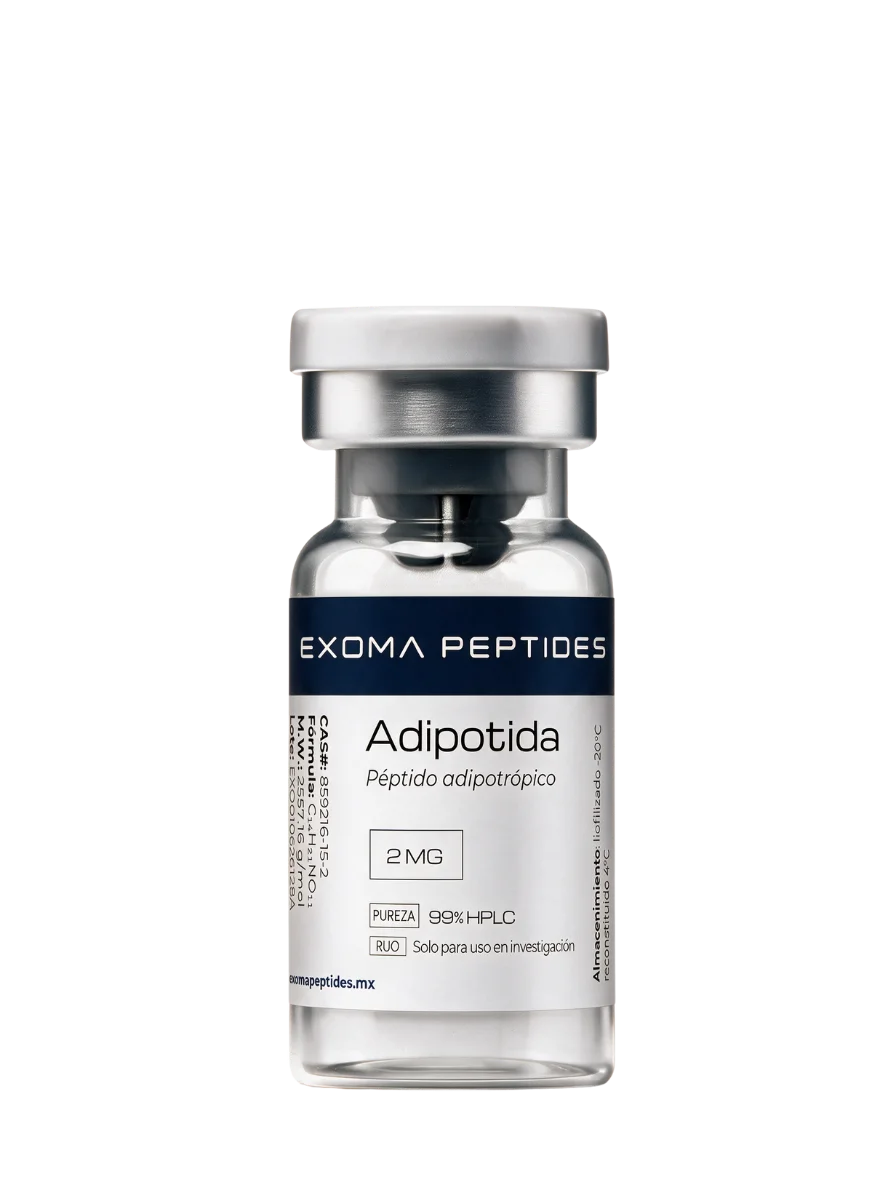
Adipotide
Adipotide — research reagent (RUO).
Technical data
- INN name
- Adipotide
- CAS
- 859216-15-2
- Molecular formula
- C111H206N36O28S2
- Molecular weight
- 2557.21 g/mol
Sizes and prices: 2 mg $1,130 MXN ($565 MXN per mg) · 5 mg $2,399 MXN ($480 MXN per mg).
Buy Adipotide in Mexico: order online with nationwide shipping in 1-4 business days depending on zone and tracking number. Prices in Mexican pesos. Material for research use only.
Adipotide is known internationally as Adipotide (INN name in English). Buy Adipotide in Mexico / buy Adipotide in Mexico: research reagent (RUO) and nationwide shipping.
Adipotida is also searched as: Prohibitin-targeting peptide 1, Prohibitin-TP01, TP01, CKGGRAKDC-GG-D(KLAKLAK)2.
Identity and composition
Adipotide (Adipotide) is a chimeric proapoptotic dual-domain peptide studied in preclinical research on the reduction of white adipose tissue. It combines a targeting domain that recognizes the vasculature of fat with a domain that induces apoptosis. Product for research use.
As for its chemical identity, its molecular formula es C111H206N36O28S2 (PubChem CID 163360068), with a molecular weight approximate of ~2557 Da for the base peptide; some supplier catalogs cite higher values (~2611-2617 Da) attributed to the acetate salt, a datum not confirmed in a primary source and which should be treated with caution.
Su sequence es CKGGRAKDC-GG-D(KLAKLAK)2: the targeting nonapeptide CKGGRAKDC linked by a Gly-Gly bridge to the proapoptotic domain D(KLAKLAK)2.
Synonyms: Adipotide, FTPP, Prohibitin-targeting peptide 1, TP01, CKGGRAKDC-GG-D(KLAKLAK)2.
The number CAS it is not included because it is not confirmed in a verifiable primary source.
Mechanism of action
Adipotide acts through a mechanism targeted and ablative, different from that of the drugs that modulate satiety or metabolism.
- Targeting: the CKGGRAKDC domain, identified through phage display in vivo, it binds to prohibitin, a membrane protein expressed in the endothelium of the vessels that irrigate white adipose tissue (Kolonin et al., Nat Med 2004; PMID 15133506).
- Proapoptotic effect: once internalized, the amphipathic domain D(KLAKLAK)2 disrupts the mitochondrial membrane, causes release of cytochrome c, and activates the caspase cascade, inducing apoptosis in the target endothelial cells.
- Consequence: ablation of that vasculature reduces the blood supply to adipocytes, favoring their resorption.
In obese primates, targeted apoptosis was confirmed in the vasculature of white adipose tissue (Barnhart et al., Sci Transl Med 2011; PMID 22072637). Specificity depends on the expression of prohibitin in the adipose endothelium.
Pharmacokinetics
Not available formal pharmacokinetic parameters (half-life, clearance, volume of distribution) confirmed in an open primary source, so no quantitative values are reported.
In the animal studies the compound was administered in a subcutaneous and daily, which qualitatively suggests a relatively short-acting exposure; however, there are no verified figures that allow it to be specified. Any pharmacokinetic interpretation must be considered tentative.
Scientific evidence
The available evidence is preliminary and of preclinical origin; it is limited to animal models and no verifiable published clinical trials in humans were located.
- En mice with diet-induced obesity, the targeted ablation of white fat was investigated (Kolonin et al., Nat Med 2004; PMID 15133506).
- En rhesus monkeys obese subjects a reported weight loss was observed of ~11% in 28 days and improvement in insulin sensitivity confirmed by MRI/DEXA (Barnhart et al., Sci Transl Med 2011; PMID 22072637).
There is no evidence of regulatory approval or established clinical development for any indication. The translation of these findings to humans is not supported by published and verifiable clinical trials, so the data should be interpreted with caution.
Research applications
Product for research use.
It may be of interest for research in:
- In vitro and animal-model studies on the biology of white adipose tissue and its vasculature.
- Research on mechanisms of targeted endothelial apoptosis mediated by the D(KLAKLAK)2 motif.
- Exploration of the role of prohibitin as a vascular marker of adipose tissue.
- Characterization of chimeric targeting peptides (homing) coupled to proapoptotic domains.
Not applicable for:
- clinical use, clinical use, diagnostic or therapeutic.
- Self-medication or any application outside a controlled research environment.
- Use in human populations, since there is no established safety or efficacy profile in the verified literature.
Research protocols
The published protocols correspond exclusively to animal models and do not constitute guidance for clinical use.
In the reviewed studies the compound was administered by subcutaneously with a daily regimen. In the primate study, a reported weight loss of ~11% in 28 days (Barnhart et al., Sci Transl Med 2011; PMID 22072637).
Numerical doses in mg/kg are not reported here because the consulted literature does not provide dosing figures supported by citation that can be cited with precision. Any experimental design must be based on the complete primary literature and on the investigator's own laboratory validation.
Reconstitution
As a general standard laboratory guide for lyophilized peptides, reconstitution is usually performed with bacteriostatic water (sterile water with ~0.9% benzyl alcohol), which allows multiple withdrawals while preserving sterility.
- Add the diluent slowly down the wall of the vial, letting it run over the pellet instead of directing the stream directly onto the peptide.
- Do not shake; swirl the vial gently until fully dissolved.
- Let it stand for a few minutes until a clear solution is obtained.
The reconstitution volume is chosen according to the desired working concentration (for example, for 2 mg or 5 mg presentations) and the needs of the experimental protocol. These are general handling indications, not dosing instructions.
Stability and storage
Standard laboratory handling recommendations for peptides:
- Lyophilized (unreconstituted): is the most stable form; it is typically stored refrigerated and, for prolonged storage, frozen. Protect from humidity and light.
- Reconstituted: maintain refrigerated and use within a short period; to store for longer, aliquot and freeze to avoid repeated freeze-thaw cycles, which degrade peptides.
- Minimize exposure to room temperature and light during handling.
These ranges are general laboratory handling knowledge; adjust to the specific conditions of the supplier and the protocol.
Safety profile
The documented safety profile comes from animal studies and there is no established safety profile in humans in the verified literature.
The main reported safety signal is of the type renal: in the primate study, the dose-limiting adverse effect was renal toxicity (changes in the renal tubular epithelium), described as dose-dependent and largely reversible after discontinuing treatment, attributed to the concentration of the peptide in the kidney (Barnhart et al., Sci Transl Med 2011; PMID 22072637).
This renal signal is the main reason for caution. As it is a research compound with no safety data in humans, it must be handled solely under controlled laboratory conditions and with appropriate protective equipment.
Comparative context
Adipotide belongs to the class of targeted pro-apoptotic peptides that combine a peptide of homing with the motif (KLAKLAK)2 / D(KLAKLAK)2.
Unlike the pharmacological agonists associated with weight loss (for example, the GLP-1 agonists), which modulate satiety and metabolic pathways, the mechanism of Adipotide is cytotoxic and ablative on the vasculature of adipose tissue: it does not act on appetite signals, but rather reduces the blood supply to adipocytes.
Su specificity depends on the expression of prohibitin in the adipose endothelium, a feature that distinguishes it from systemic pharmacological approaches and that defines both its research interest and its mechanistic limitations.
History and development
Adipotide arises from a line of research on vascular targeting based on phage display in vivo.
Kolonin et al. (Nature Medicine, 2004; PMID 15133506) identified the peptide of homing CKGGRAKDC and established the prohibitin as a vascular marker of white adipose tissue, demonstrating the targeted proapoptotic ablation of white fat in mice. Subsequently, Barnhart et al. (Science Translational Medicine, 2011; PMID 22072637) evaluated the compound in obese rhesus monkeys, documenting targeted endothelial apoptosis, weight loss, and improved insulin resistance, together with the renal toxicity signal as a dose-limiting effect.
Since then, it remains as preclinical research compound, with no clinical registration or verifiable regulatory approval.
FAQ
What is Adipotide and what is it studied for?
It is a proapoptotic dual-domain chimeric peptide investigated in preclinical models for its ability to target the vasculature of white adipose tissue. It is studied in the context of white-fat reduction and insulin resistance. It is a product for research use, not for clinical use.
How does its mechanism of action work?
Its CKGGRAKDC domain binds to prohibitin in the endothelium of the vessels that irrigate white fat; the D(KLAKLAK)2 domain disrupts the mitochondria and induces apoptosis in those endothelial cells, reducing the blood supply to the adipocytes (Kolonin et al. 2004; PMID 15133506).
Is there evidence in humans?
No. The published and verifiable evidence is preclinical, limited to mice and obese rhesus monkeys (Barnhart et al. 2011; PMID 22072637). No published clinical trials in humans were located, so the data must be interpreted with caution.
What is its main safety signal?
In primates, the reported dose-limiting adverse effect was renal toxicity (changes in the tubular epithelium), dose-dependent and largely reversible upon discontinuation of treatment. There is no established safety profile in humans.
How is it reconstituted and stored?
As a general laboratory guide, it is reconstituted with bacteriostatic water added slowly down the wall of the vial, without shaking. The lyophilizate is stored refrigerated or frozen; once reconstituted, keep refrigerated and use within a short period, aliquoting to freeze if more time is required.
How does it differ from GLP-1 agonists?
Its mechanism is ablative and cytotoxic on the adipose vasculature, whereas GLP-1 agonists modulate satiety and metabolic pathways. Adipotide depends on prohibitin expression in the endothelium of adipose tissue.
Scientific references (5)
Peer-reviewed literature on Adipotide, with its PubMed identifier when available:
- A peptidomimetic targeting white fat causes weight loss and improved insulin resistance in obese monkeys (Barnhart KF et al. · Science translational medicine · 2011) PMID 22072637.
- Reversal of obesity by targeted ablation of adipose tissue (Kolonin, et al. · Nature Medicine · 2004) PMID 15133506.
- Rapid and weight-independent improvement of glucose tolerance induced by a peptide designed to elicit apoptosis in adipose tissue endothelium. (Kim DH, et al. · Diabetes · 2012) PMID 22733798.
- A comparative study between nanoparticle-targeted therapeutics and bioconjugates as obesity medication. (Hossen N, et al. · J Control Release · 2013) PMID 23871959.
- Comment on "a peptidomimetic targeting white fat causes weight loss and improved insulin resistance in obese monkeys". (Criscione L, et al. · Sci Transl Med · 2012) PMID 22539771.
Full scientific profile: Adipotide in the compendium — mechanism of action, studies and technical data sheet.
See the full category catalog: Metabolism.