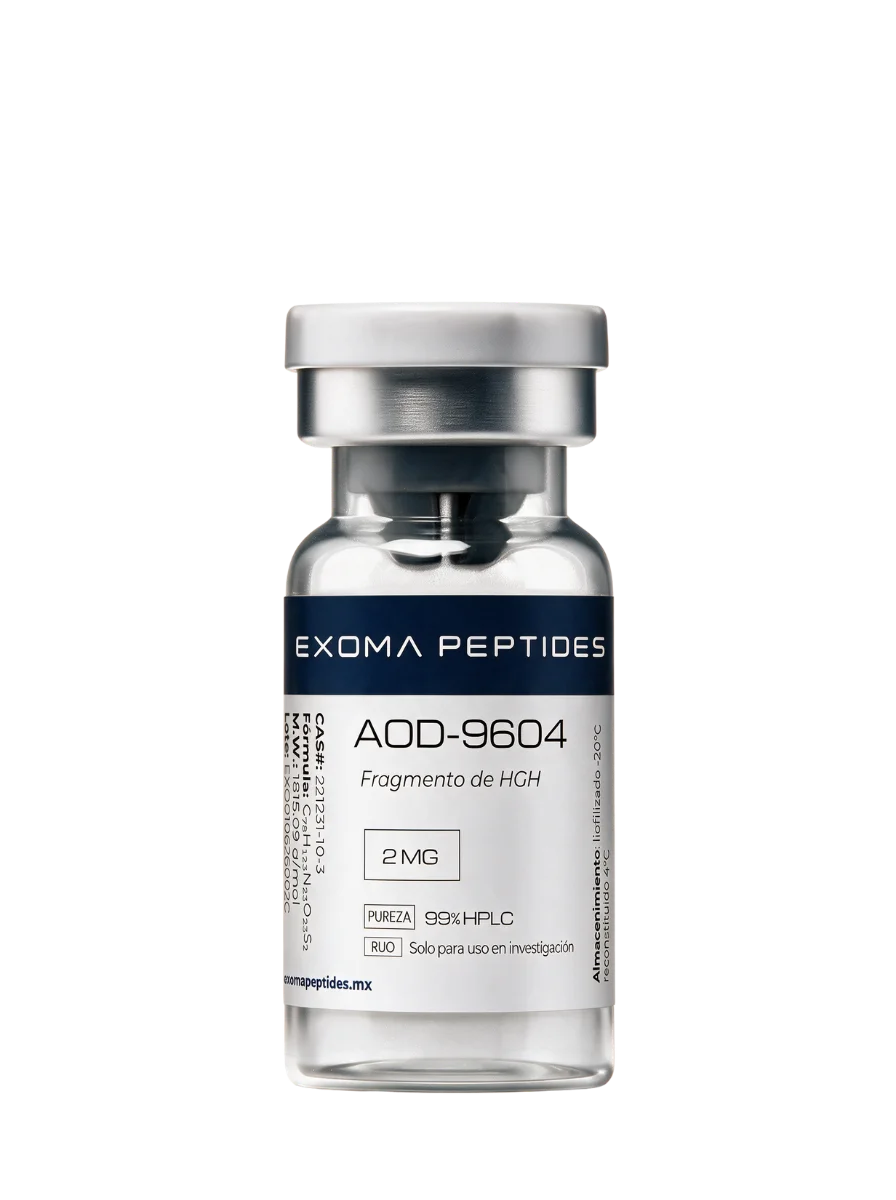
AOD-9604
AOD-9604 — reagent for research use (RUO). COA per batch available.
Technical data
- Development code
- AOD9604
- CAS
- 221231-10-3
- Molecular formula
- C78H123N23O23S2
- Molecular weight
- 1815.10 g/mol
Sizes and prices: 2 mg $780 MXN ($390 MXN per mg) · 5 mg $1,199 MXN ($240 MXN per mg) · 10 mg $1,840 MXN ($184 MXN per mg) (sold out).
Buy AOD-9604 in Mexico: order online with nationwide shipping in 1-4 business days depending on zone and tracking number. Prices in Mexican pesos. Material for research use only.
AOD-9604 is also searched as: Tyr-hGH(177-191).
Identity and composition
AOD-9604 (Advanced Obesity Drug 9604) is a synthetic peptide derived from the C-terminal fragment 176-191 of human growth hormone (hGH), the region where the lipolytic activity of the hormone resides. It is formed by the last 15 amino acids of hGH with the addition of a tyrosine residue at the N-terminal end to improve its stability, with an approximate molecular weight of 1815 Da and CAS number 221231-10-3. Unlike complete growth hormone, AOD-9604 retains only the domain involved in fat metabolism and lacks the structure necessary to bind to the GH receptor, so it does not stimulate the production of IGF-1 or cell growth. It was developed by Metabolic Pharmaceuticals as an anti-obesity candidate (hence its acronym AOD). It is distributed lyophilized as a research reagent (RUO) and is reconstituted with bacteriostatic water. As a lipolytic fragment of hGH, it is the reference comparator against the unmodified HGH Frag 176-191 and against complete growth hormone in lipid metabolism studies.
Mechanism of action
The mechanism of AOD-9604 reproduces the lipolytic action of the C-terminal region of growth hormone without activating the other hGH pathways. In adipocyte models, the peptide stimulates lipolysis (breakdown of stored triglycerides) and inhibits lipogenesis (formation and accumulation of new fat), shifting the balance of adipose tissue toward the mobilization of fatty acids. The literature proposes that this effect occurs through modulation of the β3-adrenergic pathway and an increase in intracellular cyclic AMP, with an increase in the expression and activity of lipolytic enzymes. The feature that distinguishes AOD-9604 from complete hGH is that it does not interact with the growth hormone receptor: for this reason it does not raise IGF-1, does not promote tissue growth, and —a key point in metabolic research— does not produce the diabetogenic effect or the insulin resistance associated with growth hormone, maintaining glycemia unchanged in the reported studies. This dissociation between lipolytic effect and effect on glucose and IGF-1 is the basis of the experimental interest in the peptide.
Pharmacokinetics
AOD-9604 is a short-chain peptide with a brief plasma half-life following subcutaneous administration, with rapid absorption and clearance. The literature describes its parenteral administration in preclinical models, although the original development program also explored oral formulations, limited by the low bioavailability characteristic of peptides via the gastrointestinal route. Unlike full growth hormone, its pharmacodynamic action is not reflected in changes in IGF-1 (which remains unchanged), so research response markers focus on parameters of lipid metabolism and body composition. Its pharmacokinetic profile favors frequent dosing schedules in the described experimental protocols, and its stability depends on proper storage of the lyophilizate and the reconstituted solution.
Scientific evidence
The evidence on AOD-9604 comes mainly from the development program of Metabolic Pharmaceuticals and from preclinical studies. In animal models of obesity, a consistent reduction of fat mass was documented through stimulation of lipolysis and inhibition of lipogenesis, without the adverse metabolic effects of hGH. In humans, six randomized, double-blind, placebo-controlled trials were completed (Stier H, Vos E, Kenley D. J Endocrinol Metab. 2013;3(1-2):7-15), among them two oral phase IIb studies: METAOD005 (12 weeks, 300 subjects) and METAOD006 (24 weeks, 502 subjects, 0.25 to 1 mg/day). Tolerability was good and no effects were observed on serum IGF-1 or negative effects on carbohydrate metabolism, but the effect on weight seen in the initial trials was not reproduced in the largest and longest phase IIb study (Moré MI, Kenley D. J Endocrinol Metab. 2014;4(3):64-77), and development as an anti-obesity drug was halted. It has subsequently been investigated in other contexts, including models of cartilage and joint metabolism. Within the framework of research use only (RUO), it is important to note that AOD-9604 is not approved as a medication for weight loss or for any clinical indication, and its use corresponds to scientific purposes.
Research applications
In research, AOD-9604 is used as a tool to study the dissociation between the lipolytic activity of growth hormone and its effects on growth and glucose. Among its described experimental applications are: models of lipolysis and lipogenesis in adipocytes; the investigation of lipid metabolism and body composition without interference on IGF-1 or glycemia; comparative study against full-length hGH and against HGH Frag 176-191 to isolate the lipolytic domain; models of the β3-adrenergic pathway and cyclic AMP; and exploratory studies in articular cartilage metabolism. Its value as a reagent lies precisely in acting as a "pure" lipolytic fragment, without the anabolic or diabetogenic signals of growth hormone.
Research protocols
The scientific literature describes the administration of AOD-9604 by the subcutaneous route in frequent doses within metabolic research protocols, taking advantage of its short half-life. Dosing is calculated from the milligram content of the vial and the volume of bacteriostatic water used in reconstitution. In the reported regimens, the IGF-1 or blood-glucose adjustment and monitoring associated with full growth hormone is not required, since the peptide does not alter those parameters; experimental follow-up is oriented toward markers of lipid metabolism and body composition. All handling corresponds strictly to research use only (RUO), with rotation of application sites in models that use the subcutaneous route.
Reconstitution
Lyophilized AOD-9604 is reconstituted with bacteriostatic water (sterile water with 0.9% benzyl alcohol), added slowly down the wall of the vial to avoid direct impact on the powder. The vial is swirled gently in a rotating motion until complete dissolution; it must not be shaken vigorously, since foam formation subjects the peptide to shear stress. The final concentration is determined by the volume of diluent added relative to the milligrams in the vial, which allows reproducible volumes to be dosed in the experimental protocols. A correctly reconstituted solution is clear and colorless; any turbidity or particles indicate a loss of integrity. After reconstitution, the material is kept refrigerated and protected from light.
Stability and storage
In its lyophilized form, stored at 2-8°C and protected from light and humidity, AOD-9604 maintains its stability over prolonged periods according to the batch specifications; for long-term storage it can be kept frozen. Once reconstituted, the solution should be kept refrigerated at 2-8°C and used within a short time frame (usually up to 2-4 weeks depending on the preservative in the diluent), avoiding prolonged exposure to room temperature, direct light, and repeated freeze-thaw cycles, which promote degradation of the peptide. Visual verification that the solution remains clear before each use is the practical control of structural integrity in experimental handling.
Safety profile
In phase II clinical trials, AOD-9604 showed a favorable tolerability profile, without the metabolic adverse events characteristic of growth hormone: in particular, no elevation of glycemia, insulin resistance, or increase in IGF-1 was observed, which constitutes its main safety difference from full-length hGH. The reported events were generally mild and included injection-site reactions. No effects on tissue growth or mitogenic activity were described, consistent with its inability to activate the GH receptor. Within the framework of research-use-only (RUO), the safety information is provided for scientific purposes and does not constitute clinical use guidance; AOD-9604 is not approved as a medicine.
Comparative context
AOD-9604 is positioned as the stabilized and studied version of the lipolytic fragment of growth hormone. Compared with full hGH (Somatropin), it shares only the lipolytic action but lacks its effects on IGF-1, growth, and glucose, which makes it a "pure" fragment for isolating fat metabolism. Compared with the unmodified HGH Frag 176-191, AOD-9604 incorporates an N-terminal tyrosine that improves its stability, so that in research practice both are studied as functional equivalents of the 176-191 domain, with AOD-9604 being the optimized form. Unlike the GHRH analogs (CJC-1295, MOD-GRF) and the GHRP secretagogues (Ipamorelin), which act by increasing the endogenous secretion of GH and therefore of IGF-1, AOD-9604 does not touch the somatotropic axis. And unlike tesamorelin or the GLP-1 agonists used in the management of adiposity, it operates exclusively through the lipolytic pathway of the hGH fragment.
History and development
AOD-9604 was developed beginning in the late 1990s by the Australian company Metabolic Pharmaceuticals, in collaboration with researchers from Monash University, within a program aimed at designing an anti-obesity drug based on the lipolytic region of growth hormone without its metabolic side effects. The name AOD comes precisely from "Advanced/Anti-Obesity Drug". The compound advanced through preclinical studies and through phase II clinical trials in obesity during the 2000s. Although it demonstrated a good safety profile, the efficacy results in humans were not sufficient to support its approval as a medication, and the development program was halted. Subsequently, the peptide has been the subject of exploratory research in other areas of metabolism, and it remains available as a research reagent for the study of the lipolytic component of hGH.
FAQ
What is AOD-9604?
It is a synthetic peptide derived from fragment 176-191 of the C-terminal end of human growth hormone, with an added N-terminal tyrosine for greater stability. It retains the lipolytic action of hGH without activating its receptor. Reagent for research (RUO).
How does AOD-9604 differ from complete HGH?
AOD-9604 reproduces only the lipolytic effect of growth hormone: it does not elevate IGF-1, does not stimulate growth, and does not alter glucose or generate insulin resistance, unlike full hGH.
Are AOD-9604 and HGH Frag 176-191 the same thing?
They are functionally equivalent: both correspond to the 176-191 domain of hGH. AOD-9604 is the optimized form with an N-terminal tyrosine that improves its stability.
How does AOD-9604 act on fat?
In adipocyte models it stimulates lipolysis (breakdown of stored fat) and inhibits lipogenesis (formation of new fat), an effect the literature links to the β3-adrenergic pathway and to the increase of cyclic AMP.
How is AOD-9604 reconstituted?
With bacteriostatic water added slowly down the wall of the vial, swirling gently without shaking. The solution should be clear and colorless and stored refrigerated at 2-8°C.
Is AOD-9604 approved as a weight-loss medication?
No. It is exclusively a research reagent (RUO). Its phase II clinical trials did not meet the efficacy criteria necessary for its approval, so it is not authorized as a drug.
Customer reviews
Average rating: 4.6 out of 5, based on 13 customer ratings.
Claudia A. — 5/5
The AOD-9604 arrived in perfect condition. I love the store's reliability.
Natalia V. — 4/5
It took one more day than expected but everything arrived in perfect cold condition.
Mauricio L. — 5/5
The AOD-9604 exceeded my expectations regarding delivery times. Very professional.
Beatriz E. — 5/5
No complaints, the product is exactly as described.
Brenda C. — 4/5
A slight delay with Estafeta, but the product arrived frozen.
Carla T. — 5/5
Good product, matches what is published on their website.
Cesar K. — 4/5
All good, but the courier took a few hours longer than expected.
Camilo G. — 5/5
Good product, it arrived ice-cold as it should be.
Mauricio L. — 5/5
The AOD-9604 exceeded my expectations in delivery times. Everything excellent.
Claudio P. — 4/5
The courier took a little longer but it came super cold.
Carlos F. — 5/5
It all arrived ice cold in its little cooler. Everything perfect.
Jorge E. — 4/5
Good product, secure and discreet shipping.
Certificate of analysis per batch
AOD-9604 lots with certificate of analysis published in the COA catalog:
- Lot EXO010626002A — 10 mg, issued 2026-05-30
- Lot EXO010626002B — 5 mg, issued 2026-05-30
- Lot EXO010626002C — 2 mg, issued 2026-05-29
Scientific references (5)
Peer-reviewed literature on AOD-9604, with its PubMed identifier when available:
- Detection and in vitro metabolism of AOD9604 (Cox HD et al. · Drug testing and analysis · 2015) PMID 25208511.
- AOD-9604 does not influence the WADA hGH isoform immunoassay (Orlovius AK et al. · Drug testing and analysis · 2013) PMID 24124033.
- AOD-9604 Metabolic (Wilding J · Current opinion in investigational drugs (London, England: 2000) · 2004) — A profile of a compound in development, not a trial. The indexed abstract only notes that as of February 2002 phase IIa trials were underway; it does not report efficacy outcomes. PMID 15134286.
- Metabolic studies of a synthetic lipolytic domain (AOD9604) of human growth hormone (Ng, et al. · Hormone Research · 2000) PMID 11146367.
- Effect of Intra-articular Injection of AOD9604 with or without Hyaluronic Acid in Rabbit Osteoarthritis Model (Kwon, et al. · Annals of Clinical and Laboratory Science · 2015) PMID 26275694.
Full scientific profile: AOD-9604 in the compendium — mechanism of action, studies and technical data sheet.
See the full category catalog: Metabolism.
Guides and articles about AOD-9604
Lecturas del blog de EXOMA que la editorial asoció a este compuesto: