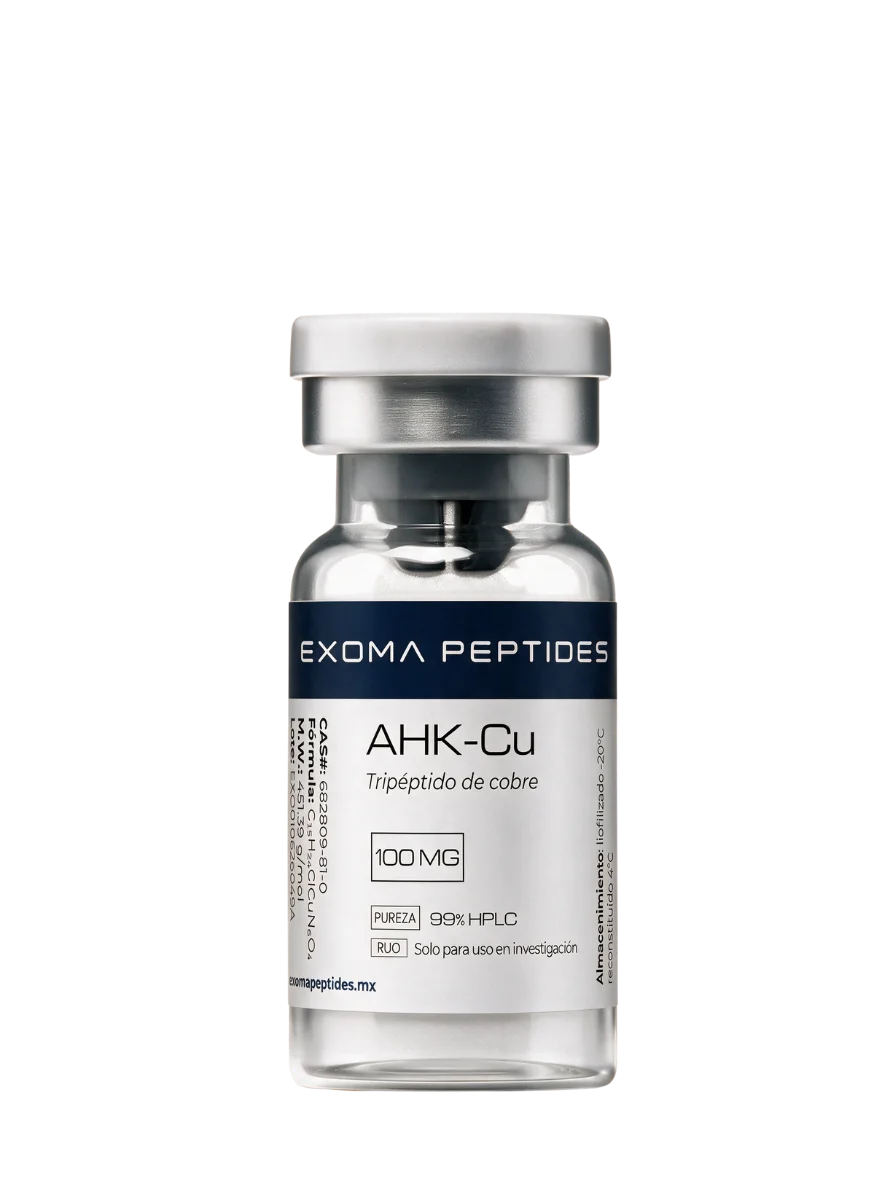
AHK-Cu
AHK-Cu — reagent for research use (RUO). COA per batch available.
Technical data
- CAS
- 682809-81-0
- Molecular formula
- C15H24CuN6O4
- Molecular weight
- 415.94 g/mol
Sizes and prices: 100 mg $1,130 MXN ($11 MXN per mg).
Buy AHK-Cu in Mexico: order online with nationwide shipping in 1-4 business days depending on zone and tracking number. Prices in Mexican pesos. Material for research use only.
AHK-Cu is also searched as: Copper Tripeptide-3, Tripeptide de cobre-3, AHK copper peptide.
Identity and composition
AHK-Cu is a tripeptide-copper complex for research use, formed by the sequence Ala-His-Lys (L-alanyl-L-histidyl-L-lysine) complexed with divalent copper Cu(II). It is a synthetic analogue of GHK-Cu in which the N-terminal glycine is substituted by alanine. It is studied mainly in models of hair follicle growth and cutaneous biology.
Its identity and sequence (L-alanyl-L-histidyl-L-lysine-Cu2+) are confirmed in the peer-reviewed literature. In the consulted literature no verified authoritative values are available for CAS number, molecular weight, or molecular formula, so these parameters are not declared here; various supplier catalogs cite figures that have not been confirmed in databases such as PubChem or DrugBank.
It is also known by names such as Tripeptide-3 copper, L-alanyl-L-histidyl-L-lysine copper and the INCI name Copper tripeptide-3 (the latter reported by suppliers and not confirmed in an authoritative source).
Product for research use.
Mechanism of action
AHK-Cu is a tripeptide-copper complex (Ala-His-Lys:Cu2+) structurally analogous to GHK-Cu. In the only peer-reviewed in vitro/ex vivo study located, at very low concentrations (range of 10^-12 to 10^-9 M) it was observed to stimulate the elongation of human hair follicles ex vivo and the proliferation of dermal papilla cells (DPC) in vitro (PMID 17703734).
In that same work, at the cellular level, a reduction of apoptosis in DPCs is described, with an increase in the ratio Bcl-2/Bax and decrease in cleaved caspase-3 y PARP. Additionally, stimulation of dermal fibroblasts was reported with an increase in the production of VEGF (mediator of angiogenesis) and decreased secretion of TGF-beta1 (PMID 17703734).
It is important to frame the level of evidence: all these findings are at the cellular/tissue in vitro and ex vivo level. There is no confirmed in vivo mechanistic evidence in humans for AHK-Cu.
Pharmacokinetics
No primary source with pharmacokinetic parameters for AHK-Cu was located. No verifiable data are available on half-life, absorption, distribution, metabolism, or elimination. Consequently, it is not possible to quantitatively describe its kinetic behavior; any figure of this kind should be considered undocumented in authoritative sources.
Scientific evidence
The available evidence on AHK-Cu is limited and low-level. The basis is essentially a 2007 in vitro/ex vivo study (Archives of Pharmacal Research) focused on human hair follicle growth and on dermal papilla cells (PMID 17703734).
No clinical trials registered in ClinicalTrials.gov were located for AHK-Cu / Copper tripeptide-3, nor phase I-III studies. The explored indications (stimulation of follicular growth, dermal angiogenesis, healing, and skin regeneration) are all preclinical; some additional claims, such as collagen synthesis, appear mostly in supplier literature and are not confirmed in an open primary source.
In summary, the preliminary evidence suggests activity at the cellular level in laboratory models, but these are preclinical data that do not allow results to be extrapolated to humans.
Research applications
Ideal for (research contexts):
- In vitro and ex vivo studies on the biology of the hair follicle and dermal papilla cells.
- Exploratory research into cellular pathways associated with proliferation and apoptosis (e.g. Bcl-2/Bax, caspase-3).
- Studies of dermal fibroblasts and mediators such as VEGF and TGF-beta1.
- Comparative work against other copper-tripeptides such as GHK-Cu.
Not applicable for:
- clinical use, therapeutic use, diagnostic or cosmetic use for personal application.
- Any expectation of a clinical outcome: there are no clinical trials or in vivo human data supporting medical applications.
Product for research use.
Research protocols
In the reference in vitro/ex vivo study, AHK-Cu was evaluated over a range of very low concentrations, from 10^-12 to 10^-9 M, in models of human hair follicle and dermal papilla cells (PMID 17703734).
No mg dosing protocols derived from clinical trials, nor administration schemes validated in humans, were located. The 100 mg presentation corresponds to the research material; any experimental design of concentration, vehicle, and frequency is left to the researcher's judgment and to their laboratory protocol, since there is no established clinical guideline to cite.
Reconstitution
As a general laboratory-handling guide, lyophilized peptides are usually reconstituted with bacteriostatic water (sterile water with approximately 0.9% benzyl alcohol), which helps limit microbial growth in solutions for repeated use.
Standard technique recommendations:
- Add the diluent slowly down the vial wall, avoiding directing the stream directly onto the powder.
- Do not shake vigorously; swirl the vial gently until complete dissolution.
- Choose the reconstitution volume according to the working concentration desired for your protocol.
These are general laboratory practices; they do not constitute clinical guidance and do not imply use in humans.
Stability and storage
As a general laboratory handling reference for lyophilized peptides:
- Lyophilized (powder): is usually best preserved at low temperatures; storage under refrigeration or, for prolonged periods, freezing, is the standard practice. Protect it from moisture and light.
- Reconstituted (in solution): is generally kept refrigerated and used within a short time; for prolonged storage, freezing is usually preferred, avoiding repeated freeze-thaw cycles.
No specific published stability data for AHK-Cu are available in a primary source, so these indications are general preservation guidelines and not validated values for this particular compound.
Safety profile
No documented safety data from primary or regulatory sources were found for AHK-Cu. There is no characterized toxicological profile nor adverse reactions described in peer-reviewed literature.
The claims of tolerability that circulate come from supplier catalogs and are not verifiable in an authoritative source. In the absence of reliable data, a precautionary stance must be assumed and it must be handled only under adequate laboratory practices.
There are no formally documented contraindications, precisely because no clinical evaluation exists. This material is exclusively for research and must not be used in humans or animals outside a controlled experimental framework.
Comparative context
AHK-Cu is a structural analog of GHK-Cu (Gly-His-Lys:Cu), the best-characterized copper-tripeptide and naturally present in human plasma. The key structural difference is the substitution of the glycine (Gly) for alanine (Ala) at the N-terminal position.
Relevant differences in prose:
- Origin: GHK-Cu is an endogenous component of the organism; AHK-Cu was designed in the laboratory and has not been described as a natural component of the body.
- Evidence base: that of GHK-Cu is considerably broader, while that of AHK-Cu is notably scarcer, supported essentially by a single in vitro/ex vivo study.
Thus, although they share the copper-tripeptide chemical class, AHK-Cu is at a much earlier stage of characterization than its reference analog.
History and development
AHK-Cu emerges as synthetic analog of GHK-Cu, designed in the laboratory by substituting the N-terminal glycine with alanine in the copper-tripeptide sequence. Unlike GHK-Cu, it has not been described as an endogenous molecule of the organism.
Its presence in the peer-reviewed scientific literature is limited: the available reference work is a 2007 in vitro study published in Archives of Pharmacal Research, focused on the effect of the tripeptide-copper complex on human hair growth (PMID 17703734). Its predominant use has been of a cosmetic/topical type in the market, rather than as an approved drug, and it does not have a registered clinical development program.
FAQ
What is AHK-Cu and what is it studied for?
It is a tripeptide-copper complex (Ala-His-Lys:Cu2+), a synthetic analog of GHK-Cu, intended for research use. In in vitro and ex vivo studies its effect on the growth of the human hair follicle and dermal papilla cells has been investigated. It is not a product for clinical use.
What is the difference between AHK-Cu and GHK-Cu?
Both are copper-tripeptides. AHK-Cu replaces the N-terminal glycine of GHK-Cu with alanine. GHK-Cu is a natural component of human plasma and is much better characterized; AHK-Cu was designed in the laboratory and its evidence base is scarcer.
Does AHK-Cu have clinical trials in humans?
No. No clinical trials registered on ClinicalTrials.gov or phase I-III studies were found. The available evidence is preclinical, essentially one in vitro/ex vivo study, and does not allow extrapolating results to humans.
What doses or concentrations have been used in studies?
In the reference in vitro/ex vivo study, AHK-Cu was evaluated over a concentration range of 10^-12 to 10^-9 M on human hair follicle and dermal papilla cells (PMID 17703734). No validated clinical dosing guidelines exist.
How is AHK-Cu reconstituted and stored?
As a general laboratory guide, lyophilized peptides are usually reconstituted with bacteriostatic water, added slowly down the wall of the vial. The powder is best stored refrigerated or frozen; once in solution, it is usually refrigerated and used within a short time, avoiding freeze-thaw cycles.
Are there safety data for AHK-Cu?
No safety data were found in primary or regulatory sources: there is no toxicological profile or characterized adverse reactions in the peer-reviewed literature. It must be handled with caution and only for research, not for clinical use.
Customer reviews
Average rating: 5.0 out of 5, based on 3 customer ratings.
Javier M. — 5/5
Excellent presentation of the AHK-Cu. You can tell the care they put into shipping.
Bruno C. — 5/5
The AHK-Cu arrived earlier than expected. I was surprised by the speed of delivery and it comes with excellent presentation.
Javier M. — 5/5
Excellent presentation of the AHK-Cu. The care in every shipment is evident.
Certificate of analysis per batch
AHK-Cu lot with certificate of analysis published in the COA catalog:
- Lot EXO010626049A — 100 mg, issued 2026-05-30
Scientific references (1)
Peer-reviewed literature on AHK-Cu, with its PubMed identifier when available:
- The effect of tripeptide-copper complex on human hair growth in vitro (Pyo, et al. · Archives of Pharmacal Research · 2007) PMID 17703734.
Full scientific profile: AHK-Cu in the compendium — mechanism of action, studies and technical data sheet.
See the full category catalog: Aesthetics · Recovery.