
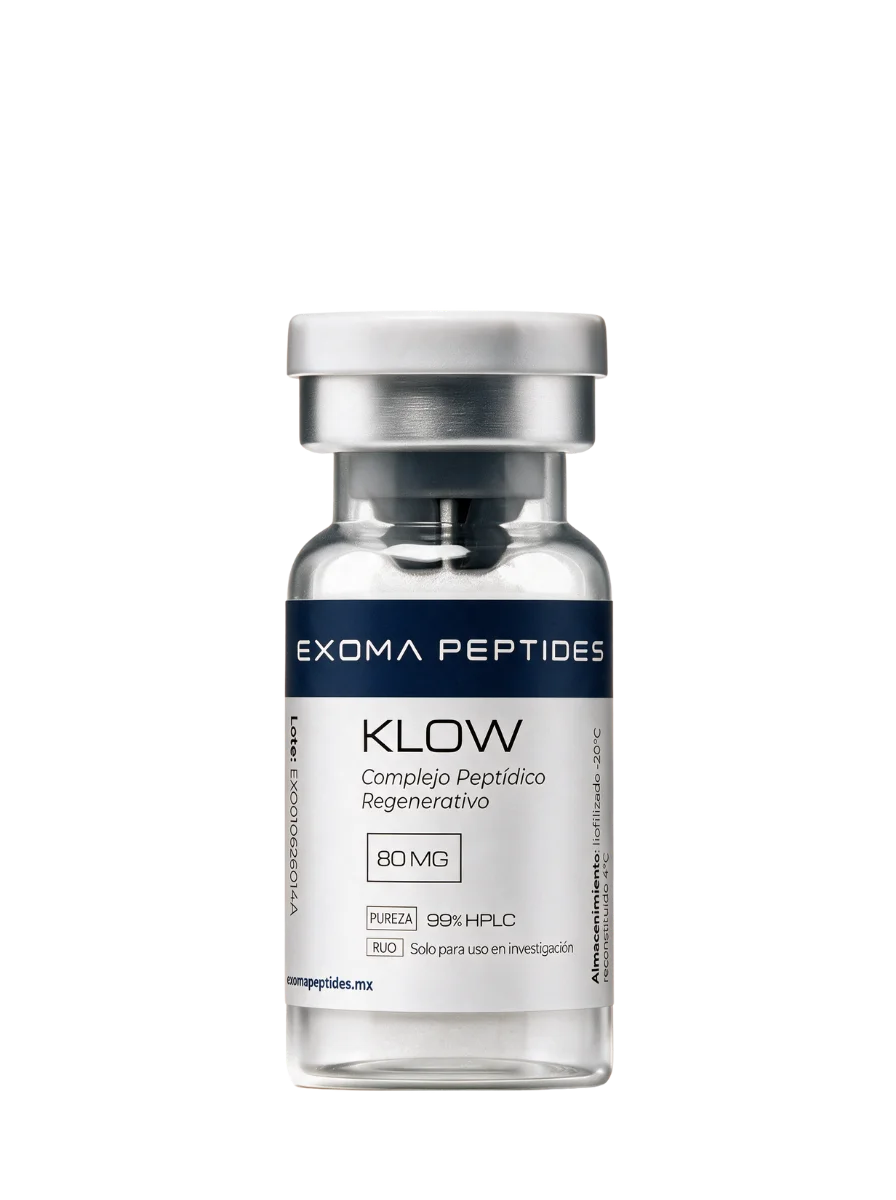
KLOW
KLOW — research reagent (RUO). COA per batch available.
Sizes and prices: 80 mg $2,940 MXN ($37 MXN per mg).
Buy KLOW in Mexico: order online with nationwide shipping in 1-4 business days depending on region, with a tracking number. Prices in Mexican pesos. Material for research use only.
KLOW is also searched as: KLOW Blend.
Identity and composition
KLOW, also identified as GLOW-80, is a multipeptide mixture for research use only (RUO) presented in a single lyophilized vial that brings together four complementary peptides: GHK-Cu 50 mg, TB-500 10 mg, BPC-157 10 mg, and KPV 10 mg, for a total of 80 mg per vial. Its dominant component is GHK-Cu (Gly-His-Lys-Cu²⁺), copper tripeptide-1, accompanied by BPC-157 (a pentadecapeptide of gastric origin), TB-500 (a synthetic fragment of thymosin β4), and KPV (the lysine-proline-valine tripeptide derived from the C-terminal portion of α-MSH). This combination positions KLOW as a blend oriented toward studies of tissue repair, extracellular matrix remodeling, and inflammatory modulation within controlled experimental models. For those seeking to buy KLOW blend Mexico, it is important to understand that the lyophilized format groups four distinct chemical entities in fixed proportions, which makes it possible to investigate synergies that are difficult to observe when studying each peptide separately. The designation GLOW-80 reflects its kinship with the GLOW family, to which KLOW adds the KPV axis. When evaluating KLOW peptides price, it is worth remembering that this is lyophilized reference material, not a finished product, and that its handling requires prior reconstitution with bacteriostatic water and well-defined cold storage conditions.
Mechanism of action
The scientific interest of KLOW lies in the fact that it integrates four distinct mechanisms of action in a single GHK-Cu BPC TB-500 KPV blend. GHK-Cu acts as a copper cofactor and remodeling signaler: it stimulates the expression of TGF-β and collagen synthesis while inhibiting extracellular matrix degradation, favoring a balance toward repair in dermal and connective tissue models. BPC-157 exerts cytoprotection and modulates the nitric oxide (NO) and vascular endothelial growth factor (VEGF) pathways, which in preclinical studies is associated with angiogenesis and mucosal stability. TB-500, the active fragment of thymosin β4, sequesters G-actin monomers and regulates cytoskeletal assembly, promoting cell migration and proliferation during tissue remodeling. The fourth vertex, KPV, provides the component that distinguishes KLOW: an anti-inflammatory action mediated by the melanocortin axis, with documented inhibition of the NF-κB pathway, especially relevant in intestinal and mucosal inflammation models. Thus, KLOW simultaneously covers matrix synthesis (GHK-Cu), vascular cytoprotection (BPC-157), cytoskeletal dynamics (TB-500), and inflammatory braking (KPV), four routes that the literature describes independently and that this blend makes it possible to investigate in combination under an RUO framework.
Pharmacokinetics
Being a blend of four peptides, the pharmacokinetics of KLOW must be understood as the superposition of individual profiles rather than as a single curve, and all the parameters described come from experimental research models (RUO). Low-molecular-weight peptides such as GHK-Cu (a tripeptide) and KPV (a tripeptide) tend to present rapid absorption and short plasma half-lives in preclinical models, with distribution toward tissues rich in melanocortin receptors in the case of KPV. BPC-157, a pentadecapeptide, shows in the literature a relatively high stability against degradation in acidic media, which has motivated its study in digestive contexts. TB-500, a larger fragment derived from thymosin β4, exhibits a broader tissue distribution and a functional persistence linked to its actin-binding capacity. Taken together, the blend does not possess a single bioavailability value or a consolidated elimination constant; each component follows its own kinetics of absorption, distribution, and clearance. Any quantitative characterization of KLOW requires specific analytical assays per component, and the available data correspond to in vitro studies and animal models, never to human clinical parameters.
Scientific evidence
The evidence supporting interest in KLOW comes from preclinical and in vitro studies on each of its four peptides, not from clinical trials of the blend as such, something that must be emphasized within its research (RUO) framework. GHK-Cu has a broad experimental base in matrix remodeling, gene expression associated with repair and collagen synthesis in fibroblast cultures. BPC-157 has been investigated in numerous animal models of tendon, muscle and gastric mucosa injury, with signaling linked to NO and VEGF. TB-500 and the thymosin β4 from which it derives have accumulated literature on cell migration, wound healing and cytoskeleton modulation in wound models. KPV, for its part, has studies in models of colitis and intestinal inflammation where it reduces NF-κB-dependent markers. The value proposition of KLOW is to bring together these four lines of evidence in a single vial to study synergies, but there are as yet no controlled trials that validate the complete blend in humans. Therefore, all use is restricted to research, and the anchor data described here must be interpreted as pharmacological foundations established per component, not as claims of combined clinical efficacy.
Research applications
In the field of research (RUO), KLOW is studied as a tool to explore the intersection between tissue repair and inflammatory control in experimental models. Its combination of GHK-Cu, BPC-157, TB-500 and KPV makes it attractive to laboratories investigating extracellular matrix remodeling, wound-healing dynamics and mucosal modulation within a single experimental design. The GHK-Cu component is studied in dermal and connective-tissue models for its role in collagen synthesis and TGF-β expression. BPC-157 is investigated in models of tendon, muscle and gastric injury for its cytoprotection via NO/VEGF. TB-500 is used in assays of cell migration and cytoskeleton-associated repair. KPV extends the range toward intestinal inflammation models, where its action on the melanocortin axis and the NF-κB pathway is of interest. For researchers evaluating buying KLOW blend Mexico, the differential value lies in being able to analyze these four pathways in parallel without preparing four separate vials. It must be reiterated that none of these applications constitutes a validated therapeutic use; all correspond to laboratory contexts, in vitro or in animal models, under a strict research framework.
Research protocols
Experimental protocols with KLOW are always designed within the research (RUO) framework and depend on the model, the target concentration and the scientific questions posed by each laboratory. Being a lyophilized blend of four peptides in fixed proportions, the first methodological step is reconstitution with 3-5 mL of bacteriostatic water, calculating the resulting concentration based on the total content of the vial in order to dose precise volumes with a micropipette in the study systems. Designs usually contemplate dose-response curves, vehicle controls and comparisons against individual peptides to discern additive or synergistic effects among GHK-Cu, BPC-157, TB-500 and KPV. Traceability requires recording lot, reconstitution date and storage conditions of each aliquot. As a reference material, there are no human dosing schemes or clinical recommendations associated with KLOW, and any administration parameter belongs exclusively to the in vitro or animal-model experimental design. Reproducibility relies on documenting the solvent used, the homogeneity of the solution and the temporal stability of the reconstituted blend throughout the study.
Reconstitution
The reconstitution of KLOW is carried out with 3 to 5 mL of bacteriostatic water, chosen because it contains benzyl alcohol that helps preserve the solution during the experimental working period. The correct procedure consists of directing the solvent slowly against the inner wall of the vial, avoiding projecting the stream directly onto the lyophilized powder, since peptides are sensitive to vigorous mechanical agitation. After adding the bacteriostatic water, the vial is left to rest and a gentle, rotating motion is applied, never an energetic agitation, until achieving a transparent and homogeneous solution containing the four components GHK-Cu, BPC-157, TB-500, and KPV dissolved uniformly. The reconstitution volume directly determines the final concentration: a smaller volume within the 3-5 mL range produces a more concentrated solution, while a larger one facilitates the pipetting of small doses. It is recommended to calculate the target concentration in advance for the experimental design and to record the exact volume used. Once reconstituted, the blend must be handled under cold conditions and protected from light, and any turbidity or visible particle is grounds for discarding the preparation within the research context (RUO).
Stability and storage
The stability of KLOW depends on its physical state and storage temperature, parameters critical to preserving the integrity of the blend's four peptides within a research (RUO) handling framework. In lyophilized form, the vial should be stored at -20 °C, a condition under which the powder maintains its stability for prolonged periods provided it remains sealed, dry and protected from repeated temperature cycles. Once reconstituted with bacteriostatic water, KLOW becomes a perishable solution that must be kept refrigerated at 2-8 °C and used within a maximum of 30 days, since peptides in solution are susceptible to hydrolysis and progressive degradation. It is advisable to protect the solution from direct light and to minimize freeze-thaw cycles, which can fragment the peptide chains and compromise the homogeneity of the blend. For studies requiring longer storage after reconstitution, some laboratories divide the solution into single-use aliquots to reduce repeated exposure to the environment. Recording the reconstitution date is essential to respect the 30-day window at 2-8 °C and to ensure that GHK-Cu, BPC-157, TB-500 and KPV maintain their experimental integrity.
Safety profile
The handling profile of KLOW is defined exclusively in the research (RUO) context, with no clinical safety data in humans existing for the blend or for its specific combination of GHK-Cu, BPC-157, TB-500 and KPV. All available information comes from preclinical and in vitro studies of the individual peptides, so safety conclusions cannot be extrapolated to contexts outside laboratory experimentation. As a lyophilized reference material, KLOW must be handled with good practices: use of appropriate protective equipment, clean surfaces, use of sterile bacteriostatic water for reconstitution and avoidance of cross-contamination between aliquots. The presence of copper in GHK-Cu and the multi-peptide nature of the blend make it advisable to maximize the traceability of lots and concentrations in each assay. No effects in human organisms are described here because the product is not intended for that purpose; its framework is strictly in vitro research and animal models. Any laboratory working with KLOW must follow the institutional biosafety protocols corresponding to synthetic research peptides and document the handling of the material in accordance with its internal standards.
Comparative context
The clearest way to place KLOW is to compare it with GLOW, from which it directly derives. GLOW is the classic three-peptide blend combining GHK-Cu, BPC-157, and TB-500, focused on tissue repair, matrix remodeling, and cytoskeletal dynamics. KLOW, also called GLOW-80, takes that same three-peptide base and adds a fourth: KPV. That K is precisely the difference between the two products. KPV incorporates an axis that GLOW does not possess: melanocortin-mediated anti-inflammatory action with inhibition of the NF-κB pathway, particularly studied in intestinal and mucosal inflammation models. That is why, when a researcher compares KLOW vs GLOW, the decision comes down to whether the experimental design needs that additional anti-inflammatory component or not: GLOW covers the reparative triad, while KLOW extends it toward inflammatory modulation. Compared with studying each peptide separately, both blends offer the advantage of fixed ratios in a single lyophilized vial, but KLOW is the only one that allows the four pathways to be investigated simultaneously. For anyone assessing KLOW peptides price, the added value lies in that fourth vertex, which broadens the experimental scope relative to the three-component variant.
History and development
KLOW belongs to a generation of multipeptide blends conceived for research (RUO) that seek to bring together in a single lyophilized vial peptides with complementary mechanisms, rather than studying them in isolation. Its lineage begins with the GLOW blend, a three-peptide formulation that popularized the combination of GHK-Cu, BPC-157, and TB-500 for their convergence on processes of tissue repair and remodeling. Building on that base, KLOW, also called GLOW-80, arises as an extension that adds KPV to incorporate the anti-inflammatory melanocortin axis, broadening the spectrum of investigable pathways. Each of its components has its own scientific trajectory: GHK-Cu was originally identified as a factor present in human plasma with remodeling capacity; BPC-157 derives from a sequence associated with gastric juice; TB-500 comes from the study of thymosin β4 and its role in cell migration; and KPV was described as the active C-terminal fragment of α-MSH. The combination of these four histories in a blend reflects the trend of peptide research toward synergistic formulations. For those wishing to buy KLOW blend Mexico for experimental purposes, this context explains why the product is offered as lyophilized reference material and not as a finished preparation.
FAQ
What does KLOW contain?
KLOW, also called GLOW-80, is a multipeptide blend for research (RUO) that brings together four peptides in a single lyophilized vial: GHK-Cu (copper tripeptide-1, the dominant component), BPC-157 (gastric pentadecapeptide), TB-500 (fragment of thymosin β4), and KPV (tripeptide derived from α-MSH). This combination groups matrix synthesis, vascular cytoprotection, cytoskeletal dynamics, and anti-inflammatory modulation into a single fixed-ratio formulation.
KLOW vs GLOW, which to choose?
The difference is KPV. GLOW combines three peptides (GHK-Cu, BPC-157, and TB-500) focused on tissue repair and remodeling. KLOW starts from that same triad and adds KPV, which contributes the anti-inflammatory melanocortin axis via NF-κB. If the experimental design only requires studying tissue repair, GLOW is sufficient; if the anti-inflammatory component is also of interest, especially in intestinal or mucosal models, KLOW is the option, as it covers all four pathways at once.
What does KPV provide?
KPV is the lysine-proline-valine tripeptide derived from the C-terminal portion of α-MSH and constitutes the K that distinguishes KLOW from GLOW. It contributes an anti-inflammatory action mediated by the melanocortin axis, with documented inhibition of the NF-κB pathway in preclinical studies. This component is especially studied in models of intestinal and mucosal inflammation, extending the scope of the blend beyond tissue repair toward the modulation of inflammation.
How is KLOW reconstituted?
KLOW is reconstituted with 3 to 5 mL of bacteriostatic water, directing the solvent slowly against the wall of the vial and avoiding projecting it onto the lyophilized powder. It is left to stand, and a gentle, rotating motion is applied until a transparent and homogeneous solution is obtained with the four peptides dissolved. The volume chosen within that range defines the final concentration, so it is advisable to calculate it in advance for the experimental design. All within the research framework (RUO).
How is KLOW stored?
In its lyophilized form, the KLOW vial must be stored at -20 °C, where it maintains its stability for prolonged periods if it remains sealed and protected from humidity. Once reconstituted with bacteriostatic water, the solution must be refrigerated at 2-8 °C and used within a maximum of 30 days. It should be protected from light, freeze-thaw cycles should be avoided, and the date of reconstitution should be recorded to respect that stability window of the four peptides.
What is KLOW used for in research?
KLOW is a research reference material (RUO) studied in experimental models to explore the intersection between tissue repair and inflammatory control. Its four peptides allow parallel investigation of matrix remodeling (GHK-Cu), vascular cytoprotection (BPC-157), cell migration (TB-500), and anti-inflammatory modulation (KPV) without preparing separate vials. It has no validated therapeutic uses; all of its applications correspond to laboratory, in vitro, or animal-model contexts.
Customer reviews
Average rating: 4.9 out of 5, based on 8 customer ratings.
Lucía A. — 5/5
Very satisfied with KLOW. Everything arrived protected and the purchase was very easy to make.
Sara L. — 5/5
Very good packaging with abundant protective plastic.
Fernanda C. — 5/5
The KLOW arrived super fast and in perfect condition. I will definitely place my orders here again.
Ana R. — 5/5
GLOW-80 is a unique blend you won't find with other suppliers. The quality is impressive.
Rodrigo N. — 5/5
The KLOW arrived in order and very well protected. It honestly exceeded my expectations regarding delivery times.
Valeria G. — 4/5
Visible results in laboratory models.
Roberto A. — 5/5
Arrived super fast, the next day. The purity is verified with a COA. I will definitely buy again
Certificate of analysis per batch
KLOW lot with certificate of analysis published in the COA catalog:
- Lot EXO010626014A — 80 mg, issued 2026-05-30
Scientific references (6)
There is no peer-reviewed literature on KLOW as a combination. What follows is the literature for each component separately, with its PubMed identifier:
- About GHK-Cu: Glycyl-L-histidyl-L-lysine-Cu(2+) rescues cigarette smoking-induced skeletal muscle dysfunction via a sirtuin 1-dependent pathway (Deng, et al. · Journal of Cachexia, Sarcopenia and Muscle · 2023) PMID 36905132.
- About BPC-157: Protective effects of pentadecapeptide BPC 157 on gastric ulcer in rats (Xue, et al. · World Journal of Gastroenterology · 2004) PMID 15052688.
- About TB-500: Thymosin beta4 accelerates wound healing (Malinda, et al. · Journal of Investigative Dermatology · 1999) PMID 10469335.
- About KPV: Dissection of the anti-inflammatory effect of the core and C-terminal (KPV) alpha-melanocyte-stimulating hormone peptides (Getting, et al. · The Journal of Pharmacology and Experimental Therapeutics · 2003) PMID 12750433.
- About GHK-Cu: Effects of topical copper tripeptide complex on CO2 laser-resurfaced skin. (Miller TR, et al. · Arch Facial Plast Surg · 2006) PMID 16847171.
- About BPC-157: Focus on ulcerative colitis: stable gastric pentadecapeptide BPC 157 (Sikiric, et al. · Current Medicinal Chemistry · 2012) PMID 22300085.
Full scientific profile: GLOW-80 in the compendium — mechanism of action, studies and technical data sheet.
See the full category catalog: Aesthetics · Recovery.