
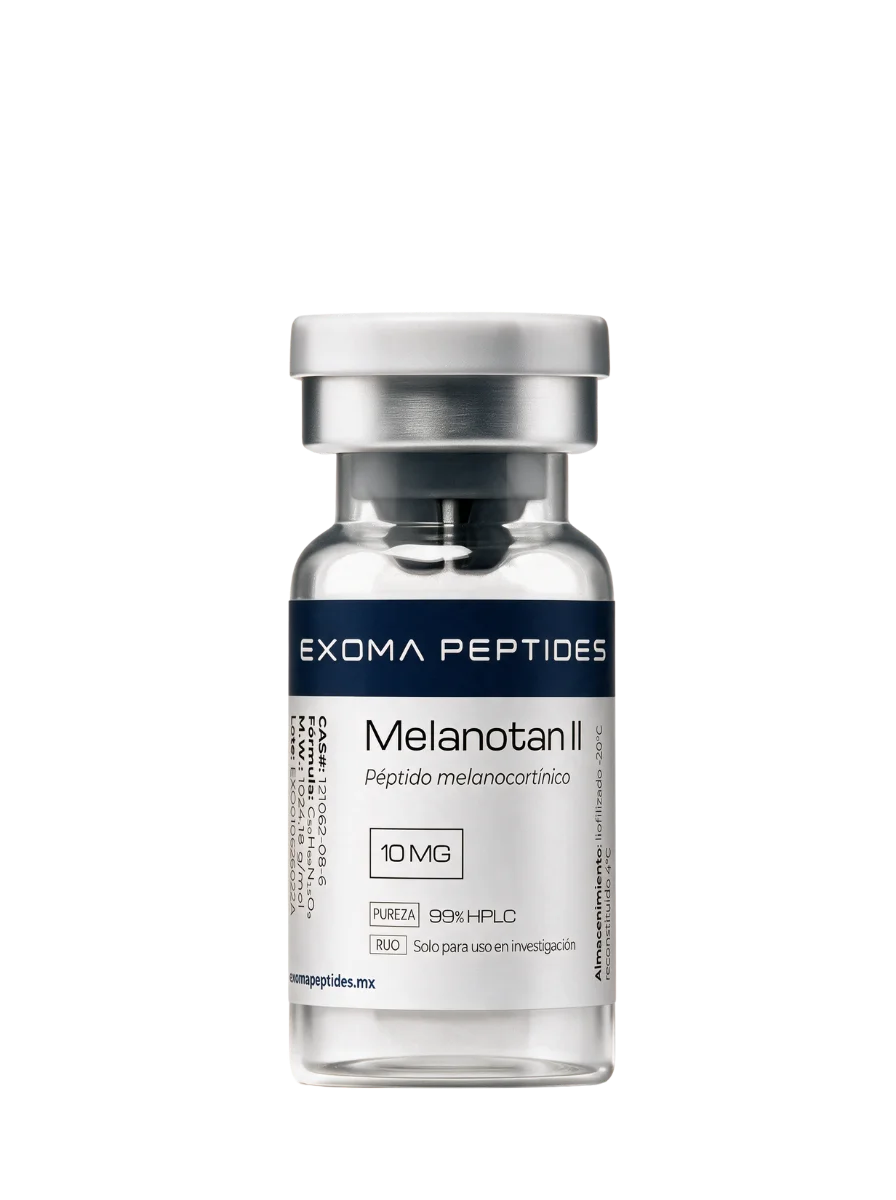
Melanotan II
Melanotan II — reagent for research use (RUO). HPLC purity 99.9% with COA per batch.
Technical data
- CAS
- 121062-08-6
- Molecular formula
- C50H69N15O9
- Molecular weight
- 1024.2 g/mol
Sizes and prices: 10 mg $780 MXN ($78 MXN per mg).
Buy Melanotan II in Mexico: order online with nationwide shipping in 1-4 business days depending on zone and tracking number. Prices in Mexican pesos. Material for research use only.
Melanotan II is also searched as: MT-II, MT-2, Melanotan-2.
Identity and composition
Melanotan II (MT-2) is a synthetic cyclic analog of alpha-melanocyte-stimulating hormone (α-MSH), a heptapeptide with a cyclic lactam structure of the sequence Ac-Nle-cyclo[Asp-His-D-Phe-Arg-Trp-Lys]-NH2, a molecular weight of approximately 1024 Da, and CAS number 121062-08-6. The cyclization and substitution with D-phenylalanine confer on it a potency and duration of action far superior to those of endogenous α-MSH, as well as resistance to enzymatic degradation. Unlike the selective analogs, Melanotan II is a non-selective agonist of the melanocortin receptors, activating MC1R, MC3R, MC4R, and MC5R, which explains its dual profile of effects on pigmentation (via MC1R) and on the central nervous system (via MC4R). It is distributed lyophilized as a research-use-only (RUO) reagent and is reconstituted with bacteriostatic water. It is the reference compound relative to Melanotan I (afamelanotide), which is more selective for MC1R, and the structural precursor of bremelanotide (PT-141).
Mechanism of action
Melanotan II exerts its action as an agonist of the G protein-coupled melanocortin receptors. In the melanocyte, activation of the MC1R receptor increases intracellular cyclic AMP, which stimulates the enzyme tyrosinase —the rate-limiting step of melanogenesis— and shifts synthesis toward eumelanin, the brown-black pigment responsible for the darkening of the skin (tanning). This effect occurs without the need for prolonged exposure to ultraviolet radiation, although light can enhance it. In parallel, and because of its non-selective nature, Melanotan II activates the MC4R receptor in the central nervous system, which in the literature is associated with effects on sexual behavior (increased arousal and erectile function) and with appetite suppression, as well as the MC3R receptor involved in energy homeostasis. The simultaneous activation of MC1R (peripheral, pigmentary) and MC4R (central, behavioral) is the characteristic that distinguishes Melanotan II from selective analogs and the basis of its interest in melanocortin system research.
Pharmacokinetics
Melanotan II is administered subcutaneously in the described models, with rapid absorption and a half-life on the order of hours, longer than that of native α-MSH thanks to its cyclic structure resistant to peptidases. Its pigmentary effect is cumulative: the induced melanogenesis manifests progressively over days to weeks of repeated administration, and the darkening persists as long as MC1R stimulation is maintained, gradually reversing upon discontinuation as the melanocytes are renewed. The central effects mediated by MC4R (sexual arousal, appetite reduction) appear more acutely after each administration. In research, the response is characterized by means of markers of melanogenesis and behavior according to the axis under study. Proper conservation of the lyophilate and of the reconstituted solution is decisive for preserving its activity.
Scientific evidence
Research on Melanotan II originated in the University of Arizona studies on melanocortin analogs as potential "sunless tanning" agents for photoprotection. The studies consistently document its capacity to induce melanogenesis and skin darkening, as well as central effects on erectile function and appetite mediated by MC4R —an observation that led to the development of bremelanotide (PT-141), a metabolite of Melanotan II, as a specific candidate for sexual dysfunction. Within the framework of exclusive research use (RUO), it is important to note that Melanotan II is not approved as a drug in any indication and that its unsupervised use has been associated with relevant adverse effects, including nausea, facial flushing, spontaneous erections and, of particular dermatological importance, the darkening and change in appearance of moles and nevi, which warrants caution in the monitoring of pigmented lesions. The information is provided for scientific purposes.
Research applications
In research, Melanotan II is used as a tool for the study of the melanocortin system and its multiple receptors. Among its described experimental applications are: models of melanogenesis and regulation of skin pigmentation via MC1R; the investigation of sexual behavior and erectile function mediated by MC4R in the central nervous system; studies of appetite regulation and energy balance through MC3R/MC4R; and comparative pharmacological characterization between selective and non-selective melanocortin agonists. As a reference pan-melanocortin agonist, it serves as a comparator against Melanotan I (MC1R-selective) and against bremelanotide (PT-141), allowing the peripheral pigmentary effects to be dissociated from the central behavioral effects.
Research protocols
The literature describes the administration of Melanotan II by the subcutaneous route in small, repeated doses, taking advantage of the cumulative nature of the pigmentary effect. In the reported regimens, an initial accumulation phase is distinguished —until the desired degree of melanogenesis for the model is reached— and a maintenance phase with less frequent administration to sustain the effect. Dosing is calculated from the milligrams in the vial and the volume of bacteriostatic water used in the reconstitution. Research protocols emphasize monitoring pigmented lesions (moles, nevi) for their tendency to darken, and the management of acute effects mediated by MC4R. All use corresponds strictly to research (RUO), with rotation of the subcutaneous injection sites.
Reconstitution
Lyophilized Melanotan II is reconstituted with bacteriostatic water (sterile water with 0.9% benzyl alcohol), added slowly down the vial wall so as not to directly impact the powder. The vial is gently swirled in rotary motions until fully dissolved; it should not be shaken vigorously, since foaming subjects the peptide to shear stress. The final concentration is determined by the volume of diluent relative to the milligrams in the vial, which allows small, reproducible volumes to be dosed given the compound's potent and cumulative nature. A properly reconstituted solution remains clear and colorless; turbidity or particles indicate a loss of integrity. After reconstitution it is kept refrigerated and protected from light.
Stability and storage
In its lyophilized form and stored at 2-8°C, protected from light and moisture, Melanotan II maintains its stability for extended periods according to the batch specifications; for long-term storage it can be kept frozen. Once reconstituted, the solution must be kept refrigerated at 2-8°C and used within a short window (usually up to 2-4 weeks depending on the preservative in the diluent), avoiding prolonged exposure to room temperature, direct light, and freeze-thaw cycles, which degrade the peptide. The cyclic structure of Melanotan II confers on it a somewhat greater stability than that of equivalent linear peptides, but visual verification of clarity before each use remains the practical control of its integrity in experimental handling.
Safety profile
Within the documented profile, adverse effects associated with Melanotan II include nausea (especially after the first administrations), facial flushing, yawning, decreased appetite, and spontaneous erections mediated by MC4R. The most relevant dermatological effect in research is the generalized darkening of the skin and, specifically, the intensification and change in appearance of moles, nevi, and ephelides (freckles), which requires monitoring any pigmented lesion. Because of its non-selective nature, it activates melanocortin receptors in multiple tissues, broadening the spectrum of effects. Within the framework of research use only (RUO), the safety information is provided for scientific purposes and does not constitute guidance for clinical use; Melanotan II is not approved as a drug and its unsupervised use carries documented risks.
Comparative context
Melanotan II is distinguished from the other melanocortin analogs by its non-selective character. Compared with Melanotan I (afamelanotide), a linear α-MSH analog with greater selectivity for MC1R and therefore a profile centered on pigmentation with fewer central effects — clinically developed for erythropoietic protoporphyria — Melanotan II is cyclic, more potent, and additionally activates MC4R, adding sexual and appetite effects. Compared with bremelanotide (PT-141), which is a metabolite of Melanotan II itself optimized specifically for sexual function via MC4R and with minimal pigmentary activity, Melanotan II retains the full tanning effect. This position as a pan-melanocortin agonist makes it the reference tool for studying the complete melanocortin system, while MT-I and PT-141 represent the selective pigmentary and behavioral branches, respectively.
History and development
Melanotan II was developed at the University of Arizona during the 1980s and 1990s, within a program that sought α-MSH analogs capable of inducing skin pigmentation as a photoprotection strategy against skin cancer — the concept of a "sunless tan" that would reduce exposure to ultraviolet radiation. From the same program emerged Melanotan I (afamelanotide), aimed at selective pigmentation, and, from the observation of the central effects of Melanotan II on erectile function, bremelanotide (PT-141) for sexual dysfunction. Although Melanotan II itself did not complete clinical development as an approved medicine, its pharmacology defined the map of the melanocortin receptors and served as the basis for the derived compounds. It remains a reference research reagent for the study of melanocortinergic signaling.
FAQ
What is Melanotan II?
It is a synthetic cyclic analog of the hormone α-MSH (heptapeptide, CAS 121062-08-6) and a non-selective agonist of the melanocortin receptors MC1R-MC5R. It is distributed lyophilized as a reagent for research use only (RUO).
How does Melanotan II induce tanning?
It activates the MC1R receptor in melanocytes, increasing cyclic AMP and tyrosinase, which stimulates eumelanin synthesis and skin darkening without requiring prolonged sun exposure.
How does it differ from Melanotan I and PT-141?
Melanotan I (afamelanotide) is more selective for MC1R (pigmentation), while PT-141 (bremelanotide) is a metabolite of MT-II focused on MC4R (sexual function). Melanotan II is non-selective and combines both effects.
Why does Melanotan II also affect appetite and sexual function?
Because of its non-selective character, in addition to MC1R it activates the MC4R receptor in the central nervous system, which mediates sexual arousal, erectile function, and appetite suppression.
How is Melanotan II reconstituted?
With bacteriostatic water added slowly down the wall of the vial, swirling gently without shaking. The solution should be clear and colorless and stored refrigerated at 2-8°C.
Is Melanotan II safe?
It is exclusively a research reagent (RUO), not approved as a medication. The literature documents effects such as nausea, flushing and, notably, the darkening of moles and nevi, so its unsupervised use entails risks.
Customer reviews
Average rating: 4.6 out of 5, based on 16 customer ratings.
Gerardo S. — 4/5
The Melanotan II arrived fine. The packaging is discreet and delivers on what was promised.
Victoria B. — 5/5
They sent me the certificate of analysis to my email without much fuss.
Daniela S. — 4/5
The Melanotan II arrived well packaged. I would have liked a bit more info on the box, but the product delivers.
Daniela S. — 4/5
The Melanotan II arrived well sealed and protected.
Gemma R. — 5/5
Good after-sales service. They answer any question.
Zulma E. — 5/5
Good service overall; the package didn't say anything compromising.
Emilio S. — 5/5
The Melanotan II arrived on time and as expected. Excellent quality, highly recommended.
Aida L. — 5/5
Very good packaging and super personable support via chat.
Abel F. — 5/5
Direct support with no runaround or annoying chatbots.
Claudia D. — 4/5
Meets expectations. Good packaging.
Adolfo P. — 5/5
They sent me the lab test by email.
Agustín B. — 5/5
They shared the HPLC report of the batch without me asking.
Daniela S. — 4/5
Good product, the Melanotan II. It arrived well sealed and the chat support was attentive.
Aldo P. — 5/5
They send you the waybill by email instantly.
Olivia Z. — 5/5
Pack of ten, you can tell the dedication in putting it together. The price per package is very worthwhile.
Analyzed by Janoshik, an independent laboratory. Each report is verifiable per batch at janoshik.com/verify.
Scientific references (5)
Peer-reviewed literature on Melanotan II, with its PubMed identifier where available:
- Melanotan II and sexual function (Wessells H, et al. · International Journal of Impotence Research · 2000) — Study on the effects of Melanotan II on sexual function and pigmentation. PMID 11035391.
- Synthetic melanotropic peptide initiates erections in men with psychogenic erectile dysfunction: double-blind, placebo controlled crossover study (Wessells, et al. · Journal of Urology · 1998) PMID 9679884.
- Activation of central melanocortin receptors by MT-II increases cavernosal pressure in rabbits by the neuronal release of NO (Vemulapalli, et al. · British Journal of Pharmacology · 2001) PMID 11739247.
- Evaluation of melanotan-II, a superpotent cyclic melanotropic peptide in a pilot phase-I clinical study. (Dorr RT, et al. · Life Sci · 1996) PMID 8637402.
- Effect of an alpha-melanocyte stimulating hormone analog on penile erection and sexual desire in men with organic erectile dysfunction. (Wessells H, et al. · Urology · 2000) PMID 11018622.
Full scientific profile: Melanotan 2 in the compendium — mechanism of action, studies and technical data sheet.
See the full category catalog: Aesthetics.
Guides and articles about Melanotan II
Lecturas del blog de EXOMA que la editorial asoció a este compuesto: