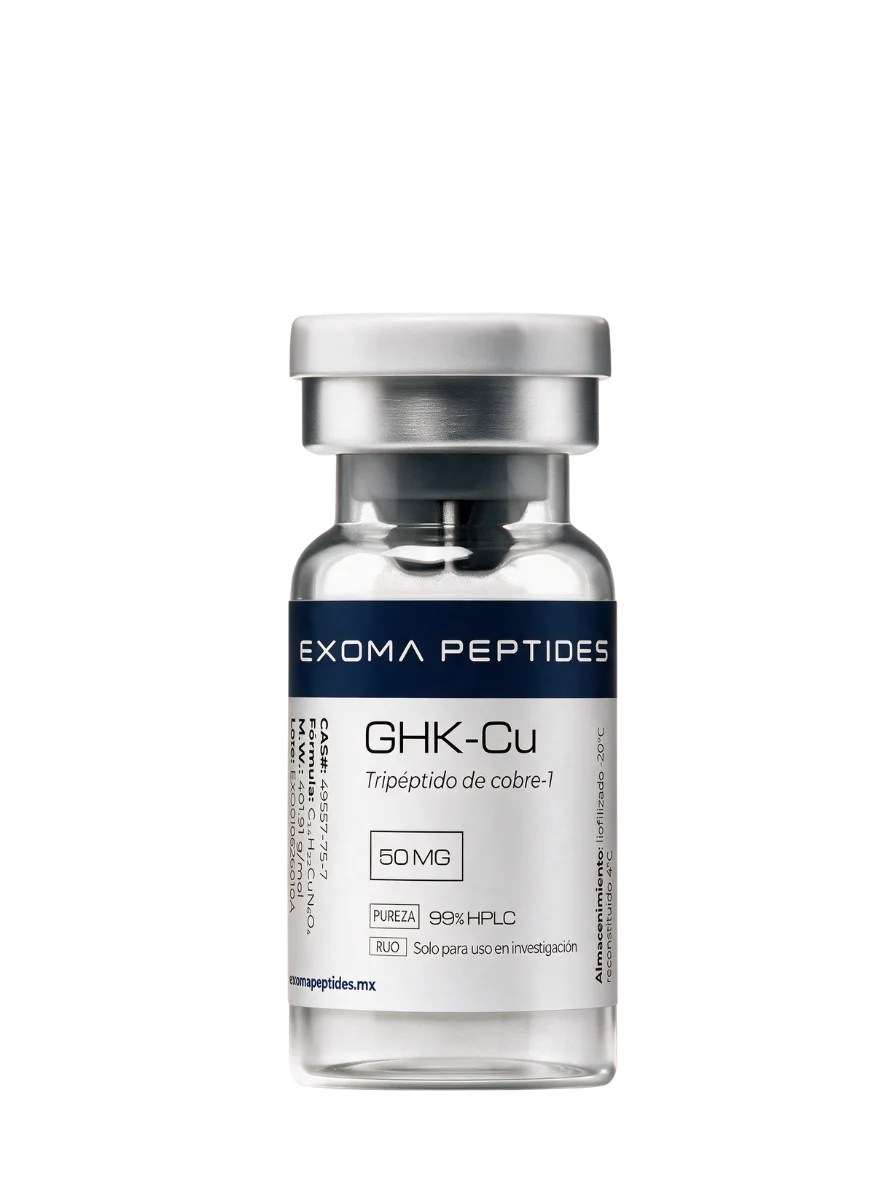
GHK-Cu
GHK-Cu — reagent for research use (RUO). HPLC purity 99.4% with COA per batch.
Technical data
- INN name
- Copper Tripeptide-1
- CAS
- 89030-95-5
- Molecular formula
- C14H23CuN6O4
- Molecular weight
- 402.92 g/mol
Sizes and prices: 50 mg $520 MXN ($10 MXN per mg) · 100 mg $780 MXN ($7.8 MXN per mg).
Buy GHK-Cu in Mexico: order online with nationwide shipping in 1-4 business days depending on zone and tracking number. Prices in Mexican pesos. Material for research use only.
GHK-Cu is known internationally as Copper Tripeptide-1 (English INN name). Buy Copper Tripeptide-1 in Mexico / comprar Copper Tripeptide-1 en México: reagent for research use (RUO) with HPLC purity, COA and nationwide shipping.
GHK-Cu is also searched as: Tripeptide de cobre-1, Prezatide copper acetate.
Identity and composition
GHK-Cu (Glycyl-L-Histidyl-L-Lysine copper(II) ion) is a copper-tripeptide complex with molecular mass 340.85 Da, formed by the GHK sequence (Gly-His-Lys) covalently bound to a divalent copper ion Cu²⁺ with high affinity (dissociation constant Kd ~10⁻¹⁶ M). It was discovered in 1973 by Dr. Loren Pickart como una fracción del plasma humano capaz de devolver al tejido hepático envejecido características de tejido joven.
GHK is a natural fragment of type I collagen, released during tissue remodeling. Its plasma concentration falls with age (from ~200 ng/mL at age 20 to ~80 ng/mL at 60), a correlation that positions it as key biomolecule in wound healing and skin regeneration.
Structure and properties:
- Linear Gly-His-Lys tripeptide of 340 Da.
- The copper coordinates with the imidazole of histidine and the terminal amino groups, forming a square planar complex.
- High aqueous solubility (>10 mg/mL).
- Characteristic blue color due to ligand-to-metal charge transfer (LMCT).
- Estabilidad moderada: sensible a pH alcalino y luz UV.
Unlike newer regenerative peptides (BPC-157, TB-500), GHK-Cu acts simultaneously as a modulator of gene expression and as a vehicle for bioavailable copper, a dual function that defines its unique profile. It is used in dermatological research, experimental cosmetics, wound healing, hair regeneration, and cellular senescence. It has no approval as a systemic medication, although topical cosmetic formulations are marketed internationally.
Mechanism of action
El mecanismo de GHK-Cu es pleiotropic, with two main arms:
1. Broad-spectrum gene expression modulator: estudios transcriptómicos (Pickart et al., Biomed Res Int 2015) muestran que GHK-Cu modula la expresión de more than 4,000 human genes (15% del genoma codificante), reseteando perfiles hacia patrones de tejido joven:
- Al alza: reparación de DNA, respuesta antioxidante (NRF2), síntesis de matriz extracelular (colágeno I, III, IV, decorina, glicosaminoglicanos), antiapoptosis.
- Downregulated: pro-inflammatory genes (TNF, IL-6) and oncogenes (>70% of those evaluated show repression).
2. Bioavailable and catalytic copper carrier: copper is a cofactor of >12 critical human enzymes (lysyl oxidase for collagen cross-linking, cytochrome c oxidase, Cu/Zn superoxide dismutase, tyrosinase, dopamine-β-hydroxylase). GHK-Cu delivers it in a controlled manner, without the toxicity of free copper.
Documented secondary mechanisms:
- Matriz extracelular: stimulates dermal fibroblasts to produce collagen I/III, elastin, glycosaminoglycans (dermatan sulfate), and proteoglycans.
- Angiogenesis: induce VEGF y bFGF en queratinocitos.
- Anti-inflammatory: reduce TNF-α, IL-6, IL-1β; inhibe NF-κB inducido por TGF-β.
- Antioxidant: estimula SOD y catalasa; quela radicales hidroxilo.
- Células madre: increases proliferation of dermal stem cells and hair bulb cells.
- Metaloproteinasas: equilibra MMP-1/MMP-2 con sus inhibidores TIMP.
- Neuroprotection: en modelos de Alzheimer modula β-amiloide e inflamación neural.
- Receptor LRP1: hipótesis emergente de receptor primario.
Diferencia con otros regenerativos: GHK-Cu acts at the transcriptional level, resetting the aging profile; BPC-157 and TB-500 act on signaling cascades (VEGF/NO and actin). Non-redundant mechanisms.
Pharmacokinetics
Formal pharmacokinetic data in humans are limited; most derive from animal and in vitro models.
Topical route (the most studied):
- Penetra el estrato córneo eficientemente por su tamaño pequeño (340 Da).
- Concentración eficaz cosmética: 0.05%–0.5% (250 a 2,500 ppm).
- Acumulación dérmica tras aplicación repetida.
Subcutaneous/intramuscular route:
- Biodisponibilidad alta (>70% estimado en animales).
- Tmax: 15–30 minutes.
- Plasma half-life: 40 minutes to 2 hours.
- Tissue accumulation at sites of active injury.
Oral route: viable parcialmente (absorción vía transportadores PepT1), pero degradación GI significativa; biodisponibilidad sistémica baja (<10%).
Metabolism: degradación proteolítica en glicina, histidina y lisina; el cobre liberado entra al pool corporal.
Elimination/distribución: copper has a prolonged tissue half-life (weeks) in liver, brain and muscle; the tripeptide is cleared rapidly. Broad cutaneous penetration and into hair follicles; modest blood-brain barrier crossing. Degradation by serum peptidases within 1–2 h.
Concentraciones endógenas: ~200 ng/mL en jóvenes, ~80 ng/mL en >60 años, base de la hipótesis de suplementación anti-senescencia.
Scientific evidence
La evidencia se concentra en preclinical models (rat, mouse, rabbit) and dermatological clinical studies con formulaciones tópicas.\n\nSkin healing:\n- Pollard et al. (Arch Facial Plast Surg 2005; PMID 15655171): aumento de la proliferación y de la expresión de factores de crecimiento en fibroblastos normales e irradiados, en cultivo celular.\n- Maquart et al. (FEBS Lett 1988, J Clin Invest 1993): estimulación de síntesis de matriz extracelular en fibroblastos humanos.\n- Úlceras venosas (Mulder et al.): reducción del 64% en área vs control a 12 semanas.\n\nAesthetic dermatology:\n- Leyden et al. (J Cosmet Dermatol 2002): mejora de arrugas, elasticidad e hidratación en mujeres ≥50 años a 12 semanas con crema GHK-Cu 0.1%.\n- Comparado con vitamina C, retinol y α-hidroxiácidos: equivalente o superior en biomarcadores de remodelación dérmica.\n\nHair regeneration: estudios de Procyte Corporation (estimulación folicular en modelos murinos); uso post-trasplante capilar.\n\nTranscriptómica: Pickart et al. (Biomed Res Int 2015): modulación de 4,000+ genes; Hong et al. (Mol Med Rep 2015): represión de genes asociados a cáncer colorrectal.\n\nOtros: neuroprotección (Alzheimer, regeneración axonal), cardiovascular (reducción de necrosis en infarto), pulmonar (EPOC/fibrosis, Campbell et al. 2012).\n\nLimitations: no existen ensayos clínicos sistémicos formales (fase II/III) parenterales; la evidencia humana es mayormente tópica.
Research applications
Cosmetic and reparative dermatology (main use in humans):
- Arrugas, líneas finas, elasticidad, fotoenvejecimiento.
- Cicatrices post-acné, post-quirúrgicas, post-quemadura; estrías.
- Chronic ulcers (venous, pressure, diabetic).
- Post-inflammatory hyperpigmentation.
Hair regeneration:
- Alopecia androgenética inicial; recuperación post-trasplante folicular; alopecia areata (preliminar).
Systemic regenerative research:
- Cicatrización de tendones y ligamentos (animal).
- Post-ischemia recovery (myocardium, brain, renal).
- Senescencia replicativa: extensión de vida útil de cultivos primarios.
Experimental neuroprotection:
- Alzheimer (reducción de placas β-amiloide), lesión medular y nerviosa periférica (regeneración axonal).
Inflammatory modulation: EPOC, fibrosis pulmonar, enfermedad inflamatoria intestinal (limitado).
Vías por aplicación:
- Topical: dermatology, hair, superficial wound healing.
- Subcutaneous: systemic research.
- Intramuscular: regeneración musculoesquelética profunda.
- Intralesional: scars, alopecia areata.
- Mesotherapy: rejuvenecimiento facial y capilar.
All systemic application is research; topical cosmetic use is approved and available in multiple jurisdictions.
Research protocols
Protocols vary by route and objective. Doses are investigational references.
Cosmetic topical (the most documented):
- Concentración: 0.05%–0.5% (250 a 2,500 ppm).
- 1–2 times/day on clean skin; effects visible at 4–8 weeks, continuous maintenance.
Facial mesotherapy:
- 2–5 mg/sesión, microinyecciones intradérmicas.
- 1 vez/semana × 4–6 sesiones, luego mensual.
Systemic subcutaneous (research):
- 1–3 mg/día, diaria o en días alternos, 4–12 semanas.
Regenerative intramuscular:
- 2–5 mg/dosis cerca del sitio de lesión, 2–3 veces/semana.
Capilar (intradérmica de cuero cabelludo):
- 1–2 mg en microinyecciones múltiples, 1 vez/semana × 8–12 semanas.
Animal models (scaling):
- Rat: 0.5–5 mg/kg/day subcutaneous. Human equivalent (factor 6.2): ~5–50 mg for a 70 kg adult in aggressive studies.
Research combinations:
- + BPC-157 (cicatrización cutánea compleja); + TB-500 (regeneración profunda); + Matrixyl (cosmética avanzada); + minoxidil (capilar).
Monitoring sistémico: cobre sérico y ceruloplasmina, función hepática, hemograma.
Reconstitution
Lyophilized GHK-Cu is reconstituted with bacteriostatic water (BAC) for injection, or with cosmetic vehicles for topical use.
Procedimiento (inyectable):
- Equilibrate vial and solvent to room temperature for 15 min.
- Clean the stopper with 70% isopropanol.
- Inject BAC slowly onto the side wall of the vial.
- Do not shake: gently roll to dissolve in 1–2 minutes.
- La solución debe ser transparent blue (color del complejo cobre); descartar si hay turbidez o color anómalo.
Reference concentrations:
50 mg vial:
- 1 mL BAC → 50 mg/mL (1 mg = 0.02 mL = 2 IU)
- 2.5 mL BAC → 20 mg/mL (1 mg = 0.05 mL = 5 IU)
- 5 mL BAC → 10 mg/mL (1 mg = 0.1 mL = 10 IU)
100 mg vial:
- 2 mL BAC → 50 mg/mL
- 5 mL BAC → 20 mg/mL (1 mg = 0.05 mL = 5 IU)
- 10 mL BAC → 10 mg/mL (1 mg = 0.1 mL = 10 IU)
Syringe: U-100 insulin syringe of 0.3–1 mL; 30–32G needle for mesotherapy, 29–31G for subcutaneous.
Uso tópico (formulación experimental): base hidrofílica (gel de ácido hialurónico, crema neutra), concentración final 0.1%–0.5%, pH óptimo 5.5–7.0. Excluir ácido ascórbico, α-hidroxiácidos y peróxidos (compiten por cobre).
Calculation: volume (mL) = dose (mg) / concentration (mg/mL).
Stability and storage
Sealed lyophilized vial:
- Store at 2–8 °C, protected from light; stability up to 24 months per manufacturer.
- Tolerates room temperature for up to 30 days.
- Sensible a luz UV: pack in aluminum or amber vial.
Vial reconstituted with BAC:
- Store strictly at 2–8 °C, protected from light; stability 28–30 days preservando actividad.
- No congelar (puede precipitar el complejo cobre). El azul debe mantenerse uniforme; el cambio a verde o incoloro indica disociación del cobre.
Topical formulation: stability 6–12 months in an opaque container with preservatives; airless containers preferable.
Estabilidad química: estable en pH 4–7; degradación rápida en pH alcalino (>8). Incompatible con quelantes fuertes (EDTA) y antioxidantes que reduzcan Cu²⁺ a Cu⁺ (ácido ascórbico). Estable térmicamente hasta 40 °C transitorio.
Degradación: descartar ante cambio de color, turbidez o precipitado; pH fuera de 5–7 reduce actividad.
Transport: cold gel pack; the lyophilized product tolerates 48–72 h at controlled temperature.
Safety profile
GHK-Cu presents a favorable safety profile, especialmente en uso tópico, ampliamente documentado en cosmética internacional.
Topical use (more established profile):
- Irritation: rare at concentrations <0.5%.
- Transient hyperpigmentation from copper: occasional, reversible.
- Sensibilidad al cobre: muy rara (<0.1%); contraindica el uso.
- No documented phototoxicity.
Systemic use (research):
- Toxicidad aguda en animales: LD50 muy alta (>1 g/kg en rata IV).
- Subcrónica: bien tolerado a dosis suprafarmacológicas 30–90 días, sin alteraciones hematológicas, hepáticas ni renales.
Genotoxicity: estudios in vitro negativos; al contrario, reprime oncogenes en transcriptómica, sugiriendo perfil protector.
Carcinogenicity: sin estudios a 2 años, pero el perfil anti-tumoral (represión de >70% de oncogenes) y la ausencia de reportes de inducción tumoral sugieren bajo riesgo.
Copper accumulation: riesgo teórico en uso sistémico prolongado a dosis altas. Contraindicated in Wilson's disease. Monitorear cobre sérico y ceruloplasmina en protocolos largos.
Hypersensitivity: precaución con alergia al níquel (reactividad cruzada teórica); reacciones locales en mesoterapia ocasionales y leves.
Pregnancy and lactation: insufficient data, use not advised as a precaution.
Interactions: incompatible con quelantes de cobre (D-penicilamina, trientina); el zinc alto puede interferir con la absorción de cobre.
WADA status: It is NOT on the prohibited list; permitido en deportistas.
Sitio de inyección: dolor leve, eritema transitorio, ocasional coloración azul-verde local que desaparece en 24–48 h.
Comparative context
vs BPC-157: GHK-Cu modulates gene expression + delivers copper; BPC-157 modulates VEGFR2/NO/wound healing. GHK-Cu dominates in skin/hair/anti-aging and is effective topically; BPC-157 in musculoskeletal/GI and requires injection (or oral GI). They are combined in complex cutaneous wound healing.
vs TB-500: TB-500 acts on G-actin and cell migration, more systemic; GHK-Cu on transcription and matrix, predominantly local/dermatological. Combination documented in tissue regeneration.
vs Matrixyl (palmitoyl pentapeptide-4): Matrixyl stimulates collagen via TGF-β-like signaling; GHK-Cu is broader (anti-inflammatory + antioxidant + matrix). Frequently combined.
vs Retinoides: potentes pero irritantes; GHK-Cu menos irritante, perfiles complementarios.
vs Vitamina C: ambos antioxidantes y pro-colágeno por mecanismos distintos, pero incompatibles: el ácido ascórbico reduce Cu²⁺ a Cu⁺ disociando el complejo. No coformular; alternar aplicaciones.
vs Growth factors (EGF, bFGF): recombinants are more expensive and labile; GHK-Cu is more stable, economical, and broader-spectrum.
vs copper-peptide analogs (AHK-Cu, FOXO4-Cu): AHK-Cu has a similar spectrum with less evidence; GHK-Cu is the most studied of the group.
Ventaja: doble mecanismo, evidencia dermatológica robusta, seguridad establecida, costo accesible, no prohibido por WADA. Disadvantage: lower individual potency in systemic musculoskeletal regeneration vs BPC-157/TB-500.
History and development
GHK-Cu was discovered in 1973 by Dr. Loren Pickart en la Universidad de California San Francisco, al investigar la diferencia entre plasma de donantes jóvenes y mayores: una fracción peptídica del plasma joven restauraba la síntesis proteica en hepatocitos de rata vieja. La fracción activa era el tripéptido GHK unido a cobre.\n\nHitos:\n- 1973: descubrimiento de la actividad biológica de GHK (Pickart).\n- 1980s: caracterización de la unión al cobre y mecanismos básicos.\n- 1988–1993: Maquart et al. (Francia) demuestran estimulación de matriz extracelular en fibroblastos humanos.\n- 1990s: Procyte Corporation comercializa formulaciones cosméticas y de cicatrización (Tricomin®, Iamin®).\n- 2002: Leyden et al. publican estudios clínicos cosméticos.\n- 2005: Pollard et al. publican efectos sobre proliferación y factores de crecimiento en fibroblastos en cultivo.\n- 2015: Pickart et al. publican el análisis transcriptómico (4,000+ genes; Biomed Res Int).\n- 2018–presente: expansión a neuroprotección, aplicaciones pulmonares y regenerativas.\n\nRegulatorio: approved as a cosmetic ingredient in the USA (FDA OTC monograph), EU (CosIng), Japan, Korea, Australia, and Mexico (COFEPRIS). NOT approved as a systemic parenteral medication. Widely available research reagent. WADA: no prohibido.\n\nPatents: Pickart and Procyte filed multiple patents (1980s–1990s) on formulations; the basic molecule is in the public domain. Academia: >150 indexed publications, with active groups in the USA, France, Korea, and China. for research use.
FAQ
Why does GHK-Cu have a blue color?
The characteristic blue color arises from ligand-to-metal charge transfer (LMCT) between the copper ion Cu²⁺ and the imidazole ring of the tripeptide's histidine. It is a visual indicator of an intact complex: if the solution turns green, colorless, or cloudy, this indicates dissociation of the copper and loss of activity. A properly reconstituted solution should retain a transparent blue color.
What is the difference between GHK and GHK-Cu?
GHK is the copper-free tripeptide, with lower biological activity (~10-100x lower depending on the assay). GHK-Cu (copper complex) is the main pharmacologically active form. Binding to copper enables its function as an enzymatic cofactor and broad transcriptional modulator. The active commercial products are GHK-Cu, not isolated GHK.
Can I combine GHK-Cu with vitamin C in my routine?
NOT in the same formulation or simultaneous application: ascorbic acid reduces Cu²⁺ to Cu⁺, dissociating the complex and inactivating it. If both are used, alternate morning/night or separate by at least 30 minutes between applications. The same applies to α-hydroxy acids (glycolic, mandelic) and other chelators/reducers.
How long does it take to see results on skin?
In cosmetic topical application (0.1-0.5%) visible effects on hydration and firmness typically appear within 4-8 weeks of consistent use. Improvements in fine wrinkles and hyperpigmentation require 12 weeks or more. Clinical studies (Leyden 2002) report significant improvements at 12 weeks with application 2 times/day.
Is GHK-Cu safe during pregnancy?
There are no formal safety studies in pregnancy or lactation. As a precaution, its use (even topical mesotherapy) is discouraged during pregnancy and lactation. Occasional topical cosmetic use is probably low risk, but the decision should be discussed with a medical professional.
Does it carry a risk of promoting cancer due to its effect on cells?
On the contrary: transcriptomic studies show that GHK-Cu represses the expression of >70% of the oncogenes evaluated and activates tumor suppressor and DNA repair genes. There are no preclinical reports of tumor induction. Its molecular profile is rather protective against carcinogenesis, although no formal 2-year studies have been carried out.
Why is it considered anti-aging?
GHK-Cu decreases in plasma with age (from ~200 ng/mL at age 20 to ~80 ng/mL at 60). Its supplementation restores transcriptional profiles of young tissue, stimulates extracellular matrix, modulates antioxidants and reduces chronic low-grade inflammation (inflammaging). In vitro studies extend the lifespan of primary cell cultures.
What is it used for in hair regeneration?
It stimulates the proliferation of hair bulb cells, prolongs the anagen phase of the hair cycle, improves vascularization of the follicle (via VEGF), and reduces perifollicular inflammation. It is used in early androgenetic alopecia, post-hair-transplant, and in studies of alopecia areata. Frequently combined with minoxidil in cosmetic clinical protocols.
Is it banned in competitive sports?
NO. GHK-Cu is not included in the prohibited-substances list of WADA or of other major anti-doping agencies. Its use is permitted in competitive athletes, unlike BPC-157, TB-500, and IGF-1, which are prohibited.
What is the optimal topical dose?
In cosmetic clinical studies the effective concentrations range from 0.05% (500 ppm) to 0.5% (5,000 ppm). Higher concentrations do not proportionally increase efficacy and may increase irritation. The generally accepted optimal range is 0.1-0.3% (1,000-3,000 ppm) applied 1-2 times/day to clean skin.
Customer reviews
Average rating: 4.8 out of 5, based on 22 customer ratings.
Sofia T. — 5/5
The powder reconstituted super easily and without residue. The QR code with the analysis gives a lot of confidence.
Rodrigo T. — 5/5
The GHK-CU arrived very fast. It gives me great peace of mind to buy on this platform.
Diego V. — 5/5
They take great care of the cold chain; the gel packs were still frozen. Very nice touch.
Samuel O. — 5/5
It arrived the day after confirming my payment. Super efficient.
Lucía B. — 5/5
First time buying here and I was delighted. The GHK-CU arrived super fast and the packaging is very discreet.
Arturo R. — 5/5
I bought 3 vials to take advantage of the discount. Recommended.
Alejandro V. — 5/5
It is my second order and it arrived super fast to Puebla. One vial came a bit damaged but they replaced it right away without giving me any trouble.
Valeria M. — 5/5
Excellent GHK-CU, it arrived very fast and the presentation is high quality. Very happy with my purchase.
Carlos M. — 4/5
The GHK-CU arrived well. Good product and correct service.
Kevin V. — 5/5
Impeccable cold chain, the gels arrived still rigid.
Lian M. — 5/5
Excellent thermal packaging; the cold packs arrived at 100%.
Lorenzo H. — 5/5
Vial with sufficient bubble wrap, nothing broken.
Leonel S. — 5/5
The cold chain was well maintained in its cooler.
Luis F. — 5/5
Super well protected with thermal packaging.
Carlos M. — 4/5
The GHK-CU arrived in good condition. The courier took an extra day, but the product excellent.
Lourdes P. — 5/5
Cooler in excellent condition, gel packs firm.
Aarón M. — 4/5
Consistent quality across batches.
Sofía V. — 5/5
The GHK-CU arrived impeccable. Excellent quality and the shipping was extremely fast.
Roberto S. — 4/5
Meets expectations. Good packaging and fast shipping.
Rafa T. — 5/5
Super good option. They answered me on WhatsApp right away when I had questions and the product has worked really well for me.
Mariana R. — 5/5
Excellent quality for the price. The powder was nicely homogeneous with no lumps, and customer service attended to me extremely quickly.
Analyzed by Janoshik, an independent laboratory. Each report is verifiable per batch at janoshik.com/verify.
Scientific references (8)
Peer-reviewed literature on GHK-Cu, with its PubMed identifier when available:
- GHK-Cu in tissue regeneration: new genomic data (Pickart L, Margolina A. · International Journal of Molecular Sciences · 2018) — Broad transcriptomic analysis of the action of GHK-Cu on gene expression in human fibroblasts and keratinocytes. PMID 29986520.
- GHK Peptide as a Natural Modulator of Multiple Cellular Pathways (Pickart L, Margolina A. · BioMed Research International · 2015) — Review of the multiple mechanisms of GHK-Cu in tissue regeneration and anti-aging. PMID 26236730.
- Glycyl-L-histidyl-L-lysine-Cu(2+) rescues cigarette smoking-induced skeletal muscle dysfunction via a sirtuin 1-dependent pathway (Deng, et al. · Journal of Cachexia, Sarcopenia and Muscle · 2023) PMID 36905132.
- Effects of topical copper tripeptide complex on CO2 laser-resurfaced skin. (Miller TR, et al. · Arch Facial Plast Surg · 2006) PMID 16847171.
- Enhanced healing of ulcers in patients with diabetes by topical treatment with glycyl-l-histidyl-l-lysine copper. (Mulder GD, et al. · Wound Repair Regen · 1994) PMID 17147644.
- Expression of glycosaminoglycans and small proteoglycans in wounds: modulation by the tripeptide-copper complex glycyl-L-histidyl-L-lysine-Cu(2+). (Siméon A, et al. · J Invest Dermatol · 2000) PMID 11121126.
- Stimulation of collagen synthesis in fibroblast cultures by the tripeptide-copper complex glycyl-L-histidyl-L-lysine-Cu2+. (Maquart FX, et al. · FEBS Lett · 1988) PMID 3169264.
- In vivo stimulation of connective tissue accumulation by the tripeptide-copper complex glycyl-L-histidyl-L-lysine-Cu2+ in rat experimental wounds. (Maquart FX, et al. · J Clin Invest · 1993) PMID 8227353.
Full scientific profile: GHK-Cu in the compendium — mechanism of action, studies and technical data sheet.
See the full category catalog: Aesthetics · Recovery.
Otras presentaciones de GHK-Cu
Guides and articles about GHK-Cu
Lecturas del blog de EXOMA que la editorial asoció a este compuesto: