
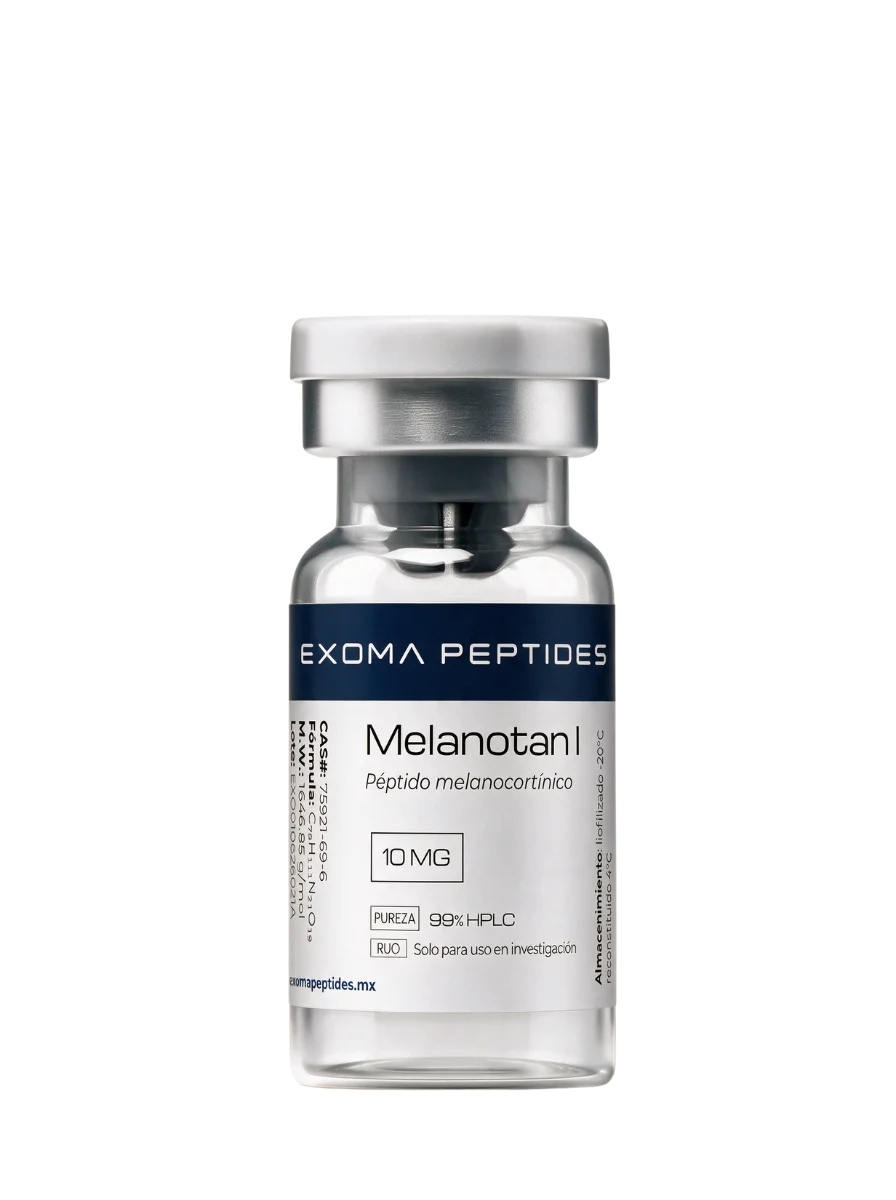
Melanotan I
Melanotan I — reactivo for research (RUO). COA per batch disponible. Contenido revisado por el Dr. Jesús Jaramillo.
Technical data
- Development code
- CUV1647
- CAS
- 75921-69-6
- Molecular formula
- C78H111N21O19
- Molecular weight
- 1646.85 g/mol
Sizes and prices: 10 mg $780 MXN ($78 MXN per mg).
Buy Melanotan I in Mexico: order online with nationwide shipping in 1-4 business days depending on zone and tracking number. Prices in Mexican pesos. Material for research use only.
Melanotan I is also searched as: Afamelanotide, [Nle4, D-Phe7]-alpha-MSH, NDP-alpha-MSH, NDP-MSH, Melanotan-1, CUV1647.
Identity and composition
Afamelanotide, known in the research setting as Melanotan I or melanotan 1, is a synthetic linear tridecapeptide that reproduces and stabilizes the structure of the alpha-melanocyte-stimulating hormone (α-MSH). Its technical nomenclature is [Nle4, D-Phe7]-α-MSH, with CAS number 75921-69-6, molecular formula C78H111N21O19, and an approximate molecular mass of 1646.9 Da. Its sequence is Ac-Ser-Tyr-Ser-Nle-Glu-His-D-Phe-Arg-Trp-Gly-Lys-Pro-Val-NH2. Unlike native α-MSH, which degrades rapidly, the substitutions of norleucine at position 4 and D-phenylalanine at position 7 confer notable enzymatic resistance and a prolonged biological life. Under the trade name Scenesse, afamelanotide was approved as a subcutaneous implant to reduce phototoxicity in patients with erythropoietic protoporphyria (EPP), making it the only melanocortin analog of this type with formal clinical registration. At EXOMA we offer Melanotan I in a 10 mg lyophilized vial strictly for research (RUO). For those looking to buy Melanotan I Mexico or to check the afamelanotide price, this material represents a well-characterized and chemically defined α-MSH analog.
Mechanism of action
The mechanism of afamelanotide is based on its action as an agonist of the melanocortin receptor system, with a marked preference for the MC1R receptor expressed in cutaneous melanocytes, although it also interacts with MC3R, MC4R and MC5R. Upon binding to MC1R, a G-protein-coupled receptor, it activates adenylate cyclase and raises intracellular levels of cyclic AMP (cAMP), which in turn stimulates the protein kinase A (PKA) pathway. This signaling cascade increases the expression and activity of tyrosinase, the rate-limiting enzyme in melanin biosynthesis, and favors the preferential production of eumelanin, the dark pigment with the greater capacity to absorb ultraviolet radiation. The experimental result is sustained eumelanogenesis that increases the pigment density of the skin and, in study models, is associated with a photoprotective effect. The enzymatic resistance conferred by Nle4 and D-Phe7 prolongs receptor occupancy relative to endogenous α-MSH. This relative selectivity for the pigmentary pathway makes Melanotan I a useful tool for studying melanocortin-MC1R signaling and the molecular mechanisms of melanogenesis in research (RUO).
Pharmacokinetics
The pharmacokinetic behavior of afamelanotide is determined by its modified peptide nature. The norleucine substitution at position 4 and the D-phenylalanine substitution at position 7 protect the molecule against degradation by peptidases and proteases, which gives it a functional half-life considerably greater than that of native α-MSH, whose duration is only minutes. In the studies that gave rise to the clinical formulation Scenesse, afamelanotide is administered as a controlled-release subcutaneous implant, which releases the peptide gradually over several days and maintains sustained systemic concentrations before its elimination. In the reconstituted lyophilized vial format, characteristic of research material, absorption after parenteral administration in models is relatively rapid, followed by distribution to tissues rich in melanocortin receptors, especially the skin. Elimination occurs by proteolysis and renal clearance of the peptide fragments. As a linear tridecapeptide, it is not absorbed orally owing to its gastric degradation. These parameters are relevant to the design of protocols with Melanotan I and must be interpreted within the framework of research use (RUO).
Scientific evidence
The strongest evidence surrounding afamelanotide comes from its development as Scenesse for erythropoietic protoporphyria (EPP), a metabolic photodermatosis in which the accumulation of protoporphyrin causes pain and intense phototoxicity with sun exposure. Controlled clinical trials demonstrated that afamelanotide, by increasing eumelanin, prolonged pain-free light-exposure time and improved patients' quality of life, which supported its regulatory approval in Europe and subsequently by the FDA. Beyond EPP, afamelanotide and its selectivity for MC1R have been the subject of research in other dermatological conditions: in vitiligo, its combination with phototherapy has been studied to promote repigmentation of lesions, and it has also been explored in various photodermatoses and photosensitivity disorders. This body of evidence positions Melanotan I as one of the best-documented melanocortin analogs from both a mechanistic and clinical standpoint. For research purposes (RUO), this scientific track record offers a robust reference framework that distinguishes afamelanotide from other peptides with more limited documentation.
Research applications
In the research (RUO) context, Melanotan I is used as a tool to study melanocyte biology, MC1R receptor signaling and the mechanisms of melanocortin-induced melanogenesis. Its relative preference for MC1R makes it a valuable pharmacological probe for dissecting the cAMP/PKA/tyrosinase pathway and for modeling eumelanin production reproducibly in experimental systems. The documented lines of application derive from its clinical development as afamelanotide: research on photoprotection applied to erythropoietic protoporphyria, repigmentation studies in vitiligo models and exploration of photodermatoses and photosensitivity disorders. It is likewise useful in comparative studies of receptor selectivity versus non-selective analogues, as well as in research on the structure-function relationship of melanocortin peptides. Its high degree of chemical characterization and prior clinical registration make it ideal for work requiring a well-defined reference compound. Those considering buying Melanotan I Mexico for research find in afamelanotide an analogue with broad experimental applications, always within the RUO framework.
Research protocols
The experimental handling parameters of Melanotan I in the laboratory start from its presentation in a 10 mg lyophilized vial. In research protocols (RUO), the peptide is reconstituted with bacteriostatic water and prepared in aliquots to preserve the stability of the material between uses. The design of any experimental scheme must consider the enzymatic resistance of the molecule, conferred by the Nle4 and D-Phe7 substitutions, which prolongs its activity compared with native α-MSH, as well as its relative selectivity for MC1R when interpreting the observed effects on eumelanogenesis. It is advisable to establish response curves and vehicle controls to characterize precisely the activation of the cAMP/PKA/tyrosinase pathway. Handling must be carried out with aseptic technique, avoiding vigorous agitation that could denature the peptide, and carefully recording the preparation conditions. EXOMA provides Melanotan I exclusively as a research reagent; the parameters described here are technical laboratory guidance and do not constitute indications for use in humans. Every protocol must be adjusted to the applicable institutional biosafety regulations and good laboratory practices.
Reconstitution
The reconstitution of Melanotan I follows the standard procedures for lyophilized peptides in research (RUO). The 10 mg vial is dissolved with 1 to 2 mL of bacteriostatic water, an amount that determines the final concentration per unit of volume and must be recorded precisely for the experimental calculation. The diluent is added by letting it run slowly down the inner wall of the vial, avoiding directing the stream directly onto the lyophilized powder; then it is left to rest and swirled gently until achieving a complete and transparent dissolution, without vigorous agitation, since excessive turbulence can fragment the peptide chain and compromise the integrity of the tridecapeptide. A correctly reconstituted solution must appear clear and free of particles; any turbidity or suspended material indicates that it must not be used. It is recommended to prepare the volume in accordance with the experimental plan and, when applicable, to fractionate into aliquots to minimize handling cycles. Bacteriostatic water is preferable over simple sterile water when repeated use of the vial is anticipated. These indications are of a technical laboratory nature and are framed strictly within the research use of afamelanotide.
Stability and storage
The stability of Melanotan I depends on its physical form and storage conditions. In the lyophilized state, the 10 mg vial of afamelanotide is notably stable and should be stored at -20 °C, protected from light and moisture, a condition under which it retains its chemical integrity for prolonged periods. Once reconstituted with bacteriostatic water, the peptide enters a more sensitive state: the solution should be kept refrigerated at a temperature of 2 to 8 °C and used within a maximum of approximately 30 days to preserve its activity. The Nle4 and D-Phe7 substitutions confer resistance to enzymatic degradation, but they do not exempt the material from good storage practices: repeated freeze-thaw cycles, prolonged exposure to room temperature and direct light must be avoided, as these factors accelerate the loss of potency. For work requiring extended storage of the solution, dividing into aliquots and controlled freezing help minimize degradation. Respecting the cold chain and these stability parameters is essential to guarantee reproducible results with afamelanotide in any research (RUO) protocol.
Safety profile
In the research framework (RUO), the characterization of the profile of afamelanotide is supported by the experience accumulated during its clinical development as Scenesse. The most characteristic and expectable biological effect is the generalized darkening of the skin through an increase in eumelanin, as well as the increase in the pigmentation of pre-existing nevi and freckles. For this reason, in the clinical context periodic dermatological surveillance is a central component of management: the monitoring of moles and of any change in pigmented lesions makes it possible to distinguish the expected pigment response from alterations that require specialized evaluation. Other effects described in the melanocortin literature include transient manifestations such as nausea or flushing, attributable to the activation of receptors in various tissues. Compared with Melanotan II, afamelanotide presents a more circumscribed selectivity toward the MC1R pigmentary pathway, with less involvement of the central effects mediated by MC4R. It is essential to emphasize that Melanotan I is marketed at EXOMA solely as a research reagent (RUO); this information describes documented pharmacological observations and does not constitute guidance for its use in humans.
Comparative context
The distinction between Melanotan I (afamelanotide) and Melanotan II is essential and must not be confused. Melanotan I is a linear α-MSH analogue with relative preference for the MC1R receptor, which directs its action toward pigmentation via eumelanin and confers a more specific selectivity; for this reason its clinical development focused on the photoprotection of erythropoietic protoporphyria. Melanotan II, by contrast, is a non-selective cyclic analogue that also strongly activates MC4R, a receptor implicated in central pathways related to sexual function and appetite regulation, so it exhibits a broader and less bounded spectrum of effects. In comparative terms, Melanotan I is more specific for the study of melanogenesis and shows less involvement of the central effects that characterize Melanotan II. Within this melanocortin family it is also worth mentioning PT-141 (bremelanotide), a derivative that represents the MC4R branch of signaling, developed precisely to explore that pathway. Understanding these differences in receptor selectivity is key to choosing the appropriate analogue for each line of research (RUO) and to correctly interpreting experimental results with melanotan 1.
History and development
The history of afamelanotide traces back to research on α-MSH analogues begun at the University of Arizona, where the pioneering work on the structure-activity relationship of melanocytic hormones identified that norleucine substitution at position 4 and D-phenylalanine substitution at position 7 produced an analogue far more potent and resistant to enzymatic degradation than the native hormone. That compound, [Nle4, D-Phe7]-α-MSH, was named Melanotan I and laid the foundation for exploring the pharmacological stimulation of melanogenesis as a photoprotection strategy. Over time, the molecule was developed under the name afamelanotide and formulated as a sustained-release subcutaneous implant by the pharmaceutical industry, culminating in its approval as Scenesse for the treatment of erythropoietic protoporphyria, first in Europe and later by the FDA. This trajectory, from the rational design of the peptide in the laboratory to its clinical registration, distinguishes afamelanotide as one of the melanocortin analogues with the greatest scientific support. For the community that today researches with Melanotan I, this trajectory constitutes a solid historical framework within research use (RUO).
FAQ
Melanotan I or Melanotan II: how do they differ?
The central difference is in receptor selectivity. Melanotan I (afamelanotide) is a linear α-MSH analog with a preference for MC1R, which directs its action toward eumelanin-based pigmentation and makes it more specific for the study of melanogenesis, with less involvement of central effects. Melanotan II is a non-selective cyclic analog that additionally strongly activates MC4R, a receptor associated with central pathways of sexual function and appetite, and therefore has a broader spectrum of effects. In research (RUO), Melanotan I is chosen when the interest is in the MC1R pigmentary pathway in a more circumscribed way.
What is afamelanotide?
Afamelanotide is the pharmacological name of Melanotan I, a synthetic linear tridecapeptide analogue of the hormone α-MSH, with the structure [Nle4, D-Phe7]-α-MSH and CAS number 75921-69-6. It acts as a melanocortin agonist with preference for MC1R, activating the cAMP/PKA pathway and tyrosinase to stimulate eumelanin production. Under the trade name Scenesse it was approved as an implant to reduce phototoxicity in erythropoietic protoporphyria. At EXOMA it is offered as a research reagent (RUO).
Why does Melanotan I resist enzymatic degradation?
Its resistance stems from two structural modifications relative to native α-MSH: the substitution of norleucine at position 4 (Nle4) and of D-phenylalanine at position 7 (D-Phe7). These modifications protect the peptide chain against peptidases and proteases, notably prolonging its biological half-life and its occupancy of the MC1R receptor. This is why afamelanotide retains activity for far longer than the natural hormone, whose duration is only minutes—an attribute relevant to the design of reproducible research protocols.
How is the 10 mg vial reconstituted and stored?
The 10 mg lyophilized vial is reconstituted with 1 to 2 mL of bacteriostatic water, allowing the diluent to run down the wall of the vial and gently swirling without vigorous shaking until a clear solution is obtained. The lyophilized material is stored at -20 °C protected from light; once reconstituted, it should be kept refrigerated at 2-8 °C and used within a maximum period of approximately 30 days. Repeated freeze-thaw cycles should be avoided to preserve the integrity of the research peptide (RUO).
What is the relationship of Melanotan I to PT-141?
Both belong to the family of melanocortin analogs derived from α-MSH, but they explore distinct branches of signaling. Melanotan I (afamelanotide) is selective toward MC1R and eumelanin-based pigmentation. PT-141, or bremelanotide, represents the MC4R branch of the system, the receptor linked to central pathways. Thus, although they share structural origin, they are investigated for different objectives depending on the melanocortin receptor they preferentially activate. This distinction is useful for selecting the appropriate peptide in each line of research (RUO).
Where to buy Melanotan I in Mexico for research?
At EXOMA we offer Melanotan I (afamelanotide) in a 10 mg lyophilized vial as a reagent strictly for research (RUO). For those looking to buy Melanotan I in Mexico or to check the afamelanotide price, it is an α-MSH analog that is well characterized chemically and pharmacologically, with CAS number 75921-69-6 and scientific backing derived from its clinical development as Scenesse. The material is delivered with the technical reconstitution and storage instructions proper to a research peptide, without any guidance for use in humans.
Customer reviews
Average rating: 5.0 out of 5, based on 1 customer rating.
Karla A. — 5/5
I prefer version I for its more subtle and protective effect.
Certificate of analysis per batch
Melanotan I batch with certificate of analysis published in the COA catalog:
- Lot EXO010626021A — 10 mg, issued 2026-05-29
Scientific references (7)
Peer-reviewed literature on Melanotan I, with its PubMed identifier where available:
- Skin pigmentation and pharmacokinetics of melanotan-I in humans (Ugwu, et al. · Biopharmaceutics & Drug Disposition · 1997) PMID 9113347.
- [Nle4-D-Phe7]-alpha-melanocyte-stimulating hormone significantly increased pigmentation and decreased UV damage in fair-skinned Caucasian volunteers (Barnetson, et al. · Journal of Investigative Dermatology · 2006) PMID 16763547.
- Afamelanotide for Erythropoietic Protoporphyria (Langendonk, et al. · New England Journal of Medicine · 2015) PMID 26132941.
- Afamelanotide and narrowband UV-B phototherapy for the treatment of vitiligo: a randomized multicenter trial. (Lim HW, et al. · JAMA Dermatol · 2015) PMID 25230094.
- Afamelanotide implants and narrow-band ultraviolet B phototherapy for the treatment of nonsegmental vitiligo in Asians. (Toh JJH, et al. · J Am Acad Dermatol · 2020) PMID 31987791.
- Evaluation of the immunogenicity of the synthetic α-melanocyte-stimulating hormone (α-MSH) analogue afamelanotide ([Nle4-D-Phe7]-α-MSH, Scenesse®) in erythropoietic protoporphyria patients by ELISA detecting both anti-afamelanotide and anti-α-MSH antibodies. (Lengweiler S, et al. · Skin Pharmacol Physiol · 2015) PMID 25402764.
- Long-term observational study of afamelanotide in 115 patients with erythropoietic protoporphyria. (Biolcati G, et al. · Br J Dermatol · 2015) PMID 25494545.
Full scientific profile: Melanotan I in the compendium — mechanism of action, studies and technical data sheet.
See the full category catalog: Aesthetics.
Guides and articles about Melanotan I
Lecturas del blog de EXOMA que la editorial asoció a este compuesto: