
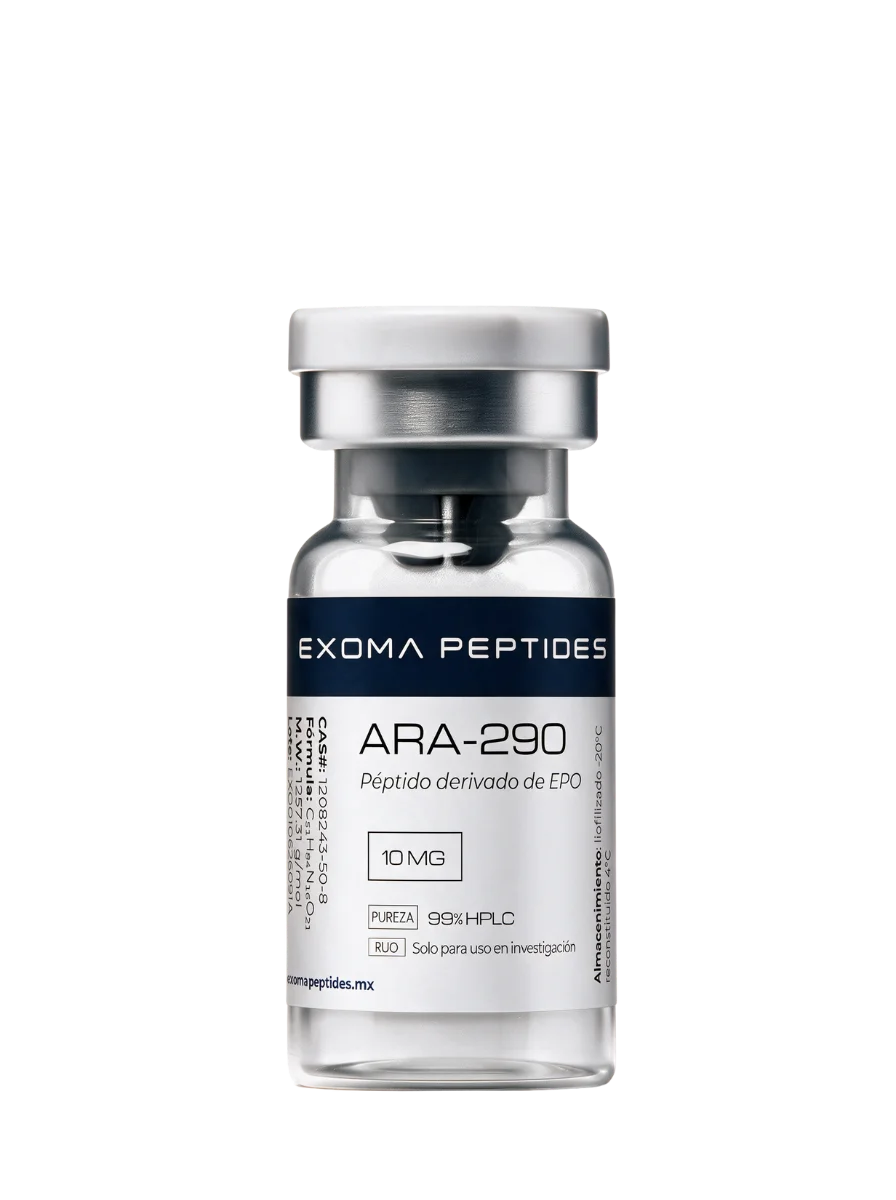
ARA-290
ARA-290 — reagent for research use (RUO).
Technical data
- INN name
- Cibinetide
- Development code
- ARA-290
- CAS
- 1208243-50-8
- Molecular formula
- C51H84N16O21
- Molecular weight
- 1257.3 g/mol
Sizes and prices: 10 mg $960 MXN ($96 MXN per mg) (out of stock).
Buy ARA-290 in Mexico: order online with nationwide shipping in 1-4 business days depending on zone and tracking number. Prices in Mexican pesos. Material for research use only.
ARA-290 is known internationally as Cibinetide (English INN name). Buy Cibinetide in Mexico / comprar Cibinetide en México: reagent for research use (RUO) and nationwide shipping.
ARA-290 is also searched as: Helix B Surface Peptide (HBSP).
Identity and composition
ARA-290, also known as cibinetide, is a synthetic undecapeptide of eleven amino acids derived from the B helix of erythropoietin (EPO), designed to reproduce its tissue-protective face without the hematopoietic activity of the original molecule. Registered under CAS number 1208243-50-8 and presented in a 10 mg lyophilized vial, this research peptide belongs to the class of cytoprotective and tissue-protective agents. Its sequence corresponds to a region of EPO that does not participate in binding to the classical erythropoietic receptor, but rather interacts with the so-called innate repair receptor. For this reason, ARA-290 preserves the tissue protection and repair signal characteristic of erythropoietin, but completely lacks its capacity to stimulate the production of red blood cells. In the context of preclinical research and exploratory studies, cibinetide is studied as a tool to model processes of cytoprotection, control of tissue inflammation, and repair of small nerve fibers. For those seeking to buy ARA-290 Mexico for laboratory purposes, EXOMA offers this material strictly for research (RUO). Any reference to cibinetide price or to the ARA-290 peptide is framed within controlled scientific use, never clinical.
Mechanism of action
The mechanism of ARA-290 (cibinetide) is distinguished from that of erythropoietin by its receptor selectivity. While classical EPO activates the homodimer of the erythropoietin receptor (EPOR2) to stimulate erythropoiesis, ARA-290 binds preferentially to the innate repair receptor (IRR), a heterocomplex formed by the erythropoietin receptor (EPOR) associated with the common beta subunit CD131. This heterodimeric receptor is expressed in tissues subjected to stress, such as neurons, immune cells, and endothelium, and only assembles under conditions of injury or inflammation. Upon activating it, ARA-290 triggers intracellular cytoprotective signaling cascades, in particular the JAK2/STAT3 pathway and the PI3K/Akt route, which promote cell survival, modulate the inflammatory response, and favor tissue repair. The decisive feature of this mechanism is that the EPOR/CD131 heterocomplex does not transmit the erythropoietic signal: ARA-290 does not activate the EPOR2 homodimer and therefore does not stimulate the maturation of erythroid precursors. In research models this profile makes it possible to study the protective effects of erythropoietin dissociated from its hematological action, a central trait of the ARA-290 peptide as an object of pharmacological study.
Pharmacokinetics
In the research models described for ARA-290 (cibinetide), the pharmacokinetic profile is characterized by a brief plasma half-life, typical of a low-molecular-weight undecapeptide subject to degradation by peptidases. After parenteral administration in preclinical studies, the peptide is rapidly distributed and its plasma clearance is fast, so that the circulating concentration declines within minutes to a few hours. This behavior contrasts strikingly with the sustained nature of its biological effects: despite transient systemic exposure, activation of the innate repair receptor in the injured tissue triggers cytoprotection and repair programs whose duration greatly exceeds the peptide's persistence in blood. This decoupling between pharmacokinetics and pharmacodynamics is a recurring point of interest in the research literature on ARA-290. The available data come from experimental studies and early-phase exploratory clinical trials, and do not constitute validated parameters for clinical use outside the research (RUO) framework. Any pharmacokinetic interpretation must be restricted to laboratory contexts and controlled scientific modeling.
Scientific evidence
The evidence on ARA-290 (cibinetide) comes from preclinical research and from exploratory phase 2 clinical trials, all within the terrain of experimental study. One of the most documented areas is painful diabetic neuropathy, where models and early studies evaluated its capacity to modulate neuropathic pain and to favor the integrity of small nerve fibers. Another relevant focus has been sarcoidosis accompanied by small-fiber neuropathy: in this indication phase 2 trials were conducted that explored the impact of cibinetide on neuropathic symptoms and markers of cutaneous innervation repair, evaluated through intraepidermal nerve fiber density. Likewise, the peptide has been studied in models of ischemia/reperfusion, where activation of the innate repair receptor is associated with cytoprotection against tissue damage derived from the lack and subsequent restoration of blood flow. Taken together, these works profile ARA-290 as a tool for investigating tissue repair and inflammation control without a hematopoietic effect. None of these findings equals an approved indication; every reference is maintained within the research framework (RUO), and whoever evaluates buying ARA-290 Mexico does so for strictly scientific purposes.
Research applications
In the laboratory research field, ARA-290 (cibinetide) is used as a tool to study the signaling of the innate repair receptor and its consequences on the protection and regeneration of tissues. The most frequent lines of study include models of small-fiber neuropathy, where the repair of cutaneous nerve endings and the modulation of pain signals is examined; models of diabetic neuropathy, oriented to understanding the relationship between metabolic damage and neuronal integrity; and models of sarcoidosis with small-fiber involvement. It is also investigated in scenarios of ischemia/reperfusion and inflammatory tissue damage, taking advantage of its capacity to activate the cytoprotective JAK2/STAT3 and PI3K/Akt routes selectively in the injured tissue. A particular experimental appeal is that ARA-290 makes it possible to dissociate tissue cytoprotection from erythropoietic stimulation, which makes it a useful probe for isolating repair mechanisms from the hematological effects of erythropoietin. All of these applications correspond exclusively to preclinical and experimental research (RUO). The ARA-290 peptide offered by EXOMA is intended for this type of scientific work; any inquiry about cibinetide price is addressed within that framework.
Research protocols
The handling protocols for ARA-290 (cibinetide) in research are aimed at preserving the integrity of the undecapeptide and ensuring experimental reproducibility. The 10 mg vial is presented lyophilized and must be reconstituted with a defined volume of bacteriostatic water, usually between 1 and 2 mL, depending on the working concentration required by the study design. Before reconstituting, it is advisable to bring the vial to room temperature and add the diluent slowly against the wall of the container, allowing the lyophilizate to dissolve on its own without vigorous agitation that could fragment the peptide. Once in solution, it is recommended to divide into aliquots to minimize freeze-thaw cycles, which degrade the molecule. In the published experimental designs, the dosing, route and frequency are established according to the animal or cellular model and the research objectives, and must always be derived from the literature and from the approval of the corresponding committee. EXOMA does not provide human administration guidelines: the information described here is technical in nature for research (RUO). Every protocol with ARA-290 peptide must be documented with traceability of lot, concentration and storage conditions.
Reconstitution
The reconstitution of ARA-290 (cibinetide) starts from a 10 mg lyophilized vial that must be rehydrated with bacteriostatic water, generally in a volume of 1 to 2 mL. The choice of volume determines the final concentration: for example, reconstituting 10 mg in 1 mL yields a solution of 10 mg/mL, while using 2 mL produces 5 mg/mL, which facilitates precise pipetting in different experimental designs. The correct procedure consists of bringing both the peptide vial and the diluent to temperature, cleaning the stopper, and introducing the bacteriostatic water slowly, letting it run down the inner wall of the vial to avoid impacting directly on the powder. It must not be agitated: a gentle, rotating motion suffices, or letting it rest for a few minutes until the lyophilizate dissolves completely and the solution becomes transparent. If visible particles or turbidity persist, it must not be used. The bacteriostatic water, by containing benzyl alcohol as a preservative, allows multiple extractions while maintaining relative sterility during the refrigerated stability period. This handling applies solely to research work (RUO). Whoever decides to buy ARA-290 Mexico must have laboratory material and adequate sterility conditions.
Stability and storage
The stability of ARA-290 (cibinetide) depends on its physical state and on the conservation temperature. In lyophilized form, the 10 mg vial is notably stable and must be kept at -20 °C, protected from light and moisture; under these conditions the undecapeptide preserves its integrity for prolonged periods, which facilitates long-term storage between experiments. Once reconstituted with bacteriostatic water, the peptide becomes more labile and its window of use shortens: the solution must be stored refrigerated at 2-8 °C and used within an approximate maximum period of 14 days, provided that sterility conditions were respected during reconstitution. To prolong the shelf life it is advisable to fractionate into aliquots and avoid the repeated freeze-thaw cycles that promote aggregation and loss of activity. Exposure to room temperature, direct light, and intense mechanical agitation must also be minimized. Recording the reconstitution date on each vial helps maintain traceability and discard out-of-specification material. These conditions correspond to laboratory handling for research (RUO) and are key to preserving the reproducibility of studies with the ARA-290 peptide.
Safety profile
In the research context, ARA-290 (cibinetide) has been characterized by a favorable tolerability profile in early-phase exploratory studies, attributed largely to its receptor selectivity. By not activating the homodimer of the erythropoietin receptor, it does not stimulate erythropoiesis and therefore does not raise the hematocrit or the hemoglobin concentration, which in theory avoids the increase in blood viscosity and the thrombotic risk associated with the use of erythropoietin. This dissociation between tissue cytoprotection and hematological effect is one of the most cited safety traits in the literature on cibinetide. Nonetheless, it is essential to emphasize that ARA-290 is a research peptide (RUO) and that it does not have approval as a medication; the tolerability data come from exploratory clinical trials and preclinical models, not from established clinical use. In the laboratory, safe handling requires good practices: use of personal protective equipment, work on clean surfaces, sterility control during reconstitution, and adequate waste disposal. EXOMA distributes the ARA-290 peptide exclusively for scientific research, without any recommendation for human administration or therapeutic indication.
Comparative context
The most illustrative comparison for ARA-290 (cibinetide) is the one established with the erythropoietin (EPO) from which it derives. Classical EPO performs two biological functions: on the one hand it stimulates the production of red blood cells by activating the homodimer of the erythropoietin receptor, and on the other it exerts a cytoprotective and tissue-protective action through the innate repair receptor. The problem for investigating its protective effects is that hematopoietic activity raises the hematocrit and entails a thrombotic and hypertensive risk that limits its experimental utility. ARA-290 resolves that duality: by corresponding to the B helix of EPO and binding selectively to the EPOR/CD131 heterocomplex, it preserves the cytoprotection and tissue repair signal WITHOUT the hematopoietic component. In practical modeling terms, this means that cibinetide makes it possible to study tissue repair and inflammation control in isolation, without confounding the results with changes in erythrocyte mass or assuming the thrombotic risk of EPO. Compared with other cytoprotective peptides, its differential value is precisely that receptor selectivity. These comparisons are scientific in nature and are maintained within the research framework (RUO); the ARA-290 peptide does not replace any medication.
History and development
The development of ARA-290 (cibinetide) arises from a key observation in the biology of erythropoietin: its protective effects on neurons, endothelium, and other tissues could be separated from its hematopoietic function. Researchers led by groups linked to Michael Brines and Anthony Cerami, pioneers in the study of the tissue-protective properties of EPO, identified that the region of the B helix of the molecule was responsible for signaling through the innate repair receptor. From that finding an undecapeptide of eleven amino acids, ARA-290, was designed, capable of reproducing that protective face without activating the classical erythropoietic receptor. The molecule was developed under the name cibinetide by the company Araim Pharmaceuticals and advanced toward exploratory phase 2 clinical trials, with special attention to small-fiber neuropathy associated with sarcoidosis and to painful diabetic neuropathy. These programs consolidated its role as a prototype of a non-erythropoietic tissue-protective agent and as a research tool for dissecting the repair mechanisms mediated by the EPOR/CD131 heterocomplex. At present, the ARA-290 peptide remains the subject of scientific study; its distribution by EXOMA is framed exclusively within research (RUO).
FAQ
Does ARA-290 increase red blood cells?
No. Unlike the erythropoietin from which it derives, ARA-290 (cibinetide) does not stimulate erythropoiesis. It binds selectively to the innate repair receptor (EPOR/CD131 heterocomplex) and does not activate the erythropoietin receptor homodimer responsible for red blood cell production. For this reason, in research studies it does not raise hematocrit or hemoglobin, which clearly differentiates it from EPO. It is a peptide for research (RUO).
What is the innate repair receptor?
The innate repair receptor (IRR) is a heterocomplex formed by the erythropoietin receptor (EPOR) associated with the common beta subunit CD131. Unlike the classic erythropoietic receptor, it only assembles and is expressed in tissues subjected to injury, inflammation, or stress. Upon activating it, ARA-290 (cibinetide) triggers cytoprotective signals via JAK2/STAT3 and PI3K/Akt that promote cell survival and tissue repair, without hematopoietic effect.
How does ARA-290 differ from erythropoietin?
ARA-290 corresponds to the B helix of erythropoietin and preserves its cytoprotective and tissue-protective action, but without hematopoietic activity. EPO stimulates red blood cell production and carries thrombotic risk; ARA-290 (cibinetide), by selectively binding to the innate repair receptor EPOR/CD131, maintains tissue protection WITHOUT raising hematocrit or that risk. This makes it useful as a research tool (RUO).
How is the 10 mg ARA-290 vial reconstituted?
The 10 mg lyophilized vial is reconstituted with bacteriostatic water, normally between 1 and 2 mL depending on the desired concentration. The diluent is added slowly down the wall of the vial, without shaking, letting the powder dissolve until a transparent solution is obtained. With 1 mL you obtain 10 mg/mL and with 2 mL, 5 mg/mL. It is a laboratory procedure for research (RUO); if the solution turns turbid or has particles, it should not be used.
How is ARA-290 (cibinetide) stored?
In lyophilized form, the ARA-290 vial should be stored at -20 °C, protected from light and moisture, where it is stable for prolonged periods. Once reconstituted with bacteriostatic water, the solution is kept refrigerated at 2-8 °C and used within a maximum period of approximately 14 days. It is advisable to divide into aliquots and avoid freeze-thaw cycles. These conditions apply to laboratory handling for research (RUO).
Can I buy ARA-290 in Mexico for research?
Yes. EXOMA offers ARA-290 peptide (cibinetide) in a 10 mg vial intended exclusively for scientific research (RUO). Anyone wishing to buy ARA-290 Mexico does so for laboratory purposes, with adequate material and sterility conditions. Information on cibinetide price and availability is handled within that research framework; no recommendation for clinical use or clinical indication is offered.
Scientific references (6)
Peer-reviewed literature on ARA-290, with its PubMed identifier when available:
- Early monocyte modulation by the non-erythropoietic peptide ARA 290 decelerates AD-like pathology progression (Al-Onaizi MA et al. · Brain, behavior, and immunity · 2022) PMID 34343617.
- ARA 290, a nonerythropoietic peptide engineered from erythropoietin, improves metabolic control and neuropathic symptoms in patients with type 2 diabetes (Brines M et al. · Molecular medicine (Cambridge, Mass.) · 2015) PMID 25387363.
- ARA 290 for treatment of small fiber neuropathy in sarcoidosis (van Velzen M et al. · Expert opinion on investigational drugs · 2014) PMID 24555851.
- ARA290, a peptide derived from the tertiary structure of erythropoietin, produces long-term relief of neuropathic pain: an experimental study in rats and β-common receptor knockout mice (Swartjes, et al. · Anesthesiology · 2011) PMID 21873879.
- ARA 290, a peptide derived from the tertiary structure of erythropoietin, produces long-term relief of neuropathic pain coupled with suppression of the spinal microglia response (Swartjes, et al. · Molecular Pain · 2014) PMID 24529189.
- ARA 290, a Nonerythropoietic Peptide Engineered from Erythropoietin, Improves Metabolic Control and Neuropathic Symptoms in Patients with Type 2 Diabetes (Brines, et al. · Molecular Medicine · 2015)
Full scientific profile: ARA-290 in the compendium — mechanism of action, studies and technical data sheet.
See the full category catalog: Recovery.