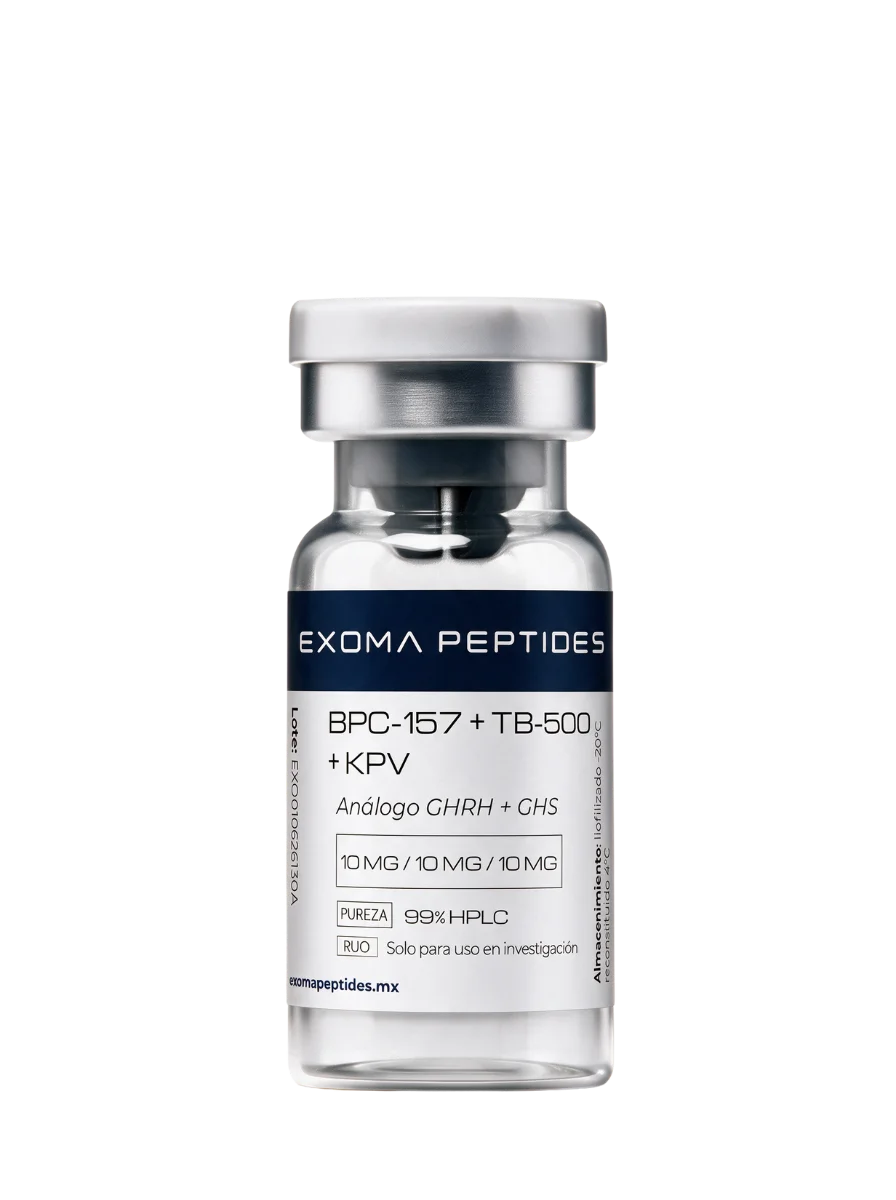
BPC-157 + TB-500 + KPV
BPC-157 + TB-500 + KPV — reagent for research use (RUO).
Technical data
- INN name
- BPC-157 + TB-500 + KPV (blend)
Sizes and prices: 10 mg + 10 mg + 10 mg $2,999 MXN ($100 MXN per mg).
Buy BPC-157 + TB-500 + KPV in Mexico: order online with nationwide shipping in 1-4 business days depending on zone and tracking number. Prices in Mexican pesos. Material for research use only.
BPC-157 + TB-500 + KPV is known internationally as BPC-157 + TB-500 + KPV (blend) (English INN name). Buy BPC-157 + TB-500 + KPV (blend) in Mexico / comprar BPC-157 + TB-500 + KPV (blend) en México: reagent for research use (RUO) and nationwide shipping.
BPC-157 + TB-500 + KPV is also searched as: Mezcla BPC-157 / TB-500 / KPV.
Identity and composition
BPC-157 + TB-500 + KPV is a research coformulation which combines three distinct peptides (10 mg + 10 mg + 10 mg), studied in preclinical models for their complementary pathways of tissue repair and inflammatory modulation. Product for research use.
It is not a single chemical entity, but a mixture of three components with separate identities:
- BPC-157 — Body Protection Compound-157, a gastric pentadecapeptide; sequence reported in secondary literature as GEPPPGKPADDAGLV.
- TB-500 — fragment/analog related to Thymosin beta-4 (Tβ4).
- KPV — tripeptide Lys-Pro-Val, corresponding to fragment 11-13 of the C-terminal end of α-MSH.
Since it is a blend and not an individual molecule, a single CAS number does not apply, and no verified open source is available for a molecular weight nor a molecular formula consolidated for the coformulation. The sequences indicated come from secondary literature and are offered only as descriptive reference.
Mechanism of action
Being a coformulation of three peptides, there is no single mechanism; the documented mechanisms correspond to each component separately, mainly in preclinical models (rodents and in vitro):
- BPC-157: in preclinical studies it has been observed to modulate healing through angiogenesis, with early up-regulation of genes such as Vegfa, Nos3 y Egr1, collagen deposition, fibroblast activity and the nitric oxide pathway, in addition to a modulatory action on inflammatory cells (Seiwerth et al., Front Pharmacol 2021; PMID 34267654).
- TB-500 / Thymosin β4: it sequesters G-actin monomers, regulating the assembly of the cytoskeleton and cell migration; in incisional wounds in the rat it has been observed that it reduces the appearance of myofibroblasts and α-SMA, organizes the collagen and minimizes the scar (Xu et al., 2010; PMID 20536458).
- KPV: derived from the C-terminal end of α-MSH, it exerts an anti-inflammatory effect apparently independent of the classical melanocortin receptors; in murine models of colitis (DSS) a reduction of the inflammatory infiltrate and of myeloperoxidase has been observed, even in mice with non-functional MC1R (Kannengiesser et al., 2008; PMID 18092346).
Important: no peer-reviewed evidence was located on the three components administered together; the proposed synergy is theoretical.
Pharmacokinetics
Not found validated human pharmacokinetics (half-life, bioavailability) in peer-reviewed sources for any of the three components in this research. The PK data that circulate come mostly from supplier catalogs and could not be independently confirmed, so it is considered a field not verifiable and any specific figure is omitted.
Scientific evidence
The available evidence is entirely preclinical/investigational y limited. For the three components it comes from in vitro and animal (rodent) studies, and none has regulatory approval as a drug for the explored indications.
In research it has been studied: BPC-157 in musculoskeletal healing (tendon, muscle, ligament, bone), gastrointestinal injury, and pain modulation, with only small pilot studies in humans and without confirmation of clinical efficacy (PMID 34267654); TB-500/Tβ4 in tissue repair, wound healing, and cornea/dry eye (PMID 20536458); and KPV in inflammatory bowel disease and colitis (PMID 18092346).
Preliminary evidence suggests complementary mechanisms of action, but no registered clinical trials were identified evaluating the specific co-formulation of the three peptides together.
Research applications
Product for research use.
Ideal for (research contexts):
- In vitro and animal-model studies on tissue repair, angiogenesis, and cell migration.
- Exploratory research on inflammatory modulation (KPV component).
- Comparative work between repair peptides (BPC-157, TB-500) and anti-inflammatory α-MSH derivatives (KPV).
Not applicable for:
- clinical use, therapeutic use, diagnosis or prevention of any condition.
- Clinical use: there is no regulatory approval or confirmed clinical evidence of efficacy, and the coformulation of the three peptides has no published efficacy or safety data.
Research protocols
The presentation of this research co-formulation is 10 mg of BPC-157 + 10 mg of TB-500 + 10 mg of KPV.
Regarding doses used in studies: the available evidence comes from preclinical models (rodents and in vitro) designed with schemes specific to each model, and no validated human dosing regimens or protocols were found for the combination of the three peptides administered together. For this reason no study dose figures are specified, so as not to attribute values not supported by the consulted literature.
The design of any experimental protocol is the responsibility of the responsible investigator, in accordance with applicable good laboratory practices.
Reconstitution
As a general standard laboratory guide for lyophilized peptides: reconstitution is usually performed with bacteriostatic water (water with approximately 0.9% benzyl alcohol as preservative), added slowly down the wall of the vial onto the lyophilized powder, without vigorous shaking; mixing by gentle rotation until complete dissolution is recommended.
The volume of reconstituent is chosen according to the working concentration desired by the researcher. This guide is general laboratory handling and does not constitute an instruction for use in humans.
Stability and storage
As a laboratory handling standard:
- Lyophilized (powder): is the most stable form; it is usually stored refrigerated and, for prolonged storage, frozen, protected from light and humidity.
- Reconstituted (in solution): once prepared with bacteriostatic water, it is stored refrigerated and handled as material with a shorter shelf life than the powder.
It is recommended to avoid repeated freeze-thaw cycles and to follow the specific conditions indicated by the supplier for each component. These ranges correspond to general handling practices, not to clinical stability data.
Safety profile
The safety data are limited and derive mainly from animal models; they should be interpreted with caution.
- BPC-157: the reviews note the absence of reported toxicity in preclinical studies and the absence of major adverse effects in the few pilot studies in humans, but without long-term safety data (PMID 34267654).
- TB-500/Tβ4 and KPV: no robust clinical safety profiles were identified.
- Coformulation of the three together: has no published safety data.
Since there is no consolidated clinical evidence, no formal list of contraindications is available. This is a research product, not approved for clinical use by regulators, and its handling should be restricted to trained personnel in controlled laboratory settings.
Comparative context
The three peptides act via pathways complementary but distinct:
- BPC-157 y TB-500 are oriented toward tissue repair, angiogenesis, and cell migration.
- KPV provides an anti-inflammatory component derived from α-MSH.
A relevant difference compared to intact α-MSH: KPV does not induce pigmentation and appears to operate through a pathway independent of the melanocortin receptors. The rationale for combining the three is theoretical (synergy between repair and anti-inflammation); no direct comparative evidence was found to support an advantage of the blend over the use of the individual components.
History and development
The three components arise from independent research lines on bioactive peptides:
- BPC-157 derives from a gastric protective protein (Body Protection Compound), studied as a stable pentadecapeptide in healing models.
- TB-500 is related to the Thymosin beta-4 (Tβ4), an actin-binding protein investigated for its role in tissue repair.
- KPV corresponds to fragment 11-13 (C-terminal end) of the hormone α-MSH, isolated for its anti-inflammatory potential without the pigmentary effect of the full hormone.
Their combination as a coformulation is a research-oriented development; the status of the three is preclinical/investigational, without regulatory approval as a drug for the studied indications.
FAQ
What is the BPC-157 + TB-500 + KPV coformulation?
It is a research blend of three distinct peptides (10 mg of each): BPC-157 and TB-500, studied in preclinical models for tissue-repair pathways, and KPV, a tripeptide derived from α-MSH with anti-inflammatory potential. It is not a single molecule and is a product for research use, not for clinical use.
Is there clinical evidence for the three peptides combined?
No. No peer-reviewed evidence was found on the three components administered together, nor registered clinical trials evaluating the specific co-formulation. The available evidence is preclinical (in vitro and rodents) and corresponds to each peptide separately.
What is the mechanism of action of each component?
In preclinical studies: BPC-157 modulates angiogenesis, collagen and the nitric oxide pathway (PMID 34267654); TB-500/Thymosin β4 regulates the cytoskeleton and cell migration, reducing myofibroblasts (PMID 20536458); and KPV reduces the intestinal inflammatory infiltrate by an apparently MC1R-independent pathway (PMID 18092346).
How is it reconstituted and stored?
As a general laboratory guide, the lyophilizate is reconstituted with bacteriostatic water added slowly down the wall of the vial, without shaking vigorously. The powder is stored refrigerated or frozen for prolonged storage; once reconstituted it is kept refrigerated and freeze-thaw cycles are avoided.
Does it have a CAS number, molecular weight, or formula?
A single CAS number does not apply because it is a mixture of three peptides and not an individual chemical entity. Nor is a consolidated molecular weight or molecular formula for the coformulation available in a verified open source.
Is it safe for clinical use?
No. It is a research product not approved by regulators for clinical use. Safety data are limited and come from animal models; the specific combination of the three peptides has no published safety data.
Customer reviews
Average rating: 4.0 out of 5, based on 1 customer rating.
Paola M. — 4/5
The complete stack arrived fine. It took two days to reach my city, everything in order and with its seals.
Scientific references (7)
Peer-reviewed literature on BPC-157 + TB-500 + KPV, with its PubMed identifier when available:
- Gut-brain axis and pentadecapeptide BPC-157 (Sikiric P, Seiwerth S, Rucman R, et al. · Current Neuropharmacology · 2016) — Review of neuroprotective effects and modulation of the brain-gut axis by BPC-157. PMID 27138887.
- BPC-157 increases growth hormone receptor expression in tendon fibroblasts (Chang CH, Tsai WC, Hsu YH, Pang JH. · Molecules · 2014) — In vitro study in human tendon fibroblasts evaluating signaling pathways activated by BPC-157. PMID 25415472.
- Stable gastric pentadecapeptide BPC 157: Novel therapy in gastrointestinal tract (Sikiric P, et al. · Current Pharmaceutical Design · 2011) — Comprehensive review of the effects of BPC-157 on the gastrointestinal tract and its therapeutic potential. PMID 21548867.
- BPC 157 enhances healing of transected rat Achilles tendon (Sikiric P, et al. · Journal of Orthopaedic Research · 2003) — Preclinical study showing acceleration of tendon healing with BPC-157. PMID 14554208.
- About BPC-157: Protective effects of pentadecapeptide BPC 157 on gastric ulcer in rats (Xue, et al. · World Journal of Gastroenterology · 2004) PMID 15052688.
- About TB-500: Thymosin beta4 accelerates wound healing (Malinda, et al. · Journal of Investigative Dermatology · 1999) PMID 10469335.
- About KPV: Dissection of the anti-inflammatory effect of the core and C-terminal (KPV) alpha-melanocyte-stimulating hormone peptides (Getting, et al. · The Journal of Pharmacology and Experimental Therapeutics · 2003) PMID 12750433.
Full scientific profile: BPC-157 in the compendium — mechanism of action, studies and technical data sheet.
See the full category catalog: Recovery · Longevity.