
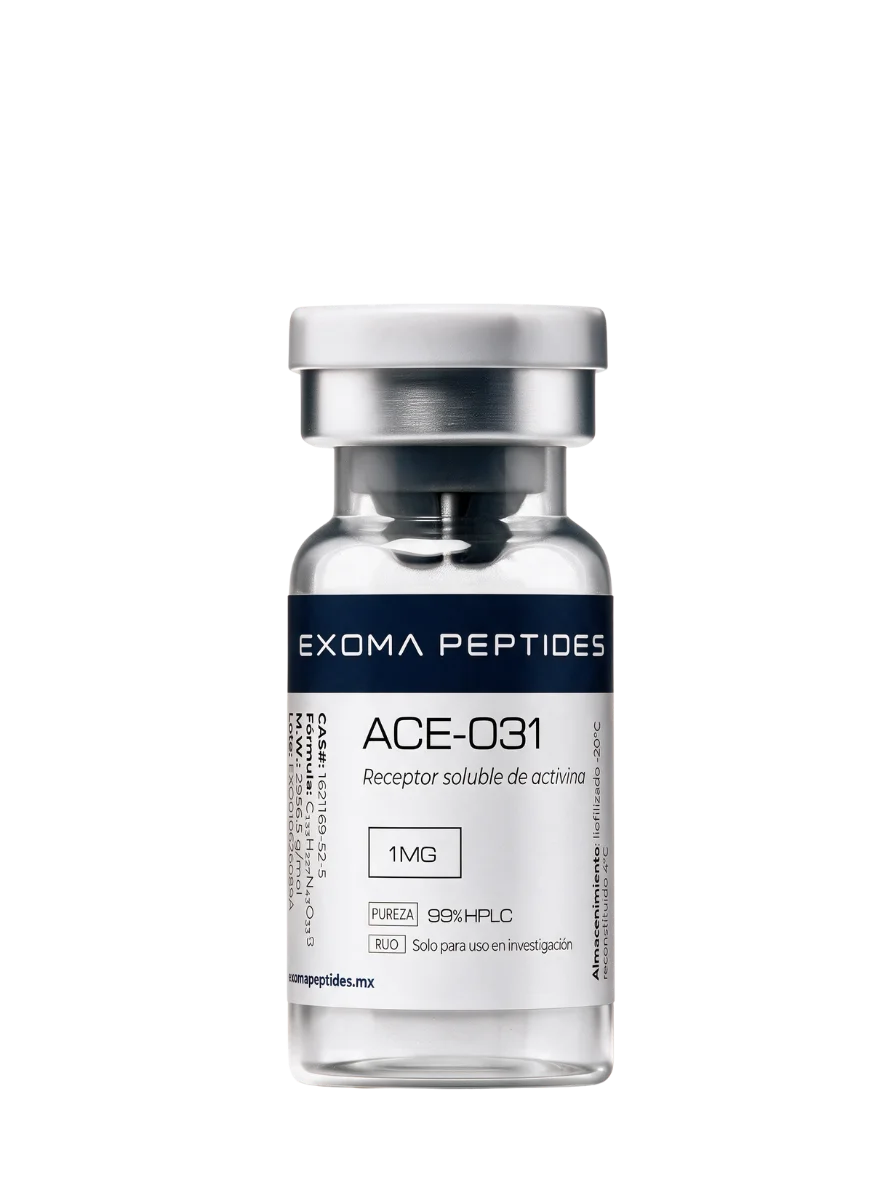
ACE-031
ACE-031 — reactivo for research (RUO). Contenido revisado por el Dr. Jesús Jaramillo.
Technical data
- INN name
- Ramatercept
- Development code
- ACE-031
- CAS
- 1169766-01-1
Sizes and prices: 1 mg $1,399 MXN ($1,399 MXN per mg) (out of stock).
Buy ACE-031 in Mexico: order online with nationwide shipping in 1-4 business days depending on zone and tracking number. Prices in Mexican pesos. Material for research use only.
ACE-031 is known internationally as Ramatercept (English INN name). Buy Ramatercept in Mexico / comprar Ramatercept en México: reagent for research use (RUO) and nationwide shipping.
ACE-031 is also searched as: ActRIIB-Fc.
Identity and composition
ACE-031 is a recombinant fusion protein which acts as a myostatin inhibitor and is investigated in the context of muscle loss and atrophy. It combines the extracellular domain of the human activin receptor type IIB (ActRIIB) fused to the Fc portion of a human IgG1, functioning as a soluble decoy receptor (ligand trap).
In the literature it is also known as Ramatercept, ActRIIB-Fc o Soluble activin receptor type IIB-IgG1 Fc fusion protein.
Because it is a recombinant fusion protein and not a small molecule, in the consulted reference material a verified CAS number, molecular weight, molecular formula or sequence are not documented; for this reason these chemical identity data are not reported here rather than estimated.
Product for research use.
Mechanism of action
ACE-031 behaves as a soluble decoy receptor (ligand trap). By presenting the extracellular domain of the ActRIIB receptor in the circulation, sequesters myostatin (GDF-8) and other ligands of the TGF-beta superfamily, such as GDF-11 and activin, preventing them from binding to the ActRIIB receptors on the cell surface (PMID 23169607).
Myostatin functions as a physiological brake on muscle growth. By blocking this negative signaling, in models and early trials a trend toward an increase in muscle mass and strength has been observed (PMID 27462804).
A relevant mechanistic point is that this blockade is not selective: the molecule also inhibits other ligands of the pathway, in particular BMP9, important for vascular homeostasis. The bleeding events (epistaxis, telangiectasias) described in research (PMID 27462804) have been attributed to this broad inhibition.
Pharmacokinetics
Its administration is subcutaneous. In a single ascending dose study, a approximate half-life of 10 to 15 days, with linear pharmacokinetics in the dose-response relationship within the range evaluated (PMID 23169607). In the trials, dosing was applied every 2 to 4 weeks. These data come from early research and should not be interpreted as established clinical parameters.
Scientific evidence
The available evidence is preliminary and limited. ACE-031 reached early clinical phase with two main studies: one of single ascending dose in healthy postmenopausal women (PMID 23169607) and a randomized, double-blind, placebo-controlled trial of multiple ascending doses in ambulatory children with Duchenne muscular dystrophy (DMD) (PMID 27462804).
In the study in healthy female volunteers, increases in lean mass (3.3%) and thigh volume (5.1%) were observed at a single dose (PMID 23169607). In the DMD trial, favorable trends were described in lean mass, bone mineral density and the 6-minute walk test; however, the study was ended prematurely due to safety concerns (PMID 27462804).
It is important to emphasize that clinical efficacy was not confirmed owing to the lack of continuation of the studies. ACE-031 has no approval for any use.
Research applications
Product for research use.
- Ideal for: laboratory and research studies on the myostatin/activin signaling pathway and ActRII receptors; characterization of ligand traps based on ActRIIB-Fc; research in models of muscle mass and atrophy.
- Not applicable for: clinical use, therapeutic use, self-administration, diagnosis or any clinical application. It is not an approved product or a medication.
The reported research focus has been the muscle loss and atrophy, with an emphasis on Duchenne muscular dystrophy, albeit without confirmation of efficacy.
Research protocols
The doses described correspond exclusively to research studies and are presented for informational purposes, not as a usage guide.
- In the single ascending dose study, a range of 0.02 to 3 mg/kg subcutaneously (PMID 23169607).
- In the trials, administration was performed every 2 to 4 weeks.
Since the clinical program was discontinued, there is no validated dosing scheme. Any handling must be restricted to the scope of controlled research.
Reconstitution
As a general laboratory handling guide for a lyophilizate, reconstitution is usually done with bacteriostatic water (water with approximately 0.9% benzyl alcohol), adding it slowly along the vial wall and without shaking vigorously.
- Direct the solvent against the wall of the vial, not directly onto the powder.
- Swirl gently until fully dissolved; avoid shaking so as not to damage the protein or generate foam.
- Visually inspect that the solution is clear before use.
This is a standard laboratory technique and does not constitute an instruction for use in people.
Stability and storage
As a general handling guideline:
- Lyophilized (powder): store refrigerated or frozen, protected from light and moisture; in this form the stability tends to be prolonged.
- Reconstituted: keep refrigerated and use within a short window; avoid repeated freeze-thaw cycles, which can degrade a fusion protein.
These are standard laboratory storage recommendations for research material, not clinical specifications.
Safety profile
The described safety profile comes from research and must be interpreted with caution.
In the DMD trial, adverse events were documented that led to early termination of the study: epistaxis (nosebleed), gingival bleeding y cutaneous telangiectasias (PMID 27462804). These bleeding events are thought to derive from the non-selective inhibition of additional ligands of the TGF-beta pathway, in particular BMP9, critical for vascular remodeling and homeostasis.
In the study in healthy female volunteers, tolerability was generally favorable, with minor injection-site reactions after single doses (PMID 23169607).
These findings reinforce that the compound is intended solely for research and not for use in people.
Comparative context
ACE-031 belongs to the class of ligand traps based on ActRII (myostatin/activin inhibitors). It shares a target with other approaches of the same family:
- Bimagrumab: antibody directed against ActRII.
- Sotatercept: based on ActRIIA-Fc, approved for pulmonary arterial hypertension.
- Luspatercept: based on modified ActRIIB, approved for anemias.
Unlike these, ACE-031 did not advance in its development due to its safety profile. The key differentiating factor is its ligand selectivity: its broad blockade, which includes BMP9, distinguishes it from more selective traps of the class.
History and development
ACE-031 was a research compound developed by Acceleron Pharma. It reached the early clinical phase with a single ascending dose study in healthy postmenopausal women (PMID 23169607) and a randomized, double-blind, placebo-controlled trial in ambulatory children with Duchenne muscular dystrophy (PMID 27462804).
The DMD program ended prematurely after the second dosing regimen owing to safety concerns (epistaxis and telangiectasias), despite favorable trends in lean mass, bone mineral density, and the 6-minute walk test. The compound was not approved for any use.
FAQ
What is ACE-031 and what is it investigated for?
It is a recombinant fusion protein (ActRIIB-Fc), also called Ramatercept, that acts as a myostatin inhibitor. It has been investigated in the context of muscle loss and atrophy, with a focus on Duchenne muscular dystrophy, without its clinical efficacy having been confirmed. It is a product for research use, not for clinical use.
How does ACE-031 work at the mechanistic level?
It works as a soluble decoy receptor: it sequesters myostatin (GDF-8) and other ligands such as GDF-11 and activin in the circulation, preventing them from activating the ActRIIB receptors. By releasing this brake on muscle, early research has observed a trend toward increased muscle mass (PMID 23169607).
Why was the development of ACE-031 stopped?
The trial in Duchenne muscular dystrophy was terminated early due to safety concerns, mainly bleeding events such as epistaxis and telangiectasias, attributed to the non-selective inhibition of BMP9 (PMID 27462804). The compound was not approved for any use.
What is the half-life of ACE-031?
In a single ascending dose study, an approximate half-life of 10 to 15 days was reported, with linear pharmacokinetics, following subcutaneous administration (PMID 23169607). In the trials, dosing was applied every 2 to 4 weeks. These are research data, not established clinical parameters.
How does ACE-031 differ from sotatercept or luspatercept?
All three belong to the class of ActRII-based ligand traps. Sotatercept (ActRIIA-Fc) and luspatercept advanced to approval in other indications, whereas ACE-031 did not continue due to its safety profile. Its broader blockade of ligands, including BMP9, is a key differentiator from more selective traps.
How is ACE-031 reconstituted and stored?
As a general laboratory guideline, the lyophilizate is reconstituted with bacteriostatic water added slowly down the vial wall, without shaking. The powder is kept refrigerated or frozen and, once reconstituted, refrigerated for a short window, avoiding freeze-thaw cycles. It is research material, not for clinical use.
Customer reviews
Average rating: 4.7 out of 5, based on 3 customer ratings.
Gonzalo S. — 5/5
Very good service when purchasing Ace-031. The package arrived earlier than expected.
Arturo P. — 4/5
The product arrived in good condition. It took a couple of days longer than I expected because of the area where I live, but other than that everything was fine with the ACE-031.
Scientific references (7)
Peer-reviewed literature on ACE-031, with its PubMed identifier when available:
- ACE-031, a soluble activin type IIB receptor, increases muscle mass and strength in the common marmoset (Callithrix jacchus) (Cadena SM et al. · PloS one · 2026) PMID 41686840.
- Gel Electrophoretic Detection of Black Market ACE-031 (Reichel C et al. · Drug testing and analysis · 2025) PMID 40312924.
- Myostatin inhibitor ACE-031 treatment of ambulatory boys with Duchenne muscular dystrophy: Results of a randomized, placebo-controlled clinical trial (Campbell C et al. · Muscle & nerve · 2017) PMID 27462804.
- A single ascending-dose study of muscle regulator ACE-031 in healthy volunteers (Attie, et al. · Muscle & Nerve · 2013) PMID 23169607.
- ACE-031, a Soluble Activin Type IIB Receptor, Increases Muscle Mass and Strength in the Common Marmoset (Callithrix jacchus). (Cadena SM, et al. · bioRxiv · 2025) PMID 41256654.
- Skeletal Response to Soluble Activin Receptor Type IIB in Mouse Models of Osteogenesis Imperfecta. (Jeong Y, et al. · J Bone Miner Res · 2018) PMID 29813187.
- Soluble Activin Receptor Type IIB Improves Muscle Regeneration Following Crotalus atrox Venom-Induced Damage. (Sonavane M, et al. · Toxins (Basel) · 2025) PMID 39998076.
Full scientific profile: ACE-031 in the compendium — mechanism of action, studies and technical data sheet.
See the full category catalog: Recovery.
Guides and articles about ACE-031
Lecturas del blog de EXOMA que la editorial asoció a este compuesto: