BPC-157
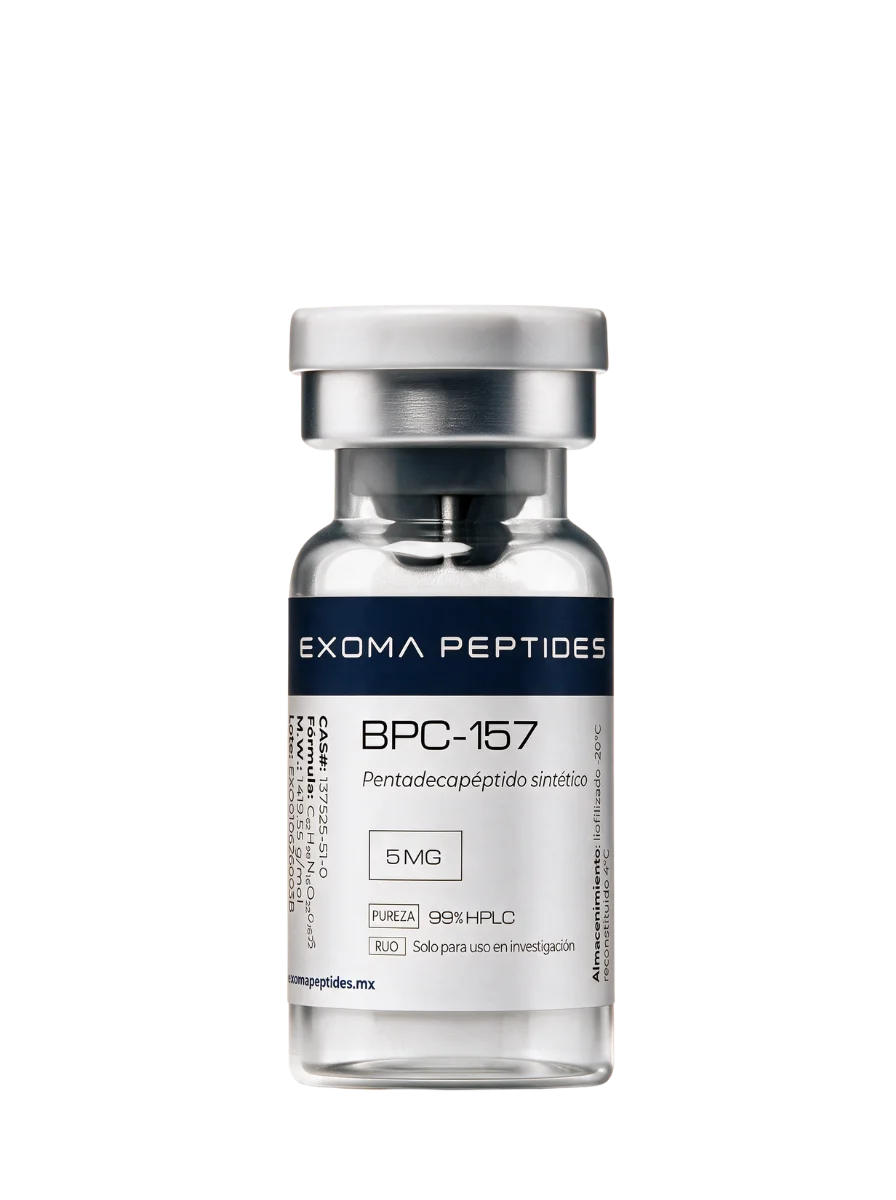
BPC-157 — reactivo for research (RUO). HPLC purity 99,4 % con COA per batch. Contenido revisado por el Dr. Jesús Jaramillo.
Technical data
- Development code
- PL 14736
- CAS
- 137525-51-0
- Molecular formula
- C62H98N16O22
- Molecular weight
- 1419.53 g/mol
Sizes and prices: 5 mg $610 MXN ($122 MXN per mg) · 10 mg $960 MXN ($96 MXN per mg) · 20 mg $1,660 MXN ($83 MXN per mg).
Buy BPC-157 in Mexico: order online with nationwide shipping in 1-4 business days depending on zone and tracking number. Prices in Mexican pesos. Material for research use only.
BPC-157 is also searched as: Pentadecapeptide BPC 157, Body Protection Compound-157, Bepecin, PL-10, PLD-116, PL 14736.
Identity and composition
BPC-157 (Body Protection Compound-157) is a synthetic pentadecapeptide of sequence GEPPPGKPADDAGLV, derived from a human gastric protective protein originally identified in gastric juice by the group of Prof. Predrag Sikiric (University of Zagreb) in the 1990s. Its molecular mass is 1419.5 Da, without disulfide bridges or post-translational modifications, which confers on it exceptional stability in the acidic gastric medium (rare among therapeutic peptides).
Unlike labile peptides such as insulin or native GLP-1, BPC-157 maintains biological activity after exposure to pH 2 for hours, which has allowed its investigation by systemic route (subcutaneous, intraperitoneal) and orally in animal models.
The molecule shows no homology with classical growth factors (VEGF, FGF, IGF-1), but modulates the expression and activity of multiple endogenous trophic systems, como agente pleiotrópico de protección y regeneración tisular. Su designación "BPC" refleja su origen funcional (compuesto citoprotector aislado de jugo gástrico); el sufijo "157" corresponde al fragmento de la proteína parental con mayor actividad en bioensayos de protección de mucosa.
BPC-157 is used exclusively as in vitro and in vivo research molecule to study wound healing, angiogenesis, the brain-gut axis, and neuroprotection. It has no regulatory approval for human therapeutic use in any jurisdiction.
Mechanism of action
El mecanismo de BPC-157 es multimodal y dependiente del contexto tisular, with no single characterized receptor to date.
1. Angiogenesis: induce VEGF-R2 (KDR) y activa la vía VEGF-R2/Akt/eNOS, promoviendo neo-vasos en sitios de lesión. En córnea de rata muestra neovascularización acelerada tras aplicación tópica.
2. Óxido nítrico (NO): incrementa la actividad de la sintasa endotelial (eNOS), mejorando vasodilatación local, perfusión y permeabilidad capilar regulada, efecto central en la mejora de cicatrización.
3. Serotonergic-dopaminergic axis: modula sistemas 5-HT y dopamina en hipocampo y núcleo accumbens; en animales muestra efectos ansiolíticos/antidepresivos y contrarregula neurotoxicidad por haloperidol y MPTP.
4. Fibroblastos/colágeno: estimula proliferación de fibroblastos, deposición ordenada de colágeno tipo I y III y maduración de matriz; tendones, ligamentos y músculo cicatrizan con menor tejido desorganizado.
5. Brain-gut axis: contrarregula daño por AINEs, alcohol, ácido y estrés en mucosa GI; restaura barrera epitelial, reduce permeabilidad intestinal patológica ("leaky gut" experimental) y modula microbiota en colitis.
6. Inflammatory pathways: reduce TNF-α, IL-1β e IL-6 en inflamación aguda, sin inmunosupresión sistémica.
7. Putative VEGFR2-NO receptor: the strongest hypothesis integrates VEGFR2 → PI3K/Akt → eNOS → NO as the central axis, with secondary cascades depending on the target tissue.
Unlike exogenous growth factors (PDGF, IGF-1), BPC-157 does not generate uncontrolled proliferation in healthy tissues, which suggests a mechanism homeostatic and context-dependent more than a pure mitogen.
Pharmacokinetics
The pharmacokinetic data are limited and derived mainly from animal models, ya que no ha completado ensayos clínicos fase I formales.
Absorption:
- Subcutaneous/intramuscular: biodisponibilidad estimada >80% en rata.
- Oral: biodisponibilidad menor pero functionally active, por acción local en mucosa GI y posible absorción intacta parcial vía transportadores PepT1.
- Intraperitoneal (experimental): absorción rápida y completa.
Distribution: broad tissue penetration after systemic administration; studies with isotopically labeled BPC-157 suggest preferential accumulation at injury sites (damaged gastric mucosa, transected tendon).
Plasma half-life: estimated at 30 minutes to 1 hour in rat (i.p.), although the biological effects persist 24–72 h, suggesting a "trigger"-type action on self-sustaining cascades rather than continuous receptor occupancy.
Metabolism: degradación proteolítica por peptidasas séricas y tisulares en aminoácidos constituyentes; sin metabolitos activos definidos.
Elimination: predominantly renal; high clearance explains the short half-life.
Serum stability: prolonged for a small peptide (>2 h in human serum in vitro).
Dose-response: curva tipo campana en algunos modelos (hormesis molecular, Sikiric et al.), con dosis intermedias óptimas y dosis muy altas atenuando la respuesta.
Scientific evidence
La evidencia proviene casi exclusivamente de preclinical models (rat, mouse, pig), published mostly by Prof. Sikiric's group since 1991; independent replication has been expanding over the last decade.
Tendon healing:
- Krivic et al. (J Orthop Res 2008): accelerated regeneration of a transected Achilles tendon in rat.
- Chang et al. (J Appl Physiol 2011): improvement in tensile strength and collagen fiber architecture.
Muscle injury:
- Novinscak et al. (J Orthop Res 2008): reparación de cuádriceps tras transección.
- Mihalj et al. (Med Sci Monit 2015): contrarregulación de daño por bupivacaína.
Gastrointestinal:
- Sikiric et al. (Eur J Pharmacol, múltiples): contrarregulación de úlceras gástricas por AINEs, alcohol y estrés.
- Klicek et al. (J Physiol Pharmacol 2013): enfermedad inflamatoria intestinal experimental.
Cardiovascular:
- Stancic-Rokotov et al.: protección frente a infarto isquémico en rata.
- Vukojevic et al. (Front Pharmacol 2018): contrarregulación de hipertensión portal.
Nervous system:
- Tudor et al.: neuroprotección en lesión medular experimental.
- Klicek et al.: contrarregulación de encefalopatía por amonio.
Hueso: Sebecic et al.: aceleración de consolidación ósea en fracturas de rata.
Human trials: scarce and of low quality (small uncontrolled IBD studies in the 90s); there are no phase II/III trials with modern methodology.
Revisiones: Sikiric et al. (Curr Pharm Des 2018) recopilan >100 estudios preclínicos; Seiwerth et al. (Int J Mol Sci 2021) revisan el mecanismo VEGFR2/NO.
Research applications
Aplicaciones documentadas en literatura preclínica:
Musculoskeletal (sports research):
- Tendinopatías (Aquiles, patelar, rotador): regeneración acelerada en 50–70% del tiempo control.
- Lesiones musculares por contusión, isquemia o miotoxicidad: restauración estructural y funcional.
- Ligamento cruzado anterior (modelo porcino): mejor organización fibrilar post-reparación.
- Consolidación de fracturas: mayor densidad mineral y resistencia mecánica.
Gastrointestinal:
- Úlcera gástrica/duodenal experimental: contrarregulación frente a AINEs (indometacina, diclofenaco), alcohol absoluto, estrés, isquemia-reperfusión.
- EII experimental (DSS, TNBS): reducción de inflamación, restauración de barrera epitelial.
- Intestino permeable: normalización de uniones estrechas (occludina, claudina-1, ZO-1).
- Fístulas digestivas: cierre acelerado.
Central nervous system:
- Traumatic spinal cord injury: partial motor recovery.
- Trauma craneoencefálico: menor edema y mejor cognición post-lesión.
- Encefalopatía hepática: contrarregulación de daño hipocampal por amonio.
- Depresión/ansiedad (forced swim, elevated plus maze): efectos ansiolíticos.
Cardiovascular:
- Infarto miocárdico: reducción de necrosis. Insuficiencia por sobrecarga: preservación de fracción de eyección. Efectos paradójicos pro-coagulación o pro-fibrinolíticos según contexto.
Skin healing: heridas y úlceras por presión (cierre acelerado, menor cicatriz hipertrófica); quemaduras.
Liver and pancreas: hepatotoxicidad por paracetamol/alcohol y pancreatitis aguda: contrarregulación.
Every application is strictly experimental; no use is validated for approved human therapeutics.
Research protocols
Preclinical protocols vary by model; doses translated to the human equivalent are for reference only.
Typical preclinical doses:
- Rata: 10 µg/kg/día (estándar); rango exploratorio 1–500 µg/kg.
- Mouse: 10–20 µg/kg/day.
- Pig: 50 µg/kg/day.
Human equivalent by allometric scaling (factor 6.2 rat→human):
- ~250–500 µg/day for a 70 kg adult as an investigational reference range.
Routes of administration in research:
- Subcutaneous: preferred for systemic protocols.
- Intramuscular: cerca del sitio de lesión musculoesquelética.
- Oral: viable due to acid stability; lower bioavailability, useful in GI protocols.
- Topical: cicatrización dérmica.
- Intraperitoneal: standard in murine models.
Frequency: 1–2 veces/día en protocolos cortos (lesión aguda); 1 vez/día en crónicos (>4 semanas).
Typical duration: lesión aguda 14–28 días; tendinopatía 4–8 semanas; estudios crónicos GI hasta 12 semanas.
Research combinations:
- + TB-500 (cicatrización compleja: angiogénesis + migración celular); + KPV (mucosa GI inflamada).
Monitoring: marcadores de cicatrización (VEGF, hidroxiprolina, fuerza tensil); seguridad (hemograma, función hepática/renal). No se ha establecido toxicidad significativa hasta 1000× la dosis efectiva en estudios subcrónicos.
Reconstitution
Lyophilized BPC-157 is preferably reconstituted with bacteriostatic water (BAC), or sterile water for single-dose injection.
Standard procedure:
- Equilibrate vial and solvent to room temperature for 15 min.
- Clean the stopper with 70% isopropanol.
- Inject BAC slowly onto the side wall of the vial.
- Do not shake: gently roll to dissolve in 1–2 minutes.
- La solución debe ser clear and colorless; descartar si hay turbidez.
Reference concentrations:
5 mg vial:
- 1 mL BAC → 5,000 µg/mL (500 µg = 0.1 mL = 10 IU)
- 2 mL BAC → 2,500 µg/mL (250 µg = 0.1 mL = 10 IU)
10 mg vial:
- 2 mL BAC → 5,000 µg/mL (500 µg = 0.1 mL = 10 IU)
- 5 mL BAC → 2,000 µg/mL (200 µg = 0.1 mL = 10 IU)
20 mg vial:
- 4 mL BAC → 5,000 µg/mL
- 5 mL BAC → 4,000 µg/mL
Syringe: U-100 insulin syringe of 0.3–0.5 mL, 29–31G × 8 mm needle for subcutaneous injection.
Subcutaneous route: any area with adipose tissue (abdomen, thigh, deltoid); in localized musculoskeletal injury, administration near the site is documented.
Calculation: volume (mL) = dose (µg) / concentration (µg/mL).
Stability and storage
Sealed lyophilized vial:
- Store at 2–8 °C; stability up to 24 months per manufacturer.
- Tolerates room temperature for up to 30 days with no documented functional loss. Protect from direct light.
Vial reconstituted with BAC:
- Store strictly at 2–8 °C; stability 28 days preservando actividad >90%; algunos estudios sugieren hasta 6 semanas con manejo aséptico riguroso.
- Do not freeze after reconstitution.
Reconstituido con agua estéril (sin conservador): uso inmediato o dentro de 24 h refrigerado.
Acid stability: característica única; mantiene actividad tras incubación a pH 2 durante 24 horas, base de su biodisponibilidad oral parcial. Thermal resistance: tolera hasta 40 °C transitorio sin degradación documentada.
Degradación: descartar ante turbidez, precipitado, cambio de color u olor anómalo.
Transport: cold gel pack; the lyophilized product tolerates 48–72 h up to 25 °C with no documented loss. Alícuotas: posibles a -20 °C en viales individuales, con una sola congelación-descongelación recomendada.
Safety profile
BPC-157 presents one of the more favorable documented preclinical safety profiles for a research peptide, although systematic human evidence is scarce.
Acute and subchronic toxicity:
- En rata a dosis hasta 1,000 µg/kg (100× la dosis efectiva) durante 30 días: sin alteraciones histopatológicas, bioquímicas ni hematológicas significativas.
- LD50 no establecida; dosis suprafarmacológicas extremas no producen letalidad en modelos documentados.
Genotoxicidad/mutagenicidad: negative in vitro studies (Ames test).
Carcinogenicity: sin estudios formales a 2 años; la naturaleza homeostática (no proliferativa indiscriminada) y la ausencia de efectos mitógenos en tejidos sanos sugieren bajo riesgo teórico. There are no preclinical reports of tumor induction.
Hypersensitivity: extremadamente rara; su origen humano (jugo gástrico) reduce inmunogenicidad.
Sitio de inyección: reacciones ocasionales, leves y autolimitadas.
Coagulation: efectos paradójicos según contexto: pro-coagulación local en hemorragia, fibrinolítico en trombosis venosa profunda.
Cardiovascular: no significant alteration of blood pressure or heart rate in documented studies.
Reproduction: limited data; no teratogenicity reported in the few available studies.
Interactions: none documented with NSAIDs (in fact it counter-regulates them), corticosteroids, antibiotics, or anticoagulants in animals.
Theoretical concerns in humans:
- Sin ensayos fase I controlados modernos: el perfil de seguridad humano is not established.
- Riesgo angiogénico hipotético en neoplasia preexistente (sin evidencia, pero plausible).
- Purity variability among unregulated suppliers.
Research recommendation: monitoreo hematológico, función hepática/renal y exclusión de pacientes con historia oncológica activa.
Comparative context
vs TB-500 (Thymosin β4 fragment 17-23): TB-500 acts on G-actin and cell migration; BPC-157 on VEGF/NO/wound healing. Both in tissue repair, frequently combined in sports research. BPC-157 is acid-stable (oral viable); TB-500 requires parenteral administration and has a longer half-life due to its larger size.
vs Growth factors (PDGF, IGF-1, FGF): BPC-157 presents no uncontrolled mitogenic risk and acts by modulating endogenous expression (the factors are substitutive, labile, and expensive).
vs KPV (Lys-Pro-Val): KPV is an anti-inflammatory tripeptide derived from α-MSH (melanocortin pathway); BPC-157 covers a broader spectrum (regeneration + protection). Combined in GI studies.
vs GHK-Cu: GHK-Cu se enfoca en cicatrización cutánea y matriz extracelular; BPC-157 abarca múltiples tejidos sistémicos.
vs LL-37: LL-37 es antimicrobiano; BPC-157 no tiene actividad antibacteriana directa.
vs Cerebrolysin: mixture of porcine neuropeptides for CNS neurotrophism; BPC-157 has CNS effects but also systemic ones.
Differential advantage: breadth of tissue applications, exceptional stability, favorable preclinical safety profile, oral viability. Disadvantage: absence of formal modern human clinical trials.
History and development
BPC-157 was identified and characterized by the group of Prof. Predrag Sikiric at the Faculty of Medicine of the University of Zagreb (Croatia) since the early 1990s.
Hitos:
- 1991–1993: first publications on the gastric protective fraction with antiulcer properties.
- 1993: identificación de la secuencia pentadecapeptídica activa (BPC-157).
- 1995–2000: caracterización de actividad en cicatrización musculoesquelética, GI y CNS.
- 2005–2015: expansión a modelos cardiovascular, hepático y neurológico.
- 2010–2020: caracterización mecanística (VEGFR2/NO).
- 2020–presente: replicación parcial por grupos independientes y expansión a modelos veterinarios.
Regulatorio:
- No cuenta con aprobación from any authority (FDA, EMA, COFEPRIS, PMDA, MHRA) for human therapeutic use.
- En 2022 la FDA lo clasificó como sustancia no compoundable bajo Section 503A/503B, excluyéndolo de farmacias de compounding en USA.
- WADA has included it on the list of prohibited substances for competitive athletes since 2019.
- In animal research, its use is governed by welfare regulations (NOM-062 in Mexico, Directive 2010/63/EU in Europe, IACUC in the USA).
Patents: the peptide itself is not protected by an active patent (discovery published >25 years ago); specific formulations and combinations may be.
Academia: >200 indexed publications, mostly from the Croatian group; the community calls for high-quality independent studies before advancing to a formal human clinical phase. Availability: research reagent; quality control among suppliers is a critical factor.
FAQ
What makes BPC-157's structure unique among peptides?
Its exceptional stability in the acidic gastric medium (it maintains biological activity at pH 2 for hours), which is rare among peptides of its size. This is due to its sequence GEPPPGKPADDAGLV without labile disulfide bonds and to its evolutionary origin in gastric juice. It allows partial oral bioavailability, a nearly unique characteristic among research peptides.
Why is it frequently combined with TB-500?
The mechanisms are complementary: BPC-157 acts on angiogenesis (VEGF-R2/NO) and modulation of tissue wound healing; TB-500 acts on G-actin favoring cell migration and cytoskeletal reorganization. The combination in research covers multiple phases of the repair process.
What is the difference between oral and subcutaneous administration?
The oral route takes advantage of acid stability and produces pronounced local effects on the GI mucosa (anti-ulcer protocols, experimental IBD). The subcutaneous route offers greater systemic bioavailability (>80%) and is preferred for musculoskeletal or systemic protocols. The choice depends on the target tissue.
Does BPC-157 have human clinical trials?
Human trials are scarce and of low methodological quality (mainly small uncontrolled studies from the 1990s in inflammatory bowel disease). There are no published phase II or phase III trials with modern methodology. All the robust evidence is preclinical.
What is the current regulatory status?
BPC-157 does NOT have approval from any regulatory authority (FDA, EMA, COFEPRIS) for human therapeutic use. The FDA excluded it from compounding in 2022. WADA prohibits it in competitive athletes since 2019. Its use is exclusively as a research reagent.
Why is the plasma half-life short but the effects last days?
BPC-157 acts as a trigger of self-sustaining cascades (gene expression of VEGFR2, eNOS, endogenous growth factors) rather than by continuous receptor occupancy. Once the reparative pathways are activated, they persist for 24-72 h independently of the plasma presence of the peptide.
How is the human equivalent dose calculated from animal models?
By allometric scaling based on body surface area: factor 6.2 for rat→human and 12.3 for mouse→human. A typical preclinical dose of 10 µg/kg in the rat corresponds referentially to ~1.6 µg/kg in humans (~110 µg for 70 kg). The extrapolation is approximate and only indicative for research protocols.
How long does a reconstituted vial last?
28 days refrigerated at 2-8 °C with BAC as solvent, preserving biological activity >90%. Some studies suggest extension to 6 weeks with rigorous aseptic handling. Without BAC (plain sterile water), use within 24 hours refrigerated.
Does it carry a risk of promoting tumors due to its angiogenic activity?
There are no preclinical reports of tumor induction in available studies, and BPC-157 shows context-dependent homeostatic action (not indiscriminate proliferation in healthy tissue). However, given the absence of formal 2-year carcinogenicity studies, its use in patients with active neoplasia is considered contraindicated as a mechanistic precaution.
Which solvent is preferable: bacteriostatic water or sterile water?
Bacteriostatic water (BAC, with 0.9% benzyl alcohol) is preferable for its multi-dose capacity of up to 28 days. Sterile water for injection is an alternative for single dose or when the absence of preservatives is required (documented allergy to benzyl alcohol). Never use tap water, non-sterile distilled water or saline solution.
Customer reviews
Average rating: 4.8 out of 5, based on 17 customer ratings.
Rodrigo K. — 5/5
It worked wonderfully for my shoulder. It came well protected with a cooler and ice gel packs.
Héctor S. — 4/5
The BPC-157 arrived in good condition. The chat support was fast and very friendly.
Valeria R. — 5/5
I really liked the speed of the shipping. The BPC-157 came protected and the store's service was very kind.
Guadalupe S. — 5/5
Good packaging, clear labels, and ideal powder consistency.
Esteban G. — 5/5
The BPC-157 arrived perfect. Always reliable.
Josefina S. — 5/5
Results from the first week, very good product.
Jessica L. — 5/5
It arrived the next day here in León. Everything super fresh.
Regina C. — 4/5
The BPC-157 arrived well sealed. I give it 4 stars because it took one extra day due to the delivery zone, but the quality is excellent.
Karen F. — 5/5
Unbeatable quality, no burning or subsequent discomfort.
Fernanda C. — 5/5
Super happy with the purchase. I checked the batch and everything matches the tests they publish.
Karla R. — 5/5
It helped my knee a lot, 100% legitimate product.
Karina N. — 5/5
It helped me a lot with my elbow discomfort.
Pablo N. — 4/5
Better price per mg than the 10mg version.
Esteban G. — 5/5
The BPC-157 arrived earlier than expected. Very good service and impeccable quality.
Klaus T. — 5/5
No discomfort on application, excellent purity.
Isabel R. — 5/5
Same quality as the 10mg one but more convenient.
Analyzed by Janoshik, an independent laboratory. Each report is verifiable per batch at janoshik.com/verify.
Scientific references (7)
Peer-reviewed literature on BPC-157, with its PubMed identifier when available:
- Gut-brain axis and pentadecapeptide BPC-157 (Sikiric P, Seiwerth S, Rucman R, et al. · Current Neuropharmacology · 2016) — Review of neuroprotective effects and modulation of the brain-gut axis by BPC-157. PMID 27138887.
- BPC-157 increases growth hormone receptor expression in tendon fibroblasts (Chang CH, Tsai WC, Hsu YH, Pang JH. · Molecules · 2014) — In vitro study in human tendon fibroblasts evaluating signaling pathways activated by BPC-157. PMID 25415472.
- Stable gastric pentadecapeptide BPC 157: Novel therapy in gastrointestinal tract (Sikiric P, et al. · Current Pharmaceutical Design · 2011) — Comprehensive review of the effects of BPC-157 on the gastrointestinal tract and its therapeutic potential. PMID 21548867.
- BPC 157 enhances healing of transected rat Achilles tendon (Sikiric P, et al. · Journal of Orthopaedic Research · 2003) — Preclinical study showing acceleration of tendon healing with BPC-157. PMID 14554208.
- Protective effects of pentadecapeptide BPC 157 on gastric ulcer in rats (Xue, et al. · World Journal of Gastroenterology · 2004) PMID 15052688.
- Focus on ulcerative colitis: stable gastric pentadecapeptide BPC 157 (Sikiric, et al. · Current Medicinal Chemistry · 2012) PMID 22300085.
- The promoting effect of pentadecapeptide BPC 157 on tendon healing involves tendon outgrowth, cell survival, and cell migration (Chang, et al. · Journal of Applied Physiology · 2011) PMID 21030672.
Full scientific profile: BPC-157 in the compendium — mechanism of action, studies and technical data sheet.
See the full category catalog: Recovery · Longevity.
Otras presentaciones de BPC-157
Guides and articles about BPC-157
Lecturas del blog de EXOMA que la editorial asoció a este compuesto: