KPV
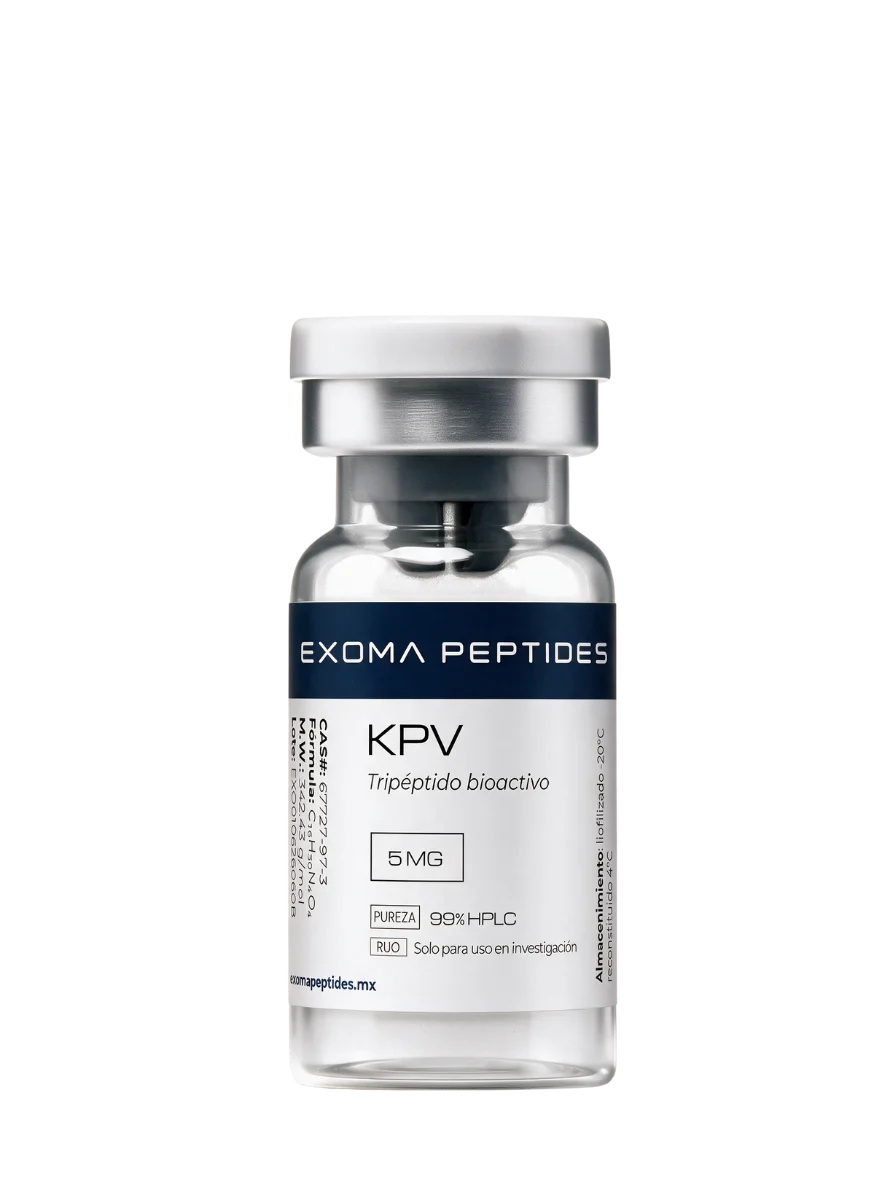
KPV — research reagent (RUO). HPLC purity 97.3 % with COA per batch.
Technical data
- CAS
- 67727-97-3
- Molecular formula
- C16H30N4O4
- Molecular weight
- 342.43 g/mol
Sizes and prices: 5 mg $700 MXN ($140 MXN per mg) · 10 mg $960 MXN ($96 MXN per mg) · 30 mg $2,620 MXN ($87 MXN per mg).
Buy KPV in Mexico: order online with nationwide shipping in 1-4 business days depending on region, with a tracking number. Prices in Mexican pesos. Material for research use only.
KPV is also searched as: L-lisil-L-prolil-L-valina, Tripeptido KPV, alfa-MSH (11-13).
Identity and composition
KPV is a synthetic tripeptide corresponding to the C-terminal fragment (residues 11-13, Lys-Pro-Val) of alpha-melanocyte-stimulating hormone (alpha-MSH), studied in preclinical models for its anti-inflammatory activity at the epithelial and immune level. Product for research use.
Chemical identity data:
- Sequence: Lys-Pro-Val (H-Lys-Pro-Val-OH; K-P-V), alpha-MSH(11-13) fragment
- CAS: 67727-97-3
- Molecular formula: C16H30N4O4
- Molecular weight: 342.43 g/mol
- Synonyms: L-lysyl-L-prolyl-L-valine, alpha-MSH (11-13), ACTH-(11-13), alpha-MSH (11-13) free acid
It is offered in presentations of 5 mg, 10 mg, 30 mg, and 500 mcg, in a 100-tablet format.
Mechanism of action
In preclinical models, KPV has been investigated as the C-terminal tripeptide of alpha-MSH with anti-inflammatory activity. At nanomolar concentrations, in cell cultures and murine models it has been observed that KPV inhibits the activation of the inflammatory pathways NF-kappaB y MAP kinase in intestinal epithelial and immune cells, with a reduction in the secretion of proinflammatory cytokines (IL-6, IL-12, IFN-gamma, IL-1beta, TNF-alpha) (Dalmasso G, et al. Gastroenterology 2008; PMID 18061177).
A distinctive feature described in the preclinical literature is that KPV is taken up into the cell interior by the di/tripeptide transporter PepT1, normally expressed in the small intestine and induced in the colon during inflammatory bowel disease, which has been proposed as a certain targeting toward inflamed tissue. Its anti-inflammatory activity in this axis appears to be independent of the melanocortin receptors, unlike intact alpha-MSH. The dependence on PepT1 was examined with PepT1-knockout mice, in which loss of the effect was observed (Dalmasso G, et al. Gastroenterology 2008; PMID 18061177).
Pharmacokinetics
No verifiable pharmacokinetic data in primary sources were identified for KPV: parameters such as half-life, bioavailability, and clearance are not reliably documented and are deliberately omitted so as not to mislead.
What the preclinical literature does describe, qualitatively, is that the intestinal absorption of KPV occurs through the transporter PepT1 (a mechanism shared with dietary di/tripeptides), which has been associated with its activity after oral administration in animal models (Dalmasso G, et al. Gastroenterology 2008; PMID 18061177). This is a characteristic of the transport mechanism, not a quantified pharmacokinetic parameter.
Scientific evidence
The available evidence on KPV is predominantly preclinical (cell cultures and murine models) and should be interpreted as preliminary and limited. No clinical trials in humans were identified that confirm efficacy or safety.
Among the areas explored at the experimental level:
- Intestinal inflammation / colitis: in DSS and TNBS murine models it has been observed that the oral administration of KPV reduced the incidence and severity of colitis (Dalmasso G, et al. Gastroenterology 2008; PMID 18061177).
- Colitis-associated cancer: in the AOM+DSS murine model, it has been reported that KPV transported by PepT1 reduced colonic tumorigenesis, with a PepT1-dependent effect (Viennois E, et al. Cell Mol Gastroenterol Hepatol 2016; PMID 27458604).
Other areas mentioned in secondary literature (skin, lung) were not verified in primary sources in this review and are not asserted here. These findings are research findings and do not establish clinical safety or efficacy in humans.
Research applications
Product for research use.
Ideal for research in:
- In vitro studies of inflammatory signaling (NF-κB and MAP kinase pathways) in epithelial and immune cell lines.
- Preclinical models of intestinal inflammation/colitis (e.g. DSS, TNBS).
- Research on peptide transport via PepT1 and targeting to inflamed tissue.
- Comparative studies with alpha-MSH on anti-inflammatory activity independent of melanocortin receptors.
Not applicable for:
- clinical use, food use, therapeutic, diagnostic, or cosmetic use.
- Self-administration or any clinical use: there are no human trials supporting safety or efficacy.
- Dermatological or pulmonary applications as substantiated claims: they appear only in unverified secondary sources.
Research protocols
The studies cited in the consulted literature describe its experimental work qualitatively (oral administration of KPV in murine models of colitis and colitis-associated cancer), but no verifiable numerical doses are available in this source (mg/kg, concentrations, or schemes) that can be reproduced with direct support. For the sake of information integrity, those figures are omitted rather than presented without basis.
The design of any research protocol is the responsibility of the qualified investigator, in accordance with their experimental model, appropriate controls and applicable institutional regulations. This product does not include dosing recommendations for humans.
Reconstitution
General laboratory handling note (qualitative guide): this presentation is offered in tablets, so it does not require reconstitution like lyophilized peptides for injection. When working with lyophilized powder material that does require solubilization, the laboratory standard consists of adding the appropriate solvent (for example, bacteriostatic water, which is water with approximately 0.9% benzyl alcohol as a preservative) down the wall of the vial, without directing the stream directly onto the material, and letting it dissolve by gentle swirling without shaking vigorously.
These instructions are for general technical handling for research use and do not imply preparation for human administration.
Stability and storage
Standard laboratory handling guide (qualitative): peptides in the solid/lyophilized state tend to be more stable than in solution. As a general practice:
- Solid product (tablets / powder): store in a cool, dry place protected from light and moisture; for long-term storage, refrigeration or freezing is usually preferred. - Material reconstituted in solution: keep refrigerated and use within a short period, minimizing freeze-thaw cycles.
The consulted literature does not provide specific stability data (numerical shelf life) for KPV, so only general handling guidelines are offered.
Safety profile
No human clinical safety data were identified in the primary sources reviewed. In murine models of colitis, oral administration of KPV was reported to be well tolerated within those studies, but there is no formal toxicological characterization or verifiable long-term safety data.
For the above reasons:
- A safety profile for clinical use cannot be established.
- No documented contraindications are available in primary sources, which reflects an absence of clinical data, not an absence of risk.
- It must be handled only as a research compound, with protective equipment and appropriate laboratory practices.
Compound for exclusive use in research; not for clinical use.
Comparative context
Compared to its parent hormone, the alpha-MSH, KPV represents only the C-terminal fragment (residues 11-13). The preclinical literature describes that it retains anti-inflammatory activity but lacks the core sequence needed to bind to melanocortin receptors (MC-R); for this reason it does not reproduce the pigmentary/melanocortic effects of full alpha-MSH.
Another relevant contrast is its absorption: unlike most peptides, that of KPV occurs via the transporter PepT1, a mechanism shared with dietary di/tripeptides. This has been proposed as the explanation for its activity after oral administration in animal models, something uncommon among peptides that usually degrade in the digestive tract. In summary, KPV is characterized in research as a "minimal" derivative of alpha-MSH that separates the anti-inflammatory signal from melanocortin signaling.
History and development
KPV derives from the study of alpha-MSH (alpha-melanocyte-stimulating hormone) and its C-terminal fragment Lys-Pro-Val, corresponding to residues 11-13 (also described as ACTH-(11-13)). Interest in this tripeptide arose upon observing, in preclinical research, that the C-terminal portion retained the anti-inflammatory activity of the full hormone without depending on melanocortin receptors.
Subsequent experimental work characterized its uptake via the PepT1 transporter and evaluated its effect in murine models of intestinal inflammation (Dalmasso G, et al. Gastroenterology 2008; PMID 18061177) and, later, in models of colitis-associated cancer (Viennois E, et al. Cell Mol Gastroenterol Hepatol 2016; PMID 27458604). Its chemical identity is registered in public reference databases (PubChem CID 125672). As of the reviewed evidence, its development remains within the scope of preclinical research.
FAQ
What is KPV and what is it studied for?
KPV is a synthetic tripeptide (Lys-Pro-Val) that corresponds to the C-terminal fragment of alpha-MSH. In preclinical research it has been studied for its anti-inflammatory activity on pathways such as NF-kappaB and MAP kinase in epithelial and immune cells. It is a product for research use; not for clinical use.
Does KPV have clinical trials in humans?
No. According to the evidence reviewed, the available information is predominantly preclinical (cell cultures and murine models). No clinical trials in humans confirming safety or efficacy were identified.
How is KPV absorbed and why does it act via the oral route in animal models?
The preclinical literature describes that KPV is taken up by the di/tripeptide transporter PepT1, a mechanism shared with dietary peptides. This has been associated with its activity after oral administration in animal models (PMID 18061177).
How does KPV differ from alpha-MSH?
KPV is only the C-terminal fragment (residues 11-13) of alpha-MSH. It retains anti-inflammatory activity in preclinical models, but it lacks the sequence necessary to bind to melanocortin receptors, so it does not reproduce the pigmentary effects of the complete hormone.
What is the dose of KPV in studies?
The available sources describe its use qualitatively (oral administration in murine models), but do not provide verifiable numerical doses that can be reproduced with direct support, so figures are not indicated. The design of protocols is the responsibility of the qualified investigator.
Is KPV safe?
There is no formal toxicological characterization or human safety data in the reviewed primary sources. In murine colitis models good tolerance was reported within those studies, but that does not establish a clinical safety profile. It is for exclusive use in research.
Customer reviews
Average rating: 4.7 out of 5, based on 11 customer ratings.
Emilio S. — 5/5
The quality is noticeable in the crimped stoppers. Good price for the service.
Karla M. — 4/5
The KPV arrived in good condition. The WhatsApp support service answered all my questions quickly.
Alvaro H. — 5/5
Super airtight packaging and careful courier handling.
Alan B. — 5/5
Zero issues. The packaging protected the bottles very well.
Boris P. — 5/5
Honestly the shipping speed surprised me.
Bianca G. — 5/5
The vial arrives free of foreign particles, impeccable.
Karla M. — 4/5
The KPV arrived in good condition. The WhatsApp support service was very efficient.
Belén H. — 5/5
Super good purchase experience, all smooth.
Bárbara S. — 5/5
Arrived very fast to my workplace in Monterrey.
Brenda L. — 5/5
Clean solution and good-quality vial.
Diana S. — 4/5
The KPV arrived fine, although the tracking took a few hours to update in the courier's system and I got a little scared lol, but everything arrived complete and in order.
Certificate of analysis per batch
KPV lots with certificate of analysis published in the COA catalog:
- Lot EXO010626060A — 10 mg, issued 2026-05-30
- Lot EXO010626060B — 5 mg, issued 2026-05-29
Scientific references (6)
Peer-reviewed literature on KPV, with its PubMed identifier when available:
- KPV and RAPA Self-Assembled into Carrier-Free Nanodrugs for Vascular Calcification Therapy (Zhang L et al. · Advanced healthcare materials · 2024) PMID 39252648.
- Transdermal Iontophoretic Delivery of Lysine-Proline-Valine (KPV) Peptide Across Microporated Human Skin (Pawar K et al. · Journal of pharmaceutical sciences · 2017) PMID 28343991.
- Inhibition of cellular and systemic inflammation cues in human bronchial epithelial cells by melanocortin-related peptides: mechanism of KPV action and a role for MC3R agonists (Land SC · International journal of physiology, pathophysiology and pharmacology · 2012) PMID 22837805.
- Dissection of the anti-inflammatory effect of the core and C-terminal (KPV) alpha-melanocyte-stimulating hormone peptides (Getting, et al. · The Journal of Pharmacology and Experimental Therapeutics · 2003) PMID 12750433.
- PepT1-mediated tripeptide KPV uptake reduces intestinal inflammation (Dalmasso, et al. · Gastroenterology · 2008) PMID 18061177.
- Melanocortin-derived tripeptide KPV has anti-inflammatory potential in murine models of inflammatory bowel disease (Kannengiesser, et al. · Inflammatory Bowel Diseases · 2008) PMID 18092346.
Full scientific profile: KPV Oral in the compendium — mechanism of action, studies and technical data sheet.
See the full category catalog: Recovery.
Otras presentaciones de KPV
Guides and articles about KPV
Lecturas del blog de EXOMA que la editorial asoció a este compuesto: