
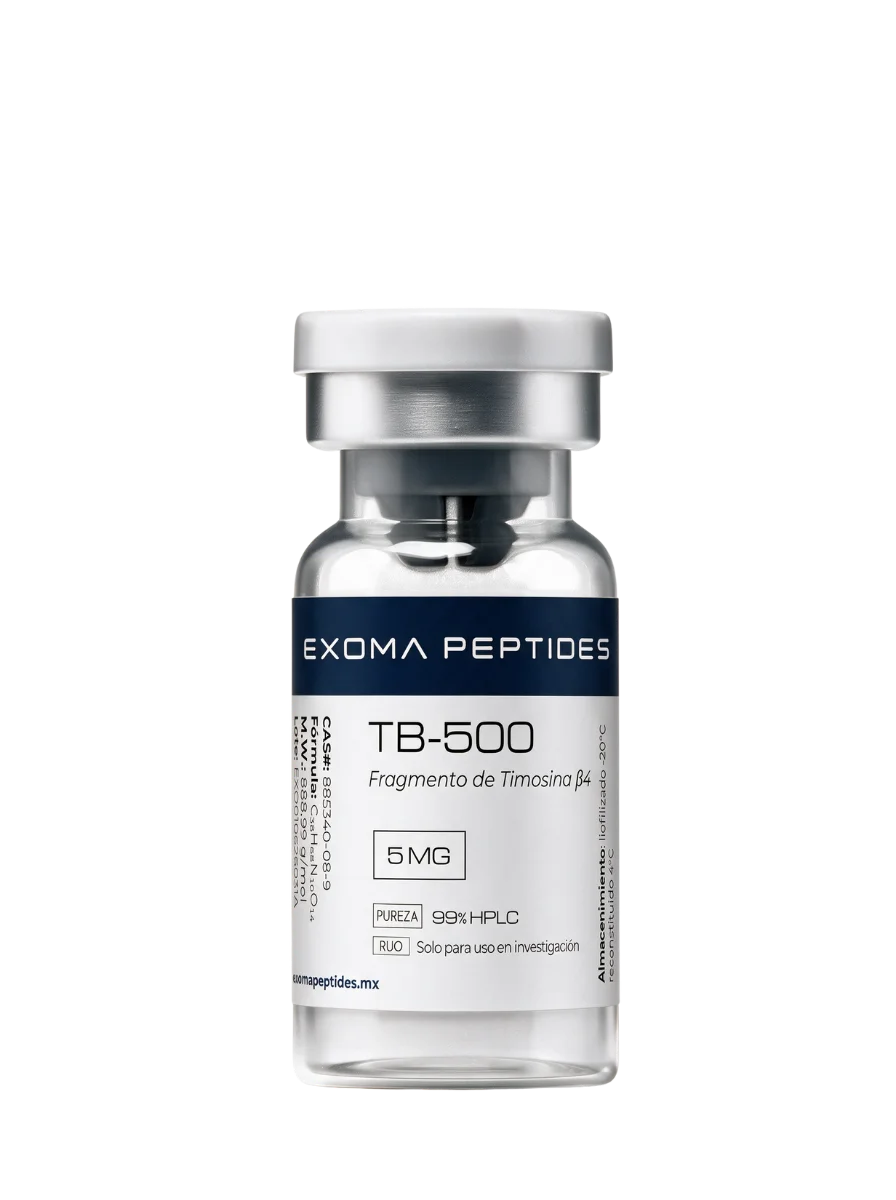
TB-500
TB-500 — research reagent (RUO). HPLC purity 99.3 % with COA per batch.
Technical data
- INN name
- Thymosin beta-4
- CAS
- 77591-33-4
- Molecular formula
- C212H350N56O78S
- Molecular weight
- 4963.44 g/mol
Sizes and prices: 5 mg $1,099 MXN ($220 MXN per mg) · 10 mg $1,190 MXN ($119 MXN per mg) · 20 mg $2,699 MXN ($135 MXN per mg).
Buy TB-500 in Mexico: order online with nationwide shipping in 1-4 business days depending on zone and tracking number. Prices in Mexican pesos. Material for research use only.
TB-500 is known internationally as Thymosin beta-4 (INN name in English). Buy Thymosin beta-4 in Mexico / buy Thymosin beta-4 in Mexico: research reagent (RUO) with HPLC purity with COA and nationwide shipping.
TB-500 is also searched as: Timosina beta 4, Tβ4, TB4.
Identity and composition
TB-500 is the synthetic fragment of amino acids 17–23 of Thymosin β4 humana (secuencia LKKTETQ), un heptapéptido de 889 Da que conserva la región biológicamente activa de la proteína parental, responsable de migración celular, angiogénesis y modulación de actina.
La Full-length Thymosin β4 (Tβ4) is a 44-amino-acid protein (4.9 kDa) widely distributed in human tissues, where it acts as main sequesterer of monomeric G-actin en células no musculares. TB-500 reproduce esta actividad central con un fragmento mínimo, simplificando la síntesis y reduciendo costos frente a la proteína recombinante completa.
Structure and properties:
- Linear heptapeptide, without disulfide bridges.
- Intermediate physicochemical stability (more sensitive than BPC-157 to extreme acidic pH).
- Moderate hydrophilicity, which facilitates aqueous reconstitution.
- No post-translational modifications required for activity.
Unlike full-length Tβ4, TB-500 lacks secondary binding sites (PINCH, ILK) and the C-terminal region involved in interactions with Von Willebrand factor, but the 17-23 fragment retains the central activity of G-actin binding and modulation of cell migration. Se utiliza exclusivamente como in vitro and in vivo research molecule en cicatrización, regeneración cardíaca experimental, neuroprotección y modulación de matriz extracelular. Sin aprobación regulatoria en ninguna jurisdicción.
Mechanism of action
El mecanismo de TB-500 se centra en la modulation of the actin cytoskeleton and of cell migration, with effects on angiogenesis and cell survival.
1. Sequestration of monomeric G-actin: binds with high affinity (~Kd 0.4–0.7 µM) to cytoplasmic G-actin, maintaining a monomeric pool available for rapid polymerization when the cell requires cytoskeletal reorganization (migration, division, phagocytosis). It is the central mechanism that distinguishes it from other regenerative peptides.
2. Promotion of cell migration: al modular la dinámica G-actina/F-actina, facilita la motilidad de células endoteliales (angiogénesis), queratinocitos (cierre de heridas), fibroblastos (remodelación de matriz), células progenitoras (reclutamiento a lesión) y cardiomiocitos progenitores (regeneración cardíaca experimental).
3. Angiogenesis: stimulates new vessels at injury sites, partially independent of VEGF (unlike BPC-157), with mobilization of circulating endothelial progenitors.
4. Modulation of inflammation: reduce citoquinas pro-inflamatorias (TNF-α, IL-6) en lesión aguda sin inmunosupresión sistémica; polariza macrófagos hacia fenotipo M2 (reparador).
5. Reduction of fibrosis: en modelos cardíacos y hepáticos atenúa el depósito excesivo de colágeno.
6. Activación de progenitores endógenos: en miocardio post-infarto sugiere reclutamiento de progenitores epicárdicos hacia linajes cardíacos.
7. Supervivencia: activa PI3K/Akt y modula Bcl-2, reduciendo apoptosis en cardiomiocitos isquémicos y neuronas.
Difference from BPC-157: BPC-157 modula VEGFR2/NO; TB-500 modula actina y migración. Convergen en cicatrización por mecanismos no superpuestos, base de su uso combinado.
Pharmacokinetics
Absorption: subcutaneous/intramuscular route with high systemic bioavailability (>70% estimated in rat); oral route very limited (degradation by GI peptidases), not used in practical research.
Distribution: broad tissue penetration after parenteral administration; preferential accumulation at sites of active injury (similar to BPC-157); moderate volume of distribution.
Plasma half-life: estimated at 2–3 hours in animal models, considerably longer than BPC-157 because of its size and sequence, which allows less frequent dosing (2–3 times/week in many protocols vs daily for BPC-157).
Metabolism: degradación proteolítica por peptidasas séricas a sus aminoácidos; sin metabolitos activos diferenciados identificados.
Elimination: renal predominante; aclaramiento moderado.
Serum stability: prolonged for a heptapeptide (>4 h in human serum in vitro), which facilitates its systemic action.
Tissue accumulation: studies with isotopically labeled peptide suggest prolonged retention in target tissues (>72 h) after parenteral administration, supporting spaced protocols.
PK linearity: aproximadamente lineal en el rango investigacional (0.5–10 mg) en modelos animales escalados.
Scientific evidence
The evidence comes mainly from preclinical models and from some limited human trials with recombinant Tβ4 (not specifically with the TB-500 fragment).
Skin healing:
- Malinda et al. (J Invest Dermatol 1999): Tβ4 acelera el cierre de heridas cutáneas en ratón.
- Sosne et al. (Exp Eye Res): cicatrización corneal acelerada y reducción de fibrosis.
- Phase II human trials with topical Tβ4 in chronic venous ulcers (RegeneRx Biopharmaceuticals): modest results.
Cardiac (the most studied area of Tβ4):
- Bock-Marquette et al. (Nature 2004): activation of embryonic cardiac programs in adult epicardium post-infarction.
- Smart et al. (Nature 2011): mobilization of epicardial progenitors toward cardiac lineages.
- Ensayos fase I/II en infarto agudo (TIME-1, TIME-2): seguridad establecida con Tβ4 IV, eficacia inconcluyente.
Corneal healing: Sosne et al. muestran que la aplicación tópica acelera la reparación de defectos epiteliales en modelos animales y humanos. Musculoskeletal: estudios preclínicos en lesión tendinosa y muscular con aceleración de reparación (datos de Tβ4 completa).
Neurological: Morris et al. (Neurobiol Aging 2010) reportan efectos neuroprotectores en Alzheimer experimental; en lesión medular, mejor recuperación motora en rata. Renal: protección frente a lesión renal aguda en nefropatía isquémica.
Limitations: most use complete recombinant Tβ4, not TB-500; human trials with pure TB-500 are scarce. Meta-analysis: reviews (Goldstein et al. 2012; Crockford et al. 2010) compile preclinical evidence of Tβ4 in multi-tissue regeneration.
Research applications
Aplicaciones documentadas en literatura preclínica y estudios con Tβ4 completa:
Cardiovascular (línea principal): reparación post-infarto (reducción de necrosis, activación de progenitores epicárdicos, mejora de fracción de eyección en modelos animales); protección frente a isquemia-reperfusión; atenuación del remodelado fibrótico.
Skin healing: úlceras crónicas (venosas, presión, diabéticas) en modelos y algunos ensayos humanos con Tβ4 tópica; heridas quirúrgicas con cierre acelerado y menor cicatriz hipertrófica; quemaduras de espesor parcial.
Ophthalmic: defectos epiteliales corneales (tópica, resultados favorables en modelos y ensayos humanos limitados); ojo seco severo; lesiones corneales químicas experimentales.
Musculoskeletal (sports research): tendinopatías y rupturas tendinosas experimentales; lesiones musculares por contusión o sobreuso; combinación con BPC-157 en cicatrización compleja.
Neurological: lesión medular traumática (recuperación motora parcial); trauma craneoencefálico (menor edema, mejor cognición); esclerosis múltiple experimental; neurodegeneración (Alzheimer, Parkinson experimentales).
Renal: nefropatía isquémica aguda; fibrosis renal crónica. Hepatic: atenuación de fibrosis por CCl4 o tioacetamida. Hematological: movilización de progenitores hematopoyéticos. General antifibrotic: aplicación transversal en múltiples órganos. Toda aplicación es strictly experimental.
Research protocols
Preclinical protocols vary by model; doses allometrically translated to the human equivalent are for reference only.
Typical preclinical doses with TB-500:
- Rat: 0.1–1 mg/kg, 2–3 times per week.
- Mouse: 0.2–2 mg/kg, 2–3 times per week.
- Rabbit, pig: cardiac protocols with full-length Tβ4 at 150–600 µg/kg.
Reference human equivalent (allometric scaling, factor 6.2 rat→human): ~2–5 mg/dose for a 70 kg adult.
Vías: subcutaneous (preferente sistémica); intramuscular (aceptable, cerca del sitio de lesión musculoesquelética); intravenosa (ensayos cardíacos con Tβ4 completa); topical (cicatrización cutánea y corneal); oral NO viable (degradación GI).
Frequency: loading 2–3 times/week for 4–6 weeks; maintenance once/week for an additional 4–8 weeks. The lower frequency than BPC-157 reflects its longer half-life.
Duration: lesión aguda 4–6 semanas; tendinopatías crónicas 8–12 semanas; estudios cardíacos largos individualizados.
Combinaciones: TB-500 + BPC-157 (the most documented, complementary mechanisms: migration + angiogenesis/wound healing); TB-500 + GHK-Cu (skin wound healing).
Monitoring: markers of wound healing in models; in hypothetical human research, complete blood count, hepatic/renal function, and preexisting oncological surveillance.
Reconstitution
Lyophilized TB-500 is reconstituted with bacteriostatic water (BAC) preferably, or sterile water for injection.
Procedimiento:
- Equilibrate vial and solvent to room temperature for 15 min.
- Clean the stopper with 70% isopropanol.
- Inject BAC slowly onto the side wall of the vial.
- Do not shake: swirl gently to dissolve in 1–2 min.
- La solución debe ser clear and colorless.
Reference concentrations:
5 mg vial:
- 1 mL BAC → 5 mg/mL (1 mg = 0.2 mL = 20 IU in a U-100 syringe)
- 2.5 mL BAC → 2 mg/mL (1 mg = 0.5 mL = 50 IU)
10 mg vial:
- 2 mL BAC → 5 mg/mL (1 mg = 0.2 mL = 20 IU)
- 5 mL BAC → 2 mg/mL (1 mg = 0.5 mL = 50 IU)
20 mg vial:
- 4 mL BAC → 5 mg/mL
- 5 mL BAC → 4 mg/mL (1 mg = 0.25 mL = 25 IU)
60 mg vial:
- 6 mL BAC → 10 mg/mL (1 mg = 0.1 mL = 10 IU). Consider increasing viscosity >10 mg/mL.
Syringe: U-100 insulin 0.5–1 mL, 29–31G × 8–13 mm needle.
Subcutaneous route: any area with adipose tissue, rotating sites; in musculoskeletal studies administration near the injury site is documented.
Calculation: volume (mL) = dose (mg) / concentration (mg/mL).
Stability and storage
Sealed lyophilized vial: store at 2–8 °C; stability up to 24 months according to the manufacturer; transient tolerance to room temperature for up to 30 days without significant functional loss; protect from light.
Vial reconstituted with BAC: store at strict 2–8 °C; stability 28 days preserving biological activity >90%; some studies suggest extension up to 6 weeks with rigorous aseptic handling. Do not freeze (microcrystals may compromise activity); protect from light.
Reconstituido con agua estéril sin conservador: uso inmediato o dentro de 24 h refrigerado.
Acid stability: menor que BPC-157; no viable la vía oral. Thermal resistance: tolera hasta 40 °C transitorias sin degradación significativa documentada.
Degradation indicators: turbidez, precipitado, partículas, cambio de color u olor anómalo → descartar.
Transport/alícuotas: cold gel pack for short shipments; the lyophilizate tolerates 48–72 h up to 25 °C. Aliquots at -20 °C possible with a single freeze-thaw. HPLC purity: idealmente >99%.
Safety profile
TB-500 exhibits a favorable preclinical safety profile, although systematic human evidence is limited (mainly extrapolated from trials with full-length Tβ4).
Acute and subchronic toxicity: in rat and mouse at doses up to 100× the effective one for 30 days, with no significant histopathological, biochemical, or hematological alterations reported. LD50 not established; extreme suprapharmacological doses do not produce lethality in the available models.
Human trials with full Tβ4 (TIME-1, TIME-2): establecieron seguridad de Tβ4 IV en pacientes post-infarto, sin eventos adversos graves atribuibles; datos extrapolables parcialmente a TB-500.
Genotoxicity: negative Ames test for Tβ4. Carcinogenicity: sin estudios formales a 2 años con TB-500; la actividad pro-angiogénica genera theoretical concern en neoplasia preexistente o predisposición tumoral, aunque sin reportes preclínicos de inducción tumoral.
Injection site reactions: occasional, mild and self-limiting. Hypersensitivity: rare (peptide of human origin). Cardiovascular: sin alteración significativa de presión arterial ni frecuencia cardíaca. Coagulation: sin efectos pro-trombóticos ni hemorrágicos relevantes. Hepatic/renal function: no alteration in available studies. Reproduction: datos muy limitados; uso desaconsejado en embarazo/lactancia.
Preocupaciones en humanos: carga oncológica preexistente (actividad angiogénica y de movilización de progenitores); ausencia de ensayos modernos con TB-500 puro (perfil humano específico no establecido); purity variability among unregulated suppliers. WADA: prohibido desde 2013 (hormona y modulador metabólico). Recomendación: monitoreo hematológico, función hepática/renal y exclusión de neoplasia activa o reciente.
Comparative context
vs BPC-157: mecanismo — TB-500 modula actina-G/migración, BPC-157 modula VEGFR2/NO/cicatrización; vida media — TB-500 ~2-3 h plasmática, BPC-157 ~30-60 min; frecuencia — TB-500 2-3 veces/semana, BPC-157 diaria; oral — BPC-157 viable, TB-500 NO; ambos en regeneración tisular, frecuentemente combinados por complementariedad.
vs full Thymosin β4: TB-500 is fragment 17-23 of Tβ4 (44 aa) and retains the core G-actin-binding activity, but lacks the secondary sites (PINCH, ILK); full-length Tβ4 is the one used in formal clinical trials (TIME-1, TIME-2); TB-500 is cheaper and simpler to synthesize.
vs growth factors (recombinant PDGF, VEGF): TB-500 does not generate uncontrolled proliferation in healthy tissue; it modulates endogenous cytoskeletal dynamics rather than substituting exogenously; it is more stable and cheaper.
vs GHK-Cu: GHK-Cu enfocado en cicatrización cutánea/matriz (expresión génica); TB-500 en migración celular sistémica; combinables en dermatología. vs IGF-1 LR3: IGF-1 LR3 anabólico potente con riesgo mitogénico; TB-500 no es anabólico ni mitogénico directo. Ventaja de TB-500: breadth of applications and prolonged half-life. Disadvantage: ausencia de ensayos humanos modernos con el fragmento puro.
History and development
TB-500 derives from work on Thymosin β4, a protein identified in the 1960s by Allan Goldstein and collaborators at the Albert Einstein College of Medicine (New York) as a component of thymic extracts with immunomodulatory activity.
Hitos:
- 1960s: identificación de la familia timosina en extractos tímicos.
- 1981: caracterización de la Tβ4 completa (Low et al.).
- 1990s: identification of the 17-23 region as the core active domain for G-actin binding.
- 1999: Malinda et al. demonstrate accelerated wound healing with Tβ4.
- 2004: Bock-Marquette et al. (Nature) publish activation of cardiac embryonic programs by Tβ4.
- 2005–2015: desarrollo clínico de Tβ4 completa por RegeneRx Biopharmaceuticals.
- 2013: WADA adds TB-500 to the prohibited list for competitive sport.
Regulatorio: TB-500 sin aprobación de ninguna autoridad (FDA, EMA, COFEPRIS, PMDA, MHRA) for human use; full-length Tβ4 completed phase II in myocardial infarction, corneal ulcer, and dermal wound healing without commercial approval. Uso veterinario: documented in equine and canine medicine for musculoskeletal injuries before strict anti-doping regulations. Patents: the peptide is not protected (fragment of a published protein). Available as a research reagent.
FAQ
What is the difference between TB-500 and full Thymosin β4?
TB-500 is the synthetic fragment of amino acids 17-23 of Thymosin β4 (a 44-amino-acid protein). TB-500 retains the central G-actin-binding region responsible for the main activity on cell migration, but lacks the secondary sites of the complete protein (PINCH, ILK, C-terminal domain). It is more economical and simpler to synthesize.
Why is it frequently combined with BPC-157?
The mechanisms are complementary and not overlapping: BPC-157 acts on angiogenesis (VEGF-R2/NO) and trophic wound-healing cascades; TB-500 acts on G-actin dynamics, favoring cell migration and cytoskeletal reorganization. The combination covers multiple phases of the repair process.
Why is it not administered orally?
TB-500 lacks the exceptional acid stability that BPC-157 has. Degradation by gastrointestinal peptidases and the low absorption of the intact peptide make the oral route not functionally useful. The subcutaneous or intramuscular route are the preferred ones in research.
Why is the dosing less frequent than BPC-157?
TB-500 has a plasma half-life of 2-3 hours (vs 30-60 min of BPC-157) and prolonged tissue retention (>72 h at injury sites). This allows protocols of 2-3 times per week, while BPC-157 typically requires daily dosing to maintain effects.
Does it have clinical trials in humans?
TB-500 specifically has no modern published clinical trials with rigorous methodology. Complete Thymosin β4 did complete phase II trials in myocardial infarction (TIME-1, TIME-2), corneal ulcer and dermal wound healing, establishing safety but without reaching commercial approval.
What is the angiogenic risk in cancer patients?
TB-500 has documented pro-angiogenic activity and modulates cell migration, which generates theoretical concern in patients with preexisting neoplasia or tumor predisposition. There are no preclinical reports of tumor induction, but given the absence of formal studies its use in patients with active cancer is considered contraindicated as a precaution.
Why is it banned by WADA?
WADA has included TB-500 on the prohibited list since 2013 under category S2 (peptide hormones, growth factors and related substances), for its potential to accelerate injury recovery and modulate tissue growth, which would constitute an undue advantage in competitive sport.
How is the human equivalent dose calculated from animal models?
By means of allometric scaling by body surface area: factor 6.2 for rat→human. A typical preclinical dose of 0.5 mg/kg in the rat corresponds referentially to ~80 µg/kg in the human (~5.6 mg for 70 kg). The extrapolation is approximate and only indicative for investigational protocols.
How long does a reconstituted vial last?
28 days refrigerated at 2-8 °C with BAC as solvent, preserving biological activity >90%. Some studies suggest extension to 6 weeks with rigorous aseptic handling. Without BAC (plain sterile water), use within 24 hours refrigerated.
Is its long-term use safe?
Subchronic toxicity in animal models up to 30 days at doses well above the effective one shows no significant alterations. However, there are no formal chronic toxicity (6-12 months) or 2-year carcinogenicity studies with pure TB-500. Prolonged use in research should include hematological monitoring, hepatic/renal function, and oncological surveillance.
Customer reviews
Average rating: 4.9 out of 5, based on 17 customer ratings.
Javier B. — 5/5
I took advantage of the double-pack promo and it works out quite well. Zero discomfort on application.
Mariana M. — 5/5
Excellent product, the TB-500. The package arrived very well sealed and protected.
Carlos M. — 4/5
Good service overall. The TB-500 took one extra day than expected due to the courier, but the product arrived in perfect condition.
Gonzalo H. — 5/5
Shipments via DHL always arrive super on time. All ok.
Valeria R. — 5/5
Excellent service with the TB-500. Everything in order.
Bruno C. — 5/5
Very good TB-500, it arrived super well protected against impacts. The payment by transfer was confirmed within a few minutes.
Mane G. — 5/5
Arrived super fast to my home in Toluca.
Nestor D. — 5/5
The best value for money in Mexico.
Noe G. — 5/5
Good after-sales service. They clarified for me how to reconstitute.
Nico H. — 5/5
It arrived super fast to Hermosillo. Everything excellent.
Norberto P. — 5/5
Prompt courier delivery in 48 hours.
Valeria R. — 5/5
Everything excellent with the TB-500. The packaging was very well protected and discreet.
Nidia L. — 5/5
Delivered on time and correctly in San Luis.
Vanessa L. — 5/5
It arrived a couple of days earlier than expected and comes with its certificate accessible via QR. Very satisfied.
Silvia G. — 5/5
A trustworthy product. Always a good experience buying here.
Felipe H. — 5/5
The 20mg version offers a better price per mg. Same quality.
Certificate of analysis per batch
TB-500 lots with certificate of analysis published in the COA catalog:
- Lot EXO010626031A — 5 mg, issued 2026-05-30
- Lot EXO010626031C — 10 mg, issued 2026-05-30
Scientific references (7)
Peer-reviewed literature on TB-500, with its PubMed identifier when available:
- Thymosin β4: a multi-functional regenerative peptide. Basic properties and clinical applications (Goldstein AL, et al. · Expert Opinion on Biological Therapy · 2012) — Review of thymosin beta-4 (TB-500) in tissue repair and regenerative medicine. PMID 22074294.
- Thymosin β4 activates ILK and promotes cardiac migration, survival, and repair (Bock-Marquette I, Saxena A, White MD, et al. · Nature · 2004) — Study in murine infarction models demonstrating that Tβ4 activates integrin-linked kinase and promotes cardiomyocyte survival. PMID 15565145.
- Thymosin β4 accelerates wound healing (Malinda KM, Sidhu GS, Mani H, et al. · Journal of Investigative Dermatology · 1999) — Study in rat dermal wound-healing models, evaluating topical and systemic application of Tβ4. PMID 10469335.
- Thymosin beta 4 promotes corneal wound healing and decreases inflammation in vivo following alkali injury (Sosne, et al. · Experimental Eye Research · 2002) PMID 11950239.
- A randomized, placebo-controlled, single and multiple dose study of intravenous thymosin beta4 in healthy volunteers. (Ruff D, et al. · Ann N Y Acad Sci · 2010) PMID 20536472.
- The effect of thymosin treatment of venous ulcers. (Guarnera G, et al. · Ann N Y Acad Sci · 2010) PMID 20536470.
- Thymosin beta-4 and venous ulcers: clinical remarks on a European prospective, randomized study on safety, tolerability, and enhancement on healing. (Guarnera G, et al. · Ann N Y Acad Sci · 2007) PMID 17495250.
Full scientific profile: TB-500 in the compendium — mechanism of action, studies and technical data sheet.
See the full category catalog: Recovery · Longevity.
Otras presentaciones de TB-500
Guides and articles about TB-500
Lecturas del blog de EXOMA que la editorial asoció a este compuesto: