
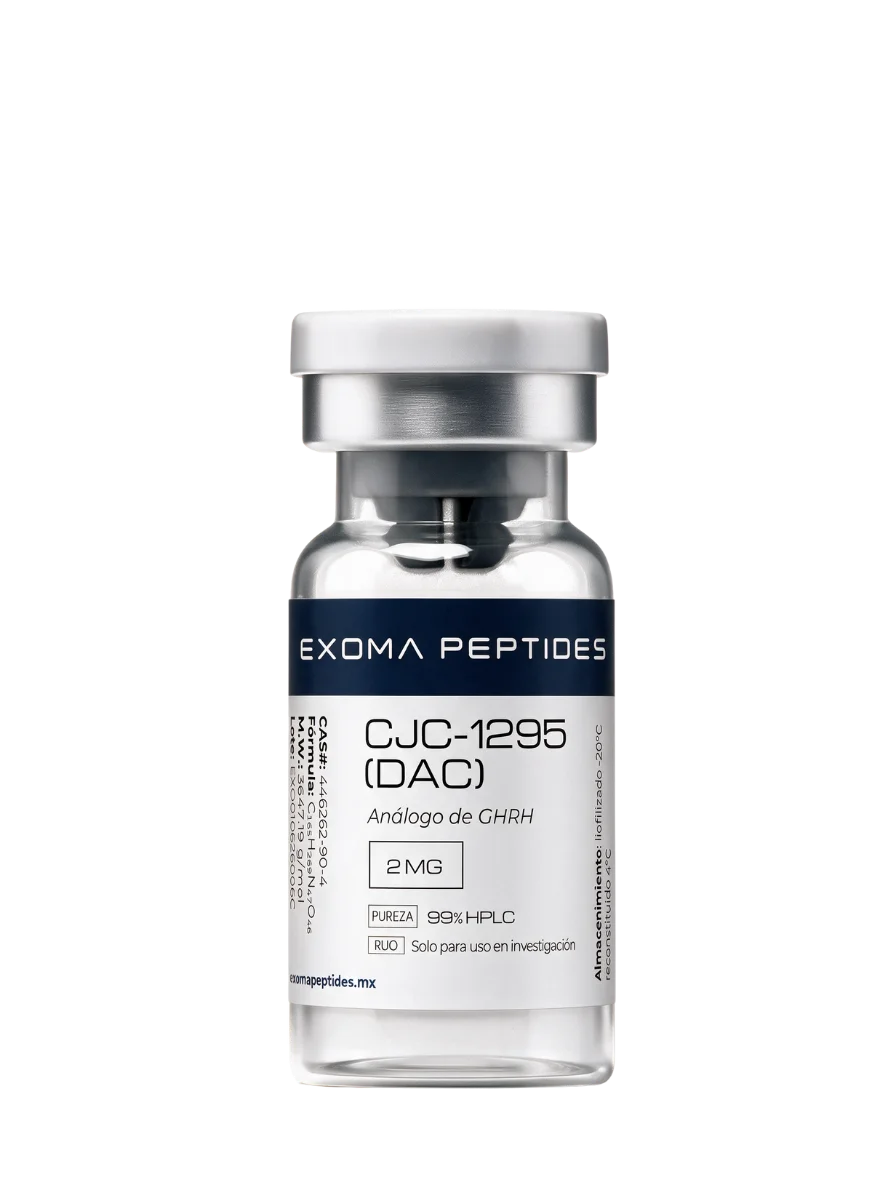
CJC-1295 (DAC)
CJC-1295 (DAC) — research reagent (RUO). COA per batch available.
Technical data
- Development code
- CJC-1295
- CAS
- 446262-90-4
- Molecular formula
- C165H269N47O46
- Molecular weight
- 3647.25 g/mol
Sizes and prices: 2 mg $899 MXN ($450 MXN per mg) · 5 mg $1,600 MXN ($320 MXN per mg) · 10 mg $2,940 MXN ($294 MXN per mg).
Buy CJC-1295 (DAC) in Mexico: order online with nationwide shipping in 1-4 business days depending on zone and tracking number. Prices in Mexican pesos. Material for research use only.
CJC-1295 (DAC) is also searched as: CJC-1295 with DAC, DAC:GRF, CJC-1295.
Identity and composition
CJC-1295 with DAC (Drug Affinity Complex) is a 30-amino-acid synthetic peptide derived from the first 29 of human GHRH, with four structural modifications (D-Ala²-Gln⁸-Ala¹⁵-Leu²⁷-GHRH) identical to the version without DAC, plus a maleimidopropionyl chain (MPA) covalently bound to the C-terminal Lys30 residue.
DAC Technology: the MPA chain reacts specifically with a free cysteine residue of the human serum albumin (Cys34), forming an irreversible covalent thioether bond. This turns the peptide into a peptide-albumin conjugate with a half-life of ~7 days (vs ~30 min de la versión Sin DAC).
Structure and properties:
- Molecular mass: 3,647.31 Da (peptide + MPA linker).
- Conjugated to albumin (66 kDa), effective mass ~70 kDa.
- High aqueous solubility; irreversible conjugation with albumin in vivo (10–30 min post-administration).
Pharmacodynamic difference with No DAC:
- Without DAC: discrete GH pulses (3–10× baseline), physiological pattern, preserved circadian rhythm.
- With DAC: sustained and "flattened" elevation of GH/IGF-1 (2–4× baseline continuous), a non-physiological pattern, altered circadian rhythm.
Esta diferencia es clínicamente significativa: el patrón sostenido puede inducir desensibilización del GHRHR y supresión del eje endógeno. CJC-1295 DAC fue la versión desarrollada por ConjuChem en programas fase I/II (lipodistrofia HIV, deficiencia parcial de GH del adulto); el desarrollo se suspendió alrededor de 2010. Se utiliza exclusivamente como research molecule en estudios del eje somatotropo de larga duración.
Mechanism of action
CJC-1295 DAC is a long-acting agonist of the GHRH receptor (GHRHR), with a molecular mechanism identical to No DAC but a radically different temporal pattern.
Molecular cascade (idéntica a Sin DAC):
- Conjugación con albúmina → "prodroga" circulante.
- Gradual release of active peptide (slow turnover).
- Unión al receptor GHRHR en somatotropas hipofisarias.
- Activación de Gs → cAMP → PKA → CREB.
- Transcripción GH1 y liberación de gránulos GH.
- GH plasmática elevada de forma sostenida → IGF-1 hepática (JAK2/STAT5).
Temporal release pattern:
- Initial elevation of GH at 6–24 h post-administration, sustained for 5–8 days.
- Loss of physiological pulsatility: GH 2–4× over baseline continuously, without discrete pulses.
- IGF-1 alcanza meseta a 48–72 h y se mantiene toda la semana.
Consecuencias del patrón no-pulsátil:
- Desensibilización del GHRHR: la estimulación crónica regula a la baja expresión y sensibilidad del receptor.
- Suppression of the endogenous axis: la elevación sostenida de IGF-1 aumenta somatostatina hipotalámica y reduce sensibilidad GHRH hipofisaria.
- "Exogenous GH-like" pattern: more closely resembles direct GH injection than the pulsatile pattern.
- Loss of circadian advantages: the nocturnal GH pulse is lost, with consequences for sleep architecture.
Synergy with GHRP: the combination with ghrelin secretagogues (Ipamorelin, GHRP-2/6) no es recomendable con la versión DAC: la elevación sostenida de GHRH satura el sistema y no aporta el efecto pulsátil sinérgico de Sin DAC.
Sustained physiological effects:
- IGF-1 elevated 30–80% over baseline throughout the week.
- Lipólisis sostenida y síntesis proteica incrementada.
- Mayor riesgo de retención hídrica y parestesias.
Pharmacokinetics
Absorption:
- Subcutaneous: biodisponibilidad alta (>70% estimado).
- Conjugation with albumin within 10–30 min post-administration.
Distribution: conjugado a albúmina (66 kDa), se distribuye siguiendo la cinética de la albúmina endógena; volumen de distribución ~10 L.
Plasma half-life: 6–8 days (~7 days), determined by the half-life of human albumin (19-21 days) and the turnover of the thioether bond.
Steady state: reached in 2–3 weeks de dosificación semanal.
Metabolism: the conjugate is catabolized together with albumin through FcRn-mediated endocytosis and lysosomal degradation, releasing active peptide and albumin fragments.
Elimination: renal predominante (fragmentos peptídicos).
Duration of the biological effect:
- Detectable GH elevation: 5–8 days.
- Sustained elevation of IGF-1: 7–10 days (plateau at 48–72 h).
- Progressive accumulation over the first 2–3 weeks.
Dosing frequency: 1 vez/semana es el esquema estándar; genera elevación sostenida sin pulsos.
PK linearity: approximately linear over the documented 30–2,000 µg weekly range.
Scientific evidence
The evidence on CJC-1295 DAC is mainly from phase I/II y preclinical models by ConjuChem, before the clinical program was discontinued.
Phase I/II clinical studies (ConjuChem):
- Teichman et al. (J Clin Endocrinol Metab 2006): caracterización en humanos sanos; elevación sostenida de GH (~2-3× basal) e IGF-1 (~1.5-2× basal) durante 7-14 días post-dosis única (60-250 µg/kg).
- Fase II en lipodistrofia HIV: modest reduction of visceral fat in small uncontrolled studies; insufficient for phase III.
- Fase II en deficiencia parcial GH del adulto: variable response, without clear superiority over recombinant GH or Sermorelin.
- ConjuChem suspendió el desarrollo clínico alrededor de 2010.
Animal models:
- Rata: incremento sostenido de IGF-1 y mejora de composición corporal en dosificación semanal × 8 semanas.
- Cerdo: mejora de composición de carcasa (contexto agropecuario).
Pharmacodynamic characterization: estudios neuroendocrinológicos confirman la pérdida de pulsatilidad GH con dosificación crónica; comparativas head-to-head con Sin DAC demuestran diferencia clara de patrón temporal.
Tejido adiposo: reducción de grasa visceral consistente en estudios pequeños humanos y animales, por lipólisis sostenida mediada por GH.
Limitations: the discontinuation of the program left the evidence truncated at phase II; the phase III trials were never conducted and current use is mostly as a research reagent.
Research applications
Applications documented in research:
Eje somatotropo (línea principal original):
- Models of adult partial GH deficiency.
- Studies of somatotropic aging (somatopause).
- Respuesta IGF-1 a estimulación sostenida vs pulsátil.
Body composition:
- Reducción de grasa visceral (fase II en lipodistrofia HIV).
- Increase in lean mass; experimental geriatric sarcopenia.
Healing and regeneration (research):
- Mediada por elevación sostenida de IGF-1 (modelos cutáneo, óseo, muscular).
Fragilidad geriátrica (preclínica): partial restoration of muscle mass and bone density in murine models.
Lipodistrofia experimental: associated with HIV/HAART (ConjuChem program) and congenital/acquired.
NOT recommended applications:
- Combinación con GHRP (Ipamorelina, GHRP-2/6): la elevación sostenida no se beneficia de estímulos pulsátiles.
- Uso paralelo con Sin DAC o Tesamorelina: redundante.
Vías: subcutánea (estándar); intramuscular (aceptable).
Consideraciones DAC: preferred for protocols seeking continuous elevation of GH/IGF-1 (senescence, experimental lipodystrophy); NOT for sports research where physiological pulsatility is sought (there Without DAC + Ipamorelin is preferable). All applications remain strictly investigational; no use has been approved for human therapeutics.
Research protocols
Los protocolos en literatura preclínica siguen un esquema semanal owing to the extended half-life.
Typical doses (research):
- 1,000–2,000 µg (1–2 mg) por dosis subcutánea, 1 vez/semana.
Most documented regimen: 2 mg weekly:
- Mismo día y hora cada semana, subcutánea (abdomen, muslo, deltoides), rotando sitios.
Alternative regimen: 1 mg twice weekly (every 3–4 days): useful for reaching steady state faster or reducing plasma peaks.
Loading scheme: 2 mg semanal × 2 semanas inicial, luego 1 mg semanal de mantenimiento.
Duration:
- Corta: 8–12 semanas.
- Prolongada: 12–24 semanas con seguimiento de IGF-1 cada 4 semanas.
- Typical cycling: 8-12 weeks on / 4 weeks off to mitigate desensitization of the GHRHR.
Do NOT combine with: GHRP (sinergia mínima por saturación), Sin DAC, Tesamorelina o Sermorelin (redundante).
Animal models (scaling):
- Rat: 50–200 µg/kg weekly.
- Mouse: 100–400 µg/kg weekly.
Monitoring:
- IGF-1 basal, a 2-4 semanas (meseta) y mensual.
- Glucemia y HbA1c (GH contrarregulador insulínico), función tiroidea, presión arterial (retención hídrica), composición corporal por DXA en estudios prolongados.
Timing: no crítico respecto a comidas dado el patrón sostenido (a diferencia de Sin DAC, que requiere ayuno).
Reconstitution
Lyophilized CJC-1295 DAC is reconstituted with bacteriostatic water (BAC) preferably.
Standard procedure:
- Equilibrate vial and solvent to room temperature for 15 min.
- Clean the stopper with 70% isopropanol.
- Inject BAC slowly onto the side wall of the vial.
- Do not shake: swirl gently to dissolve in 1–2 min.
- Solución debe ser clear and colorless.
Reference concentrations:
2 mg vial:
- 1 mL BAC → 2,000 µg/mL (1 mg = 0.5 mL = 50 IU in a U-100 syringe)
- 2 mL BAC → 1,000 µg/mL (1 mg = 1 mL = 100 IU)
5 mg vial:
- 1 mL BAC → 5,000 µg/mL (1 mg = 0.2 mL = 20 IU)
- 2.5 mL BAC → 2,000 µg/mL (1 mg = 0.5 mL = 50 IU)
- 5 mL BAC → 1,000 µg/mL (1 mg = 1 mL = 100 IU)
Syringe: insulina U-100 de 0.5–1 mL, aguja 29–31G × 8 mm. Route: subcutánea estricta (abdomen, muslo, deltoides), rotando sitios. Dose calculation: volume (mL) = dose (µg) / concentration (µg/mL).
NO mezclar en la misma jeringa with other peptides in prolonged storage: the MPA chain can react with free cysteines of other peptides, compromising activity. If co-administration is required (not recommended), use separate syringes or sites.
Stability and storage
Sealed lyophilized vial:
- Conservación: 2–8 °C, protegido de luz. Estabilidad hasta 24 meses según fabricante.
- Transient tolerance to room temperature: up to 30 days.
Vial reconstituted with BAC:
- Strict storage at 2–8 °C; stability 14–21 days (the MPA chain is relatively stable in solution). Do not freeze; protect from light.
Reconstituido con agua estéril sin conservador: uso inmediato o dentro de 24 h refrigerado.
Chemical sensitivity: optimal pH 5–7; accelerated degradation at alkaline pH. The maleimide group of the MPA can react with free cysteines in solution (other peptides, contaminants); keep the vial sterile.
Thermal sensitivity: transiently tolerates up to 25 °C; prolonged exposure degrades the MPA linker.
Degradation indicators: turbidez, partículas o cambio de color → descartar.
Frozen aliquots: possible at -20 °C in individual vials; a single freeze-thaw. Once bound to albumin in vivo, the stability of the conjugate is very high (days-weeks), which supports the prolonged half-life.
Safety profile
CJC-1295 DAC presents a profile similar to Without DAC but with mayor riesgo de eventos por elevación sostenida de GH/IGF-1.
Common adverse events (mild, transient):
- Facial flushing: common post-dose.
- Sensación de calor u "hormigueo": frecuente.
- Mild headache: 10–15%.
- Injection-site reactions: 5–10%.
- Dizziness, transient drowsiness.
Eventos por elevación sostenida GH/IGF-1 (more frequent than with No DAC):
- Water retention significant, especially the first 2–4 weeks; mild peripheral edema.
- Paresthesias in hands (túnel carpiano funcional): frecuente con dosis altas o uso prolongado.
- Arthralgia ocasionales, dosis-dependientes.
- Hyperglycemia: GH contrarregulador insulínico; vigilancia en diabéticos.
- Functional insulin resistance (aumento de HOMA-IR) en uso prolongado.
Infrequent events: ginecomastia (rare, more frequent than with without DAC), alteration of the thyroid axis (monitoring >8 weeks) and of the cortisol axis.
Preocupaciones específicas de DAC:
- Higher theoretical oncological risk: la elevación sostenida (vs pulsátil) se asocia con mayor riesgo proliferativo in vitro y observacional.
- Suppression of the endogenous axis por dosificación crónica; posible deficiencia funcional al suspender.
- Loss of circadian architecture del sueño.
Absolute contraindications: active neoplasia or recent oncological history (stricter than without DAC), poorly controlled diabetes, proliferative retinopathy, decompensated heart failure, pregnancy, lactation, minors.
Relative contraindications: túnel carpiano preexistente, trastornos tiroideos, hipertensión no controlada, insuficiencia hepática/renal.
Interactions: glucocorticoides (reducen respuesta GH); insulina/antidiabéticos (ajuste por efecto contrarregulador); anticoagulantes (precaución por unión a albúmina).
WADA status: prohibido en deportes competitivos desde 2008, categoría S2. HPLC purity: idealmente >99%.
Comparative context
vs CJC-1295 Without DAC (main comparison):
- DAC: vida media ~7 días, dosificación semanal, patrón sostenido no fisiológico. Sin DAC: ~30 min, 1-3×/día, patrón pulsátil fisiológico.
- DAC: greater sustained absolute elevation of IGF-1; without DAC: higher but transient GH pulses and with less suppression of the axis.
- DAC: greater fluid retention and paresthesias; without DAC: milder adverse effects but requires multiple daily injections.
vs Tesamorelin: half-life ~30 min (pattern like without DAC); FDA-approved for HIV lipodystrophy (the only approval of a GHRH analog). DAC never reached approval.
vs direct recombinant GH: exogenous GH (half-life 3-6 h, daily injection) fully suppresses the axis; DAC stimulates endogenous production but suppresses it partially, intermediate between without DAC and direct GH.
vs IGF-1 LR3: acts directly on IGF-1 receptors (greater mitogenic potency and risk); DAC acts upstream. vs MGF: variante de IGF-1 con efectos locales, mecanismo distinto.
Practical recommendation: without DAC + Ipamorelin is preferred over DAC for most contemporary protocols because of its better safety profile and more physiological pattern.
History and development
CJC-1295 DAC was developed by ConjuChem Biotechnologies (Montreal, Quebec, Canada) applying its proprietary DAC (Drug Affinity Complex) technology to extend the half-life through irreversible covalent conjugation to serum albumin.
Chronological milestones:
- ~2000: ConjuChem identifica modificaciones GHRH (D-Ala²-Gln⁸-Ala¹⁵-Leu²⁷) resistentes a DPP-4.
- 2003: síntesis y caracterización de CJC-1295 con DAC; estudios fase I en humanos sanos hasta 2006.
- 2006: publication by Teichman et al. (J Clin Endocrinol Metab) on PK/PD.
- 2006–2009: fase II en lipodistrofia HIV y deficiencia parcial GH del adulto.
- 2008: WADA incluye CJC-1295 (DAC y Sin DAC) en la lista prohibida.
- 2010: ConjuChem halts clinical development; the company is sold and the programs are discontinued.
Razones de suspensión: resultados fase II modestos, competencia de Tesamorelina (aprobada FDA 2010) y GH recombinante, preocupaciones por el patrón no-fisiológico y costos vs mercado limitado.
Regulatory context: no cuenta con aprobación de ninguna autoridad (FDA, EMA, COFEPRIS) for human use; WADA has banned it since 2008. The DAC technology was patented by ConjuChem; its expiration allowed generic production as a research reagent.
FAQ
What is the main difference from CJC-1295 No-DAC?
The presence of the maleimidopropionyl (MPA) chain that covalently binds to serum albumin, extending the half-life from ~30 minutes (without DAC) to ~7 days (DAC). This radically changes the temporal pattern: without DAC generates discrete physiological GH pulses; DAC produces a sustained and flattened NON-physiological elevation of GH/IGF-1. Without DAC preserves pulsatility; DAC suppresses it.
Why is it recommended less than the No-DAC version?
The non-pulsatile pattern of DAC produces greater desensitization of the GHRHR receptor, partial suppression of the endogenous axis, greater fluid retention, greater risk of paresthesias, and greater theoretical oncological concern (the sustained vs. pulsatile elevation of GH/IGF-1 is associated with greater proliferative risk in models). Without DAC + Ipamorelin is preferred for most modern protocols.
How many times a week is it administered?
Once per week is the standard schedule. The ~7-day half-life allows weekly dosing while maintaining sustained levels. Some protocols use twice-weekly dosing (every 3-4 days) with 1 mg to reach steady state faster or reduce plasma peaks. More frequent dosing provides no additional benefit and only increases accumulation.
Can I combine it with Ipamorelin as with the No DAC version?
It is NOT recommended. The sustained GHRH elevation already saturates the somatotropic system, and the addition of Ipamorelin does not provide the synergistic pulsatile effect observed with No DAC + Ipamorelin. For protocols seeking GHRH+GHRP synergy, use No DAC. For sustained-elevation protocols, use DAC alone.
When is steady state reached?
Approximately between weeks 2-3 of regular weekly dosing. During the first 2-3 weeks there is a progressive accumulation of plasma GH/IGF-1. Afterward a plateau is reached. Any dose adjustment takes ~2 weeks to be fully reflected in plasma levels.
Does it suppress my endogenous GH production?
Yes, partially. Unlike Without DAC, which preserves endogenous pulsatility, the sustained elevation of IGF-1 induced by DAC generates significant negative feedback on the hypothalamus (increases somatostatin) and pituitary (reduces GHRHR sensitivity). The pattern more closely resembles exogenous GH than physiological stimulation. Upon discontinuation there may be transient functional deficiency.
How long does a reconstituted vial last?
14-21 days refrigerated at 2-8 °C with BAC as solvent, preserving activity. The MPA chain is chemically reactive (it can bind to free cysteines from contaminants), so strict aseptic handling is required. Without BAC (plain sterile water), use within 24 hours refrigerated.
Why does it cause more water retention than the No DAC version?
Sustained elevation of GH/IGF-1 stimulates renal tubular reabsorption of sodium and water continuously, generating cumulative fluid retention. Without DAC, the discrete pulses allow a return to baseline between doses. With DAC, the continuous elevation maintains the retentive stimulus constantly, especially during the first 2-4 weeks until partial adaptation.
Is it prohibited in sports?
Yes. WADA has included CJC-1295 (DAC and Without DAC) on the list of prohibited substances since 2008 under category S2 (peptide hormones, growth factors and related substances). Its use is prohibited at all times (not only in competition) in athletes regulated by the WADA code.
Does it carry a higher oncological risk than DAC-free?
Theoretically yes, although without formal comparative studies. Sustained (non-pulsatile) elevation of GH/IGF-1 is associated with greater proliferative risk in in vitro models and observational studies of acromegaly. As a precaution, its contraindication in patients with active neoplasia or a recent oncological history is stricter than with Without DAC. Without DAC is preferred if there is any oncological concern.
Customer reviews
Average rating: 4.7 out of 5, based on 6 customer ratings.
Silvia T. — 5/5
The CJC-1295 (DAC) arrived impeccable. Very happy with the punctuality of delivery.
Eduardo R. — 5/5
The DAC version is more convenient due to its long half-life.
Mauricio V. — 4/5
The CJC-1295 (DAC) arrived fine, it took one extra day due to the courier but the product comes complete and sealed.
Raúl C. — 4/5
Meets expectations. Good documentation.
Arturo P. — 5/5
The CJC-1295 (DAC) arrived in perfect condition. The package was very discreet and secure. Highly recommended.
Certificate of analysis per batch
CJC-1295 (DAC) batches with certificate of analysis published in the COA catalog:
- Lot EXO010626006A — 5 mg, issued 2026-05-28
- Lot EXO010626006B — 10 mg, issued 2026-05-30
- Lot EXO010626006C — 2 mg, issued 2026-05-30
Scientific references (4)
Peer-reviewed literature on CJC-1295 (DAC), with its PubMed identifier where available:
- Human Growth Hormone-Releasing Factor (hGRF)1-29-Albumin Bioconjugates Activate the GRF Receptor on the Anterior Pituitary in Rats: Identification of CJC-1295 as a Long-Lasting GRF Analog (Jetté, et al. · Endocrinology · 2005) PMID 15817669.
- Prolonged Stimulation of Growth Hormone (GH) and Insulin-Like Growth Factor I Secretion by CJC-1295, a Long-Acting Analog of GH-Releasing Hormone, in Healthy Adults (Teichman, et al. · Journal of Clinical Endocrinology & Metabolism · 2006) PMID 16352683.
- Pulsatile Secretion of Growth Hormone (GH) Persists during Continuous Stimulation by CJC-1295, a Long-Acting GH-Releasing Hormone Analog (Ionescu, et al. · Journal of Clinical Endocrinology & Metabolism · 2006) PMID 17018654.
- Once-Daily Administration of CJC-1295, a Long-Acting Growth Hormone-Releasing Hormone (GHRH) Analog, Normalizes Growth in the GHRH Knockout Mouse (Alba, et al. · American Journal of Physiology - Endocrinology and Metabolism · 2006) PMID 16822960.
Full scientific profile: CJC-1295 + Ipamorelin in the compendium — mechanism of action, studies and technical data sheet.
See the full category catalog: Hormonal · Metabolism.
Otras presentaciones de CJC-1295 (DAC)
Guides and articles about CJC-1295 (DAC)
Lecturas del blog de EXOMA que la editorial asoció a este compuesto: