
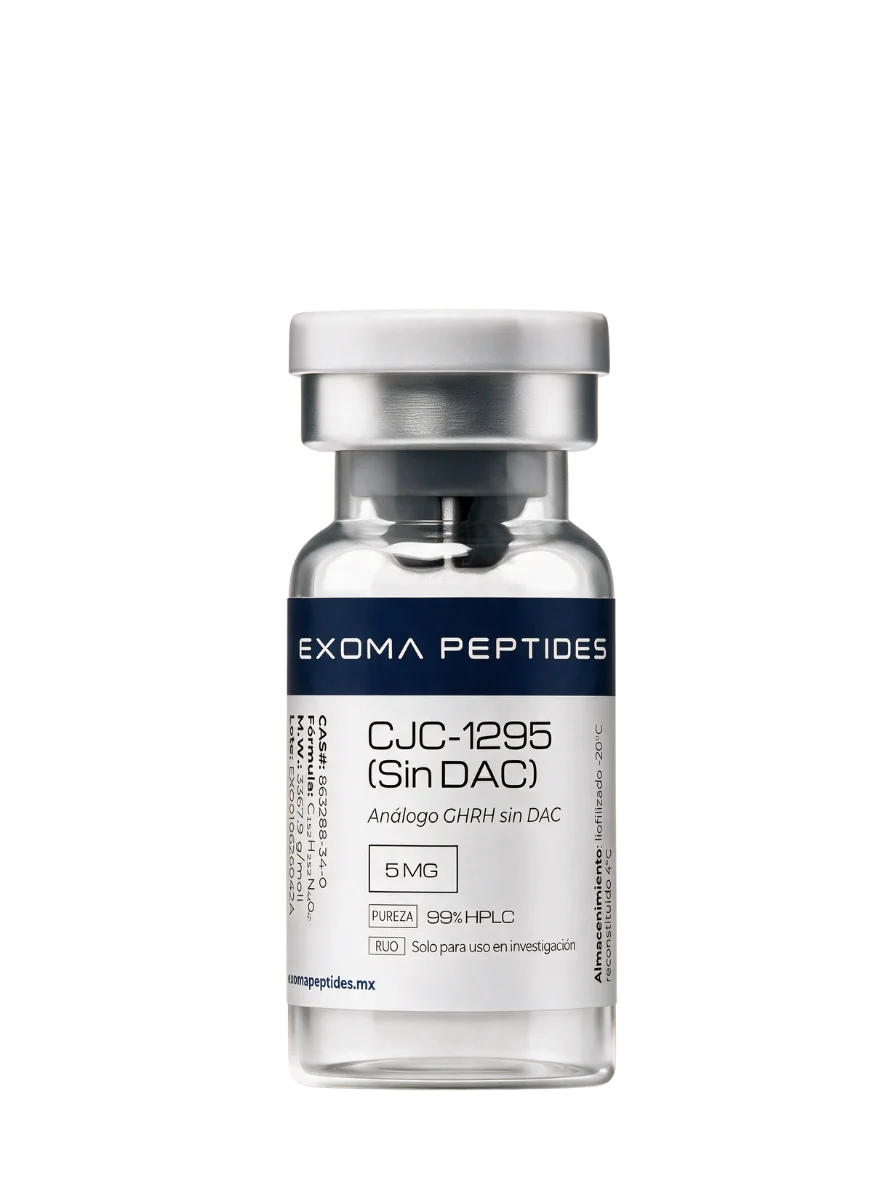
CJC-1295 (Without DAC)
CJC-1295 (No DAC) — reagent for research use (RUO). HPLC purity 98.2% with COA per batch.
Technical data
- INN name
- CJC-1295 without DAC
Sizes and prices: 5 mg $1,099 MXN ($220 MXN per mg) (out of stock) · 10 mg $1,440 MXN ($144 MXN per mg) (out of stock).
Buy CJC-1295 (Sin DAC) in Mexico: order online with nationwide shipping in 1-4 business days depending on zone and tracking number. Prices in Mexican pesos. Material for research use only.
CJC-1295 (No DAC) is known internationally as CJC-1295 without DAC (English INN name). Buy CJC-1295 without DAC in Mexico / comprar CJC-1295 without DAC en México: reagent for research use (RUO) with HPLC purity, COA and nationwide shipping.
CJC-1295 (Sin DAC) is also searched as: Mod GRF (1-29), Modified GRF 1-29, CJC-1295 no DAC, GRF(1-29) tetrasustituido.
Identity and composition
CJC-1295 sin DAC (también mod GRF 1-29 o Modified Growth Hormone Releasing Factor 1-29) is a synthetic 30-amino-acid peptide derived from the first 29 of human GHRH (Growth Hormone Releasing Hormone), with four strategic substitutions (D-Ala²-Gln⁸-Ala¹⁵-Leu²⁷-GHRH) that confer resistance to dipeptidyl peptidase-4 (DPP-4).
Origin of the name: the Canadian laboratory ConjuChem developed two versions of the GHRH analog: "with DAC" (Drug Affinity Complex, half-life ~7 days) and "without DAC" (half-life ~30 min). The without-DAC version is also known as CJC-1295 SDAC o mod GRF 1-29.
Structure and difference from DAC:
- Same 30-amino-acid peptide backbone.
- Without the maleimidopropionyl (MPA) chain que en el DAC permite unión covalente a albúmina.
- Short plasma half-life (~30 min).
- Liberación de GH fisiológica pulsátil, preserving endogenous circadian architecture.
Physicochemical properties: molecular mass 3,367.9 Da; high aqueous solubility after reconstitution; good stability when lyophilized; moderate sensitivity to temperature, extreme pH and light.
Unlike native GHRH (degraded in <2 min by DPP-4), it maintains activity ~30 min, enough to induce a pulse of endogenous GH sin alterar el ritmo circadiano, lo que lo diferencia del DAC en algunos protocolos. Se usa exclusivamente como research molecule del eje somatotropo, composición corporal y neuroendocrinología. No tiene aprobación regulatoria.
Mechanism of action
CJC-1295 Without DAC is a GHRH receptor (GHRHR) agonist from the somatotroph cells of the anterior pituitary.
Molecular cascade:
- Unión al GHRHR acoplado a proteína Gs.
- Activación de adenilato ciclasa → incremento de cAMP.
- Activación de PKA → fosforilación de CREB.
- Transcripción del gen GH1 y liberación de gránulos preformados de GH.
- Plasma GH pulse (3–10× over baseline), peaking at 15–30 min post-administration.
- GH acts on the liver and peripheral tissues inducing IGF-1 (via JAK2/STAT5).
- IGF-1 mediates much of the anabolic and proliferative effects.
Induced secretion pattern: single well-defined pulse, similar to the nocturnal physiological one; duration ~2–3 h; return to baseline before the next dose (avoids suppression by somatostatin/IGF-1).
Synergy with ghrelin secretagogues (GHRP): combinado con Ipamorelina o GHRP-6 la liberación es synergistic (not additive), potentially reaching 5–10× the sum of individual pulses. Mechanism: GHRH stimulates somatotrophs; GHRP acts on somatotrophs AND on the hypothalamic arcuate nucleus inhibiting somatostatin (removes the brake).
Efectos fisiológicos secundarios: sustained increase in plasma IGF-1 (mediated by hepatic GH), lipolysis in adipose tissue (direct GH effect), stimulation of protein synthesis in skeletal muscle (via IGF-1), improved sleep quality (nocturnal GH pulses), and modulation of cellular immunity.
Preservation of the endogenous axis: a diferencia de la GH exógena (que suprime totalmente la producción endógena por retroalimentación negativa), lo stimulates sin sustituirlo, característica que reduce el riesgo de atrofia hipofisaria y dependencia funcional.
Pharmacokinetics
Absorption: vía subcutánea con biodisponibilidad alta (>70% estimado); Tmax 15–30 min.
Distribution: extensive after parenteral administration; moderate crossing of the blood-brain barrier.
Plasma half-life: approximately 30 minutes, similar to the range of modified endogenous GHRH.
Metabolism: degradación proteolítica por peptidasas séricas (pese a resistencia DPP-4) y captación tisular.
Elimination: predominantly renal; rapid clearance.
Duration of the biological effect: pulso de GH ~2–3 h; elevación secundaria de IGF-1 de 24–48 h; recuperación basal antes de la siguiente dosis.
Frequency: 1–3 times/day allows separate physiological pulses; more frequent dosing may desensitize the GHRHR.
Serum stability: degradación en 1–2 h in vitro en suero humano.
Diferencia PK con el DAC: Sin DAC = vida media ~30 min, pulsos discretos, patrón fisiológico; Con DAC = vida media ~7 días, elevación sostenida y aplanada de GH/IGF-1, no fisiológica.
No accumulation: the short half-life prevents accumulation; each dose generates an independent pulse. IGF-1 kinetics: observable elevation at 12–24 h; with chronic daily dosing, IGF-1 stabilizes 30–80% over baseline.
Scientific evidence
La evidencia se concentra en preclinical models and some phase I/II studies with the DAC version (partially extrapolable).
Pharmacokinetics/farmacodinámica:
- Teichman et al. (J Clin Endocrinol Metab 2006): caracterización en humanos sanos del CJC-1295 DAC, con datos de liberación GH/IGF-1.
- Studies with mod GRF 1-29 (No DAC equivalent): GH pulses of 3–10× baseline with doses of 50–100 µg subcutaneous in healthy subjects.
Animal models: in rat and mouse, increased muscle mass, reduced fat and improved wound healing after chronic dosing; in pig and cattle, improved carcass composition (agricultural context).
Somatotropic axis: estudios neuroendocrinológicos confirman preservación de pulsatilidad con Sin DAC vs supresión con DAC; la combinación con ghrelina/GHRP muestra sinergia consistente.
Clinical research: no phase II/III trials with the No-DAC form for approved human indications. ConjuChem halted development around 2010 after phase II in HIV-associated lipodystrophy, with no commercialization.
Body composition: small uncontrolled studies in somatotropic aging show modest increases in lean mass and reduced visceral fat (12–24 weeks). Sleep: la polisomnografía muestra incremento de fase III–IV tras dosis nocturnas.
Limitations: most human studies are small, uncontrolled, or non-indexed; rigorous data come mostly from animal models.
Research applications
Applications documented in research:
Eje somatotropo/endocrinología: respuesta GH/IGF-1 a estímulo GHRH en sujetos sanos y patológicos; deficiencia parcial de GH del adulto (modelo de provocación); envejecimiento somatotropo (somatopausa).
Body composition: increased lean mass (12–24 week studies); reduced visceral fat (direct GH lipolysis); muscle preservation under caloric restriction.
Recovery/regeneration (sports research): cicatrización tisular (IGF-1 mediado), reparación muscular post-ejercicio, tendinopatía crónica.
Sleep: mejora de fase de sueño profundo; insomnio asociado a deficiencia GH del adulto mayor.
Fragilidad geriátrica: sarcopenia experimental; restauración parcial de composición corporal en modelos murinos de envejecimiento.
Standard combinations:
- Sin DAC + Ipamorelina: the best documented for synergy and selectivity; 100 µg + 100–200 µg subcutaneous, 1–3 times/day.
- Sin DAC + GHRP-6: similar, with additional appetite (ghrelinergic effect).
- Sin DAC + GHRP-2: higher GH pulses, greater marginal stimulation of cortisol/prolactin.
Routes of administration: subcutaneous (standard route); intramuscular (acceptable, no clear advantage); intranasal (explored in research, reduced bioavailability). All clinical application remains strictly investigational; no use has been approved for formal human therapeutics.
Research protocols
Los protocolos preclínicos e investigacionales siguen un esquema de physiological pulses.
Dosis típicas: 100 µg por dosis subcutánea (rango 50–200 µg); frecuencia 1–3 veces/día.
Best-documented regimen (100 µg × 3/day): morning while fasting; mid-afternoon before training (sports research); night before sleep (takes advantage of the nocturnal GH pulse).
Esquema simplificado (200 µg × 1/día nocturno): maximiza el pulso GH durante el sueño, con mejor adherencia.
Combinaciones:
- Sin DAC 100 µg + Ipamorelina 100–200 µg: the most studied, consistent synergy.
- Sin DAC 100 µg + GHRP-2 100 µg: high GH pulse.
- Sin DAC + Tesamorelina: NO recomendable (ambos GHRH análogos, redundantes).
Duration: short research 8–12 weeks; extended 12–24 weeks with 2–4 week breaks to avoid desensitization. Typical cycling "5 days on / 2 off" or "12 weeks on / 4 off".
Timing con comidas: en ayunas o ≥2 h post-comida (la insulina elevada reduce la respuesta GH); esperar 20–30 min post-dosis antes de comer.
Animal models: rata 5–20 µg/kg/dosis; ratón 10–30 µg/kg/dosis.
Monitoring: IGF-1 basal y a 4–8 semanas; glucemia (GH contrarregulador); función tiroidea; composición corporal por DXA en estudios prolongados.
Reconstitution
Lyophilized CJC-1295 Without DAC is reconstituted with bacteriostatic water (BAC) preferably.
Procedimiento:
- Equilibrate vial and solvent to room temperature for 15 min.
- Clean the stopper with 70% isopropanol.
- Inject BAC slowly onto the side wall of the vial.
- Do not shake: swirl gently to dissolve in 1–2 min.
- La solución debe ser clear and colorless.
Reference concentrations:
2 mg vial:
- 1 mL BAC → 2,000 µg/mL (100 µg = 0.05 mL = 5 IU in a U-100 syringe)
- 2 mL BAC → 1,000 µg/mL (100 µg = 0.1 mL = 10 IU)
5 mg vial:
- 1 mL BAC → 5,000 µg/mL (100 µg = 0.02 mL = 2 IU)
- 2.5 mL BAC → 2,000 µg/mL (100 µg = 0.05 mL = 5 IU)
- 5 mL BAC → 1,000 µg/mL (100 µg = 0.1 mL = 10 IU)
Syringe: insulina U-100 de 0.3 mL, aguja 30–32G × 6–8 mm.
Route: subcutánea estricta (abdomen, muslo, deltoides), rotando sitios.
Calculation: volume (mL) = dose (µg) / concentration (µg/mL).
Combinaciones: can be mixed in the same syringe with Ipamorelin and GHRP-2/GHRP-6 immediately before injecting, with no documented loss of activity for immediate use. Do not mix in a vial for prolonged storage (uncharacterized peptide-peptide interactions).
Stability and storage
Sealed lyophilized vial: store at 2–8 °C protected from light; stability up to 24 months per manufacturer; transient tolerance to room temperature for up to 30 days.
Vial reconstituted with BAC: store at strict 2–8 °C; stability 14–21 days preserving activity (shorter than BPC-157/TB-500 due to the greater sensitivity of the GHRH analog). Do not freeze; protect from light.
Reconstituido con agua estéril sin conservador: uso inmediato o dentro de 24 h refrigerado.
Thermal sensitivity: transiently tolerates up to 25 °C; prolonged exposure to room temperature reduces activity faster than other peptides.
Chemical sensitivity: pH óptimo 5–7; degradación acelerada en pH alcalino; sensible a agitación vigorosa.
Degradation indicators: turbidez, partículas o cambio de color → descartar; precipitado al refrigerar → agitar suavemente y, si persiste, descartar.
Transport/alícuotas: strict cold gel pack; the lyophilized product tolerates 24–48 h up to 25 °C. Aliquots at -20 °C possible with a single freeze-thaw (shelf life up to ~60 days).
Safety profile
CJC-1295 Without DAC presents a acceptable safety profile in research, with adverse events generally mild and transient.
Eventos comunes (leves, transitorios):
- Rubor facial (flushing): 15–25%, 5–15 min post-dosis.
- Sensación de calor/hormigueo: 10–20%.
- Mild dizziness or brief headache: 5–10%.
- Injection site reactions: 2–5%, mild erythema.
- Somnolencia (con dosis nocturnas, deseable en algunos protocolos).
Asociados a respuesta GH/IGF-1 sostenida: retención hídrica leve ocasional; parestesias en manos (túnel carpiano funcional) poco común con dosis bajas; artralgias leves ocasionales; hiperglucemia leve (GH contrarregulador; vigilar en diabéticos).
Infrecuentes pero relevantes: changes in insulin sensitivity (monitoring with prolonged use); rare gynecomastia, from prolactin elevations (more with DAC or GHRP-2/6); occasional thyroid alteration with use >12 weeks.
Teóricas en uso prolongado: acromegalia funcional con dosis muy altas y prolongadas; riesgo oncológico por carácter mitogénico de GH/IGF-1 (precaución con neoplasia o predisposición tumoral).
Absolute contraindications: neoplasia activa o historia oncológica reciente; diabetes mal controlada; retinopatía proliferativa; embarazo, lactancia; menores.
Relativas: túnel carpiano preexistente; trastornos tiroideos no controlados; insuficiencia hepática/renal moderada–severa.
Hypersensitivity: extremely rare. Interactions: glucocorticoids may reduce the GH response; insulin requires adjustment because of the counter-regulatory effect. WADA: CJC-1295 (Sin DAC y DAC) prohibidos desde 2008 (categoría S2, hormonas peptídicas y factores liberadores). HPLC purity: ideally >99%; lower purity may contain fragments with immunogenic potential.
Comparative context
vs CJC-1295 with DAC: Sin DAC = vida media ~30 min, pulsos fisiológicos, 1–3×/día; DAC = ~7 días, elevación sostenida y aplanada, 1×/semana. Sin DAC preserva la pulsatilidad endógena; el DAC produce mayores incrementos absolutos de IGF-1.
vs Tesamorelin: GHRH analog with half-life ~30 min, the only one approved by the FDA (HIV lipodystrophy); very similar pattern, more formal clinical evidence but higher cost.
vs Sermorelin: GHRH 1-29 sin modificar, vida media ~10–20 min, menos potente; Sin DAC es un Sermorelin mejorado con resistencia a DPP-4.
vs native GHRH: endogenous with half-life <2 min, not viable as a drug; No DAC is the stable analog with a physiological pattern.
vs GH recombinante: la GH exógena suprime el eje y no es pulsátil; Sin DAC lo estimula y genera pulsos fisiológicos sin "hipófisis perezosa" en uso intermitente.
vs Ipamorelina: agonista de ghrelina/GHSR (no GHRHR); mecanismos complementarios → frequently combined. Ventaja de Sin DAC: patrón fisiológico, menor desensibilización, flexibilidad y costo accesible. Disadvantage: requiere múltiples dosis diarias.
History and development
CJC-1295 fue desarrollado por la biofarmacéutica canadiense ConjuChem Biotechnologies (Montreal, Quebec), within a program to extend the half-life of peptides through albumin conjugation (DAC™ technology).
Hitos:
- 1980s–1990s: desarrollo de Sermorelin (GHRH 1-29) por Serono.
- ~2000: ConjuChem identifies the modifications (D-Ala²-Gln⁸-Ala¹⁵-Leu²⁷) that confer resistance to DPP-4.
- 2003–2006: caracterización preclínica y fase I con y sin DAC.
- 2006: publication by Teichman et al. (JCEM) on CJC-1295 with DAC in humans.
- 2008: WADA lo incluye en la lista prohibida (S2).
- 2010: ConjuChem suspende el desarrollo tras fase II en lipodistrofia HIV, sin comercialización.
Name: CJC = ConjuChem Inc.; 1295 = código interno. Tras la suspensión, la versión Sin DAC siguió produciéndose como mod GRF 1-29, functional and structural equivalent.
Regulatorio: without approval from any authority (FDA, EMA, COFEPRIS) for human use; Tesamorelin (analog) does have FDA approval. Available as a research reagent.
FAQ
What is the difference between CJC-1295 without DAC and mod GRF 1-29?
They are functionally and structurally the same molecule. CJC-1295 (Without DAC) is the original name from ConjuChem; mod GRF 1-29 (Modified Growth Hormone Releasing Factor 1-29) is the designation used by research peptide laboratories after the discontinuation of ConjuChem's clinical development. Both terms are used interchangeably for the same compound.
Why combine it with Ipamorelin?
The mechanisms are complementary and synergistic: CJC-1295 Without DAC activates GHRH receptors (positive stimulus on somatotroph cells); Ipamorelin activates ghrelin/GHSR receptors (inhibits endogenous somatostatin, releasing the brake). The combination produces GH pulses 5-10× greater than the sum of the individual ones. Ipamorelin is preferred over GHRP-2/6 for its selectivity (no effects on cortisol/prolactin).
Why is it administered on an empty stomach?
Elevated (postprandial) insulin significantly reduces the GH response to GHRH stimulation. Administration while fasting or ≥2 hours after a meal maximizes the magnitude of the induced GH pulse. It is also recommended to wait 20-30 minutes post-dose before eating so as not to interfere with the ongoing pulse.
What is the key difference with CJC-1295 DAC?
The presence of the maleimidopropionyl (MPA) chain in the DAC version allows covalent binding to serum albumin, extending the half-life from ~30 min to ~7 days. This produces a sustained, flattened elevation of GH/IGF-1 (non-physiological) versus the discrete pulses of No DAC (physiological). No DAC preserves endogenous pulsatility; DAC suppresses it.
How many times a day should it be administered?
The most documented schedule is 100 µg × 3 times/day (morning fasting, mid-afternoon, night before sleep) to maximize discrete pulses. Simplified schedule: 200 µg × 1 time/day at night taking advantage of the circadian GH pulse. More than 3-4 doses/day may induce desensitization of the GHRHR receptor without additional gain.
How long does a reconstituted vial last?
14-21 days refrigerated at 2-8 °C with BAC as solvent, preserving activity. This is shorter than BPC-157/TB-500 (28 days) due to the greater chemical sensitivity of the GHRH-analog peptide. Without BAC (plain sterile water), use within 24 hours refrigerated. Aliquots at -20 °C extend viability ~60 days.
Does it suppress my endogenous GH production?
NO, it stimulates the axis rather than replacing it, unlike exogenous recombinant GH which totally suppresses endogenous production by negative feedback. However, very prolonged use (>16 continuous weeks) may induce desensitization of the GHRHR receptor, so cycling with 2-4 week breaks is recommended.
Is it prohibited in sports?
Yes. WADA has included CJC-1295 (both No DAC and DAC) on the list of prohibited substances since 2008 under category S2 (peptide hormones, growth factors and related substances). Its use is prohibited at all times (not only in competition) in athletes regulated by the WADA code.
Is there a risk of causing cancer?
GH and IGF-1 are documented mitogenic factors, and chronic stimulation of the axis raises theoretical concern about the growth of pre-existing neoplasms or tumor predisposition. There are no formal carcinogenicity studies with CJC-1295 specifically. As a precaution, it is contraindicated in patients with active neoplasia or a recent oncological history. Its use in research should exclude these profiles.
When are the effects on body composition seen?
Changes in plasma IGF-1 are observable at 2-4 weeks. Subtle modifications in body composition (increase in lean mass, reduction of visceral fat) typically require 8-12 weeks of consistent use with concomitant nutrition and sports research. The magnitude of the effect is modest vs more aggressive interventions (exogenous GH), with a relatively more favorable safety profile.
Customer reviews
Average rating: 4.2 out of 5, based on 5 customer ratings.
Verónica G. — 4/5
Everything was correct with the CJC-1295. The shipment arrived within the estimated time.
Gerardo O. — 4/5
Everything correct with the CJC-1295. Good value for money and it arrived within the agreed timeframe.
Gerardo O. — 4/5
Everything correct with the CJC-1295. Good value for money and on-time delivery.
Ricardo A. — 5/5
Excellent CJC-1295 (No DAC). Everything arrived in order, well sealed and with its tracking number from day one.
Certificate of analysis per batch
CJC-1295 (No DAC) batch with certificate of analysis published in the COA catalog:
- Lot EXO010626042B — 10 mg, issued 2026-05-30
Scientific references (4)
Peer-reviewed literature on CJC-1295 (No DAC), with its PubMed identifier where available:
- Prolonged stimulation of growth hormone (GH) and insulin-like growth factor I secretion by CJC-1295, a long-acting analog of GH-releasing hormone, in healthy adults (Teichman, et al. · The Journal of Clinical Endocrinology and Metabolism · 2006) PMID 16352683.
- Advances in the detection of growth hormone releasing hormone synthetic analogs (Semenistaya, et al. · Drug Testing and Analysis · 2021) PMID 34665524.
- Injectable Peptide Therapy: A Primer for Orthopaedic and Sports Medicine Physicians (Mayfield CK, et al. · The American Journal of Sports Medicine · 2026) PMID 41476424.
- Safety and Efficacy of Approved and Unapproved Peptide Therapies for Musculoskeletal Injuries and Athletic Performance (Mendias CL, et al. · Sports Medicine · 2026) PMID 41966639.
Full scientific profile: CJC-1295 + Ipamorelin in the compendium — mechanism of action, studies and technical data sheet.
See the full category catalog: Hormonal · Metabolism.
Otras presentaciones de CJC-1295 (Sin DAC)
Guides and articles about CJC-1295 (No DAC)
Lecturas del blog de EXOMA que la editorial asoció a este compuesto: