
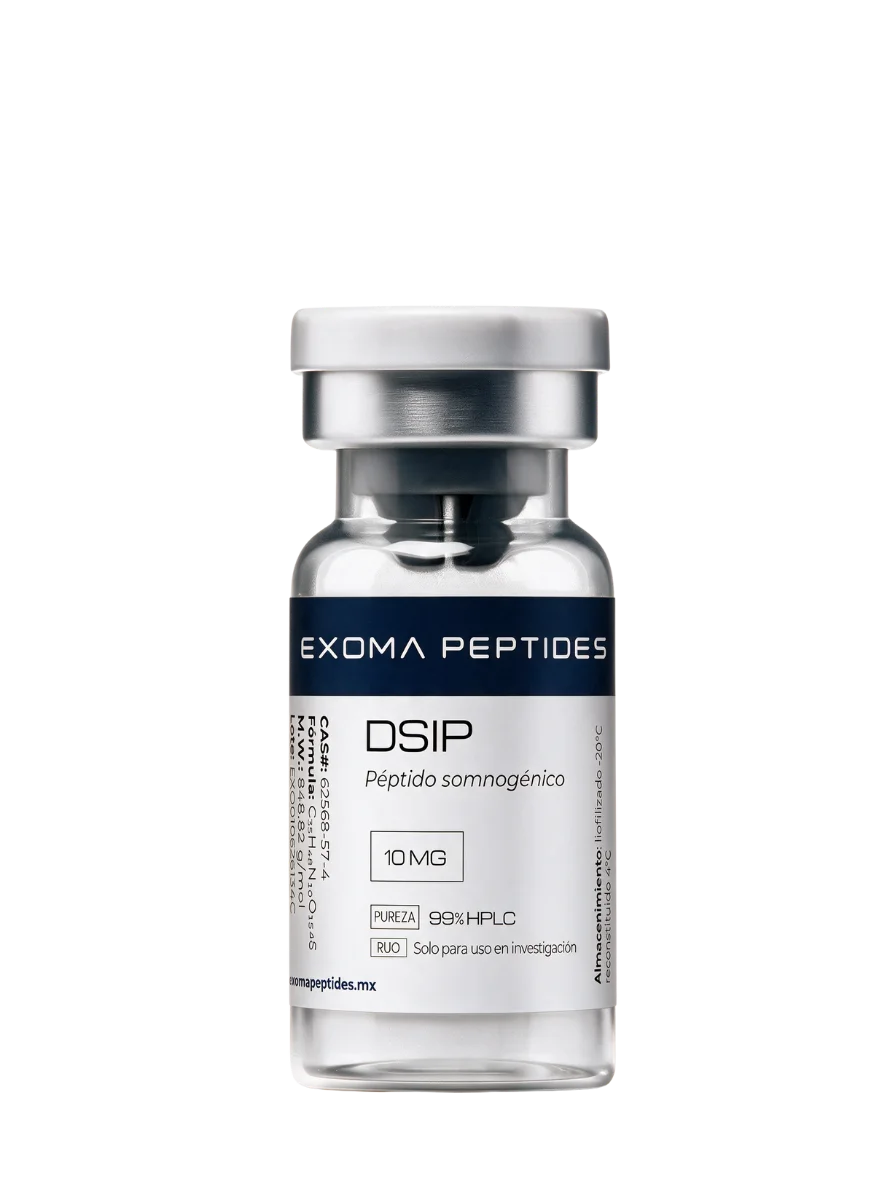
DSIP (Delta Sleep-Inducing Peptide)
DSIP (Delta Sleep-Inducing Peptide) — reagent for research use (RUO). HPLC purity 99.4% with COA per batch.
Technical data
- INN name
- DSIP
- CAS
- 62568-57-4
- Molecular formula
- C35H48N10O15
- Molecular weight
- 848.89 g/mol
Sizes and prices: 5 mg $699 MXN ($140 MXN per mg) (out of stock) · 10 mg $999 MXN ($100 MXN per mg) · 15 mg $1,199 MXN ($80 MXN per mg).
Buy DSIP (Delta Sleep-Inducing Peptide) in Mexico: order online with national shipping in 1-4 business days depending on zone and tracking number. Prices in Mexican pesos. Material exclusively for research.
DSIP (Delta Sleep-Inducing Peptide) is known internationally as DSIP (English INN name). Buy DSIP in Mexico / comprar DSIP en México: reagent for research use (RUO) with HPLC purity, COA and nationwide shipping.
DSIP (Delta Sleep-Inducing Peptide) is also searched as: Delta Sleep-Inducing Peptide, WAGGDASGE.
Identity and composition
El DSIP (Delta Sleep-Inducing Peptide) is a endogenous nonapeptide which has been investigated in preclinical models and in early human studies for its association with sleep regulation and delta EEG activity. It is offered in presentations of 5 mg, 10 mg and 15 mg. Product for research use.
Verifiable chemical identity data (reference block):
- Name: Delta Sleep-Inducing Peptide / Delta Sleep-Inducing Peptide
- Synonyms: Delta-sleep-inducing peptide, Delta EEG-inducing peptide, Emideltide, DSIP
- CAS: 62568-57-4
- Molecular formula: C35H48N10O15
- Molecular weight: ~848.8 g/mol (reported as ~849)
- Sequence: Trp-Ala-Gly-Gly-Asp-Ala-Ser-Gly-Glu (WAGGDASGE); nonapeptide
- PubChem CID: 68816
These identity constants are confirmed in PubChem and in the reference literature and are presented only as characterization of the compound.
Mechanism of action
DSIP is an endogenous nonapeptide first isolated in the 1970s from the cerebral venous blood of rabbits in a sleep phase. In experimental models, its intraventricular infusion has been associated with a specific increase in EEG activity in the delta and spindle bands, rather than with classic pharmacological sedation; the foundational literature has reported a mean increase in delta activity of close to 35% versus controls (PMID 568769; PMID 6895513).
Beyond the effect on the EEG and sleep, the review by Graf and Kastin documents that DSIP-type material is distributed in the brain, peripheral organs, and plasma, and has been associated with the modulation of neurotransmitter levels, circadian/locomotor patterns, and hormonal levels (including HPA-related axes), with a dose- and time-response curve of the type non-linear (U-shaped) (PMID 6145137).
Note: receptor-level actions (for example, effects on GABA or NMDA currents) appear in secondary literature and were not confirmed in the primary sources reviewed; they are described here only as a contextual observation, not as an established mechanism.
Pharmacokinetics
No reliable data were confirmed for half-life, clearance, or volume of distribution in the reviewed sources. The available human study used a single intravenous dose of 25 nmol/kg, but did not report pharmacokinetic parameters (PMID 6895513).
For the above reasons, any quantitative characterization of DSIP kinetics must be considered not established with the evidence compiled here.
Scientific evidence
The evidence on DSIP is preliminary and limited, based mostly on experimental work from the 1970s and 1980s and on small early human studies; the existence of registered modern late-phase clinical trials could not be confirmed.
The human data come from small studies, such as an intravenous infusion in six healthy volunteers in which an increase in total sleep time and a shorter sleep-onset latency in the later phase were reported (PMID 6895513). The reference review notes broader putative functions in hormonal, circadian and neuropharmacological regulation (PMID 6145137).
These findings should be treated as preliminary and not as established clinical efficacy.
Research applications
Product for research use.
Ideal for:
- In vitro and preclinical-model studies on sleep regulation and EEG activity (delta/spindles).
- Exploratory research on neuroendocrine, circadian and neurotransmitter pathways described in the reference literature.
- Methodological laboratory work (peptide characterization, assay development).
Not applicable for:
- Any diagnostic, therapeutic, clinical, or veterinary use.
- Self-administration or clinical formulation.
- Efficacy conclusions: the available evidence is preliminary and does not support clinical indications.
Research protocols
The doses reported in the literature correspond to research contexts and do not constitute a usage guideline. In the available human study, one single intravenous dose of 25 nmol/kg in six volunteers (PMID 6895513).
In the reference experimental works, the effects on the EEG were observed after intraventricular infusion in animal models, not by administration routes standardized for humans (PMID 568769; PMID 6145137).
No additional validated dosing schemes are available in the reviewed sources; any protocol must be defined by the researcher according to their experimental design.
Reconstitution
As a standard general laboratory guideline for lyophilized peptides:
- Reconstitute with bacteriostatic water (sterile water with ~0.9% benzyl alcohol) for multi-use research, or with sterile water for injection when the design requires it.
- Add the diluent letting it run down the wall of the vial, without directing the stream directly onto the powder, to minimize mechanical degradation.
- Swirl gently until completely dissolved; do not shake vigorously.
- Calculate the concentration according to the milligrams of the vial (5, 10, or 15 mg) and the diluent volume used, to determine the volume per aliquot in the protocol.
Stability and storage
Standard laboratory handling for peptides:
- Lyophilized (powder): it is the most stable form; it is usually stored refrigerated and, for prolonged storage, frozen, protected from light and humidity.
- Reconstituted (in solution): maintain refrigerated and use it within a short time window, since peptides in solution are less stable.
- Avoid repeated freeze-thaw cycles; consider aliquots to reduce handling of the main vial.
- Label with reconstitution date and concentration.
These are general storage practices; they do not replace the specific conditions validated by each laboratory.
Safety profile
The documented safety profile is very limited. In the small human intravenous study (n=6), DSIP was reported as well tolerated, with no adverse psychological, physiological, or biochemical effects observed (PMID 6895513).
These are early, small-sample data that do not constitute a complete safety profile; the review by Graf and Kastin provides no detailed data on toxicity or contraindications (PMID 6145137). No validated information is available on interactions, special populations, or chronic exposure.
As a research material, it must be handled with standard laboratory precautions and with no destination for clinical use.
Comparative context
Unlike conventional sedative-hypnotics, the early human study explicitly noted that DSIP did not produce sedation "in the classic pharmacological manner", which suggests that it is associated with the facilitation of the endogenous architecture of sleep (enhancement of delta activity) rather than a depression of the central nervous system (PMID 6895513).
In terms of class, DSIP is a endogenous signaling peptide, not a CNS depressant molecule; its described response is non-linear (U-shaped) with respect to dose and time (PMID 6145137), a pattern different from that of agents with a more direct dose-effect relationship.
No direct head-to-head comparisons with other compounds were confirmed.
History and development
DSIP was first isolated in the 1970s from the cerebral venous blood of rabbits in the sleep phase, and its name derives from this due to its association with the induction of delta EEG activity. Its sequence as a nonapeptide (Trp-Ala-Gly-Gly-Asp-Ala-Ser-Gly-Glu) was characterized through amino acid analysis, sequencing, and synthesis, confirming its activity on delta and spindle EEG (PMID 568769).
The consolidation of knowledge about the compound was captured in the review by Graf and Kastin, which described its endogenous distribution and its putative multiple functions (EEG, neurotransmitters, circadian rhythms, and hormone levels) (PMID 6145137). Subsequent work in humans was limited to small early-phase studies (PMID 6895513), without advancing toward confirmed registered late-phase trials.
FAQ
What is DSIP and what is it investigated for?
DSIP (Delta Sleep-Inducing Peptide) is an endogenous nonapeptide that has been investigated in preclinical models and in early human studies for its association with sleep regulation and the enhancement of delta EEG activity. The evidence is preliminary. It is a product for research use; not for clinical use.
What is the formula and molecular weight of DSIP?
Its molecular formula is C35H48N10O15, with a molecular weight of ~848.8 g/mol (reported as ~849), CAS 62568-57-4 and PubChem CID 68816. Its sequence is Trp-Ala-Gly-Gly-Asp-Ala-Ser-Gly-Glu (WAGGDASGE), a nonapeptide.
Does DSIP act as a classic sedative?
Not in the classical way. In an early human study it was reported that it did not produce sedation in the conventional pharmacological manner, but rather was associated with the facilitation of the endogenous architecture of sleep through enhancement of delta activity (PMID 6895513). It is a preliminary observation, not an established efficacy.
What dose has been used in DSIP studies?
In the available human study, a single intravenous dose of 25 nmol/kg was used in six volunteers (PMID 6895513). No additional validated dosing schemes exist in the sources reviewed; any protocol is defined by the researcher.
How is DSIP reconstituted and stored?
As a general laboratory guide, the lyophilizate is reconstituted with bacteriostatic water, letting it run down the wall of the vial and swirling gently. In powder form it is stored refrigerated or frozen; once reconstituted, refrigerated and for a short window, avoiding freeze-thaw cycles.
Are there safety data for DSIP?
The data are very limited. In a small intravenous study (n=6), good tolerance was reported with no observed adverse effects (PMID 6895513), but this does not constitute a complete safety profile and there are no detailed data on toxicity or contraindications.
Customer reviews
Average rating: 4.8 out of 5, based on 10 customer ratings.
Sofía E. — 5/5
I ordered DSIP again and the service remains just as excellent. Zero complaints.
Esteban G. — 5/5
I ordered DSIP on a recommendation and everything turned out excellent. The package arrived sealed and without any issue.
Lucía B. — 5/5
Very happy with my DSIP. It arrived earlier than expected.
Fernanda C. — 5/5
The DSIP arrived super fast. I had doubts about the payment but they assisted me excellently via WhatsApp and everything went perfectly.
Daniel V. — 4/5
Promising results in our studies.
Raúl M. — 5/5
The DSIP arrived in excellent condition. Very good service and fast home delivery.
Lucía B. — 5/5
First time buying DSIP here and I was fascinated with the speed of shipping.
Adrián C. — 4/5
The product arrived in perfect condition. Excellent service.
Claudia R. — 5/5
It arrived super fast and well packaged. I had my doubts because I had never ordered DSIP online, but honestly the service delivered perfectly on what they promise.
Certificate of analysis per batch
DSIP (Delta Sleep-Inducing Peptide) batches with a certificate of analysis published in the COA catalog:
- Lot EXO010626134A — 5 mg, issued 2026-05-29
- Lot EXO010626134C — 10 mg, issued 2026-05-30
Scientific references (6)
Peer-reviewed literature on DSIP (Delta Sleep Inducing Peptide), with its PubMed identifier when available:
- Delta-sleep-inducing peptide (DSIP): a review (Graf MV, et al. · Neuroscience & Biobehavioral Reviews · 1984) — Review of DSIP: isolation, characterization, and available evidence on its reported effects on sleep. PMID 6145137.
- Synthetic delta-sleep-inducing peptide improves sleep in insomniacs. (Schneider-Helmert D, et al. · Lancet · 1981) PMID 6112579.
- Opioid detoxification with delta sleep-inducing peptide: results of an open clinical trial. (Backmund M, et al. · J Clin Psychopharmacol · 1998) PMID 9617990.
- Characterization of a delta-electroencephalogram (-sleep)-inducing peptide (Schoenenberger, et al. · Proceedings of the National Academy of Sciences (PNAS) · 1977) PMID 265572.
- A clinical trial with DSIP (Kaeser · European Neurology · 1984) PMID 6391926.
- Effects of delta sleep-inducing peptide on sleep of chronic insomniac patients. A double-blind study (Bes, et al. · Neuropsychobiology · 1992) PMID 1299794.
Full scientific profile: DSIP in the compendium — mechanism of action, studies and technical data sheet.
See the full category catalog: Sleep · Recovery.
Guides and articles on DSIP (Delta Sleep-Inducing Peptide)
Lecturas del blog de EXOMA que la editorial asoció a este compuesto: