
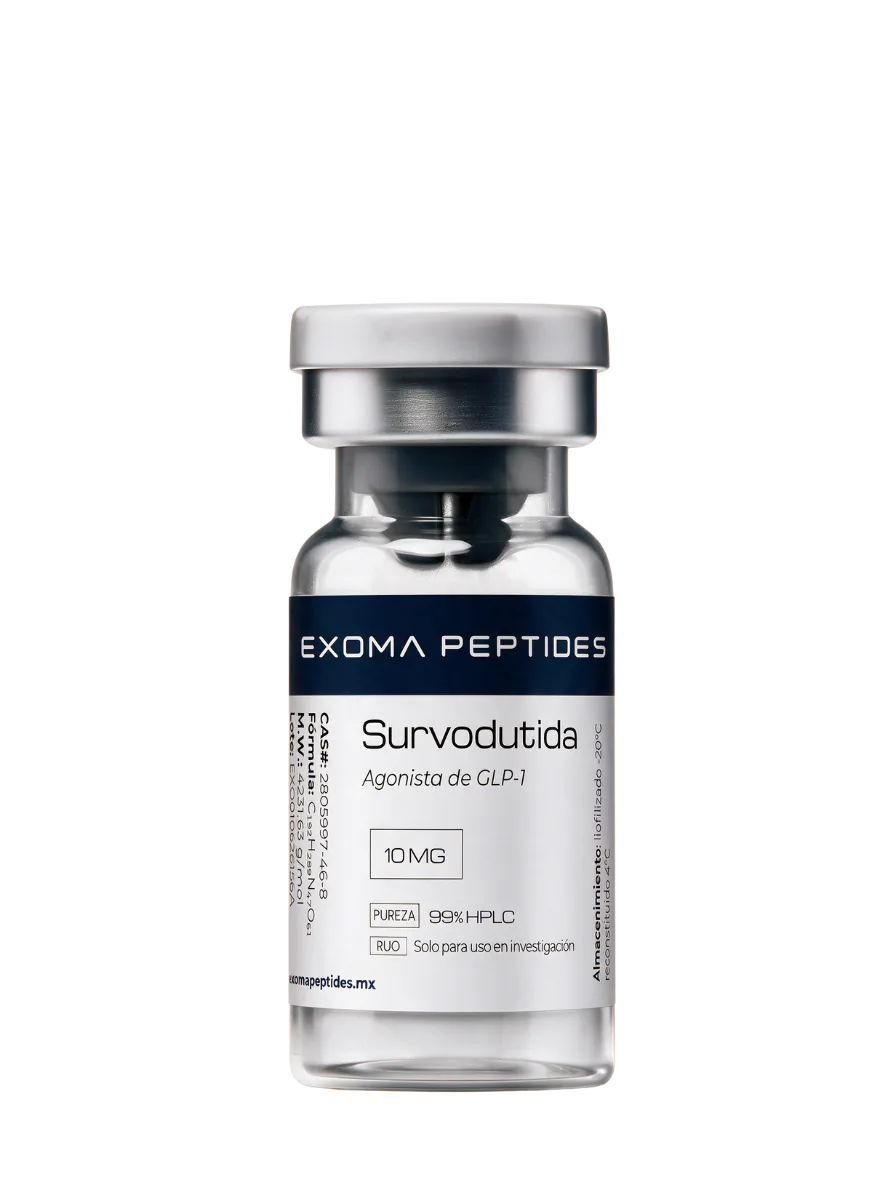
Survodutide
Survodutide — research reagent (RUO).
Technical data
- INN name
- Survodutide
- Development code
- BI 456906
- CAS
- 2805997-46-8
- Molecular formula
- C192H289N47O61
- Molecular weight
- 4231.69 g/mol
Sizes and prices: 10 mg $3,670 MXN ($367 MXN per mg).
Buy Survodutide in Mexico: order online with nationwide shipping in 1-4 business days depending on zone and tracking number. Prices in Mexican pesos. Material for research use only.
Survodutide is known internationally as Survodutide (INN name in English). Buy Survodutide in Mexico / buy Survodutide in Mexico: research reagent (RUO) and nationwide shipping.
Survodutida is also searched as: BI 456906.
Identity and composition
Survodutide (BI 456906) it is a peptide in clinical research, designed as dual agonist of GLP-1 receptors (GLP-1R) and glucagon receptors (GCGR). It has been studied in the context of metabolic disorders such as metabolic dysfunction-associated steatohepatitis (MASH/NASH) and obesity. It is not an approved product.
Product for research use.
Chemical identity data supported by public sources:
- CAS number: 2805997-46-8
- Molecular formula: C192H289N47O61
- Molecular weight: ~4232 g/mol (PubChem, calculated value)
- Synonyms: BI 456906, BI-456906, DrugBank DB18989
Regarding the exact amino-acid sequence, no confirmation in an open primary source is available, so it is not detailed here. Structurally it is described as an acylated peptide derived from the glucagon backbone, with a fatty-acid side chain.
Mechanism of action
Survodutide is a dual peptide agonist that acts on two targets: the GLP-1 receptor (GLP-1R) and the glucagon receptor (GCGR). Structurally it is an acylated peptide derived from the glucagon backbone; its fatty-acid side chain promotes albumin binding, which is associated with a prolonged half-life compatible with weekly subcutaneous administration.
The mechanistic hypothesis evaluated in the trials posits that dual GCGR/GLP-1R agonism could be more effective than isolated GLP-1R agonism in MASH and obesity: the aim is to combine the anorexigenic and satiety effect attributed to the GLP-1 arm with an increase in energy expenditure and in hepatic lipolysis/fat oxidation attributed to the glucagon component.
Its identity as a dual GCGR/GLP-1R agonist is supported by the source of the published clinical trial (NEJM 2024; PMID 38847460). The quantitative potency values (EC50) appear only in supplier catalogs and are not included here as confirmed.
Pharmacokinetics
The compound was designed to once-weekly subcutaneous administration. Acylation with a fatty acid and the consequent binding to albumin support a prolonged half-life, compatible with weekly dosing.
No numerical half-life value or quantitative pharmacokinetic parameters were identified in an open primary source, so these data are left as unverified and no figures are reported.
Scientific evidence
The available evidence corresponds to a compound in clinical research, not approved. It has been studied mainly in two metabolic areas:
- MASH/NASH with fibrosis (F1-F3): in a 48-week Phase 2 trial (NCT04771273; NEJM 2024, PMID 38847460) survodutide was investigated versus placebo. In that study, improvement of MASH without worsening of fibrosis was observed, with a predominantly gastrointestinal adverse-event profile.
- Obesity/overweight: in the phase 3 SYNCHRONIZE-1 trial (N Engl J Med, June 2026; PMID 42253238; NCT06066515), 725 adults with obesity, or with overweight and at least one related complication, without type 2 diabetes, received weekly subcutaneous survodutide titrated up to 3.6 mg or 6.0 mg, or placebo, for 76 weeks; the mean change in body weight at week 76 was -12.2 % and -13.0 % versus -5.4 % with placebo.
It is important to frame the scope: the phase 3 results are already published in a peer-reviewed primary source (SYNCHRONIZE-1 in obesity, PMID 42253238; SYNCHRONIZE-MASLD in metabolic steatotic liver disease, PMID 42252333), but the compound remains without regulatory approval and here it is offered exclusively as material for research. On the whole, the available evidence suggests an investigative interest in the dual mechanism, without this constituting a promised result.
Research applications
Use framing: Product for research use.
Ideal for (research contexts):
- In vitro studies and experimental models on dual GLP-1R/GCGR agonism.
- Mechanistic research oriented toward energy metabolism, satiety, and hepatic lipid metabolism.
- Reference and analytical characterization work on the peptide.
Not applicable for:
- Any use in clinical use, diagnosis, treatment or self-administration.
- Clinical use outside an authorized trial, since it is an unapproved investigational compound.
Research protocols
In the Phase 2 clinical trial in MASH with F1-F3 fibrosis (NCT04771273; NEJM 2024, PMID 38847460), administration schemes were investigated weekly subcutaneous with doses of 2.4 / 4.8 / 6.0 mg versus placebo, over 48 weeks.
These figures correspond to a clinical research protocol and are cited descriptively; they do not constitute a usage guideline or a dosing recommendation. In the phase 3 trials in obesity (SYNCHRONIZE-1; N Engl J Med, June 2026; PMID 42253238) administration was subcutaneous, weekly, titrated up to 3.6 mg or 6.0 mg; these are likewise figures from a clinical research protocol and also do not constitute a usage guideline or a dosing recommendation.
Reconstitution
As a general laboratory handling guide for lyophilized peptides, reconstitution is usually performed with bacteriostatic water (water for injection with benzyl alcohol) added slowly onto the wall of the vial, avoiding vigorous shaking. It is recommended to let the vial rest and dissolve by gentle rotation until a clear solution is obtained.
The volume of diluent is chosen according to the working concentration desired for the research protocol. These instructions are standard laboratory handling and do not imply preparation for clinical use.
Stability and storage
As a standard handling guideline:
- Lyophilized: the powdered peptide is usually best stored frozen and protected from light and moisture; dry material tends to be more stable during prolonged storage. - Reconstituted: once in solution, it is recommended to keep it refrigerated, protected from light, and use it within a short period, avoiding repeated freeze-thaw cycles.
These indications are for general laboratory handling; the literature consulted does not provide specific stability data for this compound.
Safety profile
The documented safety profile comes from the Phase 2 trial in MASH (NEJM 2024; PMID 38847460). In that study, the most frequent adverse events were gastrointestinal (nausea, vomiting, diarrhea), typical of the incretin class and associated with dose escalation.
These are general-level safety notes based on Phase 2 evidence; the complete profile of serious adverse events and specific contraindications is not detailed here. As an investigational compound, its safety profile is not fully characterized. It must be handled only in research contexts, with standard laboratory precautions.
Comparative context
Class comparison, of a mechanistic nature (no head-to-head comparison of verified efficacy was performed):
- Compared to pure GLP-1R agonists (for example, semaglutide): survodutide adds glucagon receptor (GCGR) agonism to GLP-1R agonism.
- Compared with the dual GIP/GLP-1 agonist (tirzepatide): survodutide combines a distinct target, the GCGR, instead of GIP.
The central mechanistic difference is that survodutide incorporates the glucagon component, oriented toward adding energy expenditure and a direct reduction of hepatic fat, in addition to the satiety effect of the GLP-1 arm. This is a class description and does not imply demonstrated superiority.
History and development
Survodutide (development code BI 456906, also referred to as DrugBank DB18989) is a compound in clinical investigation, not approved. Its development has been oriented toward metabolic indications, with a 48-week Phase 2 trial in MASH/NASH with F1-F3 fibrosis (NCT04771273; NEJM 2024, PMID 38847460) and already published phase 3 trials: SYNCHRONIZE-1 in obesity (N Engl J Med, June 2026; PMID 42253238; NCT06066515) and SYNCHRONIZE-MASLD in metabolic steatotic liver disease (Nat Med, June 2026; PMID 42252333).
The design concept responds to the hypothesis of dual GCGR/GLP-1R agonism as a strategy differentiated from single-receptor agonists. The phase 3 results are published in a peer-reviewed primary source; even so, the compound remains without regulatory approval and is offered here exclusively as research material.
FAQ
What is survodutide and how does it act?
It is a research peptide described as a dual agonist of the GLP-1 (GLP-1R) and glucagon (GCGR) receptors. It has been studied in metabolic disorders such as MASH and obesity. It is a product for research use, not for clinical use.
How does survodutide differ from semaglutide or tirzepatide?
It is a class mechanistic difference: semaglutide is a pure GLP-1R agonist and tirzepatide is a dual GIP/GLP-1 agonist, while survodutide combines GLP-1R with the glucagon receptor (GCGR). No verified head-to-head comparison of efficacy is available.
What clinical evidence exists on survodutide?
The confirmed primary evidence is Phase 2 in MASH with F1-F3 fibrosis (NCT04771273; PMID 38847460), where improvement of MASH without worsening of fibrosis was observed. There is Phase 3 development in obesity, whose figures were not verified in a primary source.
What is the chemical identity of survodutide?
Its CAS number is 2805997-46-8, with molecular formula C192H289N47O61 and an approximate molecular weight of 4232 g/mol (value calculated in PubChem). It is described as an acylated peptide derived from glucagon; the exact sequence is not confirmed in an open primary source.
What doses were used in the studies?
In the Phase 2 trial in MASH, weekly subcutaneous doses of 2.4, 4.8, and 6.0 mg were investigated versus placebo over 48 weeks. These are data from a research protocol and do not constitute a dosing regimen.
How is it reconstituted and stored?
As a general laboratory guideline, the lyophilized peptide is reconstituted with bacteriostatic water added down the wall of the vial and dissolved by gentle rotation. The powder is best preserved frozen; once in solution, it is refrigerated, protected from light and used within a short period.
Scientific references (3)
Peer-reviewed literature on Survodutide, with its PubMed identifier where available:
- A Phase 2 Randomized Trial of Survodutide in MASH and Fibrosis (Sanyal, et al. · New England Journal of Medicine · 2024) PMID 38847460.
- Glucagon and GLP-1 receptor dual agonist survodutide for obesity: a randomised, double-blind, placebo-controlled, dose-finding phase 2 trial (le Roux, et al. · The Lancet Diabetes & Endocrinology · 2024) PMID 38330987.
- Survodutide Once Weekly for the Treatment of Adults with Obesity (le Roux, et al. · New England Journal of Medicine · 2026) PMID 42253238.
Full scientific profile: Survodutide in the compendium — mechanism of action, studies and technical data sheet.
See the full category catalog: Metabolism · Hormonal.