
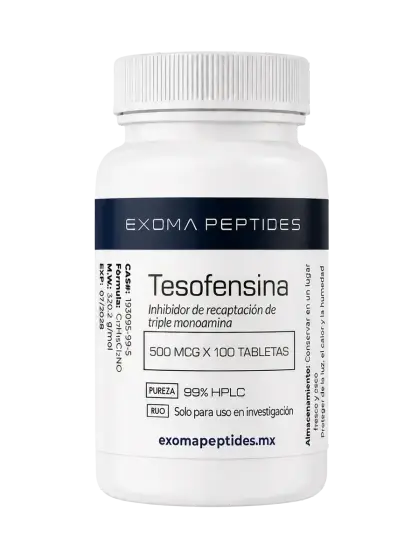
Tesofensine
Tesofensine — research reagent (RUO).
Technical data
- INN name
- Tesofensine
- Development code
- NS-2330
Sizes and prices: 500 mcg × 100 tablets $1,626 MXN.
Buy Tesofensine in Mexico: order online with nationwide shipping in 1-4 business days depending on zone and tracking number. Prices in Mexican pesos. Material for research use only.
Tesofensine is known internationally as Tesofensine (INN name in English). Buy Tesofensine in Mexico / buy Tesofensine in Mexico: research reagent (RUO) and nationwide shipping.
Tesofensina is also searched as: NS-2330.
Identity and composition
Tesofensine is a synthetic small-molecule, non-peptide monoamine reuptake inhibitor (serotonin, norepinephrine and dopamine). Originally developed by NeuroSearch (Denmark) for Parkinson's and Alzheimer's. Redirected to obesity research after observing consistent weight loss as a side effect.
Mechanism of action
It inhibits the presynaptic transporters DAT, NET and SERT, prolonging monoaminergic signaling in hypothalamic synapses that regulate satiety and energy expenditure. DAT inhibition in the arcuate nucleus and norepinephrine modulation in the lateral hypothalamus reduce appetite and increase thermogenesis. It does not act on GLP-1 or GIP receptors.
Pharmacokinetics
Oral bioavailability ~90%. Tmax 6–8 hours. Elimination half-life 220–240 hours (~9–10 days), allowing daily dosing with steady state in 4–6 weeks. Hepatic metabolism via CYP3A4 to the active metabolite M1 with a similar half-life. Mixed renal and biliary excretion.
Scientific evidence
A Danish phase II trial (Astrup et al., Lancet 2008, n=203) with 0.25, 0.5 and 1.0 mg for 24 weeks in obesity showed additional weight loss over diet of 6.7%, 11.3% and 12.8% vs. 2.2% placebo. Phase III program paused due to cardiovascular findings. Recent research in neurogenic orthostatic hypotension and hypothalamic obesity.
Research applications
Research of refractory obesity, models of hypothalamic obesity post-craniopharyngioma, neurogenic orthostatic hypotension, and studies of monoaminergic pharmacology of appetite control.
Research protocols
Reported research doses: 0.25–0.5 mg orally once daily, in the morning to avoid interference with sleep. Slow titration recommended due to the prolonged half-life: start at 0.25 mg and maintain for at least 2–4 weeks before evaluating an increase. Do not combine with other serotonergics due to risk of serotonin syndrome.
Reconstitution
No reconstitution required. Oral capsules or tablets formulated in compounding pharmacy or research. Store in a closed container at 15-25 °C, protected from moisture and light. Verify purity by HPLC in each batch.
Stability and storage
Stable crystalline solid at room temperature protected from light and humidity. Stability of formulated capsules typically 24 months. It does not require refrigeration. The prolonged half-life implies that any dose suspension takes 4–6 weeks for complete elimination.
Safety profile
Frequent adverse events: dry mouth, insomnia, constipation, headache. Critical cardiovascular finding: dose-dependent increase in heart rate (~7 bpm at 0.5 mg) and systolic blood pressure (~2 mmHg). Theoretical risk of serotonin syndrome with SSRIs, MAOIs, or triptans. Contraindicated in ischemic heart disease or uncontrolled hypertension.
Comparative context
Against GLP-1 analogues (semaglutide, tirzepatide, retatrutide), it produces comparable or superior magnitude of weight reduction in oral monotherapy, but with a less favorable cardiovascular profile. Against phentermine, its prolonged half-life allows once-daily dosing. Against bupropion/naltrexone, a triple monoaminergic mechanism vs. a dual one.
History and development
Synthesized by NeuroSearch in the 1990s for early Parkinson's disease. Trials in Parkinson's and Alzheimer's showed no significant efficacy but consistent weight loss. Repurposed for obesity with notable phase II results (2008). The cardiovascular program paused development. Approved in Argentina (2024) as Nupelt for obesity under medical supervision.
FAQ
Why is slow titration needed?
Due to its half-life of 220-240 hours, plasma steady state is not reached until 4-6 weeks. Increasing the dose sooner can accumulate concentrations and exacerbate cardiovascular effects.
Can it be combined with GLP-1 analogs?
There is no controlled clinical evidence supporting this combination. The mechanisms are distinct, but the combination has not been formally studied.
What is the main safety finding?
Dose-dependent increase in heart rate and systolic blood pressure observed in phase II, which paused the phase III program in general obesity.
Is it administered orally or subcutaneously?
Exclusively oral. Its oral bioavailability is ~90% and there is no injectable formulation studied in the clinic.
Customer reviews
Average rating: 4.8 out of 5, based on 5 customer ratings.
V. A. — 5/5
Preclinical research carried out with this compound shows an exact dosing of 500mcg consistent with HPLC. The labeling is sober and technical, facilitating the internal reagent catalog. The integrity of the butyl stopper ensures there is no degradation from atmospheric exposure prior to its handling in the laboratory.
B. S. — 5/5
The product meets the quality-control standards for research models. The dissolution is clear and the reconstitution process shows no foam formation or particles in suspension. Adequate logistics management is observed and the secondary packaging provides protection against impacts during transport.
D. L. — 5/5
The material received for the in vitro study exhibits superior lot consistency. After reconstitution, the solution's clarity is total, indicating precise, contaminant-free chemical synthesis. Transit times were satisfactory and the vial seal remained hermetic under controlled cold-chain conditions.
N. E. — 4/5
The purity report is consistent with the results obtained in the liquid chromatography analysis. A slight variation is observed in the internal vacuum pressure of the vial, although the peptide's stability remained intact for the weight-reduction assays in controlled models. Delivery was punctual and the packaging is professional.
R. O. — 5/5
The Tesofensine unit shows a purity consistent with the attached certificate of analysis. The lyophilizate shows immediate solubility in sterile saline solution, resulting in a homogeneous mixture without visible sediment, which is critical for reproducibility in experimental protocols. The packaging adequately protects the integrity of the vial.
Scientific references (6)
Peer-reviewed literature on Tesofensine, with its PubMed identifier where available:
- Tesofensine, a novel antiobesity drug, silences GABAergic hypothalamic neurons (Perez CI et al. · PloS one · 2024) PMID 38656972.
- Tesofensine, a monoamine reuptake inhibitor for the treatment of obesity (Bello NT et al. · Current opinion in investigational drugs (London, England: 2000) · 2009) PMID 19777399.
- Tesofensine and weight loss (Tsai AG · Lancet (London, England) · 2009) PMID 19249625.
- Effect of tesofensine on bodyweight loss, body composition, and quality of life in obese patients: a randomised, double-blind, placebo-controlled trial (Astrup, A, et al. · Lancet · 2008) PMID 18950853. [Con expresion de preocupacion editorial vigente. Interpretar con cautela.]
- Tesofensine, a novel triple monoamine reuptake inhibitor, induces appetite suppression by indirect stimulation of alpha1 adrenoceptor and dopamine D1 receptor pathways in the diet-induced obese rat (Axel, AM, et al. · Neuropsychopharmacology · 2010) PMID 20200509.
- The effect of the triple monoamine reuptake inhibitor tesofensine on energy metabolism and appetite in overweight and moderately obese men (Sjödin, A, et al. · International Journal of Obesity · 2010) PMID 20479765.
Full scientific profile: Tesofensine in the compendium — mechanism of action, studies and technical data sheet.
See the full category catalog: Metabolism · Orals.