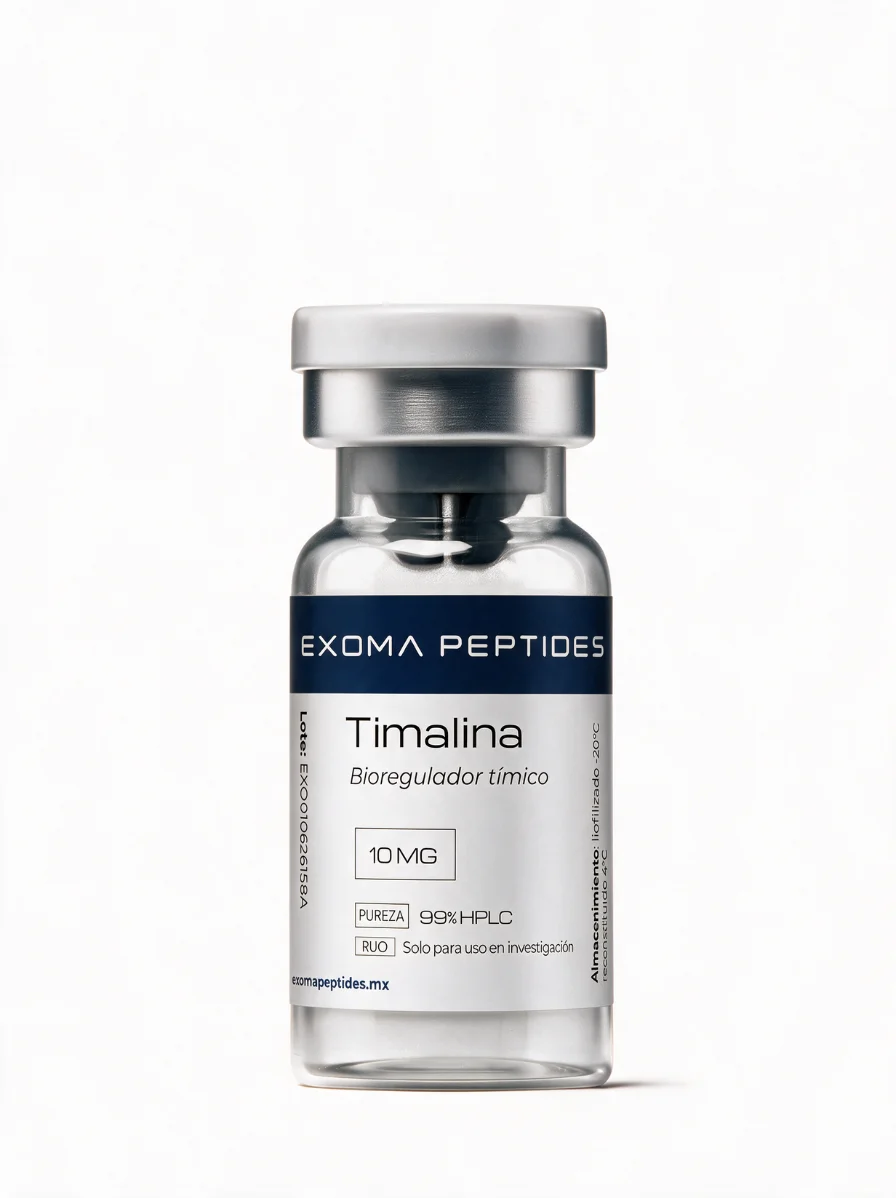
Thymalin
Thymalin — reagent for research use (RUO).
Technical data
- INN name
- Thymalin
Sizes and prices: 10 mg $960 MXN ($96 MXN per mg).
Buy Thymalin in Mexico: order online with nationwide shipping in 1-4 business days depending on zone and tracking number. Prices in Mexican pesos. Material for research use only.
Thymalin is known internationally as Thymalin (English INN name). Buy Thymalin in Mexico / comprar Thymalin en México: reagent for research use (RUO) and nationwide shipping.
Timalina is also searched as: Timalin, Complejo polipeptidico de timo.
Identity and composition
Thymalin (Thymalin) is a low-molecular-weight polypeptide complex isolated from the thymus of calves, studied as an immunological bioregulator in research. It is not a single defined peptide, but a mixture of short peptides, so it is handled and described differently from an individual molecule.
Owing to its polypeptide-mixture nature, Thymalin does not have a unique chemical identity constant: it is not assigned a confirmed unique CAS number, nor a defined molecular weight, molecular formula or amino-acid sequence. It is advisable to keep this in mind because some catalogs mistakenly assign it the CAS or the molecular weight of Thymulin, which is a distinct compound.
Among its synonyms and designations are Thymalin, Timalin, Thymalinum and "thymus polypeptide extract (Khavinson)".
Product for research use.
Mechanism of action
At the mechanistic level, Thymalin is described as a complex whose active components are short peptides (for example, the dipeptides EW/thymogen and KE/vilon, and the tripeptide EDP). It is proposed that these peptides regulate gene expression by binding to DNA sequences and histones, thereby modulating the synthesis of cytokines and of proteins linked to cell differentiation and apoptosis (Khavinson et al., 2021; PMC8365293).
At the functional level, the developer group's literature documents that it restores the number and ratio of T and B lymphocytes and their subpopulations, increases their functional activity and phagocytosis; in particular, the KE peptide is described as inducing CD4/CD5 expression in thymic cells, promoting T-cell differentiation (PMC8365293).
It is important to note that much of this mechanistic characterization comes from a single research group, so it should be interpreted as documented mechanistic evidence but of concentrated origin.
Pharmacokinetics
No verifiable human pharmacokinetics for Thymalin were located in the consulted sources. As it is a polypeptide complex administered by the parenteral route, the pharmacokinetic parameters of its individual molecules (half-life, distribution) are not characterized in the reviewed literature. No numerical values for half-life or clearance are reported, since they do not appear in verified sources.
Scientific evidence
The available evidence is preliminary and limited, and it comes mostly from Russian groups and single-center studies, which restricts its generalization. The indications studied —always in a research context— include immune correction in acute and chronic infections, immunosuppression following chemo- or radiotherapy, and geroprotection.
In a long-term geroprotective study (6 to 8 years of follow-up in 266 elderly people), the use of Thymalin was associated with a reported reduction in mortality (Khavinson & Morozov, 2003; PMID 14523363). In a single-blind randomized trial in severe COVID-19 in elderly people (n=80, Chita, Russia), with a regimen of 10 mg/day for 10 days, faster recovery of lymphopenia, a decrease in IL-6 and lower hospital mortality were observed (19.4% vs 40.9%; p=0.039) (Kuznik et al., 2021; PMC8654498).
These results should be interpreted with caution, owing to the small sample size and the origin from a single research group. No registrations on ClinicalTrials.gov or FDA or EMA approvals were identified; its status as a drug corresponds to the Russian Federation.
Research applications
Ideal for (in research):
- Immunology studies and modulation of T- and B-lymphocyte subpopulations in preclinical models.
- Mechanistic research on cytokine regulation and cell differentiation.
- Research lines in geroprotection and immunocorrection, within controlled protocols.
Not applicable for:
- clinical use, therapeutic use, diagnosis or any clinical application.
- Research that requires a molecule of a unique defined sequence (Thymalin is a polypeptide mixture, not a single peptide).
- Studies that depend on fixed chemical identity constants (CAS, molecular weight, sequence), which are not defined for this complex.
Product for research use.
Research protocols
The doses described here correspond exclusively to regimens reported in studies, for research context purposes and without constituting a recommendation for use.
In the trial in severe COVID-19 in the elderly, a regimen of 10 mg per day for 10 days by the parenteral route (Kuznik et al., 2021; PMC8654498). The reference presentation of this data sheet is 10 mg.
For the long-term geroprotective study, no verifiable numerical regimen is detailed in the consulted literature, so it is not specified here. Outside of these study contexts, there are no verified standardized protocols in the consulted sources.
Reconstitution
As a general standard laboratory guide for lyophilized peptides: reconstitution is usually performed with bacteriostatic water (water with approximately 0.9% benzyl alcohol), added slowly along the vial wall to avoid abrupt agitation of the material.
- Let the vial reach room temperature before reconstituting.
- Direct the diluent against the wall, not directly onto the powder.
- Do not shake; swirl the vial gently until completely dissolved.
The volume of diluent is chosen according to the concentration desired for the experimental work. These instructions are general laboratory handling technique, not a dosing regimen.
Stability and storage
As a laboratory handling standard for peptides and polypeptide complexes:
- Lyophilized (powder): is the most stable form; it is typically stored refrigerated or frozen, protected from light and moisture. For prolonged storage, freezing is preferred. - Reconstituted (in solution): is less stable; it is kept refrigerated and it is recommended to use it within a short period. The use of bacteriostatic water helps to limit microbial growth in multidose laboratory uses. - Avoid repeated freeze-thaw cycles, which can degrade the material.
These ranges are qualitative storage guidance; the literature consulted does not provide specific numerical stability data for Thymalin.
Safety profile
The safety profile of Thymalin should be considered poorly characterized according to Western regulatory standards. The developer group's publications describe favorable tolerability and report not having observed adverse effects, even in older-age groups (Kuznik et al., 2021; PMC8654498).
However, these claims come from the authors themselves and the articles do not detail a systematic and complete monitoring of adverse events. Therefore, the absence of reported events is not equivalent to a fully established safety profile.
No formally documented contraindications are recorded in the sources consulted. As it is a research product, its handling must follow the corresponding laboratory biosafety practices.
Comparative context
Within its class of thymic peptides, Thymalin is distinguished by being a polypeptide mixture and not a molecule of a single composition:
- Thymalin (Thymalin): polypeptide complex from bovine thymus, with no unique defined CAS, molecular weight, or sequence.
- Thymulin: serum thymic factor, a defined nonapeptide (sequence pGlu-Ala-Lys-Ser-Gln-Gly-Gly-Ser-Asn), with CAS 63958-90-7. It is a distinct compound from Thymalin.
- Thymosin alpha-1: synthetic peptide of known sequence.
The most important practical point is do not confuse Thymalin with Thymulin: some supplier catalogs erroneously assign to Thymalin the CAS or molecular weight of Thymulin, which is incorrect, since Thymalin does not possess those unique identity constants.
History and development
Thymalin is a bioregulator developed in the USSR and later Russia, within the Khavinson school (Institute of Bioregulation and Gerontology, St. Petersburg), beginning in the 1970s and 1980s. It falls within a line of research on regulatory peptides derived from tissues such as the thymus and the pineal gland.
Most of the indexed clinical literature on the compound comes from this same research environment, which constitutes both its documentary basis and its principal limitation in terms of generalization. Its regulatory status as a drug corresponds to the Russian Federation; no FDA or EMA approvals or ClinicalTrials.gov registrations were identified in the consulted sources.
FAQ
Are Thymalin and Thymulin the same?
No. Thymalin (Thymalin) is a polypeptide mixture from the bovine thymus without a unique sequence or CAS, while Thymulin is a defined nonapeptide with CAS 63958-90-7. Some catalogs confuse them and mistakenly assign to Thymalin the constants of Thymulin.
What is the CAS number and molecular weight of Thymalin?
Thymalin does not have a confirmed unique CAS number or a defined molecular weight, because it is a polypeptide complex and not an individual molecule. Any CAS or molecular weight assigned to it usually corresponds in reality to Thymulin, which is another compound.
What dose of Thymalin has been used in studies?
In a trial in severe COVID-19 in older people, a scheme of 10 mg per day for 10 days by the parenteral route was used (Kuznik et al., 2021; PMC8654498). These figures correspond only to the research context.
What has Thymalin been researched for?
In studies, immune correction in infections, immunosuppression after chemo- or radiotherapy and geroprotection have been investigated. The evidence is preliminary and comes mostly from a single research group, so it must be interpreted with caution.
How is Thymalin reconstituted and stored?
As a general laboratory guideline, it is reconstituted with bacteriostatic water added slowly down the wall of the vial, without shaking. The lyophilized powder is preserved refrigerated or frozen; once reconstituted it is kept refrigerated and used within a short period.
Is it approved by the FDA or the EMA?
No FDA or EMA approvals nor registrations in ClinicalTrials.gov were identified. Its status as a drug corresponds to the Russian Federation. This product is offered for research use; not for clinical use.
Scientific references (8)
Peer-reviewed literature on Thymalin, with its PubMed identifier when available:
- Peptides of pineal gland and thymus prolong human life (Khavinson, et al. · Neuroendocrinology Letters · 2003) PMID 14523363.
- Thymalin: Activation of Differentiation of Human Hematopoietic Stem Cells (Khavinson, et al. · Bulletin of Experimental Biology and Medicine · 2020) PMID 33237528.
- The Influence of KE and EW Dipeptides in the Composition of the Thymalin Drug on Gene Expression and Protein Synthesis Involved in the Pathogenesis of COVID-19 (Linkova, et al. · International Journal of Molecular Sciences · 2023) PMID 37686182.
- [Experimental and clinical study of a new immunoregulator preparation thymalin]. (Khavinson VKh, et al. · Voen Med Zh · 1982) PMID 7048731.
- [Thymalin in the combined treatment of parkinsonism patients]. (Musienko GV, et al. · Lik Sprava · 1999) PMID 10424021.
- [Effectiveness of thymalin and prodigiozan in the complex treatment of patients with dysentery]. (Boĭko IN, et al. · Voen Med Zh · 1985) PMID 3901509.
- [Effectiveness of administration of thymalin in the complex treatment of pulmonary tuberculosis]. (Kogosova LS, et al. · Probl Tuberk · 1990) PMID 2080155.
- [Morphological compound and indicators of the blood clotting system in severe COVID-19 patients of middle aged and elderly during treatment of Tocilizumab and Thymalin.]. (Kuznik BI, et al. · Adv Gerontol · 2022) PMID 36169363.
Full scientific profile: Thymalin in the compendium — mechanism of action, studies and technical data sheet.
See the full category catalog: Bioregulators.