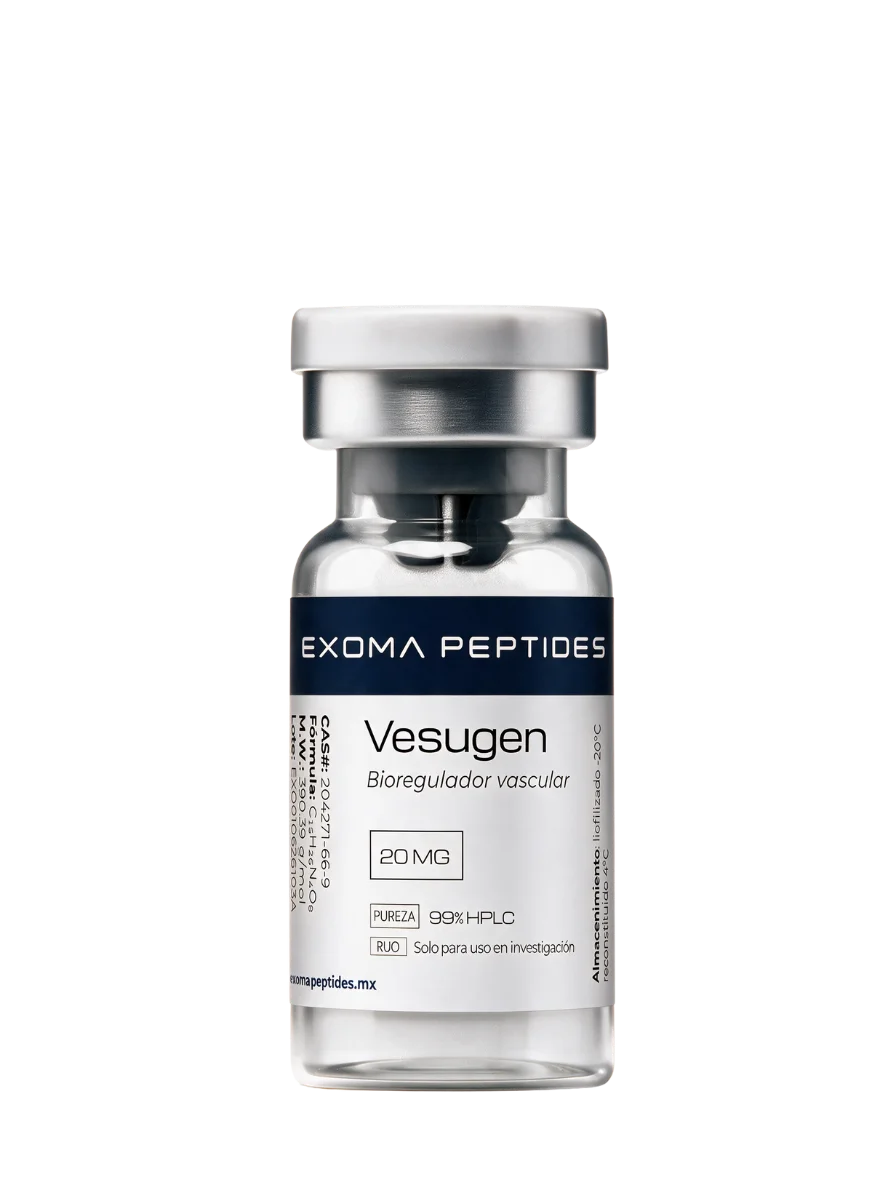
Vesugen
Vesugen — research reagent (RUO).
Technical data
- CAS
- 204271-66-9
- Molecular formula
- C15H26N4O8
- Molecular weight
- 390.39 g/mol
Sizes and prices: 20 mg $1,750 MXN ($88 MXN per mg).
Buy Vesugen in Mexico: order online with nationwide shipping in 1-4 business days depending on zone and tracking number. Prices in Mexican pesos. Material for research use only.
Vesugen is also searched as: KED, Tripeptide KED.
Identity and composition
Vesugen is the synthetic tripeptide Lys-Glu-Asp (KED), a short bioregulator of the class of "cytomedins" developed by the Khavinson group, studied in research for its tropism toward the endothelium and the vascular wall. Product for research use.
Its chemical identity is confirmed in PubChem (CID 87571363):
- Sequence: Lys-Glu-Asp (KED)
- Molecular formula: C15H26N4O8
- Molecular weight: 390.39 g/mol
- Synonyms: KED, Lys-Glu-Asp, lysyl-glutamyl-aspartic acid (L-lysyl-L-glutamyl-L-aspartic acid)
The CAS number is not available in the reference sources consulted, so it is omitted. Vesugen is usually presented as a lyophilized powder for laboratory use only, in a presentation of 20 mg.
Mechanism of action
The proposed mechanism for Vesugen (KED) centers on the regulation of gene expression in vascular endothelial cells. The originating group proposes a model of interaction of short peptides with DNA/promoter regions; it is worth noting that this direct KED-DNA interaction has not been independently confirmed.
In documented in vitro work with vascular endothelial cell cultures, the KED peptide has been observed to normalize the expression of endothelin-1 (a marker found elevated in atherosclerosis/restenosis) and was associated with the restoration of intercellular communication through connexins (Kozlov et al., Adv Gerontol. 2016; PMID 28539025).
The same group additionally reports an increase in sirtuin-1 (SIRT1) and of the proliferation marker Ki-67. These mechanistic claims come essentially from investigators affiliated with Khavinson and, as far as the sources document, do not have independent Western replication, so they must be interpreted as preliminary.
Pharmacokinetics
No published and verified pharmacokinetic data are available for Vesugen/KED. Parameters such as the half-life, absorption, distribution, metabolism and excretion (ADME) have not been characterized in indexed primary sources. Any quantitative claim about its dynamics would be speculative; for transparency, this section is left as uncharacterized within the research context.
Scientific evidence
The available evidence on Vesugen is limited, of low methodological quality and of a preclinical/exploratory nature. The data are predominantly in vitro (vascular endothelial cell cultures) and come almost entirely from the group of origin (Khavinson and collaborators), such as the work on the vasoprotective activity of the peptide KED in atherosclerosis and restenosis (Kozlov et al., Adv Gerontol. 2016; PMID 28539025).
No registered clinical trials were identified (no confirmed NCT records in ClinicalTrials.gov) nor any formal phases of clinical development. There are small Russian clinical reports cited in secondary sources that could not be verified in indexed primary sources and that do not meet modern standards of randomized controlled trials. In preclinical studies, lines related to endothelial/vascular protection, endothelial dysfunction associated with aging, and atherosclerosis/restenosis have been explored in an exploratory manner. Everything must be considered preliminary.
Research applications
Product for research use. Vesugen is not approved by regulators (FDA/EMA) and must not be used for diagnostic or therapeutic purposes.
It may be of interest for research in:
- In vitro studies of vascular endothelial biology and gene expression (e.g., endothelin-1, connexins).
- Exploratory preclinical models of endothelial dysfunction and vascular aging.
- Characterization work within the class of short bioregulators/cytomedins.
Not applicable for:
- clinical use, supplementation, or any clinical/therapeutic use.
- Efficacy conclusions: the evidence is preliminary and does not allow asserting results in humans.
Research protocols
The consulted literature does not provide numerical doses from studies that can be cited with support for Vesugen/KED. The available data are predominantly in vitro and do not describe reproducible dose regimens in verified primary sources.
Therefore, specific doses from studies are not documented here. The design of any research protocol is left to the discretion of the responsible laboratory, under appropriate controls. The reference presentation is 20 mg of lyophilized powder.
Reconstitution
As a general standard laboratory handling guide, lyophilized peptides are usually reconstituted with bacteriostatic water (water for injection with approximately 0.9% benzyl alcohol as a preservative), which allows the solution to be stored for a longer time than simple sterile water.
General technique guidelines:
- Add the diluent slowly down the wall of the vial, avoiding directing the stream directly onto the powder.
- Do not shake; swirl the vial gently until fully dissolved.
- Calculate the diluent volume according to the desired working concentration for the 20 mg available.
This information is laboratory-handling guidance, not a recommendation for use in humans.
Stability and storage
As a laboratory handling standard for peptides of this type:
- Lyophilized (powder): is the most stable form. It is usually stored refrigerated and, for prolonged storage, frozen, protected from light and humidity.
- Reconstituted (in solution): is less stable and must be kept refrigerated, being used within a short period according to laboratory practice.
- Avoid repeated freeze-thaw cycles, which can degrade the peptide.
No specific published stability data are available for Vesugen/KED; the above is a general handling guide.
Safety profile
No formal safety, toxicology, or documented adverse-event data were identified in verified primary sources for Vesugen/KED. It is important to emphasize that the absence of published data does not equate to safety: means the profile has not been characterized.
There are no documented contraindications in primary sources, precisely because there is no verified body of safety data. It is a compound for for research use only, not approved by regulators (FDA/EMA) and not intended for clinical use. Any handling must be carried out with the laboratory precautions appropriate for uncharacterized research material.
Comparative context
Vesugen belongs to the class of short tripeptides/bioregulators of Khavinson, along with other peptides of the same family:
- Epithalon (AEDG): assigned to pineal tropism.
- Pinealon (EDR): assigned to the central nervous system.
- Chonluten (EDG): assigned to bronchial tissue.
- Vesugen (KED): the one assigned to tropism for endothelium/vascular wall.
The class logic is that each tripeptide is associated with a target tissue. It is important to note that the comparison of potency or superiority of Vesugen against other members of the class is not supported by independent comparative data, so no relative advantage should be inferred.
History and development
Vesugen is part of the line of "cytomedins" or short peptide bioregulators developed by the group of Khavinson, at the Institute of Bioregulation and Gerontology in St. Petersburg. Within this program, short peptides assigned to different target tissues were synthesized; Vesugen (tripeptide Lys-Glu-Asp, KED) was attributed an endothelial/vascular tropism.
Its chemical identity was subsequently catalogued in PubChem (CID 87571363). The bulk of the associated research is in vitro and comes from the originating group itself; no formal clinical development programs or trial registrations were identified that would support progress beyond the exploratory preclinical stage.
FAQ
What is Vesugen and what is it studied for?
Vesugen is the synthetic tripeptide Lys-Glu-Asp (KED), a short bioregulator of the Khavinson class studied in preclinical research for its tropism toward the endothelium and the vascular wall. It is a product for research use; not for clinical use.
What is the chemical identity of Vesugen?
According to PubChem (CID 87571363), its sequence is Lys-Glu-Asp (KED), its molecular formula is C15H26N4O8, and its molecular weight is 390.39 g/mol. The CAS number does not appear in the available reference sources, so it is omitted.
Are there clinical trials of Vesugen?
No registered clinical trials or confirmed NCT registrations were identified. The available evidence is predominantly in vitro and comes almost entirely from the group of origin, so it must be considered preliminary and preclinical.
How is Vesugen 20 mg reconstituted?
As a general laboratory guide, lyophilized peptides are usually reconstituted with bacteriostatic water, adding it slowly down the wall of the vial and swirling gently without shaking. This is handling guidance, not a recommendation for use in humans.
What is known about the safety of Vesugen?
No formal safety, toxicology, or adverse-event data were identified in verified primary sources. The absence of data is not equivalent to safety: the profile is not characterized. It is a research compound not approved by the FDA/EMA.
How does Vesugen differ from other Khavinson peptides?
It shares its class with Epithalon (pineal), Pinealon (CNS), and Chonluten (bronchial); Vesugen (KED) is assigned endothelial/vascular tropism. There are no independent comparative data supporting superiority over the others.
Customer reviews
Average rating: 4.8 out of 5, based on 4 customer ratings.
Roberto Z. — 5/5
Everything excellent with the Vesugen. The site is very secure and delivery without setbacks.
Diego M. — 5/5
Everything excellent with the Vesugen. I ordered for the first time and I was honestly surprised at how fast and secure everything arrived.
Camila O. — 4/5
All good with the Vesugen, it arrived sealed and in good condition. The courier took one extra day due to traffic, but the package came perfect.
Scientific references (2)
Peer-reviewed literature on Vesugen, with its PubMed identifier when available:
- Epigenetic aspects of peptidergic regulation of vascular endothelial cell proliferation during aging (Khavinson, et al. · Advances in Gerontology · 2014) PMID 25051766.
- The efficacy of peptide bioregulators of vessels in lower limbs chronic arterial insufficiency treatment in old and elderly people (Kitachev, et al. · Advances in Gerontology · 2014) PMID 25051774.
Full scientific profile: Vesugen in the compendium — mechanism of action, studies and technical data sheet.
See the full category catalog: Bioregulators.
Guides and articles about Vesugen
Lecturas del blog de EXOMA que la editorial asoció a este compuesto: