
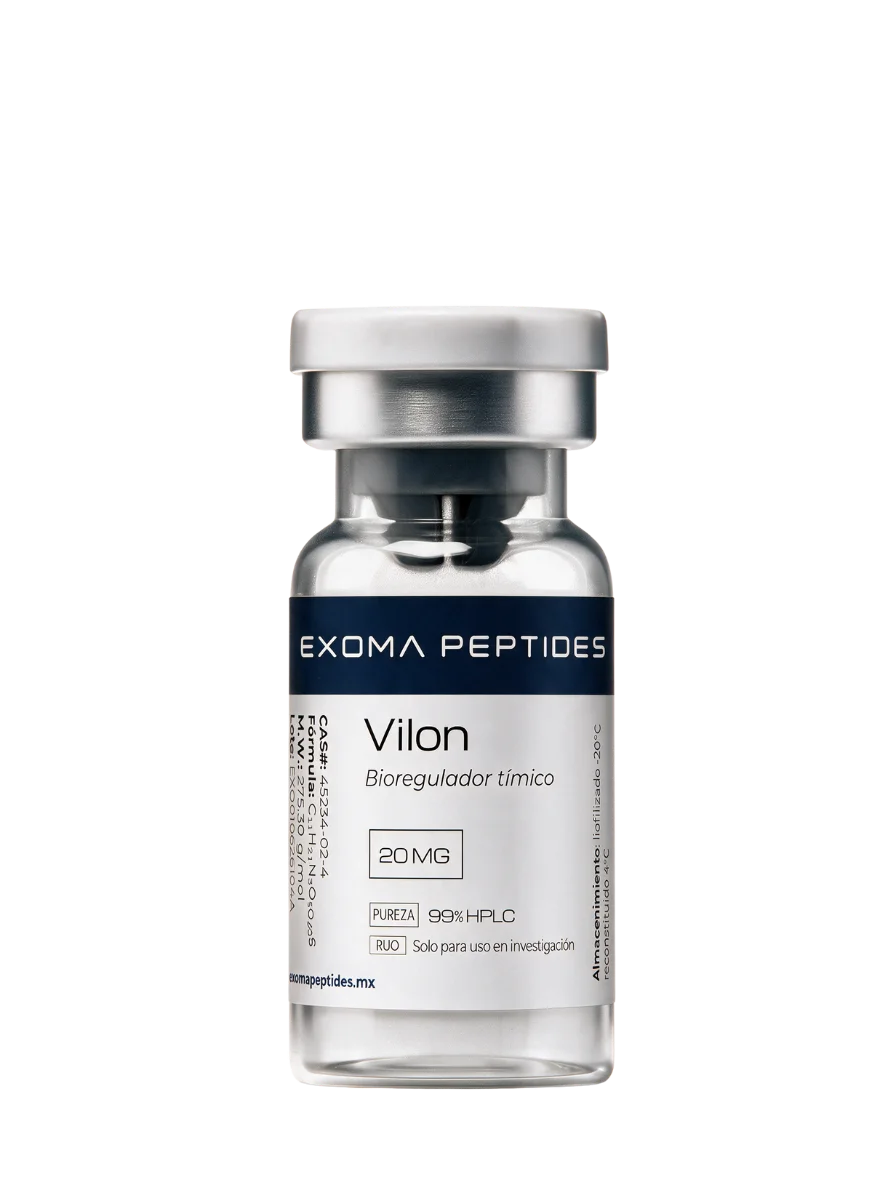
Vilon
Vilon — reagent for research use (RUO).
Technical data
- CAS
- 45234-02-4
- Molecular formula
- C11H21N3O5
- Molecular weight
- 275.31 g/mol
Sizes and prices: 20 mg $1,750 MXN ($88 MXN per mg).
Buy Vilon in Mexico: order online with nationwide shipping in 1-4 business days depending on zone and tracking number. Prices in Mexican pesos. Material for research use only.
Vilon is also searched as: N-L-Lisil-L-glutamico, N-L-Lysyl-L-glutamic acid, Dipeptido KE, Vilon dipeptide.
Identity and composition
Vilon is a short synthetic dipeptide with sequence Lys-Glu (lysine-glutamic, KE), studied in preclinical research as a peptide fragment associated with the activity of thymic bioregulators. It is investigated mainly for its possible immunomodulatory effects and its role in experimental models of aging.
As for its chemical identity, it corresponds to the dipeptide L-lysyl-L-glutamic, with molecular formula C11H21N3O5 (confirmed in PubChem CID 7010502). Its approximate molecular weight is 275.30 g/mol, derived from that formula. Among its synonyms are Lysylglutamic acid, L-Lys-L-Glu, Lys-Glu and KE dipeptide. No assigned CAS number is available in verified sources, so it is omitted.
Product for research use.
Mechanism of action
The mechanistic data on Vilon come mostly from in vitro studies and must be interpreted as preliminary. In the THP-1 monocyte/macrophage line, the evidence suggests that Vilon exhibits a limited modulatory capacity over the phosphorylation of ERK1/2, unlike other peptides in its series; however, in combination with LPS an effect on the tyrosine phosphorylation of ERK1/2 and the activation of STAT1 phosphorylation was observed (Avolio et al., 2022; PMID 35408963).
In that same model a downregulation of adhesion between monocytes and endothelial cells, which has been interpreted as a possible anti-inflammatory/immunomodulatory action through an apparently receptor-independent mechanism (PMID 35408963).
The literature of the Khavinson group has proposed that these short peptides could interact with DNA structures and modulate gene expression, but that hypothesis was not independently verified in the open sources consulted and should be considered unconfirmed.
Pharmacokinetics
No verifiable pharmacokinetic data were identified for Vilon in the consulted sources. There is no information available on half-life, absorption, distribution, or elimination in humans or in animal models in the consulted literature. As it is a research compound without verifiable clinical trials, its pharmacokinetic profile is not established and any numerical parameter is deliberately omitted for lack of support.
Scientific evidence
The available evidence on Vilon is preclinical, scarce, and preliminary in nature. In murine models, one study reported that administration of the dipeptide Lys-Glu inhibited the growth of spontaneous tumors (reduction of pulmonary adenomas) and increased life expectancy in female CBA mice (Khavinson and Anisimov, 2000; PMID 10944717). These findings correspond to animal models and do not allow extrapolating results to humans.
At the cellular level, in vitro studies have examined immunomodulation and inflammatory signaling in THP-1 lines (PMID 35408963). No registered clinical trials were identified on ClinicalTrials.gov for Vilon; the exploratory indications (anti-aging, immunomodulation, T lymphocyte maturation) come from experimental research and not from verifiable controlled clinical trials. It should be considered a research compound without confirmed regulatory approval in the reviewed sources.
Research applications
Use framing: Product for research use.
Ideal for (research contexts):
- In vitro studies of inflammatory signaling and immunomodulation in cell lines (e.g., monocytes/macrophages).
- Mechanistic research on short bioregulator peptides and their effect on pathways such as ERK1/2 and STAT1.
- Exploratory preclinical models of aging and tumor biology in animals.
- Comparative studies within the Khavinson peptide series.
Not applicable for:
- Any form of clinical use, supplementation, or therapeutic use.
- Clinical or diagnostic use: there are no verifiable controlled clinical trials or confirmed regulatory approval.
- Claims of efficacy in people: the evidence is limited to preclinical and cellular models.
Research protocols
The literature reviewed does not include numerical doses or validated administration schedules for Vilon, so no quantities in mg from specific studies are reported. The available documentation qualitatively describes the use of the dipeptide Lys-Glu in murine models (PMID 10944717) and its application in in vitro assays on THP-1 cell lines (PMID 35408963), without dosing parameters that can be reproduced with direct support.
Any experimental protocol must be designed and validated by the responsible researcher in accordance with the primary literature and the standards of their institution. No dose recommendations are offered here owing to the absence of citable data.
Reconstitution
As a standard general laboratory handling guide for lyophilized peptides, reconstitution is usually carried out with bacteriostatic water (water for injection with approximately 0.9% benzyl alcohol as a preservative), although sterile water may also be used depending on the study design.
General technique recommendations:
- Allow the vial and the diluent to reach room temperature before handling.
- Add the diluent, letting it run slowly down the inner wall of the vial, without injecting directly onto the powder.
- Do not shake vigorously; swirl gently until complete dissolution.
- Calculate the diluent volume according to the concentration desired for the experimental work.
These indications are for general handling and do not constitute a validated protocol specific to Vilon.
Stability and storage
As standard laboratory handling practice for short peptides:
- Lyophilized (powder): is usually kept stable for prolonged periods when stored cold, preferably refrigerated and, for long-term storage, frozen. It must be kept protected from moisture and light. - Reconstituted (in solution): once dissolved, it is advisable to keep it refrigerated and use it within a short period; for more prolonged storage, freezing in aliquots is generally resorted to. - Aliquots: aliquot to avoid repeated freeze-thaw cycles, which can degrade the peptide.
These ranges correspond to a general handling guide; the literature consulted provides no specific stability data measured for Vilon.
Safety profile
The safety profile of Vilon is not established in humans. In the verified sources, no formal safety, toxicology or clinical pharmacokinetic data were identified.
In the murine model, no significant effects were reported on body weight, food consumption, or estrous function (PMID 10944717). However, these findings correspond to animals and do not allow safety in humans to be inferred.
La absence of verifiable clinical trials implies that there are no documented data on contraindications, interactions or adverse events in humans. For this reason it must be handled exclusively as research material, with the corresponding laboratory precautions, and never intended for clinical use.
Comparative context
Vilon belongs to the class of short bioregulator peptides developed by the Khavinson group. It is considered a short active fragment associated with the activity of Thymalin (thymus extract).
In the in vitro study on THP-1 cells it was compared with other peptides in the series, such as Epitalon/Epithalon (sequence Ala-Glu-Asp-Gly). Unlike these, Vilon showed a lower capacity to increase ERK1/2 phosphorylation, which suggests a weaker or different signaling profile within its own class (PMID 35408963).
In summary, among Khavinson's bioregulatory peptides, Vilon is distinguished by its minimal dipeptide structure (Lys-Glu) and by a signaling pattern that appears more discreet than that of other members of the series.
History and development
Vilon was developed by the group of Khavinson, at the Institute of Bioregulation and Gerontology in Saint Petersburg, as a short synthetic dipeptide (Lys-Glu, KE) related to the activity of thymic bioregulators, in particular as a fragment associated with Thymalin.
Its initial research focused on animal models: around the year 2000, Khavinson and Anisimov reported effects of the dipeptide on spontaneous tumor growth and life expectancy in mice (PMID 10944717). Subsequently, interest extended to in vitro studies of immunomodulation and inflammatory signaling in cell lines (PMID 35408963).
It is described as a research compound without confirmed regulatory approval outside of possible historical uses in Russia, which could not be verified in the open sources consulted.
FAQ
What is Vilon and what is it studied for?
Vilon is a synthetic dipeptide of sequence Lys-Glu (KE), developed by the Khavinson group. It is investigated in preclinical models for its possible immunomodulatory effects and its role in experimental studies of aging and inflammation. It is a product for research use; not for clinical use.
What is the chemical identity of Vilon?
It corresponds to the dipeptide L-lysyl-L-glutamic acid, with molecular formula C11H21N3O5 (confirmed in PubChem CID 7010502) and an approximate molecular weight of 275.30 g/mol derived from said formula. No verified CAS number is available in the consulted sources.
Are there clinical trials of Vilon in humans?
No registered clinical trials were identified on ClinicalTrials.gov. The available evidence is preclinical and limited, coming from murine models and in vitro studies in cell lines. Its safety and efficacy profile in humans is not established.
How does Vilon differ from other Khavinson peptides such as Epitalon?
Vilon is a short dipeptide (Lys-Glu), whereas Epitalon is a tetrapeptide (Ala-Glu-Asp-Gly). In in vitro studies on THP-1 cells, Vilon showed a lower capacity to increase ERK1/2 phosphorylation, suggesting a distinct signaling profile within its class (PMID 35408963).
How is Vilon reconstituted and stored in the laboratory?
As a general guide, lyophilized peptides are usually reconstituted with bacteriostatic water, adding the diluent slowly down the wall of the vial without shaking. The powder is stored refrigerated or frozen, and once reconstituted it is advisable to refrigerate it and split it into aliquots to avoid freeze-thaw cycles.
What is known about the safety of Vilon?
There are no formal safety or toxicology data in humans in the verified sources. In murine models no significant effects on weight, feeding or estrous function were reported (PMID 10944717), but these findings cannot be extrapolated to people. It must be handled only as research material.
Customer reviews
Average rating: 5.0 out of 5, based on 3 customer ratings.
Gabriela S. — 5/5
The Vilon arrived in record time. I highly recommend the store for its reliability.
Mónica C. — 5/5
Excellent quality of the Vilon. It arrived on the second day after I made my payment and very well protected.
Scientific references (5)
Peer-reviewed literature on Vilon, with its PubMed identifier when available:
- [The effect of vilon (Lys-Glu) on 1.2-dimethylhydrazine-induced neoplasia] (Pliss GB et al. · Voprosy onkologii · 2005) PMID 16308980.
- Studies of the effects of Vilon and Epithalon on gene expression in mouse heart using DNA-microarray technology (Anisimov SV et al. · Bulletin of experimental biology and medicine · 2002) PMID 12360356.
- Effect of vilon on biological age and lifespan in mice (Khavinson VK et al. · Bulletin of experimental biology and medicine · 2000) PMID 11140587.
- Inhibitory effect of peptide vilon on the development of induced rat urinary bladder tumors in rats (Pliss, et al. · Bulletin of Experimental Biology and Medicine · 2001) PMID 11586406.
- Immunomodulating effects of Vilon and its analogue in the culture of human and animal thymus cells (Sevostianova, et al. · Bulletin of Experimental Biology and Medicine · 2013) PMID 23486604.
Full scientific profile: Vilon in the compendium — mechanism of action, studies and technical data sheet.
See the full category catalog: Bioregulators.