
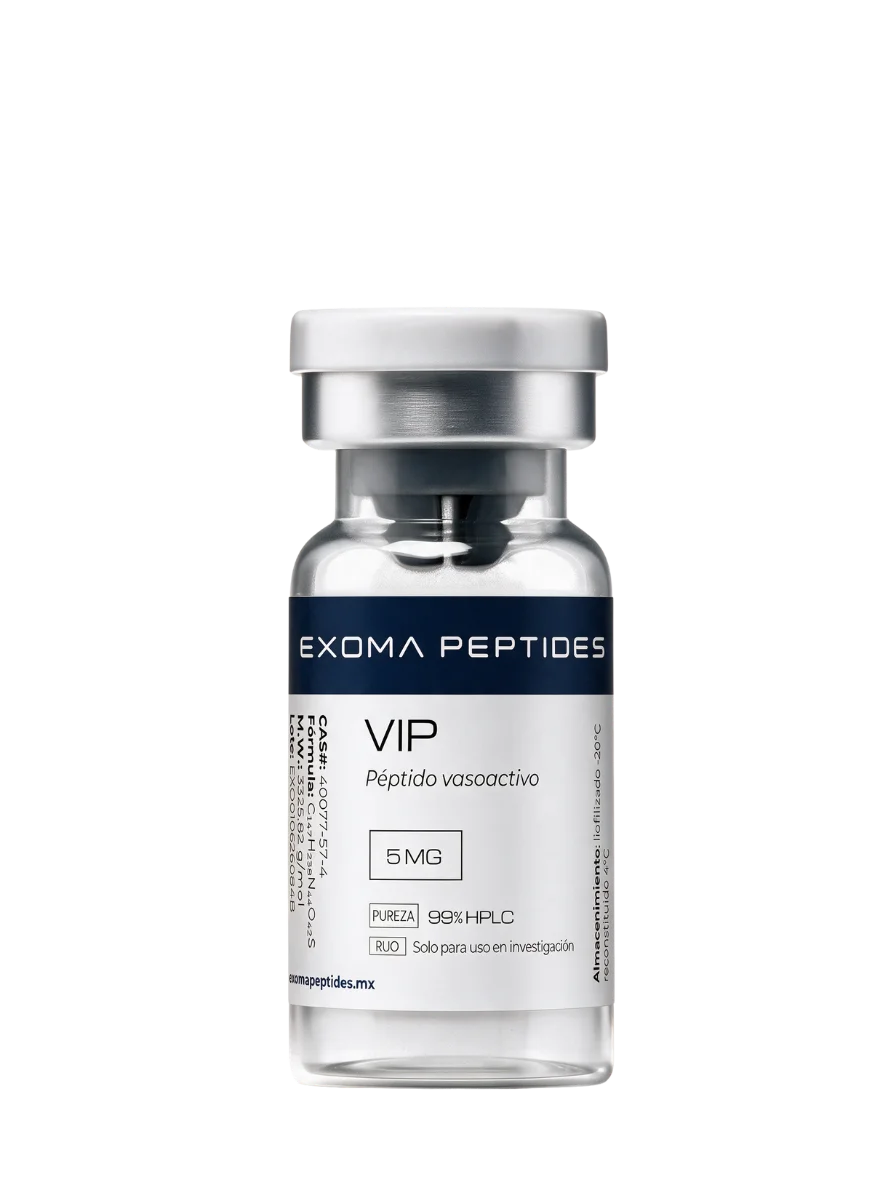
VIP
VIP — research reagent (RUO).
Technical data
- INN name
- Vasoactive Intestinal Peptide
- CAS
- 40077-57-4
- Molecular formula
- C147H238N44O42S
- Molecular weight
- 3325.85 g/mol
Sizes and prices: 5 mg $1,249 MXN ($250 MXN per mg) · 10 mg $1,590 MXN ($159 MXN per mg).
Buy VIP in Mexico: order online with nationwide shipping in 1-4 business days depending on region, with a tracking number. Prices in Mexican pesos. Material for research use only.
VIP is known internationally as Vasoactive Intestinal Peptide (INN name in English). Buy Vasoactive Intestinal Peptide in Mexico / buy Vasoactive Intestinal Peptide in Mexico: research reagent (RUO) and nationwide shipping.
VIP is also searched as: Peptido intestinal vasoactivo, Aviptadil, VIP humano.
Identity and composition
El VIP (vasoactive intestinal peptide, also known as aviptadil) is a neuropeptide of 28 amino acids studied in research for its capacity to activate G protein-coupled receptors and modulate vascular tone, insulin secretion, and immune responses. It is material intended exclusively for research use.
As for its chemical identity, VIP has a molecular formula C147H237N43O43S and a molecular weight of 3326.8 g/mol, values confirmed in PubChem (CID 53314964). Its reported canonical sequence is His-Ser-Asp-Ala-Val-Phe-Thr-Asp-Asn-Tyr-Thr-Arg-Leu-Arg-Lys-Gln-Met-Ala-Val-Lys-Lys-Tyr-Leu-Asn-Ser-Ile-Leu-Asn-NH2 (HSDAVFTDNYTRLRKQMAVKKYLNSILN), with the C-terminal end amidated; this sequence is well documented as that of human VIP, although it was not directly verified in an open primary database. No CAS number confirmed in open primary reference sources is available, so it is omitted.
Its synonyms include vasoactive intestinal peptide, vasoactive intestinal polypeptide, aviptadil, and VIP.
Product for research use.
Mechanism of action
VIP acts as agonist of two class B G protein-coupled receptors: VPAC1 y VPAC2. The activation of these receptors raises the levels of cAMP, which in laboratory models is associated with smooth muscle relaxation (vasodilation), positive inotropic and chronotropic effects, as well as immune and neuromodulatory modulation.
The distribution of these receptors helps to understand the broad spectrum of effects studied: VPAC1 is widely expressed (CNS, liver, lung, intestine, T lymphocytes), while VPAC2 appears in the CNS, pancreas, skeletal muscle, heart, kidney, adipose tissue, and stomach. In the pancreas, the binding of VIP to VPAC2 has been investigated as a stimulus of glucose-dependent insulin secretion (PMID 36204104).
Pharmacokinetics
The pharmacokinetic behavior of VIP is dominated by a very short plasma half-life, attributed to rapid enzymatic degradation; this characteristic consistently limits the inhaled and systemic routes and has motivated the development of modified administration strategies (PMID 23094831).
Some secondary sources mention a half-life on the order of one minute, but that value was not confirmed with an exact figure in the available primary material, so here it is described only qualitatively as extremely brief. This short duration has driven the use of biodegradable depots and of prolonged-half-life analogs, such as fusions with elastin-like polypeptide (for example, PB1046).
Scientific evidence
The available evidence on VIP/aviptadil is preliminary and largely inconclusive, and it should be interpreted with caution. The literature describes it as investigated in multiple indications, with several discontinued programs. Inhaled/nebulized and systemic formulations have been studied.
One of the best-characterized research avenues is the development of selective VPAC2 agonists for type 2 diabetes, with the hypothesis of stimulating glucose-induced insulin secretion without causing hypoglycemia (PMID 36204104, review). Across the board, the evidence indicates that clinical utility is limited by the short half-life and the wide distribution of the peptide (PMID 23094831).
Certain catalog claims —such as trials in pulmonary arterial hypertension and idiopathic pulmonary fibrosis reported as discontinued around 2011, or specific phases in COVID-19/ARDS— were not verified in primary registries and must be treated as unconfirmed.
Research applications
Ideal for (research context):
- In vitro and preclinical studies on VPAC1/VPAC2 receptor signaling and the cAMP pathway.
- Research on vasodilation and effects on smooth muscle in laboratory models.
- Studies on glucose-dependent insulin secretion mediated by VPAC2.
- Comparative work with long half-life analogs and related peptides (for example, PACAP).
Not applicable for:
- clinical use, clinical use, diagnostic or therapeutic.
- Any administration in people or animals outside an authorized research protocol.
Product for research use.
Research protocols
The literature reviewed does not include numerical doses derived from studies that can be cited for VIP/aviptadil, so no trial regimens or amounts are specified.
The presentations of this product (5 mg y 10 mg) correspond only to the amount of lyophilized peptide per vial and do not constitute a dose recommendation. The design of any protocol, including working concentrations and volumes, is the responsibility of the researcher according to their experimental objectives and the relevant primary literature.
Reconstitution
As a general laboratory handling guide, lyophilized peptides such as VIP are usually reconstituted with bacteriostatic water (sterile water with approximately 0.9% benzyl alcohol).
- Add the solvent slowly down the wall of the vial, letting it run over the lyophilizate; avoid injecting the stream directly onto the powder.
- Do not shake: gently swirl the vial until fully dissolved.
- Adjust the solvent volume according to the desired working concentration, considering the 5 mg or 10 mg content of the vial.
These indications are of a general technical nature and do not replace each laboratory's internal procedures.
Stability and storage
As a laboratory handling standard for peptides:
- Lyophilized (unreconstituted): is the most stable form. It is best kept frozen and protected from humidity and light for its prolonged storage.
- Reconstituted: once in solution, the peptide is less stable and must be kept under refrigeration, used within a short period; for extended storage, freezing in aliquots is usually preferred.
- Avoid repeated freeze-thaw cycles, as they can degrade the peptide.
Since the molecule is characterized by rapid enzymatic degradation in biological media, careful handling of the cold chain is especially relevant.
Safety profile
The safety information documented in open sources for VIP is limited and must be interpreted with caution, also considering that this is research material and not for clinical use.
- The activation of VPAC1 has been associated with gastrointestinal effects, which is why research has sought selective VPAC2 agonists (PMID 36204104). - Due to its vasodilatory and inotropic/chronotropic action, cardiovascular effects might be expected (for example, hypotension, tachycardia or flushing); however, these were not confirmed in detail in the open primary sources and are noted as unverified.
No formal contraindications or adverse-event rates are available in the literature consulted, so no figures are reported.
Comparative context
VIP belongs to the secretin/glucagon superfamily and shares homology and receptor overlap with the PACAP (pituitary adenylate cyclase-activating peptide). Unlike VIP, which activates VPAC1 and VPAC2, PACAP additionally activates the PAC1 receptor.
Compared to native VIP, the selective VPAC2 analogs —for example, PB1046 (Vasomera)—have been designed with two objectives: to avoid the gastrointestinal effects associated with VPAC1 activation and to prolong the half-life, one of the main limitations of the native peptide. These differences summarize the development rationale within this class: moving from a short-acting dual agonist toward more selective and longer-acting agonists.
History and development
VIP is described as a 28-amino-acid neuropeptide of the secretin/glucagon superfamily, whose pharmaceutical form is known as aviptadil. Throughout its development it has been investigated in multiple indications through inhaled/nebulized and systemic formulations, with results largely inconclusive or discontinued programs.
According to catalog sources not verified against primary registries, prior trials in pulmonary arterial hypertension and idiopathic pulmonary fibrosis were reportedly discontinued around 2011. The recurring limitation of its short half-life drove modified-administration strategies and the development of long-acting analogs, such as PB1046, based on fusion with elastin-like polypeptide. In parallel, the pathway of selective VPAC2 agonists has been explored for type 2 diabetes (PMID 36204104).
FAQ
What is VIP and what is it researched for?
VIP (vasoactive intestinal peptide, or aviptadil) is a 28-amino-acid neuropeptide that acts as an agonist of the VPAC1 and VPAC2 receptors. It has been investigated for its effects on vasodilation, glucose-dependent insulin secretion and immune modulation. It is a product for research use, not for clinical use.
What is the difference between VIP and aviptadil?
Aviptadil is the name of the pharmaceutical form of vasoactive intestinal peptide (VIP). In practice, both terms refer to the same 28-amino-acid peptide sequence studied in research.
Why does VIP have such a short half-life?
VIP is rapidly degraded by enzymatic action, which confers on it a very brief plasma half-life and limits the inhaled and systemic routes (PMID 23094831). For this reason, biodegradable depots and long-half-life analogs have been developed.
How does VIP differ from PACAP?
Both belong to the secretin/glucagon superfamily and share homology. VIP activates VPAC1 and VPAC2, while PACAP additionally activates the PAC1 receptor. The selective VPAC2 analogs, such as PB1046, seek to reduce gastrointestinal effects and prolong the half-life.
How is VIP reconstituted in the laboratory?
As a general guide, lyophilized peptides are reconstituted with bacteriostatic water (water with approximately 0.9% benzyl alcohol), adding it down the wall of the vial and swirling gently without shaking. The volume is adjusted according to the working concentration and the content of the vial (5 mg or 10 mg).
What safety effects have been documented for VIP?
Open information is limited. The activation of VPAC1 has been associated with gastrointestinal effects (PMID 36204104). Due to its vasodilatory action cardiovascular effects could be expected, but they were not confirmed in open primary sources and are considered unverified.
Scientific references (6)
Peer-reviewed literature on VIP, with its PubMed identifier when available:
- Vasoactive intestinal peptide: cardiovascular effects (Henning RJ et al. · Cardiovascular research · 2001) PMID 11121793.
- Vasoactive intestinal peptide (VIP): an amnestic neuropeptide (Flood JF et al. · Peptides · 1990) PMID 2178250.
- The vasoactive intestinal peptide (VIP) receptor: recent data and hypothesis (Luis J et al. · Biochimie · 1988) PMID 2852963.
- Polypeptide with broad biological activity: isolation from small intestine (Said, et al. · Science · 1970) PMID 5450698.
- Vasoactive intestinal peptide/pituitary adenylate cyclase activating polypeptide, and their receptors and cancer (Moody, et al. · Current Opinion in Endocrinology, Diabetes and Obesity · 2016) PMID 26702849.
- The role of vasoactive intestinal peptide in pulmonary diseases (Zhong, et al. · Life Sciences · 2023) PMID 37742737.
Full scientific profile: VIP in the compendium — mechanism of action, studies and technical data sheet.
See the full category catalog: Hormonal · Bioregulators.