
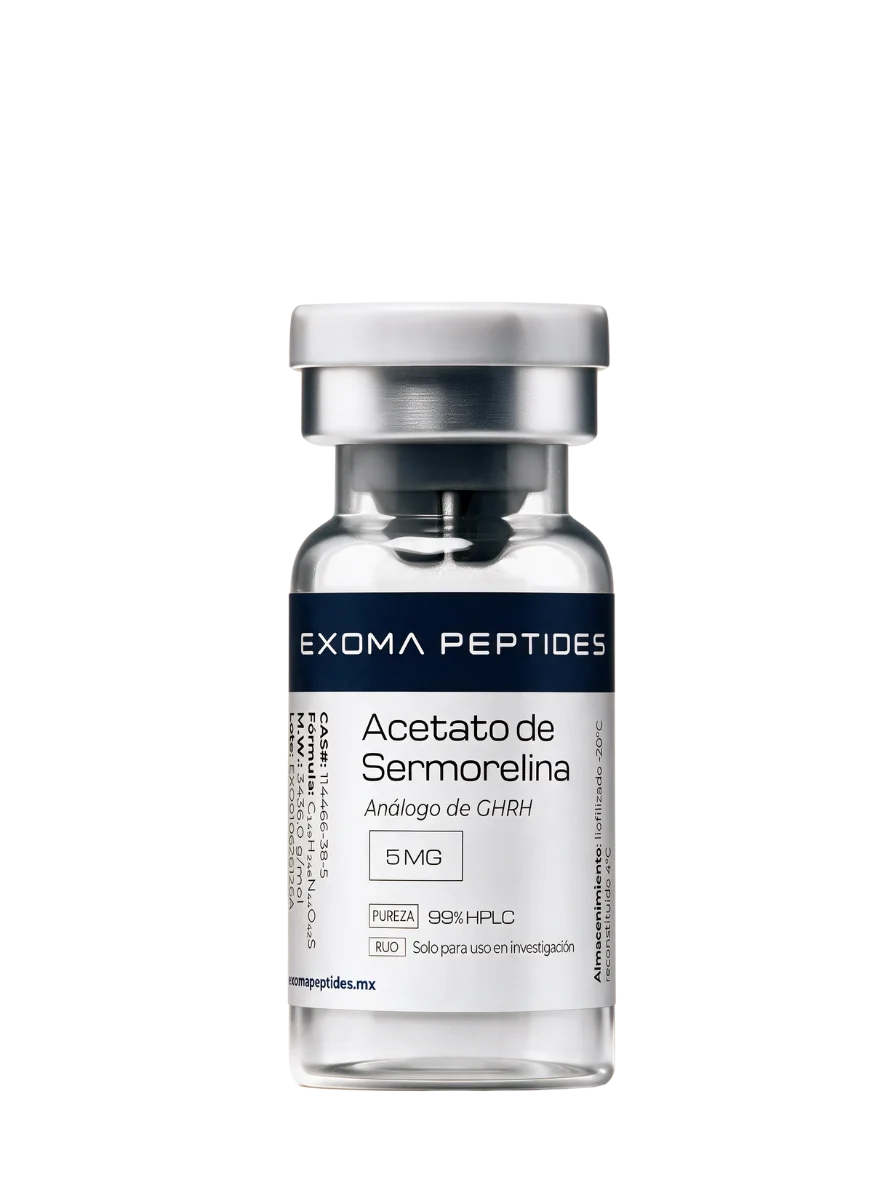
Sermorelin acetate
Sermorelin Acetate — research reagent (RUO). COA per batch available.
Technical data
- INN name
- Sermorelin Acetate
- CAS
- 86168-78-7
- Molecular formula
- C149H246N44O42S
- Molecular weight
- 3357.93 g/mol
Sizes and prices: 5 mg $980 MXN ($196 MXN per mg) · 10 mg $1,799 MXN ($180 MXN per mg) · 15 mg $2,699 MXN ($180 MXN per mg).
Buy Sermorelin Acetate in Mexico: order online with nationwide shipping in 1-4 business days depending on zone and tracking number. Prices in Mexican pesos. Material for research use only.
Sermorelin Acetate is known internationally as Sermorelin Acetate (INN name in English). Buy Sermorelin Acetate in Mexico / buy Sermorelin Acetate in Mexico: research reagent (RUO) with COA per batch and nationwide shipping.
Sermorelin Acetate is also searched as: Sermorelin, GRF (1-29) NH2, GHRH (1-29) amida.
Identity and composition
El Sermorelin acetate (Sermorelin, GRF 1-29) is a synthetic 29-amino-acid peptide corresponding to the N-terminal 1-29 fragment of human growth hormone-releasing hormone (GHRH); it is studied as an agent that stimulates the release of endogenous growth hormone (GH) through the GHRH receptor. Product for research use.
This 1-29 sequence essentially retains the biological activity of the full 44-amino-acid GHRH. Chemical identity data confirmed in reference:
- CAS number: 86168-78-7 (free base)
- Molecular weight: 3357.9 g/mol
- Molecular formula: C149H246N44O42S
- Sequence: Tyr-Ala-Asp-Ala-Ile-Phe-Thr-Asn-Ser-Tyr-Arg-Lys-Val-Leu-Gly-Gln-Leu-Ser-Ala-Arg-Lys-Leu-Leu-Gln-Asp-Ile-Met-Ser-Arg-NH2 (29 amino acids, C-terminal end amidated)
It is also known as GRF 1-29, GHRH (1-29), GHRH(1-29)-NH2 and by the historical brands Geref and Gerel. Its PubChem identifier is CID 16132413.
Mechanism of action
Sermorelin reproduces the 1-29 fragment of endogenous GHRH and binds to the GHRH receptor (GHRH-R) in the somatotroph cells of the anterior pituitary, mimicking the action of natural GHRH and stimulating the synthesis and release of the organism's own growth hormone (GH).
A physiologically relevant feature is that the resulting GH release is pulsatile and remains subject to negative feedback (somatostatin), so that the hypothalamus-pituitary-GH axis is preserved. In research with healthy subjects it was observed that the intravenous administration of low doses (0.25 µg/kg) elicited significant GH release, with a maximal response toward 1-2 µg/kg, and that GH levels remained elevated for around 3 hours despite the rapid elimination of the peptide from the circulation (PMID: 8329825).
Pharmacokinetics
After intravenous administration, GHRH(1-29)-NH2 rapidly eliminates from the circulation; in the open primary source this is described qualitatively as "rapid elimination" and a confirmed numerical half-life value is not available (the figures circulating in secondary literature could not be verified in a primary source, so they are omitted).
Despite this rapid clearance, the pharmacodynamic effect persists: in healthy subjects, GH levels remained elevated for approximately 3 hours after the IV dose. The intranasal bioavailability is low, around 3-5 % relative to the intravenous route (PMID: 8329825).
Scientific evidence
The available evidence on sermorelin comes mainly from studies of pharmacokinetics and stimulation of GH secretion in healthy subjects (intravenous and intranasal administration) and of its use as a diagnostic test of somatotropic function (PMID: 8329825).
Historically, sermorelin acetate was approved by the FDA in 1997 (Geref brand) for the diagnosis and treatment of growth hormone deficiency in children. It is important to note that the evidence regarding supposed anti-aging or performance applications is not supported by robust regulatory trials and must be interpreted with caution. Taken together, these are data that must be considered limited and of a research context, not definitive conclusions.
Research applications
Product for research use.
Ideal for:
- In vitro and laboratory studies on the signaling of the GHRH receptor (GHRH-R) in somatotroph cell models.
- Research on mechanisms of pulsatile GH release and feedback of the hypothalamus-pituitary-GH axis.
- Comparative work within the class of GH secretagogues that act via the GHRH pathway.
Not applicable for:
- clinical use, therapeutic use, clinical diagnosis, or self-medication.
- Use in animals or people outside a controlled research framework.
- Any application involving administration to living beings for treatment purposes.
Research protocols
In documented research with healthy subjects via the intravenous route, a dose-response relationship: low doses of 0.25 µg/kg already elicited significant GH release, with the maximum response observed toward 1-2 µg/kg (PMID: 8329825). The intranasal route was also studied, with low bioavailability (~3-5 % relative to IV).
These values correspond to the context of the cited studies and are presented solely for research informational purposes; they do not constitute a dosing guideline or a recommendation for use. This product's presentations (5 mg, 10 mg and 15 mg) refer to the amount of lyophilized peptide per vial for laboratory handling.
Reconstitution
As a general laboratory handling guide for lyophilized peptides, reconstitution is usually performed with bacteriostatic water (water for injection with approximately 0.9 % benzyl alcohol), which helps limit microbial growth in preparations for repeated use.
- Add the diluent, letting it run slowly down the inner wall of the vial, without directing the stream straight onto the powder.
- Do not shake vigorously; swirl gently (circular motion) until complete dissolution so as not to damage the peptide.
- The diluent volume is chosen according to the desired working concentration for the corresponding vial (5 mg, 10 mg or 15 mg).
This information is a standard description of laboratory technique and does not imply preparation for use in living beings.
Stability and storage
As a standard handling reference for peptides:
- Lyophilized (powder): is the most stable form; it is usually stored protected from light and humidity, refrigerated, and for prolonged storage, frozen.
- Reconstituted (in solution): is less stable; it is generally kept refrigerated and handled while minimizing temperature cycles.
- Avoid repeated freeze-thaw cycles, which can degrade the peptide.
These ranges correspond to general laboratory storage practices and do not constitute instructions for preparation intended for clinical use.
Safety profile
The safety profile of sermorelin comes largely from its historical labeling as an approved product, so it must be considered not exhaustive and subject to the limitations of the available sources.
In its approved use, the most frequently reported adverse reaction was reaction or redness at the injection site. Facial flushing, headache, dizziness and, rarely, hypersensitivity reactions have also been described.
Detailed safety notes and a complete adverse event profile were not confirmed in the open primary sources consulted; for this reason, this information is offered as a historical label reference and not as a complete safety profile. We reiterate that this is a product for research use only, not for clinical use.
Comparative context
Within the GH secretagogues that act via the GHRH receptor, sermorelin (native GRF 1-29) has a short half-life due to its degradation by the DPP-IV enzyme at position 2 of the chain.
- Modified analogs such as tesamorelin, or those that incorporate D-Ala at position 2, show a longer half-life and lower metabolic clearance compared with the native fragment.
- Secretagogues via the ghrelin receptor pathway (GHSR), such as ibutamoren/MK-677 or the GHRPs, stimulate GH through a distinct and complementary mechanism to that of GHRH; therefore, they do not share a target with sermorelin.
In general terms, sermorelin is distinguished by being the native active fragment of GHRH, which makes it a reference molecule within this class for mechanistic studies.
History and development
Sermorelin acetate was approved by the FDA in 1997 under the brand Geref, for the diagnosis and treatment of growth hormone deficiency and growth retardation in children. Its commercial production was discontinued in 2008 for commercial reasons, so it stopped being marketed as an FDA-approved product.
Since then it has appeared mainly through compounding pharmacies for off-label use. The molecule corresponds to the N-terminal 1-29 fragment of human GHRH, a region identified as retaining the essential biological activity of the complete 44-amino-acid hormone, which motivated its development as a shorter and more manageable synthetic peptide for studies of somatotropic function.
FAQ
What is sermorelin acetate and what is it researched for?
It is a 29-amino-acid synthetic peptide (GRF 1-29) corresponding to the N-terminal fragment of human GHRH. It is investigated for its ability to bind to the GHRH receptor and stimulate the release of endogenous growth hormone. It is a product for research use, not for clinical use.
How does sermorelin act on growth hormone?
It binds to the GHRH receptor on the somatotrope cells of the anterior pituitary and mimics endogenous GHRH, stimulating the synthesis and release of GH. The release is pulsatile and preserves the physiological negative feedback of the hypothalamic-pituitary-GH axis (PMID: 8329825).
What is the difference between sermorelin and tesamorelin or MK-677?
Sermorelin is the native GRF 1-29 fragment with a short half-life due to degradation by DPP-IV. Tesamorelin and analogs with D-Ala at position 2 have a greater half-life. MK-677/ibutamoren acts through the ghrelin receptor (GHSR), a distinct and complementary pathway.
Is sermorelin still FDA-approved?
It was approved by the FDA in 1997 (brand Geref) for growth hormone deficiency in children, but its commercial production was discontinued in 2008 for commercial reasons. Today it is not marketed as an FDA-approved product.
What is used to reconstitute the lyophilized sermorelin?
As a general laboratory guideline, lyophilized peptides are usually reconstituted with bacteriostatic water (water with ~0.9% benzyl alcohol), added down the wall of the vial and with a gentle swirl, without shaking. It is laboratory handling information, not preparation for clinical use.
How long does reconstituted sermorelin remain stable?
The lyophilizate is the most stable form and is usually stored refrigerated or frozen for prolonged storage; once reconstituted it is less stable and is kept refrigerated, avoiding repeated freeze-thaw cycles. These are standard laboratory preservation practices.
Customer reviews
Average rating: 4.5 out of 5, based on 4 customer ratings.
Carlos B. — 4/5
The Sermorelin Acetate arrived fine. The courier service met the estimated timeframe.
Fernanda C. — 5/5
The Sermorelin Acetate arrived impeccable and very well protected. Top-notch service.
Sofía V. — 5/5
The Sermorelin Acetate arrived impeccable. Very good presentation and shipping was extremely fast.
Certificate of analysis per batch
Batches of Sermorelin Acetate with a certificate of analysis published in the COA catalog:
- Lot EXO010626126A — 5 mg, issued 2026-05-29
- Lot EXO010626126B — 10 mg, issued 2026-05-28
- Lot EXO010626126C — 15 mg, issued 2026-05-29
Scientific references (6)
Peer-reviewed literature on Sermorelin Acetate, with its PubMed identifier when available:
- A potentially effective drug for patients with recurrent glioma: sermorelin (Chang Y et al. · Annals of translational medicine · 2021) PMID 33842627.
- Sermorelin: a better approach to management of adult-onset growth hormone insufficiency? (Walker RF · Clinical interventions in aging · 2006) PMID 18046908.
- Sermorelin: a review of its use in the diagnosis and treatment of children with idiopathic growth hormone deficiency (Prakash A et al. · BioDrugs: clinical immunotherapeutics, biopharmaceuticals and gene therapy · 1999) PMID 18031173.
- Effects of single nightly injections of growth hormone-releasing hormone (GHRH 1-29) in healthy elderly men. (Vittone J, et al. · Metabolism · 1997) PMID 9005976.
- Priming with GHRH (1-29) NH2: an aid in differential diagnosis between hypothalamic and pituitary deficiencies. (Bueno G, et al. · J Pediatr Endocrinol · 1994) PMID 7735368.
- Growth response to growth hormone-releasing hormone(1-29)-NH2 compared with growth hormone. (Neyzi O, et al. · Acta Paediatr Suppl · 1993) PMID 8329826.
Full scientific profile: Sermorelin Acetate in the compendium — mechanism of action, studies and technical data sheet.
See the full category catalog: Hormonal · Metabolism.