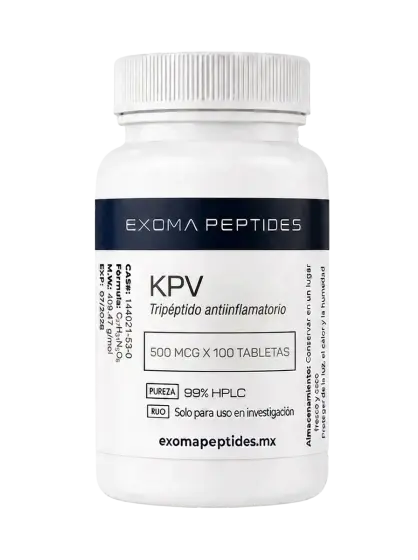
Oral KPV
KPV Oral — research reagent (RUO).
Technical data
- INN name
- KPV
- CAS
- 67727-97-3
- Molecular formula
- C16H30N4O4
- Molecular weight
- 342.43 g/mol
Sizes and prices: 500 mcg × 100 tablets $1,862 MXN.
Buy KPV Oral in Mexico: order online with nationwide shipping in 1-4 business days depending on zone and tracking number. Prices in Mexican pesos. Material for research use only.
KPV Oral is known internationally as KPV (INN name in English). Buy KPV in Mexico / buy KPV in Mexico: research reagent (RUO) and nationwide shipping.
KPV Oral is also searched as: L-lisil-L-prolil-L-valina, Tripeptido KPV, alfa-MSH (11-13).
Identity and composition
El KPV is a tripeptide of sequence L-lysyl-L-prolyl-L-valine (Lys-Pro-Val, KPV), corresponding to the fragment 11-13 of the C-terminal end of the hormone α-MSH (alpha-melanocyte-stimulating hormone). Its molecular formula is C16H30N4O4, with an approximate molecular mass of 342.4 g/mol. It is found in the literature as α-MSH (11-13), KPV y Lys-Pro-Val. It does not have a consolidated pharmaceutical development code, precisely because it never advanced through a formal clinical program; in the open sources reviewed, different CAS identifiers circulate depending on whether it refers to the free peptide or its salt (acetate), so the identifier must be verified against the Batch COA and not be taken for granted. Proposed pharmacological class: anti-inflammatory peptide derived from melanocortin. Regulatory status: KPV is not approved by the FDA, the EMA or COFEPRIS for any indication; it is not an authorized medicine, food, or supplement. It is offered as material exclusively for research.
Mechanism of action
The dominant mechanistic hypothesis for KPV combines two elements. First, entry mediated by PepT1 (SLC15A1): this proton-coupled di- and tripeptide cotransporter is expressed in the brush border of the small intestine and, in the published models, is induced in inflamed colon epithelium and in immune subpopulations; its affinity for tripeptides makes KPV a plausible substrate. Second, interference with intracellular pro-inflammatory signaling: culture studies describe reduced phosphorylation/degradation of IκB, reduced nuclear translocation of NF-κB, attenuation of the pathway MAPK and decrease in IL-8, IL-6 and TNF-α after inflammatory stimulus, in addition to reports of better maintenance of proteins of tight binding and lower paracellular permeability.
What is not established is substantial and worth stating: there is no identified intracellular molecular target nor a validated binding protein for KPV; the relative contribution of PepT1 versus other entry routes has not been quantified; the role of melanocortin receptors remains under debate, since several effects persist without them but total independence has not been demonstrated; and there is no demonstration that this mechanism operates in human tissue in vivo. The available evidence is limited and investigational in nature.
Pharmacokinetics
In the open primary sources reviewed, no confirmed value for half-life, oral bioavailability, Cmax, Tmax or AUC was found for KPV. When figures appear in secondary material, they differ between sources and no single point value is reproduced here, because it does not come from identifiable pharmacokinetic studies.
What can be stated is qualitative. KPV is a polar tripeptide with a basic lysine residue, so its expected behavior is high aqueous solubility and low passive transcellular permeability. Like any short peptide administered by the luminal route, it is exposed to gastric, pancreatic and brush border peptidases, so its half-life in the tract and in plasma is presumed to be brief. The proposed absorption in the preclinical models occurs through active transport via PepT1, not by diffusion, which makes exposure dependent on the local expression of the transporter. Consequently, the oral design has been studied with the logic of local action on mucosa rather than sustained systemic exposure. None of these points has been characterized in humans.
Scientific evidence
The level of evidence for KPV is preclinical. What exists in the open literature are in vitro studies in intestinal epithelium cell lines and in immune cells, and in vivo studies in murine models of colitis (typically induced by DSS o TNBS), where reductions in inflammatory markers, less weight loss, and better histological scores relative to vehicle have been reported. There is also formulation work —nanoparticulate and colonic-release systems— that employs KPV as a molecule of interest. No controlled clinical trials in humans supporting efficacy for any indication were located, nor a registered development program. KPV is not approved by the FDA, the EMA or COFEPRIS as a drug; it is neither a medication nor an authorized supplement. Therefore, any extrapolation of the findings in rodents or in cell culture to an effect in people is speculative. The available evidence is limited and of an investigational nature.
Research applications
Product for research use. Oral KPV is used as an experimental tool in lines of work such as: (1) models of intestinal inflammation in vivo (DSS- or TNBS-induced colitis in rodents) to characterize mucosal response, histological score and local cytokines; (2) intestinal epithelium cultures (Caco-2, HT-29, T84) to study transport through PepT1, tight junction integrity, and translocation of NF-κB; (3) assays in macrophages and neutrophils to evaluate proinflammatory signaling independent of melanocortin receptors; (4) development of oral formulation, including colonic delivery systems, mucoadhesive matrices and nanoparticles, where KPV functions as a model tripeptide cargo; (5) comparative studies compared to other fragments of α-MSH and against reference anti-inflammatories. All these applications correspond to in vitro and animal research. This is material exclusively for research.
Research protocols
In the literature, the studied ranges depend entirely on the experimental system and are not transferable between them. In in vitro assays with intestinal epithelium cell lines or immune cells, KPV has been used at concentrations on the order micromolar, with reports of activity also at lower concentrations in some designs; the exact figures differ between publications and a single point value is not reproduced here. In murine colitis models, oral, intrarectal and systemic administration regimens have been used, as well as colonic-release nanoparticulate formulations, with daily exposures over the course of the model; the designs are not comparable to one another and there is no consolidated reference regimen.
None of these ranges constitutes a dosing regimen nor is extrapolable to humans. There is no established dose for humans because there are no clinical studies supporting it. This material is not for human administration under no circumstances. Any protocol must be defined by the responsible researcher, with vehicle controls, an institutional ethics committee where applicable, and documentary registration of the batch used.
Reconstitution
This presentation does not require reconstitution. It is a oral solid in 500 mcg tablet (package of 100 units), ready to weigh, count or fraction according to the experimental design. It does not include a vial, is not mixed with bacteriostatic water and no injectable-type procedure applies.
If the protocol requires a laboratory stock solution, the general guidance is: prefer material in characterized powder rather than the tablet, since the finished form contains excipients (binders, glidants) that interfere with quantification, spectrophotometry, and cell-based assays. KPV is a polar tripeptide with good solubility in reagent-grade water or aqueous buffer; for cell work it is advisable to adjust pH, filter through a 0.22 µm membrane and verify osmolarity. If it is still started from a tablet, it must be crushed, extracted in the chosen solvent and clarified by centrifugation and filtration, documenting that recovery was not verified analytically unless a control is run. Prepare single-use aliquots and record batch, date, and nominal concentration. Material for research use exclusively.
Stability and storage
Solid (tablet): store in the original container tightly closed, in a place cool, dry and protected from light, preferably between 2 and 8 °C for long-term storage, or at controlled room temperature for short periods. Peptides are sensitive to humidity; keep the desiccant in the container and avoid condensation cycles when moving from refrigeration to room temperature -let the closed container warm before opening it. For extended storage, freezing at −20 °C in a sealed container and with protection against moisture.
Stock solutions: prepare at the time of use whenever possible. If they must be stored, divide into single-use aliquots, label with concentration, solvent, and date, and store at −20 °C (or −80 °C for longer periods). Avoid freeze-thaw cycles repeated and prolonged exposure to room temperature or extreme pH, which favor hydrolysis of the peptide bond. Aqueous solutions of short peptides are the most vulnerable.
Each lot is accompanied by its COA, with identity and purity determined by HPLC; verify the identifier, the reported purity and the batch data before beginning any experimental series.
Safety profile
No human safety data were found for KPV: there are no clinical toxicology studies, tolerability trials, pharmacovigilance, or adverse-reaction reports that can be cited, because the compound never underwent registered clinical development. Nor was a complete regulatory toxicology package identified—repeated-dose, genotoxicity, reproduction studies—nor a NOAEL published in accessible sources.
In the field preclinical, the reports in murine models of colitis describe apparent tolerance to the exposures employed, without manifest toxicity documented in those designs. That observation has limited scope: the studies were of limited duration, with small sample sizes, endpoints centered on inflammation and not on safety, and without long-term follow-up. Absence of signals is not evidence of safety. A compound that modulates inflammatory signaling raises, in principle, open questions about immune surveillance and response to infection that the available literature does not answer.
Handle as laboratory reagent: personal protective equipment, avoid inhalation of powder when fractioning, do not ingest, keep out of reach of unauthorized persons. Material for research use exclusively.
Comparative context
Within the EXOMA catalog, oral KPV belongs to the group of compounds with evidence preclinical, oriented toward gastrointestinal mucosa, and it should be distinguished from its neighbors. Compared to other melanocortin fragments in the catalog, KPV is the shortest and the one that depends least on classical receptors: much of its activity described in the literature does not require MC1R/MC3R, whereas longer α-MSH analogs are studied precisely for their receptor affinity. Compared with BPC-157 in oral presentation —another compound with preclinical data in the digestive tract— the difference is one of proposed mechanism: BPC-157 has been investigated around angiogenesis and tissue repair, whereas KPV is studied as a modulator of proinflammatory epithelial and immune signaling via PepT1/NF-κB. Relative to the injectable peptides in the catalog, oral KPV changes the object of study: it does not seek systemic exposure, but rather luminal contact. None of these compounds has regulatory approval or demonstrated clinical efficacy; the comparison is between research tools, not between treatments.
History and development
KPV arises from the study of the melanocortins: upon fractionating the α-MSH it was observed that its C-terminus, the residues 11-13 (Lys-Pro-Val), retained anti-inflammatory activity in several assays, which opened a line of work on the minimal active fragment. That finding was documented in immunopharmacology literature starting in the last decades of the 20th century. Interest was renewed in the 2000s and onward, when it was described that the peptide transporter PepT1 is expressed in the epithelium of the inflamed colon and in immune cells, offering a plausible route of entry for tripeptides administered by the luminal route; on that basis, studies were published in murine colitis models and formulation work with nanoparticle and colonic-release systems. Despite that trajectory, KPV never entered a registered clinical development program or obtained regulatory approval. Its current status is that of research compound: active in preclinical publications, absent from the pharmacopoeia.
FAQ
Why is KPV presented as an oral tablet and not as an injectable vial?
Because the preclinical evidence for KPV is concentrated in intestinal inflammation, and an oral form puts the compound in direct contact with the mucosa to be studied. In addition, the transporter PepT1, proposed as an uptake route, is expressed in the intestinal epithelium and appears overexpressed in models of inflamed colon. In this design, luminal exposure is the object of the experiment, not an obstacle.
What is the half-life and oral bioavailability of KPV?
In the open primary sources reviewed, no confirmed value for half-life, oral bioavailability, Cmax, Tmax, or AUC for KPV was located. Qualitatively, a tripeptide is expected to be subject to hydrolysis by luminal and brush-border peptidases, with systemic exposure probably low and brief, but that is a general pharmacological expectation and not a measured value that we can reproduce as a figure.
Is KPV approved by any health authority?
No. KPV does not have approval from the FDA, the EMA ni COFEPRIS, and it has no known registered clinical development file. It is distributed as a research reagent, without any therapeutic indication whatsoever.
Does it require reconstitution?
No. It is a oral solid in a 500 mcg tablet, ready to weigh, count or dose in the experimental design. Reconstitution only applies if the researcher needs a stock solution for analytical or in vitro work, in which case it is advisable to start from characterized powder material and not from a tablet, because of the excipients.
Are there safety data in humans?
No human safety data were located: there are no published clinical toxicology, pharmacovigilance, or tolerability studies that we can cite. The preclinical reports describe apparent tolerance to the exposures used in their models, which does not equate to an established safety profile. The absence of signals in rodents does not authorize any conclusion about people.
How does it differ from full-length α-MSH?
KPV is only the fragment 11-13 of the α-MSH, that is, its last three residues. The complete peptide is studied mainly for its interaction with melanocortin receptors (MC1R, among others), whereas the anti-inflammatory activity described for KPV in several models appears not to require those receptors. They are related objects of study but with distinct mechanistic hypotheses.
Customer reviews
Average rating: 4.8 out of 5, based on 5 customer ratings.
M. C. — 4/5
Stable compound that maintains its properties after the reconstitution process. Total homogeneity is observed in the sample, which is critical to guarantee reproducibility in preclinical study models. The technical support provided the COA quickly.
N. E. — 5/5
The lot received shows a total absence of suspended particles after mixing with the solvent. The delivery logistics were efficient and the secondary packaging offered the necessary protection against light and external temperature changes.
S. B. — 5/5
The purity reported by HPLC is reflected in the clarity of the resulting solution. The transit time was short and the labeling meets the technical requirements for organization in our institution's research inventory.
P. A. — 5/5
The integrity of the vial was verified upon arrival, confirming an adequate hermetic seal. After reconstitution, the compound presented complete solubility without macroscopic residues, aligning with the purity standards indicated in the lot's certificate of analysis.
B. R. — 5/5
The material arrived duly identified and with packaging that preserves the stability of the peptide. The dosage of 500mcg agrees with the spectrophotometric measurements carried out in the laboratory, facilitating the standardization of the in vitro experimental protocol.
Scientific references (7)
Peer-reviewed literature on KPV Oral, with its PubMed identifier when available:
- KPV and RAPA Self-Assembled into Carrier-Free Nanodrugs for Vascular Calcification Therapy (Zhang L et al. · Advanced healthcare materials · 2024) PMID 39252648.
- Transdermal Iontophoretic Delivery of Lysine-Proline-Valine (KPV) Peptide Across Microporated Human Skin (Pawar K et al. · Journal of pharmaceutical sciences · 2017) PMID 28343991.
- Inhibition of cellular and systemic inflammation cues in human bronchial epithelial cells by melanocortin-related peptides: mechanism of KPV action and a role for MC3R agonists (Land SC · International journal of physiology, pathophysiology and pharmacology · 2012) PMID 22837805.
- Dissection of the anti-inflammatory effect of the core and C-terminal (KPV) alpha-melanocyte-stimulating hormone peptides (Getting, et al. · The Journal of Pharmacology and Experimental Therapeutics · 2003) PMID 12750433.
- PepT1-mediated tripeptide KPV uptake reduces intestinal inflammation (Dalmasso, et al. · Gastroenterology · 2008) PMID 18061177.
- Melanocortin-derived tripeptide KPV has anti-inflammatory potential in murine models of inflammatory bowel disease (Kannengiesser, et al. · Inflammatory Bowel Diseases · 2008) PMID 18092346.
- Lysine-Proline-Valine peptide mitigates fine dust-induced keratinocyte apoptosis and inflammation by regulating oxidative stress and modulating the MAPK/NF-κB pathway. (Sung J, et al. · Tissue Cell · 2025) PMID 40073467.
Full scientific profile: KPV Oral in the compendium — mechanism of action, studies and technical data sheet.
See the full category catalog: Orals.
Otras presentaciones de KPV Oral
Guides and articles about KPV Oral
Lecturas del blog de EXOMA que la editorial asoció a este compuesto: