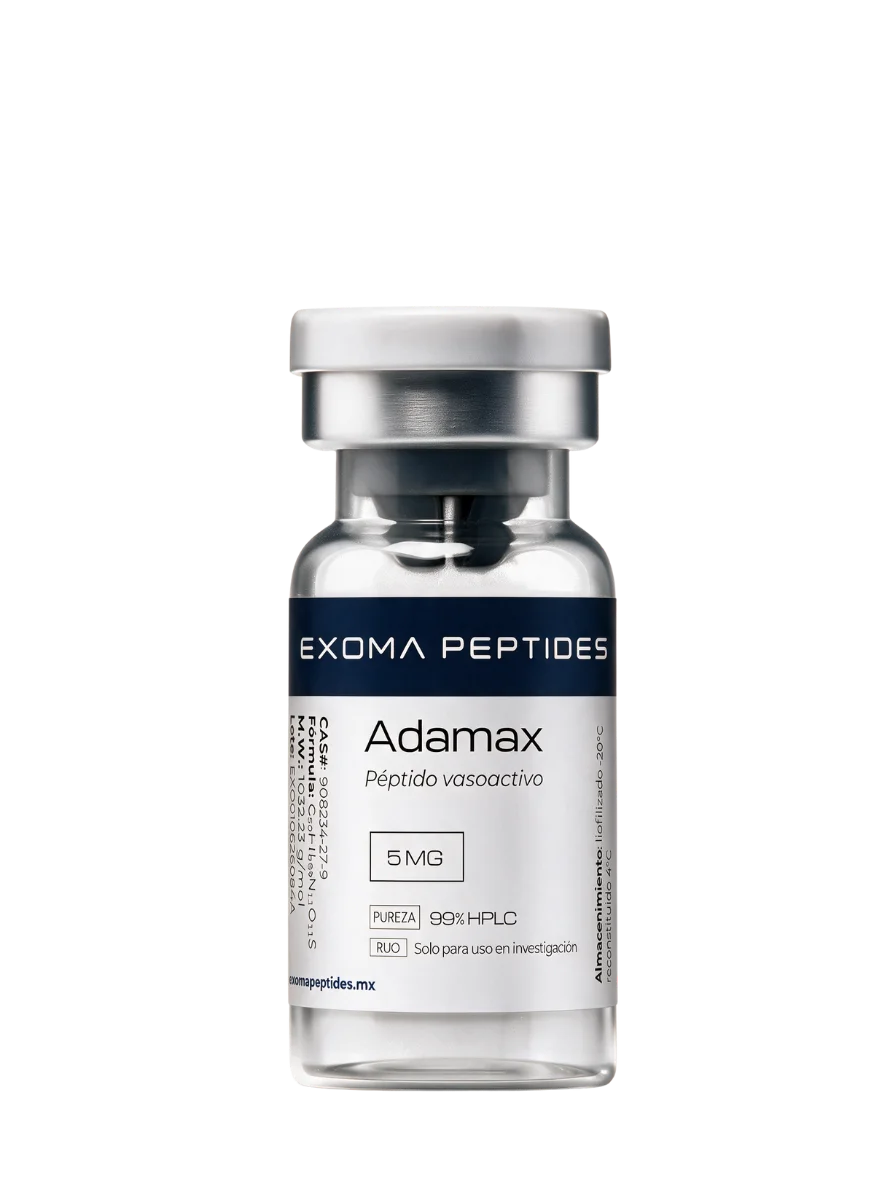
Adamax
Adamax — reagent for research use (RUO).
Sizes and prices: 5 mg $1,920 MXN ($384 MXN per mg).
Buy Adamax in Mexico: order online with nationwide shipping in 1-4 business days depending on zone and tracking number. Prices in Mexican pesos. Material for research use only.
Identity and composition
Adamax is a designer peptide (designer peptide) that is marketed among research suppliers as a cognitive enhancer and that regulatory authorities classify as an analog of adrenocorticotropic hormone (ACTH) (Medsafe, 2025; Agen74-5.7). It is described as a Semax-type analog with added structural modifications. Product for research use.
As for its chemical identity, Adamax is a compound with reference constants not confirmed in open primary chemical databases. It does not have a CAS verified, nor with molecular weight, molecular formula o peptide sequence confirmed in primary sources (PubChem/DrugBank return no entry for the compound); the values circulating in supplier catalogs and wikis diverge from one another, so they are omitted here so as not to communicate unverified data.
Among the synonyms and designations under which it appears include: N-acetyl-Semax (adamantane analog), ACTH(4-10) analog and analog designer of Semax. These designations reflect the attributed structural class, not a characterization confirmed in peer-reviewed literature.
Mechanism of action
El the mechanism of action of Adamax is not characterized in the primary literature: the regulatory source that names it classifies it as an ACTH analog and explicitly notes that its mechanism is usually unknown and that clinical research on its benefits is limited (Medsafe 2025; Agen74-5.7).
By structural analogy it is attributed to being derived from Semax, an analog of ACTH(4-10). It is worth clearly distinguishing the two things: the available literature describes the mechanism of the peptide parenteral Semax —not of Adamax—, where in preclinical models upregulation has been observed of BDNF and of the receptor trkB in the rat hippocampus after intranasal administration (Dolotov et al., Brain Res. 2006; PMID 16996037). That study does not research Adamax; it is cited only as context for the parent compound.
The framework melanocortinergic and the idea that an adamantane moiety would increase lipophilicity are consistent with the ACTH/melanocortin class and with the modification pattern reported by suppliers, but are not confirmed in any primary source for Adamax specifically.
Pharmacokinetics
There are no verified pharmacokinetic data for Adamax in the primary literature. Supplier claims of a plasma half-life of 'several hours' —attributed to the N-acetylation and the adamantane moiety, which would supposedly increase resistance to proteolysis— are not confirmed in primary sources and are presented here solely as an unverified claim of the commercial material, not as an established parameter.
As a class reference, the parent peptide Semax is characterized by a very short plasma half-life (on the order of minutes); the claim that Adamax would extend it is a supplier's design hypothesis, not a measured and published result.
Scientific evidence
La evidence on Adamax is very limited and of low confidence. There are no clinical trials registered in ClinicalTrials.gov nor publications indexed in PubMed for the compound. It is a designer peptide marketed as a nootropic, not a drug in formal development (Medsafe 2025; Agen74-5.7).
In June 2025, Medsafe (New Zealand) flagged it within a proposal to classify ACTH analogs—including Adamax and Semax—as prescription medicines, motivated by unregulated importation, marketing with nootropic claims, limited clinical data, and an unknown safety profile; the decision was deferred at the committee's 74th meeting (July 2025).
Any attributed cognitive indication is preclinical, theoretical or extrapolated from the parent Semax, not demonstrated for Adamax. The available preliminary evidence does not allow efficacy in humans to be established.
Research applications
Product for research use. The following framing is exclusively for in vitro / preclinical research contexts.
May be of interest for research in:
- Exploratory studies on ACTH analogs and designed peptides of the melanocortin class.
- Comparative structure-activity work against the parent peptide Semax.
- Analytical characterization (identity, purity, stability) of peptides not catalogued in standard chemical databases.
Not applicable for:
- clinical use, supplementation, or any therapeutic or diagnostic use.
- Studies requiring a mechanism or pharmacokinetics previously validated in a primary source (none exist for Adamax).
- Cognitive efficacy claims: there is no clinical support for the compound.
Research protocols
There are no documented study doses for Adamax in primary literature or in registered trials, so it is not possible to cite protocols, dosing ranges, or administration schemes supported by evidence for this specific compound.
Any dose figure circulating in supplier material lacks support in a primary source and is not reproduced here. In a research context, the handling parameters must be defined according to the laboratory's experimental design and not from unverified efficacy indications.
Reconstitution
Standard general laboratory handling guide for lyophilized peptides (not a use indication or a dose):
- El bacteriostatic water (water for injection with ~0.9% benzyl alcohol) is the usual diluent for reconstituting lyophilized peptides intended for laboratory handling.
- It is recommended to add the diluent letting it run down the wall of the vial, without projecting the stream directly onto the powder, to reduce mechanical stress on the peptide.
- Do not shake; swirl the vial gently until fully dissolved.
- The reconstitution volume is chosen according to the working concentration desired for a 5 mg vial, adjusting the volume of bacteriostatic water to the target concentration of the experiment.
- Work with aseptic technique and sterile materials.
Stability and storage
General storage guide for research peptides (standard laboratory handling):
- Lyophilized: the dry powder is the most stable form. It is usually kept refrigerated for short-term use and frozen (for example, at -20 °C or below) for prolonged storage, protected from light and moisture.
- Reconstituted: once in solution, stability decreases; store refrigerated and use within a short period, avoiding repeated exposure to room temperature.
- Freeze-thaw cycles: it is advisable to minimize them; aliquoting before freezing helps avoid repeated thaws.
There are no specific published stability data for Adamax; the above is qualitative handling guidance, not a validated datum for the compound.
Safety profile
There is no documented safety profile for Adamax in primary literature. The available regulatory source expressly indicates that little is known about its adverse effects and its long-term effects, and that clinical research is limited (Medsafe 2025; Agen74-5.7).
Medsafe has intercepted it in border seizures as an unapproved product and recommends restricting its importation without prescription. Given the absence of toxicological data and established contraindications, it must be handled with the precautions appropriate to an uncharacterized research material: use exclusively in controlled settings, adequate protective equipment, and no administration to people. Insufficient information is available to define specific contraindications.
Comparative context
Compared to its class, Adamax is presented as a derivative of Semax (analog of ACTH(4-10)) to which would have been added a N-acetylation and a adamantane moiety, with the stated intention by suppliers of increasing lipophilicity, resistance to proteolysis and plasma half-life (Semax has a half-life on the order of minutes).
Key points of the comparison:
- These supposed advantages come from supplier material and are not verified in primary sources.
- El Semax has substantially more peer-reviewed literature available, including preclinical studies of its mechanism (BDNF/trkB); Adamax lacks its own studies.
- Both share the regulatory classification as ACTH analogs flagged by Medsafe (2025).
In summary: Adamax is positioned as an 'improved' variant of Semax, but the practical difference is backed by marketing, not by comparative primary evidence.
History and development
Adamax is a designer peptide arising from the research-supplier circuit, marketed as a nootropic rather than developed as a drug through a formal pathway. It does not come from a documented clinical development program nor does it appear in open primary chemical databases (PubChem/DrugBank).
Its appearance on the regulatory radar took shape in June 2025, when Medsafe (New Zealand) included it —together with Semax and other ACTH analogs— in a proposal before the Medicines Classification Committee to classify them as prescription medicines, motivated by unregulated importation, marketing with cognitive claims, limited clinical data and an unknown safety profile. The decision was delayed at the 74th meeting of the committee (July 2025) (Agen74-5.7). Structurally it is described as a derivative of Semax, an analog of ACTH(4-10).
FAQ
What is Adamax and what is it investigated for?
Adamax is a designer peptide regulatorily classified as an analog of the hormone ACTH and marketed by suppliers as a cognitive enhancer. It is studied in research contexts on ACTH/melanocortin analogs. It is a product for research use; not for clinical use, and it has no demonstrated efficacy in humans.
What is the mechanism of action of Adamax?
It is not characterized in primary literature; the available regulatory source indicates that its mechanism is usually unknown (Medsafe 2025). By analogy it is linked to the parent Semax, in which upregulation of BDNF and trkB has been observed in preclinical models (PMID 16996037), but that has not been demonstrated for Adamax.
Does Adamax have a confirmed CAS or molecular formula?
Not in open primary chemical sources. PubChem and DrugBank do not return an entry for the compound, and the values of CAS, molecular weight and formula that circulate in catalogs and wikis are divergent among themselves, so they are not communicated as verified data.
How does Adamax differ from Semax?
It is presented as a Semax derivative with added N-acetylation and an adamantane residue, with the intention declared by suppliers of increasing lipophilicity, resistance to proteolysis and half-life. These advantages are not verified in primary sources; Semax has a much larger peer-reviewed bibliography.
What is known about the safety of Adamax?
There is no safety profile documented in primary literature. Medsafe (2025) notes that little is known about its adverse and long-term effects, and has intercepted it as an unapproved product, recommending restricting its importation without a prescription. It must be handled only as research material.
How is Adamax reconstituted and stored in the laboratory?
As a general laboratory guide, lyophilized peptides are reconstituted with bacteriostatic water, letting it run down the wall of the vial, without shaking. The lyophilized powder is stored refrigerated or frozen; once reconstituted it is refrigerated and used within a short period, minimizing freeze-thaw cycles.
Customer reviews
Average rating: 5.0 out of 5, based on 3 customer ratings.
Cecilia T. — 5/5
The Adamax arrived perfect. I love how easy it is to browse and buy on their website.
Gabriela I. — 5/5
Excellent Adamax, it arrived earlier than expected and in perfect condition. Thank you very much for the professionalism!
Scientific references (2)
There is no peer-reviewed literature on Adamax as a combination. What follows is the literature for each component separately, with its PubMed identifier:
- Sobre Semax (compuesto padre): The efficacy of semax in the treatment of patients at different stages of ischemic stroke (Gusev, et al. · Zhurnal Nevrologii i Psikhiatrii imeni S.S. Korsakova · 2018) PMID 29798983.
- Sobre Semax (compuesto padre): Brain Protein Expression Profile Confirms the Protective Effect of the ACTH(4-7)PGP Peptide (Semax) in a Rat Model of Cerebral Ischemia-Reperfusion (Sudarkina, et al. · International Journal of Molecular Sciences · 2021) PMID 34201112.
Full scientific profile: Adamax in the compendium — mechanism of action, studies and technical data sheet.
See the full category catalog: Cognitive.